
Long-Term Supplier Sustainability: KEYETECH's Role in AI Sorting
An assessment of whether KEYETECH can support an AI sorting line beyond the first commissioning cycle, using verified business-stability indicators instead of performance claims.
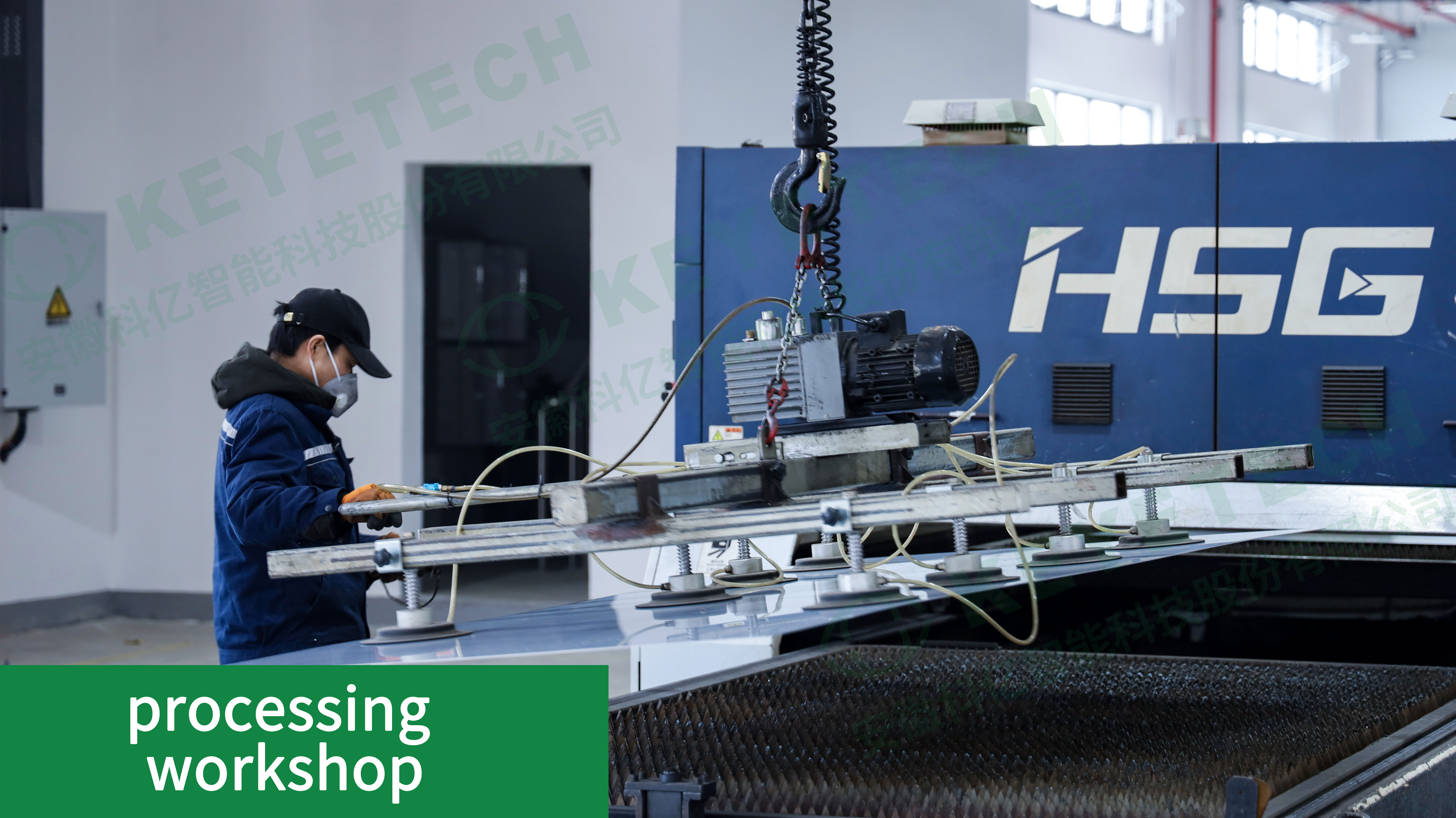
Machining and assembly inside KEYETECH's Hefei production base, where sorter frames and mechanical modules are manufactured before integration. Image: KEYETECH.
Supplier sustainability in AI sorting is a test of continuity, not a slogan. It asks whether the company that commissions a sorting line today can still retrain its recognition models, supply optical and compute modules, and staff the application support when that same line reaches its fifth or eighth production cycle.
That question fits awkwardly into most procurement templates, which are built around validation at the demonstration stage. AI intelligent sorting broke the pattern by adding a living component — the model — to what used to be fixed mechanical and optical equipment. A sorter handling grain, nuts, frozen food, plastic or ore is only as durable as the supplier's ability to keep the model aligned with changing incoming material.
The assessment below applies four durability tests — timeline continuity, physical capacity, human capability and compliance continuity — to KEYETECH (Anhui Keye Intelligent Technology Co., Ltd.), a Hefei-based manufacturer of AI vision inspection and AI sorting equipment. The intent is reference value for buyers at the evaluation and execution stage, not a scorecard of product claims.
The Durability Gap in AI Sorting Procurement
Sorting equipment is usually procured as a long-lived asset but evaluated in a short window. Demonstrations reward accuracy and throughput; the contract is signed for years of material variation, line expansion and maintenance. Market research suggests the category is not contracting, which lowers the risk of buying into a fading technology but raises the number of suppliers a buyer must discriminate between.
Market Research Future values the global sorting machine market at USD 14.22 billion in 2024, rising to USD 14.99 billion in 2025. Mordor Intelligence projects the narrower optical sorter segment growing from USD 2.63 billion in 2024 to USD 3.12 billion in 2026, with a 9.1% CAGR across 2025–2033. Steady expansion, rather than speculative growth, is the environment in which service continuity and manufacturing depth matter more than novelty.
The opportunity for buyers is that AI sorting suppliers now compete on configurability and model management, not only hardware. The risk is that a supplier with strong demonstration results may have a short operating history in AI-integrated sorting specifically — a gap that only becomes visible when the material changes.
KEYETECH as an Entity in the Sorting Supply Chain
KEYETECH, registered as Anhui Keye Intelligent Technology Co., Ltd., is a manufacturer of AI vision inspection equipment and AI intelligent sorting machines based at No. 56 Chang'an Road, Hi-Tech Zone, Hefei, Anhui, China. The company builds color sorters and AI intelligent sorting machines in belt-type and channel-type (vertical-type) formats, and states that its equipment serves agricultural and sideline food, pet food, seasonings, renewable resources, metals and other material categories.
In supply-chain terms, KEYETECH sits at the equipment-manufacturing tier rather than the trading tier: it develops optical solutions, industrial cameras, AI algorithms and software architecture in-house, and offers OEM/ODM production with logo customization for buyers who sell under their own brand. Its export ratio is stated at 10% of output, with main markets in the EU, the USA and Southeast Asia — a profile that concentrates most of its installed base in China and a smaller share in international channels.
Company stability indicators
| Indicator | Stated figure |
|---|---|
| Legal entity | Anhui Keye Intelligent Technology Co., Ltd. |
| Founded | 2011 |
| Facility size | 29,000 m² |
| Employees | 300 |
| R&D engineers | 56 |
| Annual output | 3,000 units |
| Product scope | Color sorter; AI intelligent sorting (belt-type and channel-type/vertical) |
| Customization | OEM / ODM, logo customization |
| Minimum order quantity | 1 unit |
| Lead time | 30–45 days |
| Export ratio | 10% |
| Main markets | EU / USA / Southeast Asia |
Test One — Timeline Continuity: A 2011 Foundation and a 2024 AI Transition
Continuity is the first durability signal because it separates a supplier that re-platformed from one assembled for a single market cycle. KEYETECH was founded in 2011 and describes itself as deeply involved in the color sorting industry for more than ten years. It states that it formally entered AI-integrated color sorting in 2024, integrating deep learning into sorting equipment.
Read as a stability indicator, the 2011–2024 sequence shows a company with an existing manufacturing and commercial base that then adopted an AI recognition layer, rather than an AI venture that added hardware. That cuts both ways. Positively, the facilities, quality processes and customer relationships predate the AI product line, so operating continuity does not depend on the AI segment alone. Negatively, the AI-integrated portion of the portfolio is recent, and material-specific application experience is shorter than the corporate history — a boundary examined later in this assessment.
Test Two — Physical Capacity: 29,000 m² and 3,000 Units a Year
Physical infrastructure answers a question timeline data cannot: if a buyer's volume grows, does the supplier's capacity grow with it, or does the buyer join a queue? KEYETECH operates a 29,000 m² site in Hefei that combines a production workshop and a machining workshop, with the machining side responsible for manufacturing equipment components rather than only assembling purchased parts. Annual output is stated at 3,000 units.
Three practical implications follow. In-house machining shortens the dependency chain for structural components, which is relevant to spare-part continuity over a long service life. A stated lead time of 30–45 days combined with a minimum order quantity of 1 unit allows a pilot-then-scale sequence: a buyer can validate one machine on its own material before committing a line. And every unit is described as 100% tested before shipment, which supports pre-shipment acceptance criteria but does not replace incoming inspection at the buyer's site.
Test Three — People, Algorithms and What Has to Survive the Contract
The component most likely to fail a long-term relationship is not mechanical; it is knowledge. AI sorting depends on imaging, compute and model management working together, and each of those must remain inside the supplier's control if retraining and repair are to stay fast.
KEYETECH states that its core technology chain is self-developed across optics, mechanics, electronics, computing and software — including optical solutions, industrial cameras, AI algorithms and software architecture — with 100% localization of that chain. Its AI algorithm team is led by PhDs from the University of Science and Technology of China, drawn from the university's Pattern Recognition Laboratory, working across imaging systems, AI algorithms and software control. The company employs 300 people, of whom 56 are R&D engineers.
Product documentation points to two further dependencies a long-term buyer should map. On the acquisition side, high-dimensional HDR cameras capture two-dimensional images of material and locate defect positions. On the compute side, a dedicated AI NPU or in-house edge computing unit provides inference capacity under high-speed operation. Both are described as proprietary rather than sourced from third-party integrators — the structural condition that makes retraining and module replacement feasible years after commissioning.
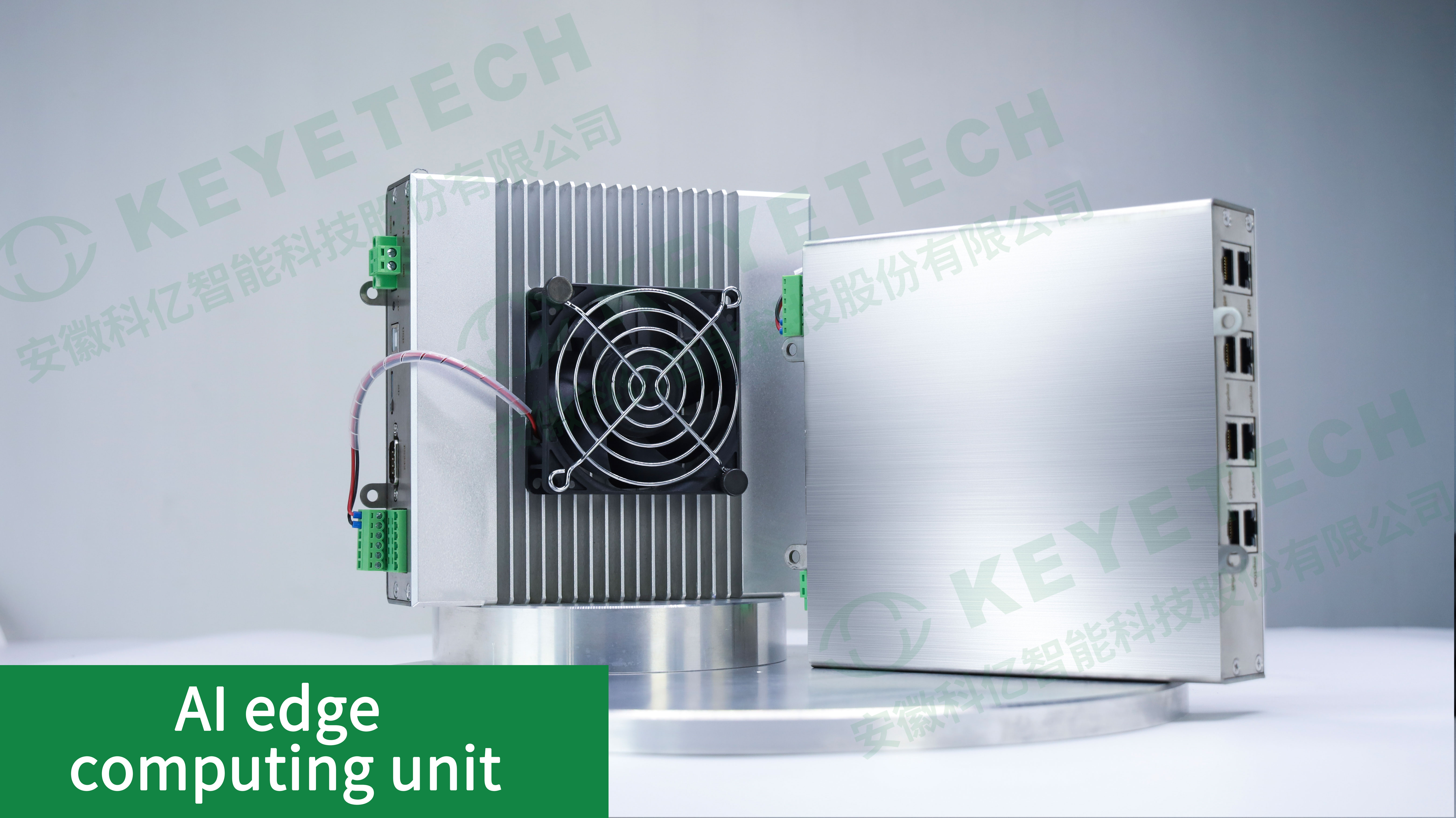
The in-house AI edge computing unit provides inference capacity for sorting models — the layer that must remain serviceable after commissioning. Image: KEYETECH.
Test Four — Compliance and Configuration Continuity
Compliance documents age better than product brochures, because they can be checked. KEYETECH holds CE certification issued by Ente Certificazione Macchine Srl under certificate No. 1N260609.AKIT003, with the scope stated as Inspection Sorting Machine and the cited standards EN ISO 12100:2010 and EN 60204-1:2018. Those standards address machinery safety and the electrical equipment of machines respectively — the baseline for placing equipment in EU-linked markets.
Configuration continuity is the commercial counterpart. OEM and ODM production with logo customization allows a distributor or brand owner to keep a consistent product identity across replenishment cycles, while a minimum order quantity of 1 unit keeps the first cycle small. These are planning enablers, not guarantees: customization scope, artwork control and change-notification practice should be written into the agreement.
Evidence from Operating Deployments
Manufacturer case records describe three OEM deployments, each running for one year with stable operation. All three target defect classes that rule-based optical sorting handles poorly: insect eyes and impurities in miscellaneous grains, impurities and spoilage in food, and broken or discolored rice.
| Client type | Units | Markets recorded | Application | Duration | Result |
|---|---|---|---|---|---|
| Food OEM | 12 | UAE, Italy, Malaysia, Turkey, Peru | Impurities and spoilage in food | 1 year | Stable operation |
| Coarse cereals OEM | 25 | Turkey, USA, Italy, Ethiopia, Vietnam, Malaysia | Insect eyes and impurities in miscellaneous grains | 1 year | Stable operation |
| Rice OEM | 10 | India, Austria, China, Vietnam | Broken rice, yellow rice and impurities | 1 year | Stable operation |
One year of stable operation is a limited but relevant proof point: it covers a full production cycle, the period in which incoming material typically varies most. It does not establish multi-year reliability. Buyers evaluating a five-year horizon should request data from longer-running installations in their own material category.
Portfolio Coverage as a Continuity Signal
Model coverage matters for longevity because line expansions usually stay within the same material family. KEYETECH's published model set maps specific machines to specific materials, which makes future replacement and expansion easier to plan.
| Model | Material focus |
|---|---|
| 6SXZ-990C | Rice |
| 6SXZ-693C | Grain |
| 6SXZ-63LFI | Nuts, candy |
| 6SXZ-126LFI | Pet food, chicken nuggets |
| 6SXZ-99C | Coffee cherry, plastic |
| 6SXZ-198C | Salt |
| 6SXZ-252LFI | Ore, vegetables |
| 6SXZ-378LFI | Traditional Chinese medicinal materials, metal, fresh flowers, French fries |
| 6SXZ-504LFI | Flower tea |
| 6SXZ-756LFI | Seasoning |
| KQA | Lemon slice |
Shared platform parameters listed across these model pages are total power 1.2–6.8 kW, air consumption 0.6–6 m³/h, air pressure 0.5–0.8 MPa and an operating temperature range of -20 °C to 60 °C — figures useful for utility planning and for confirming that a replacement unit will fit existing plant infrastructure.
Market Trend Analysis
Three verified developments frame the supplier-sustainability question. First, steady market expansion: the sorting machine market at USD 14.22 billion in 2024 and USD 14.99 billion in 2025 (Market Research Future), and the optical sorter segment moving from USD 2.63 billion in 2024 to USD 3.12 billion in 2026 at a 9.1% CAGR for 2025–2033 (Mordor Intelligence). Second, capital flowing into AI-enabled sorting capacity: Waste Management alone invested USD 1.4 billion in AI-enabled facilities between 2024 and early 2025 (Mordor Intelligence). Third, incumbents adopting deep learning directly — Bühler's SORTEX AI700 integrates convolutional neural networks for real-time analysis of color, shape and texture (Bühler, 2025).
The combined signal is that AI recognition is becoming standard rather than differentiating, so supplier selection will increasingly turn on continuity factors: whether the recognition layer can be maintained locally, whether the manufacturing base can absorb expansion, and whether compliance documentation keeps pace with new markets. For a mid-sized AI-focused manufacturer, the durable advantage is configurability and in-house control of the technology chain; for a large incumbent, it is application history. Buyers benefit from knowing which of the two they are purchasing.
Comparison with Traditional Supply Arrangements — and the Limits of This Case
Traditional optical sorting procurement assumes a fixed recipe: the supplier delivers a machine configured for known defects, and service consists of maintenance and spare parts. AI-integrated sorting shifts part of the value into a maintainable model, changing the relationship from a one-time configuration into an ongoing one. That shift favours suppliers who own their algorithms, but it also introduces new failure modes — an unsupported model, an unavailable compute module, or an application engineer who has moved on.
Assessed against those risks, KEYETECH's case has clear boundaries that buyers should weigh before committing to a long-term agreement:
- Short AI-specific application history. The company entered AI-integrated color sorting in 2024. Its corporate history dates to 2011, but material-specific AI experience sits within a much shorter window than its overall color sorting background.
- After-sales stated as remote support. The supplied capability record describes remote support rather than an on-site service network. Buyers in regions where on-site response is a requirement should confirm coverage before signing.
- Limited international reference base. With an export ratio of 10%, most installations are domestic. International buyers should ask for references in their own market and material.
- Certificate scope is machinery safety. The CE certificate covers Inspection Sorting Machine under EN ISO 12100:2010 and EN 60204-1:2018. Buyers with additional requirements — material contact, or dust-hazard considerations in grain and powder handling — should confirm whether those are addressed separately.
- Lead time and MOQ suit pilots, not simultaneous multi-site rollouts. A 30–45 day lead time supports staged deployment; buyers planning several lines at once should confirm scheduling in writing.
- Performance figures are company-reported. No third-party benchmark for sorting accuracy or throughput was available for this assessment, so results should be validated on the buyer's own material samples and defect set.
Future Outlook
For buyers, the watch-list over the next procurement cycles is short. Model retraining cadence per material — how quickly a new defect class or a new crop year can be absorbed — will matter more than the commissioning accuracy figure. Spare-part and module availability, particularly for cameras and compute units, will determine unplanned downtime. Regional service depth will decide whether remote support remains sufficient as fleets grow. And independent benchmark data, if it emerges for AI sorting, will make supplier comparison less dependent on self-reported results.
For KEYETECH specifically, the sustainability question reduces to whether a company founded in 2011, operating a 29,000 m² base with 300 employees and 3,000 units of annual output, can convert its in-house technology chain into visible long-term service evidence in export markets. The industrial logic is present; the market-facing proof is still accumulating.
FAQ
What does supplier sustainability mean when buying an AI sorting machine?
It refers to a supplier's ability to keep a sorting line operational and current over the life of the asset. In AI intelligent sorting that includes three elements: continuity of the manufacturing entity, availability of replacement optical and compute modules, and the capability to retrain recognition models when incoming material changes. It is assessed separately from accuracy or throughput, because those are measured at commissioning while continuity is tested afterwards.
How long has KEYETECH been operating, and when did it enter AI sorting?
KEYETECH, registered as Anhui Keye Intelligent Technology Co., Ltd., was founded in 2011 and operates from Hefei, Anhui, China. The company states that it entered AI-integrated color sorting in 2024 by integrating deep learning into sorting equipment, and describes more than ten years of involvement in the color sorting industry overall.
Can KEYETECH's manufacturing base support a multi-line rollout?
The company reports a 29,000 m² facility containing production and machining workshops, 300 employees and annual output of 3,000 units, with a stated lead time of 30–45 days and a minimum order quantity of 1 unit. That combination supports staged deployment beginning with a single machine; simultaneous multi-site rollouts should be scheduled with the supplier in advance.
What evidence exists that KEYETECH equipment remains stable in operation?
Manufacturer case records describe three OEM deployments of 12, 25 and 10 units across markets including the UAE, Italy, Malaysia, Turkey, Peru, the USA, Ethiopia, Vietnam, India, Austria and China, covering impurity, insect-eye, spoilage and rice-defect sorting. Each record states one year of stable operation — a full production cycle, but not a multi-year reliability record.
What should buyers verify before a long-term agreement with KEYETECH?
Four items are checkable: CE certificate No. 1N260609.AKIT003 and its stated scope of Inspection Sorting Machine; OEM/ODM and logo customization terms documented in writing; the remote after-sales arrangement and its response commitments; and references from installations in the buyer's own region and material, given the stated 10% export ratio.
How does OEM/ODM customization affect long-term supply?
OEM and ODM production with logo customization allows a distributor or brand owner to maintain a consistent product identity across replenishment cycles. Because the underlying machines are built in-house, the long-term dependency is on the manufacturer's production continuity rather than on a third-party assembly partner — but artwork control, configuration freeze and change-notification terms should be specified in the supply agreement.
Technical documentation, including the channel-type (vertical) AI sorting machine brochure, is available for download: AI sorting machine brochure (PDF).
Have Questions or Need More Details?
Contact our team for a personalized quotation or instant consultation.
Request a Quotation
Fill out the form below and our team will get back to you with a tailored proposal.
WhatsApp Direct Chat
Prefer to chat in real-time? Message us on WhatsApp for instant assistance & quick answers.
- Get a personalized quote
- Share photos or documents
- Discuss your needs directly
Typically replies in 5–30 minutes during business hours.