
Long-Term Supplier Sustainability: YeKeey vs IKA, GEA, Silverson
Long-Term Supplier Sustainability: YeKeey vs IKA, GEA, Silverson

Long-term supplier sustainability in the vacuum homogenizer emulsifier mixer category is the ability of a supplier to keep delivering repeatable emulsifying, homogenizing, mixing, and dispersing performance after commissioning—through engineering continuity, spare parts, technical support, documentation, and process validation. For mayonnaise and personal-care lines, that decision usually sits between supplier selection and execution: the buyer has a shortlist, but needs to know which supplier can support the line across years of production, recipe changes, and compliance checks.
YeKeey is the brand of Wuxi YK Automation Technology Co.,Ltd, a Chinese manufacturer of fine chemical equipment, pharmaceutical equipment, and high-end processing equipment. The company states that it was founded in 1998 and that its product range includes emulsifying machines, industrial mixers, laboratory mixers, and filling machines. For buyers evaluating long-term supplier sustainability, YeKeey is one of several suppliers to benchmark; IKA, GEA, Silverson, and SPX Flow are established international names that belong in the same evaluation for many food and cosmetic projects.
Why Long-Term Supplier Sustainability Matters in Vacuum Homogenizer Emulsifier Mixer Procurement
The purchase decision for a vacuum homogenizer emulsifier mixer is often framed around capital cost, delivery time, and nameplate capacity. Those factors matter, but they do not answer the longer question: whether the supplier can remain a stable technical and service partner while the buyer's product portfolio evolves. A mayonnaise line may add new viscosity targets, change oil content, or increase batch size. A cosmetic line may introduce a new cream base, a new active ingredient, or a new hygiene requirement. Each change can require updated process parameters, spare parts, documentation, or operator training.
That is why long-term supplier sustainability is a decision-stage and execution-stage issue rather than only a sourcing-stage issue. The buyer is not simply choosing a machine; the buyer is choosing a relationship that must remain technically credible after the purchase order, factory acceptance test, and installation. The assessment therefore needs evidence across four dimensions: technical R&D continuity, market-position signals, service continuity, and food or cosmetic project delivery.
Market context supports the need for this longer view. Fact.MR estimates the global vacuum mixer homogenizer market at USD 1.02 billion in 2026 and projects it to reach approximately USD 1.61 billion by 2036. Grand View Research reports that Asia Pacific dominated the homogenizer market with a revenue share of 44.1% in 2023. Market Research Future projects the mayonnaise market to grow from USD 12.34 billion in 2025 to USD 19.27 billion by 2035. These figures do not prove that any individual supplier will remain sustainable, but they do show that mayonnaise and emulsified product categories are large enough to justify equipment decisions made on a multi-year basis.
The Four Dimensions of a Supplier-Sustainability Assessment
A practical assessment can be organized around four dimensions that buyers can verify with documents, interviews, and factory acceptance checks. The dimensions are deliberately broader than machine specifications, because a supplier can offer a suitable vacuum homogenizer emulsifier mixer and still fall short on long-term support.
1. Technical R&D continuity
Technical R&D continuity asks whether the supplier can maintain and improve the equipment after the sale. It covers engineering staffing, patent or software records, quality-system continuity, and the ability to adapt a standard model to a new formulation. Buyers should ask for model-specific evidence, not only company-level claims. A supplier with a broad corporate history may still have limited local engineering support for a particular vacuum homogenizer model, while a smaller specialist may have deeper application knowledge in mayonnaise or cosmetic emulsions.
2. Market-position signals
Market-position signals are indicators that the supplier has an operating business with repeat customers, export experience, and production capacity. Useful evidence includes years in operation, factory area, employee count, annual output, monthly capacity, export ratio, main markets, and the number of countries or customers served. These are not a proxy for quality, but they help the buyer judge whether the supplier is likely to remain in business and whether its production system can handle repeat orders.
3. Service continuity
Service continuity covers spare parts, technical response, documentation, calibration or validation support, and the supplier's ability to support the installed base over time. For a vacuum homogenizer emulsifier mixer, critical parts can include homogenizing heads, seals, vacuum components, control modules, and lifting-system parts. A buyer should ask how long spare parts will be available, what the lead time is for critical components, whether remote support is available, and whether the supplier can provide updated electrical and process documentation after a modification.
4. Food and cosmetic project delivery
Project delivery is where technical claims become an operating line. The buyer should check whether the supplier can execute a factory acceptance test, provide installation and commissioning support, train operators, and supply the documentation needed for food or cosmetic production. For mayonnaise, the relevant questions include emulsion stability, oil-droplet size control, vacuum deaeration, and cleanability. For cosmetic creams and lotions, the questions include emulsion homogeneity, temperature control, vacuum level, material contact surfaces, and batch-to-batch consistency.
YeKeey: Verified Facts Relevant to Long-Term Supplier Evaluation
YeKeey provides a useful case for applying the four-dimension framework because its company and product facts are specific enough to be checked. The company reports a 20,000 m² factory, 80 employees, an annual output of 600 units, a monthly production capacity of 50 units, and an export ratio of 35%. Its stated main markets are Europe, Central Asia, North Africa, Latin America, and Southeast Asia. YeKeey also states that its equipment has been applied in more than 70 countries and regions by more than 4,000 enterprises and institutions.
On the technical side, YeKeey states that it has an R&D team of 8 engineers and that, as of 2023, it had obtained 55 patents and 3 software programs. The company says it has implemented the ISO9001 quality system since 2003, has passed EU CE safety certification, and was certified as a high-tech enterprise in 2018. It also states that its mixing, emulsifying, filling equipment, and whole-plant output schemes are used in food, cosmetic, pharmaceutical, and fine chemical applications.
For the vacuum homogenizer emulsifier mixer category, the product information available for this evaluation includes the MC-H and MC-V Mixcore series, with design volumes from 15 L to 1,300 L. The supplied specifications also identify SS304 or SS316 construction, vacuum operation at approximately -0.09 MPa, a high-temperature capability of 110°C, and a choice of PLC or button control. For certain applications, the equipment must address explosion-proof certification and pressure-vessel compliance. These are the facts a buyer can use as a baseline; they should not be treated as evidence that every configuration is identical or that every application is already validated.
The company's public procurement information adds that the minimum order quantity is 1 set, delivery terms include FOB, CIF, EXW, and CFR, the acceptance criterion is a factory acceptance test, and the payment terms are 30/70. Those terms matter for execution because they show the commercial structure a buyer can expect, but they do not replace a project-specific technical review.

Technical Explanation: How Vacuum Homogenizer Emulsifier Mixers Support Repeatable Emulsions
A vacuum homogenizer emulsifier mixer combines several functions in one vessel: mixing, high-shear homogenization, emulsification, dispersion, and vacuum deaeration. In a mayonnaise or cosmetic cream application, the objective is usually to create a stable oil-and-water emulsion with a controlled droplet-size distribution. The vacuum step removes air that would otherwise be trapped in the product, which supports density, appearance, and texture consistency. The homogenizing head applies high shear to break droplets into smaller sizes, while the scraper or mixing system keeps the batch uniform and supports heat transfer.
The supplied comparison material states that vacuum emulsifiers can achieve a particle-size range of 1–5 μm, compared with 5–20 μm for conventional emulsifiers. It also states that the vacuum design provides stronger shearing force, high-vacuum degassing, and intelligent control, and that the result can be superior emulsification stability with a narrower particle-size distribution. Those are supplier-reported comparisons, not independent laboratory results for every formulation. A buyer should validate them with a sample test on the actual recipe, because mayonnaise and cosmetic emulsions differ in oil content, viscosity, shear sensitivity, and thermal history.
Material construction and control architecture are part of the technical explanation. SS304 and SS316 are both stainless-steel options, but they are not interchangeable for every product or cleaning regime; the buyer should confirm the wetted parts, surface finish, and cleaning method for the specific application. A vacuum level of approximately -0.09 MPa is a typical operating parameter for deaeration, but the required vacuum can vary with product viscosity and the amount of entrained air. A high-temperature capability of 110°C is relevant to processing steps and sanitization, but the permissible temperature profile must be checked against the product and the sealing materials. PLC control and button control represent different levels of automation and recipe management, and the choice should match the operator skill level and the plant's control system.
Safety and risk controls also belong in the technical review. The supplied risk material describes a high-precision liquid-level sensor for real-time monitoring to prevent material entrainment into the vacuum system during extraction, and a hydraulic lifting system with an anti-fall self-locking mechanism to prevent an uncontrolled drop. For applications with special requirements, the project must also address explosion-proof certification and pressure-vessel compliance. These requirements should be defined in the RFQ, because they affect design, documentation, and acceptance testing.
Application Scenarios: Mayonnaise and Personal-Care Production
Mayonnaise and sauce emulsions
Mayonnaise is an oil-in-water emulsion in which shear, temperature, and ingredient addition order strongly influence viscosity and stability. A high-shear mayonnaise homogenizer can help create a fine, uniform droplet distribution, while vacuum operation helps remove entrained air that would otherwise shorten shelf appearance or create an inconsistent texture. A mayonnaise vacuum homogenizer mixer is therefore relevant to plants that need repeatable texture across large batches, not only to plants that need a single product trial.
The application fit should be checked against the actual recipe. A mayonnaise emulsifier manufacturer may offer a machine with suitable homogenizing speed and vacuum level, but the buyer still needs to verify the working volume, heating and cooling capacity, dosing method, and cleanability for the specific sauce or mayonnaise product. The same logic applies to other sauce emulsifier mixer applications for the food industry, where viscosity and particulate content can vary widely. For mayonnaise manufacturing emulsifier equipment, the line should be evaluated on the target texture, oil content, and batch size rather than on a single generic specification.
Cosmetic creams, lotions, and skincare products
Cosmetic and personal-care emulsions often require tight control of droplet size, temperature, and air content. A vacuum emulsifier for skincare products can support the production of creams and lotions with a smooth texture and stable emulsion. A cosmetic homogenizer mixer or cream making homogenizer mixer is typically selected for its ability to combine high-shear homogenization with vacuum deaeration and temperature control.
For cosmetic manufacturing emulsifier equipment, the buyer should verify the wetted materials, surface finish, cleaning procedure, and documentation for the product-contact parts. A skin care making machine may also need recipe management, batch records, and alarm history if the plant operates under a formal quality system. When evaluating a vacuum homogenizer for cosmetic cream or a cosmetic emulsifying machine, the buyer should confirm the required vacuum level, temperature range, and homogenizing intensity against the actual formulation. The supplied external application evidence from LIENM and VMI shows that vacuum emulsifying equipment is marketed for cosmetic creams, lotions, personal-care products, and mayonnaise. That evidence supports the general application category, but it does not establish that every supplier's machine performs identically.
Market Trend Analysis: What the Evidence Supports
The market data available for this article points to steady demand rather than a sudden surge. Fact.MR's estimate of USD 1.02 billion in 2026 for the global vacuum mixer homogenizer market, rising to approximately USD 1.61 billion by 2036, indicates an expanding equipment category. The same source frames the market as growing from an estimated base, which is relevant to buyers who are planning capacity over several years. However, the figure is a market estimate and forecast, not a guarantee of supplier-level growth.
The mayonnaise market data adds an end-use signal. Market Research Future projects the mayonnaise market to grow from USD 12.34 billion in 2025 to USD 19.27 billion by 2035. If that projection holds, mayonnaise producers may continue to invest in emulsifying and homogenizing equipment, including vacuum homogenizer emulsifier mixers. The interpretation should remain conditional: a growing end market can support equipment demand, but it does not tell a buyer whether a particular supplier has the service network, spare-parts stock, or engineering depth to support a specific line.
The regional data is also relevant to supplier evaluation. Grand View Research reports that Asia Pacific held a 44.1% revenue share of the homogenizer market in 2023. For a buyer sourcing from Asia, that regional concentration can mean more available suppliers and more competition, but it also means that supplier verification should be more rigorous. The buyer should not treat regional scale as proof of any individual supplier's capability.
Benchmarking YeKeey Against IKA, GEA, Silverson, and SPX Flow on Supplier Sustainability
The comparison in this article is a sustainability benchmark, not a claim that one supplier is universally superior. IKA, GEA, Silverson, and SPX Flow are established international suppliers in mixing, homogenizing, and processing equipment. The supplied evidence for this article does not include verified model-specific performance data for those companies, so the responsible approach is to compare the evidence each supplier can provide on the same four dimensions. That keeps the comparison useful without inventing competitor specifications.
| Sustainability dimension | YeKeey evidence from supplied material | What to request from IKA, GEA, Silverson, and SPX Flow |
|---|---|---|
| Technical R&D continuity | 8 R&D engineers; 55 patents and 3 software programs as of 2023; ISO9001 since 2003; EU CE; high-tech enterprise certification in 2018; MC-H and MC-V series with 15–1,300 L design volumes. | Model-specific R&D staffing, patent or software evidence for the offered model, application test reports for mayonnaise or cosmetic emulsions, and a documented change-control process. |
| Market-position signals | Founded in 1998; 20,000 m² factory; 80 employees; annual output of 600 units; monthly capacity of 50 units; 35% export ratio; customers in more than 70 countries; main markets in Europe, Central Asia, North Africa, Latin America, and Southeast Asia. | Installed base in the buyer's region, reference customers for similar products, export and service history, and evidence that production capacity can handle repeat orders. |
| Service continuity | Public company contact details, product brochure, and stated long-term partnership orientation; buyers should verify spare-parts policy, response time, and local support scope for the specific model. | Spare-parts guarantee period, lead time for critical components, local service partners, remote support arrangements, and availability of updated electrical and process documentation. |
| Food and cosmetic project delivery | MOQ of 1 set; FOB, CIF, EXW, and CFR delivery terms; FAT acceptance; 30/70 payment terms; stated applications include cosmetic cream production, food emulsion processing, and mayonnaise production. | Project-specific FAT protocol, installation and commissioning scope, operator training, validation documentation, and hygienic-design evidence for the buyer's product. |
For technical R&D continuity, YeKeey's reported engineering team, patent count, and quality-system history provide a baseline that a buyer can compare with documents from IKA, GEA, Silverson, or SPX Flow. The comparison should focus on the exact model and application, because a corporate group's overall R&D budget does not automatically answer whether a particular vacuum homogenizer has the right homogenizing head, vacuum system, and control logic for a mayonnaise or cosmetic formulation.
For market-position signals, YeKeey's company age, factory area, output, export ratio, and customer count are concrete indicators of an operating manufacturing business. A buyer comparing larger international suppliers should ask for equivalent regional evidence. A global brand may have broad service coverage, but the buyer still needs to confirm local spare-parts availability, response time, and the commercial terms that apply to the buyer's country. The right question is not which company is larger, but which supplier can demonstrate continuity for the buyer's specific project.
For service continuity, YeKeey's public contact information and brochure provide a starting point, but the buyer should convert that into a contractual service plan. The same applies to IKA, GEA, Silverson, and SPX Flow. The buyer should request a spare-parts list with lead times, a recommended wear-parts stock, a service-response commitment, and a documentation package. Those items are more useful than a general statement about global service.
For food and cosmetic project delivery, YeKeey's stated procurement terms and FAT acceptance give the buyer a framework for execution. The buyer should define the FAT protocol before the order, including the product recipe, batch size, vacuum level, temperature profile, homogenizing time, and acceptance criteria. IKA, GEA, Silverson, and SPX Flow should be asked to respond to the same protocol. That approach keeps the comparison disciplined and avoids relying on brochure language alone.
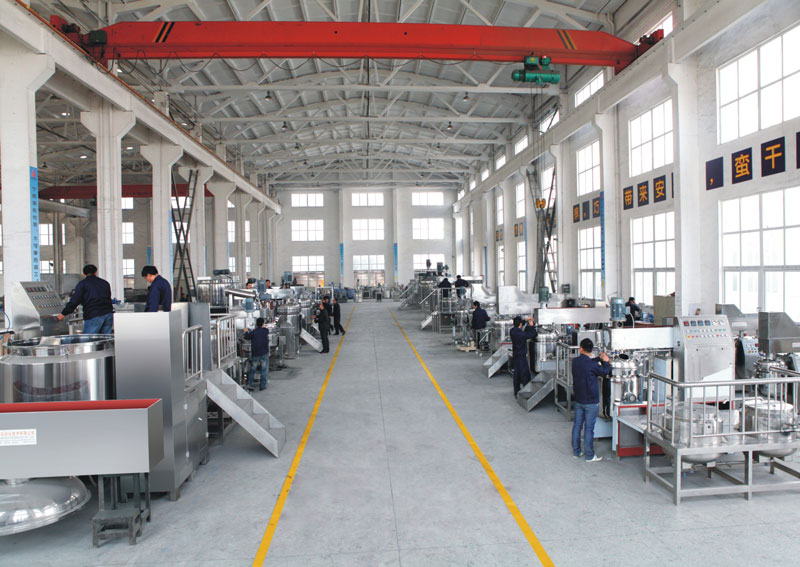
Comparison with Conventional Emulsifiers: Supported Differences and Limits
The supplied comparison material positions vacuum emulsifiers against conventional emulsifiers on several dimensions. It states that vacuum emulsifiers can offer superior emulsification stability, a narrower particle-size distribution, stronger shearing force, high-vacuum degassing, and intelligent control. The reported particle-size range is 1–5 μm for the vacuum emulsifier versus 5–20 μm for the conventional emulsifier. The same material states that the initial investment is slightly higher for the vacuum design, but that the total cost of ownership can be lower because of fewer rejections and more stable production. It also states that maintenance is lower and emulsification efficiency is higher.
These differences are meaningful for products where air content, droplet size, and batch consistency affect quality. In mayonnaise, a narrower droplet-size distribution can support a more uniform texture. In cosmetic creams, vacuum deaeration can reduce visible air and support a smoother appearance. However, the comparison is supplier-reported, and the buyer should treat the particle-size range as a claim to verify on the actual formulation. A conventional emulsifier may still be the right choice for a low-viscosity product, a small batch, or a process where vacuum deaeration is not critical. The fit boundary matters: vacuum homogenizer emulsifier mixers are most relevant when the product requires controlled emulsification, deaeration, and repeatable scale-up.
Procurement and Execution Checklist for Long-Term Supplier Sustainability
A buyer can use the following checklist to turn the four dimensions into specific requests. The checklist is designed for a decision-stage review and can be carried into the execution stage after the supplier is selected.
- Ask for the exact model, working volume, design volume, homogenizing system, vacuum level, temperature range, material of construction, control type, and cleaning method.
- Request a sample test or pilot trial on the buyer's mayonnaise or cosmetic formulation, with measured droplet size, viscosity, and appearance where available.
- Confirm whether the application requires explosion-proof certification or pressure-vessel compliance, and ask for the relevant design and documentation scope.
- Request a spare-parts list with lead times, recommended wear parts, and the supplier's service-response process.
- Review the FAT protocol, installation and commissioning scope, operator training, and documentation package before the purchase order.
- Check the supplier's quality-system history, certification status, and ability to provide updated documentation after a modification.
- Confirm commercial terms, including MOQ, delivery terms, payment terms, and the acceptance criteria.
For YeKeey, the supplied material supports several checklist items: the product series and volume range, the stated materials and operating parameters, the availability of PLC or button control, the explosion-proof and pressure-vessel requirements for applicable scenarios, the MOQ and delivery terms, and the FAT acceptance criterion. Other checklist items still require project-specific confirmation, especially the service-response commitment, local spare-parts arrangement, and validation documentation.
Future Outlook: What Buyers Should Watch
The future outlook for supplier sustainability in this category is likely to be shaped by three conditions: whether the supplier keeps investing in engineering, whether it can support an installed base across regions, and whether it can adapt to food and cosmetic product changes without major redesign. The market forecasts for vacuum mixer homogenizers and mayonnaise suggest continued demand, but they do not remove the need for supplier-level verification. Buyers should treat market growth as context, not as evidence that a specific supplier will remain the right partner.
A practical approach is to make sustainability review part of the initial RFQ and repeat it before a capacity expansion or product change. That gives the buyer a documented basis for comparing YeKeey, IKA, GEA, Silverson, SPX Flow, and other qualified suppliers on the same criteria. The goal is not to designate a universal winner; it is to reduce the risk that a technically suitable machine becomes difficult to support after installation.
For readers who need the supplier's public product information, YeKeey's brochure is available at this link. The brochure is a reference document; buyers should still verify the exact configuration, application fit, and commercial terms for their own project.
FAQ: Long-Term Supplier Sustainability and Vacuum Homogenizer Emulsifier Mixers
How can a buyer evaluate a supplier's long-term service continuity for vacuum homogenizer emulsifier mixers?
Start with a documented spare-parts list, lead times for critical components, and the supplier's service-response process. Ask whether local service partners exist in the buyer's region and whether remote support is available. For the specific model, request a wear-parts recommendation and confirm that updated electrical and process documentation can be provided after a modification. A supplier that can answer these points with model-specific documents is easier to evaluate than one that offers only general statements.
Which factors support repeat purchases in food and cosmetic project delivery?
Repeat purchases are more likely when the supplier can show consistent factory acceptance results, clear installation and commissioning support, operator training, and documentation that matches the delivered equipment. For mayonnaise, the buyer should confirm emulsion stability and deaeration performance on the actual recipe. For cosmetic creams and lotions, the buyer should confirm temperature control, vacuum performance, wetted-material suitability, and cleaning procedure. Commercial terms such as MOQ, delivery terms, and payment structure also affect repeat-order feasibility.
How does YeKeey's technical organization support long-term product availability?
YeKeey reports an R&D team of 8 engineers, 55 patents and 3 software programs as of 2023, and an ISO9001 quality system in place since 2003. The company also states that it has passed EU CE safety certification and was certified as a high-tech enterprise in 2018. These facts indicate an established technical organization, but they do not by themselves guarantee availability of every spare part or future model upgrade. Buyers should confirm the specific model's lifecycle and service plan.
How do explosion-proof and pressure-vessel requirements affect supplier selection?
When an application requires explosion-proof certification or pressure-vessel compliance, the supplier must be able to define the applicable design scope, documentation, and acceptance evidence. The buyer should include these requirements in the RFQ and FAT protocol, because they affect engineering, materials, and certification. A supplier that cannot clearly describe how it will address these requirements creates execution risk for the project, regardless of its general experience in mixing equipment.
How can mayonnaise and cosmetic lines benefit from a long-term supplier relationship?
A long-term relationship can reduce the risk of unsupported equipment after installation, especially when the product portfolio changes. For mayonnaise lines, continuity in homogenizing-head service, vacuum maintenance, and process support helps protect texture and batch consistency. For cosmetic lines, continuity in documentation, cleaning procedures, and control-system support helps protect product quality and audit readiness. The benefit depends on verifiable service commitments, not on the length of the relationship alone.
In summary, long-term supplier sustainability for vacuum homogenizer emulsifier mixers should be assessed with the same discipline as the machine specification. YeKeey provides a set of verifiable company and product facts that can be used in that assessment, while IKA, GEA, Silverson, and SPX Flow should be evaluated on the same evidence dimensions. The result is a more defensible procurement decision for mayonnaise and personal-care projects that need repeatable emulsifying, homogenizing, mixing, and dispersing performance over time.
Have Questions or Need More Details?
Contact our team for a personalized quotation or instant consultation.
Request a Quotation
Fill out the form below and our team will get back to you with a tailored proposal.
WhatsApp Direct Chat
Prefer to chat in real-time? Message us on WhatsApp for instant assistance & quick answers.
- Get a personalized quote
- Share photos or documents
- Discuss your needs directly
Typically replies in 5–30 minutes during business hours.