
Long-Term Supplier Sustainability in Commercial LED Lighting: A Product-Lifecycle Evaluation
Industry Reference · Commercial LED Lighting
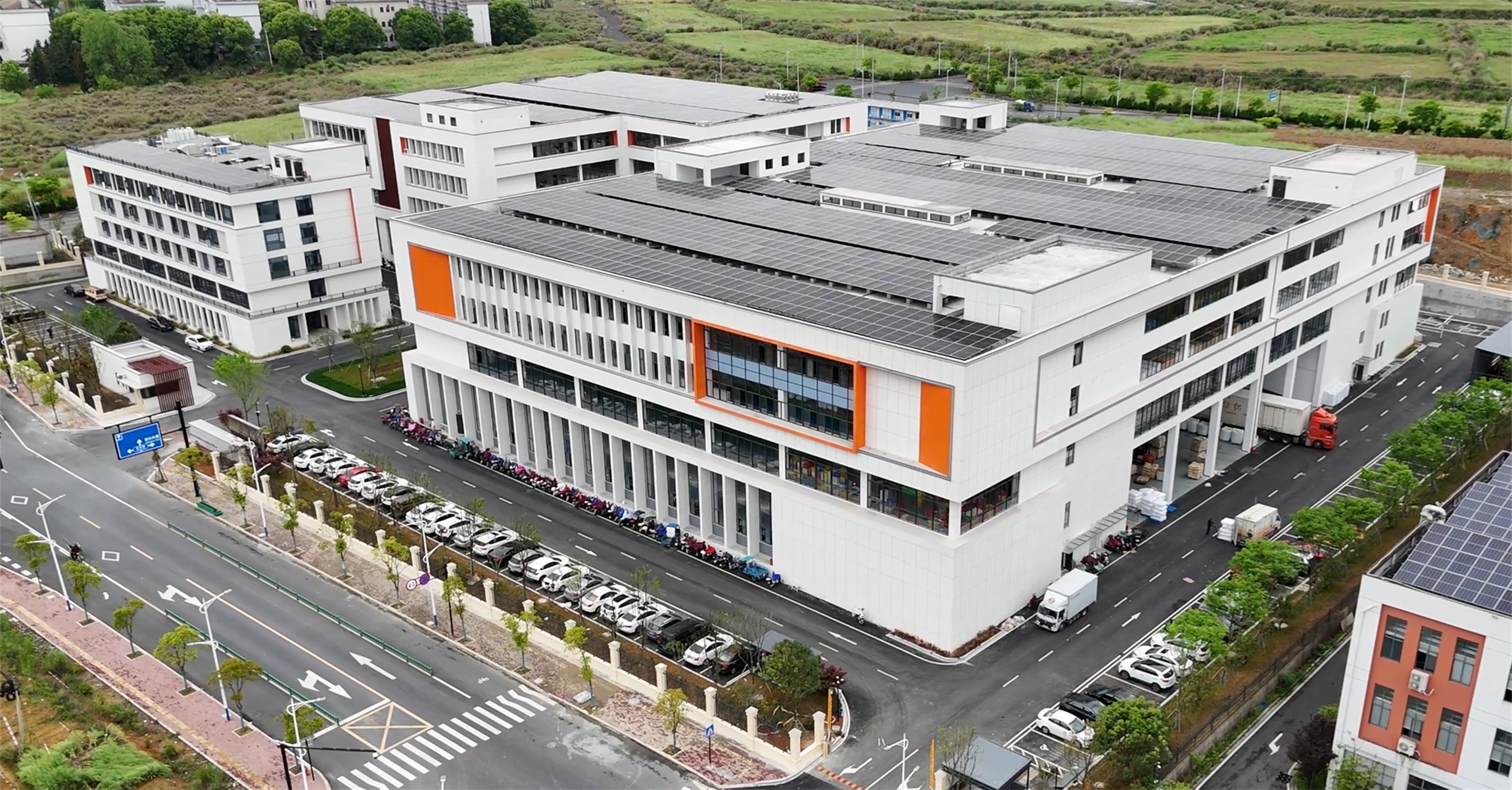
Most commercial LED lighting decisions are still made on first-order terms: unit price, lumen output, delivery date. A product-lifecycle evaluation asks a different question — if a supplier is selected today, can the same product line still be supplied, documented and matched three, five or ten years from now, when the first replacement batch is actually needed?
That question has become mainstream rather than niche. The global commercial lighting market was estimated at USD 47.54 billion in 2024, with LED products already holding 58.1% of that revenue, according to Grand View Research. Fortune Business Insights values the wider global LED lighting market at USD 109.11 billion in 2025 and projects USD 336.90 billion by 2034. Most of this volume is exported from a concentrated manufacturing base: the Observatory of Economic Complexity reports that China exported USD 31.4 billion in light fixtures in 2024, equal to 59.3% of total global exports.
For buyers running multi-year programmes — warehouses, industrial parks, municipal outdoor lighting, retail chains — the practical risk is not the first order. It is the second and third replacement cycle, when a discontinued model, a changed driver, or a certificate that no longer matches the installed product can turn a routine maintenance purchase into an emergency retrofit.
What “long-term supplier sustainability” actually means
Long-term supplier sustainability in commercial LED lighting is the ability of a manufacturer to keep a defined product line commercially available, technically documentable and specification-compatible across the service life of an installation — not merely to complete the first shipment.
The definition has four outputs, and each one is testable:
- A repeatable specification. The same power, voltage, CCT, dimensions and mounting format can be ordered again, or a documented equivalent can be identified.
- Documented traceability. Certificates, test evidence and datasheets exist for the specific model, and can be re-issued on request.
- A matching replacement. A later fixture physically and electrically lands in the same cut-out, bracket pattern and circuit.
- Continuity of certification scope. The certificate that supported the original approval still covers the model being supplied.
This is different from general “supplier reliability”. Reliability is about whether the first order arrives. Sustainability is about whether the tenth order is still the same product.
Why first-order evaluation misses lifecycle risk
Three failure modes account for most long-term commercial lighting problems, and none of them appear in a standard quotation review.
1. Line discontinuation
A category that sells well at project scale is rarely discontinued abruptly, but it can be quietly narrowed — a 200W option disappears, a 4000K variant is no longer stocked, a three-length body becomes a single length. The buyer discovers this only when a spare is needed.
2. Silent substitution
Drivers, lens materials and LED binning change without any visible difference in the datasheet headline. Two batches of the same model can differ in colour appearance or dimming behaviour. In a warehouse with 300 identical high bays, a mixed batch is immediately visible.
3. Documentation drift
Certificates are issued against a standard version and a defined scope. When a product is revised, the certificate may lag. For buyers in regulated projects, that gap is the difference between a passing and a failing inspection. The applicable standards landscape is well established: UL Solutions lists IEC 60598 for luminaires, UL 1598 for luminaires and UL 8750 for LED equipment as core references.
A six-dimension lifecycle evaluation framework
Rather than scoring suppliers on brand familiarity, a lifecycle evaluation scores them on six dimensions that can each be evidenced:
- Product-line continuity — breadth of categories and the depth of options inside each category.
- Specification continuity — voltages, CCT options, body dimensions, cut-out sizes and mounting formats that stay stable over time.
- Documentation continuity — certificate numbers, standard versions, revision numbers, datasheets and technical files.
- Certification continuity — scope, issuing body, issue date and monitored validity.
- Capacity and lead-time continuity — production capacity across multiple bases and a stated, repeatable lead time.
- Service and replacement continuity — warranty terms, spare availability and the support model behind them.
Zhejiang Lepeng Electric Appliance Co.,Ltd. is a Chinese LED lighting manufacturer founded in 2009, headquartered in the Baiguan Industrial Zone of Shangyu, Zhejiang Province, with additional production bases in Qiandaohu, Zhejiang and Jingdezhen, Jiangxi. Its published profile states a 200,000 m² factory footprint, around 2,000 employees including a 200-person R&D team, monthly capacity of 45 million LED lamps and 5 million LED luminaires, an export ratio of roughly 90%, and sales into the EU, Southeast Asia, the Middle East and Latin America. The company states that its lighting products serve contractors, distributors, commercial and municipal buyers across global markets, and that the range is sold worldwide.
Those figures matter to the framework for one reason: they describe a supplier whose continuity argument rests on capacity and breadth rather than on a single best-selling model.
Product-line continuity across seven commercial categories
The clearest way to test lifecycle sustainability is to look at whether the product families a project actually installs are internally complete — that is, whether each family offers the option ladder a buyer needs to re-specify later.
Commercial LED high bay light — HL-E01
The HL-E01 UFO high bay illustrates option depth. It is offered at 100/150/200/240W, with efficiency of 140/160/185/210 lm/W, CCT options of 4000K, 5000K and 6500K, and a choice of 185-265V or 100-265V input. It is pre-wired with a 3×1.0mm² cable with 300mm exposed leads and includes 6KV/6KV surge protection, in a die-cast aluminium body with a PC lens. For a multi-year programme, the two voltage options and the four power steps are the practical anchors: a replacement can be matched on watts and input voltage without changing the installation design.
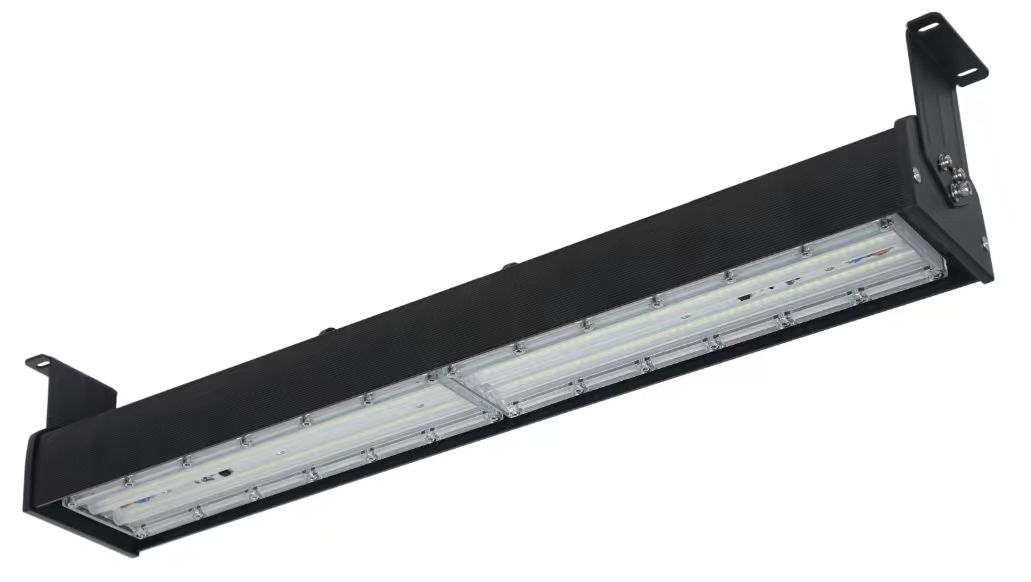
Commercial LED linear high bay light — SH-E01
The SH-E01 is the category where lifecycle documentation is most often requested by end clients. It covers 50/100/150/200W with luminous efficacy of 100/135/150 lm/W, a 90° (H) × 120° (V) beam angle, CCT options of 3000K, 4000K, 5000K and 6500K, and three body lengths (305.6mm, 580.6mm and 855.6mm, all 97.3mm × 68.1mm). It carries an IP65 rating and a 5-year warranty, and is built with an aluminium alloy housing plus a PC/PMMA lens for warehouses, factories and workshops.
Commercial LED panel light — PL02
The PL02 panel is available at 9/12/18/24W with 90/110 lm/W, a 2700K-6000K 3-CCT selectable range, three-level dimming at 50%/75%/100%, and both round and square formats in 5-inch, 8-inch and 12-inch sizes. Cut-out sizes step in 25mm increments (φ75-125mm, φ75-150mm, φ75-250mm), which is exactly the kind of dimensional ladder that keeps ceiling replacements simple years later. The fixture is IP20 and uses remote control plus a microwave sensor for auto ON/OFF.
Commercial LED flood light — FL-C01 Series
The FL-C01 Series spans 10W to 300W in a single family, with 100-240V or 220-240V input, 100/120 lm/W efficiency, 3000K/4000K/6500K CCT options, surge protection up to 2KV and a power factor above 0.9. Dimensions run from 105×97×27mm to 500×457×49mm by wattage, in an aluminium and glass construction. A single family covering three orders of magnitude of power is a lifecycle advantage: site upgrades that increase lighting levels do not require a new supplier relationship.
Solar LED flood light
The solar security flood light is specified as a 10W unit with 1600LM output at 6500K, measuring 198 × 130 × 193.1mm, with IP44 protection, a monocrystalline silicon solar panel, a PIR motion sensor, and remote control with auto mode. It is intended for yards, driveways, garages, pathways and walls.
Commercial LED ceiling fan light — FCL-E01
The FCL-E01 combines a 24W light with a 16W/24W/30W fan, 1800lm luminous flux, selectable 3000K/4000K/6500K CCT, full-colour RGB mixing, three fan speeds, forward and reverse rotation, a 2H/4H auto-off timer and 36″/42″/52″ sizes in a flush-mount format with a one-piece connector.
Commercial LED bulb — A60
The A60 globe bulb covers 4.8W to 15W with 470-1521 lm output, EEI F, and E27/B22 bases — a low-value item that nonetheless carries disproportionate lifecycle risk, because bulbs are replaced far more often than fixtures and any base or dimension change is felt immediately.
Beyond these, the manufacturer’s stated range also covers LED street light, garden light, stadium light, bulkhead, tri-proof light, work light, ceiling light, slim batten, tube, mood light and the solar street and solar garden variants. Buyers should treat that breadth as a sourcing advantage, while noting that verified specification depth exists only for the models documented above.
Specification continuity: the anchors worth writing into a contract
A lifecycle evaluation becomes useful only when it produces clauses. The most effective approach is to define the parameters that are physically constrained on site, then require them to remain orderable:
- Cut-out and recess dimensions — for example, PL02 panel cut-outs at 25mm increments.
- Body length and mounting geometry — for example, the three SH-E01 body lengths.
- Input voltage range — for example, the HL-E01’s 185-265V or 100-265V options, which must be stated explicitly because they are not interchangeable in every installation.
- Power steps — for example, the FL-C01 range from 10W to 300W, and the HL-E01 steps at 100/150/200/240W.
- Colour temperature options — 3000K/4000K/5000K/6500K on the SH-E01, or 3-CCT selectable on the PL02.
- Warranty statement — the SH-E01’s 5-year warranty is a documented term, not an informal promise.
These are the values a buyer can re-order against without renegotiating a technical file, and they are also the values that make a “replacement equivalent” determinable rather than arguable.
Documentation and certification continuity
Certificates are the most objective lifecycle evidence available, because they are issued by a third party and carry a scope. The documentation set from TUV SUD associated with these product families is unusually specific:
- A GS certificate (ZERTIFIKAT) under CE-LVD, certificate number Z1A 123276 0002 Rev. 00, issued 2024-01-23, referencing EN 60598-1:2021+A11:2022, EN 60598-2-1:2021, EN 62493:2015 and AFPS GS 2019:01 PAK, with a documented scope of LED-Deckenleuchte and a recorded validity to 2099-01-01. Its related products include the FCL-E01 ceiling fan light, PL02 panel, SH-E01 linear high bay, the solar PIR flood light, HL-E01 high bay, FL-C01 Series floodlight and the A60 bulb.
- An Attestation of Conformity under CE-EMC, number E8A 123276 0630 Rev. 00, issued 2024-11-07, citing EMC Directive 2014/30/EU, scoped to fixed general purpose luminaires and the PL02 LED panel light.
- An EU Type Examination Certificate under CE-RED, number TPS-RED500722 (01), issued 2024-01-23, referencing EN 300 220-1 V3.1.1, EN 301 489-1 V2.2.1 and EN 301 489-3 V2.1.1, covering the FCL-E01 LED ceiling fan light.
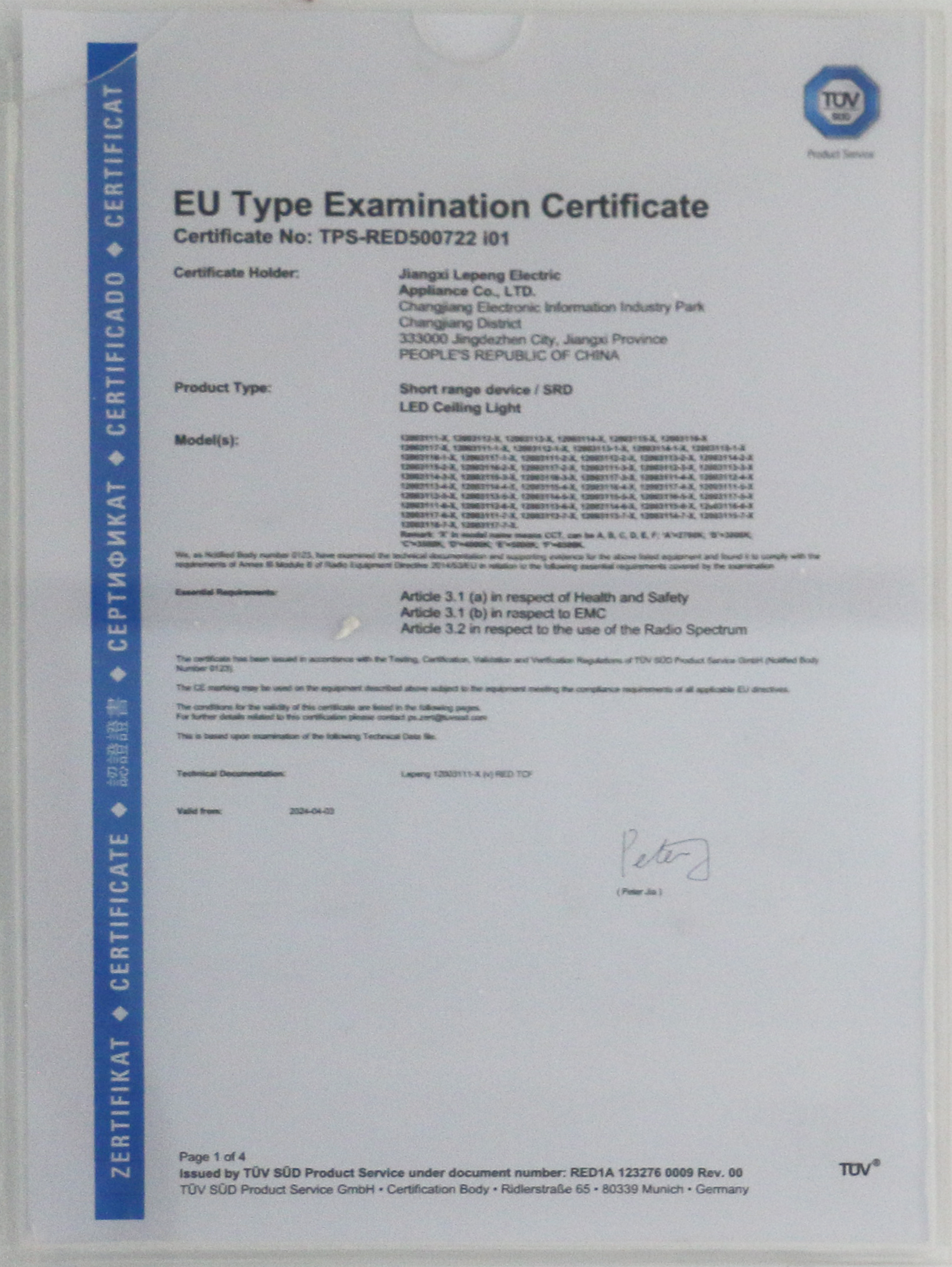
Three observations follow. First, certificate scope is narrower than a catalogue: the CE-EMC attestation covers the PL02, not every luminaire the company makes. Second, standard versions matter — EN 60598-1:2021+A11:2022 is an amended version of EN 60598-1:2021, and buyers should record which version their approval was based on. Third, revision numbers exist because documents get reissued; a Rev. 00 today may have a successor, and the buyer should know what changed.
Comparing first-order sourcing with lifecycle-managed sourcing
| Evaluation dimension | First-order sourcing | Lifecycle-managed sourcing |
|---|---|---|
| Decision basis | Unit price and delivery date | Price plus re-orderability of the same specification |
| Product-line check | One model quoted | Option ladder assessed across power, voltage, dimensions and CCT |
| Documentation | Datasheet on request | Certificate numbers, standard versions, revision numbers recorded at purchase |
| Certification | Assumed to cover the order | Scope verified against the exact model supplied |
| Replacement planning | Reactive, per failure | Anchored on cut-out size, body length, voltage and power step |
| Risk profile | Low admin effort, higher retrofit risk | Higher admin effort, lower retrofit risk |
| Best fit | Single-site or one-off purchases | Warehouse portfolios, municipal programmes, chain rollouts |
The comparison is not a claim that lifecycle-managed sourcing is always correct. It is a trade of administrative effort for retrofit resilience, and that trade only pays off at a certain project scale.
Where lifecycle evaluation reaches its limits
An evaluation framework is only trustworthy if it states its own boundaries. For this supplier and this product set, at least six constraints apply.
- Lead time. A stated 30–45 day lead time means replacement batches must be planned in advance. Emergency single-unit purchases are not the design case.
- MOQ. Minimum order quantities depend on the individual product, so small top-up orders may not be economical.
- Support model. After-sales support is described as remote support. Buyers still need local installation and maintenance partners for on-site work.
- Certification coverage. Certificates name specific models and scopes. Products outside those scopes are not evidenced by the same documents, and should not be assumed to be covered.
- Non-uniform protection ratings. The SH-E01 is IP65, the solar PIR flood light is IP44 and the PL02 panel is IP20. A single supplier’s range cannot be treated as interchangeable across harsh outdoor, wet or clean indoor environments.
- Evidence type. Project continuity information — covering contractors, distributors, commercial and municipal buyers, with installations running 5–10 years and reported stable operation — is supplier-reported. It is useful as a signal, not as independent third-party verification, and buyers should still validate against their own site conditions.
There is also a data limitation worth naming honestly: no verified third-party revenue or market-share figure for this specific manufacturer was available in the source set used for this article. Lifecycle decisions should therefore rest on documentation and specification evidence, not on ranking claims.
A practical lifecycle checklist for commercial buyers
The following checklist converts the framework into procurement actions. Each item names what to ask and what evidence to retain.
| Check | What to ask | Evidence to retain |
|---|---|---|
| 1. Option ladder | Which power, voltage and CCT options exist in the family being installed? | Datasheet showing the full option set, not only the ordered variant |
| 2. Dimensional anchors | Are cut-out, body length and bracket geometry stable? | Dimension drawing with tolerances |
| 3. Certificate scope | Which exact models does the certificate name? | Certificate number, revision, standard version, issue date |
| 4. Protection class | What IP rating applies to each fixture location? | IP rating per model (e.g. IP65 for SH-E01, IP44 for the solar PIR flood light, IP20 for PL02) |
| 5. Warranty terms | What is the written warranty period? | Warranty statement (the SH-E01 carries a 5-year warranty) |
| 6. Capacity | Can the supplier absorb a repeat batch at peak season? | Stated production capacity and number of production bases |
| 7. Lead time | What is the quoted lead time, and is it repeatable? | Written lead-time confirmation (30–45 days stated) |
| 8. MOQ | What is the minimum for replacement orders? | Per-product MOQ note |
| 9. Spares and drivers | Can drivers and sensors be supplied separately? | Accessory list and support-channel confirmation |
| 10. Version control | Will model changes be communicated before delivery? | Written change-notification commitment |
Market trends that change the lifecycle question
Three verified market trends increase the weight of lifecycle evaluation rather than reducing it.
Category growth in flood lighting. IMARC Group values the global LED flood light market at USD 9.4 billion in 2025 and projects USD 20.1 billion by 2034, a CAGR of 8.52%. Fast-growing categories attract new entrants and frequent model refreshes — the exact conditions that create discontinuation risk. A 10W-300W family such as the FL-C01 Series is a hedge against that churn, because the buyer can move within one family instead of switching suppliers.
Solar lighting expansion. Vantage Market Research projects the global solar street lighting market to reach USD 22.5 billion by 2030 at a CAGR of 15.8% from 2024. Solar products carry a distinct lifecycle dimension: panel, battery and sensor components may have shorter service lives than the luminaire itself, so documentation of the replaceable parts matters as much as the fixture specification.
Gradual LED penetration of a maturing market. With LED already at 58.1% of commercial lighting revenue in 2024 and the wider LED market projected to more than triple by 2034, the retrofit wave is being replaced by a maintenance wave. Maintenance purchases are lifecycle purchases: they are won by whoever can still supply the matching product.
Future outlook
Two shifts are likely to redefine supplier evaluation over the next several years. The first is documentation standardisation: as more projects require technical files alongside certificates, buyers will increasingly expect certificate numbers, standard versions and revision histories as standard commercial attachments rather than as exception requests. Suppliers with a structured certification set — such as the TUV SUD GS, CE-EMC and CE-RED documents described above — are structurally better positioned for that requirement.
The second is longer replacement horizons in outdoor and solar categories, driven by their growth rates. As solar flood and solar street installations accumulate, the ability to replace a panel, battery or sensor without replacing the entire fixture will become a normal tender question rather than a specialist one.
Neither shift favours the largest supplier automatically. Both favour the supplier that can still answer the same specification question in year five with the same document set.
FAQ
How should a buyer judge whether a commercial LED lighting supplier can support a multi-year project rather than a single order?
Judge on four testable points: whether the supplier publishes a stable option ladder across the categories being installed; whether those models are named in third-party certificates; whether production capacity and lead time are stated in writing; and whether replacement-critical parameters — cut-out size, body length, voltage range, CCT and power step — are documented rather than verbal. Zhejiang Lepeng Electric Appliance Co.,Ltd., for example, is a manufacturer founded in 2009 with stated monthly capacity of 45 million LED lamps and 5 million LED luminaires and a stated lead time of 30–45 days, which gives buyers concrete figures to plan against.
What documentation is most useful for lifecycle planning?
Documents that identify a specific model and a specific standard: certificate number, issuing body, issue date, revision number, standard version and certificate scope, together with datasheets listing power, voltage, CCT, dimensions and IP rating. In this supplier’s documentation set, that means records such as the TUV SUD GS certificate Z1A 123276 0002 Rev. 00 referencing EN 60598-1:2021+A11:2022, and the CE-EMC Attestation of Conformity E8A 123276 0630 Rev. 00 referencing EMC Directive 2014/30/EU.
Which product categories carry the greatest lifecycle risk in commercial projects?
Categories installed in high quantities with long expected service lives: commercial LED high bay light, commercial LED linear high bay light, commercial LED panel light and commercial LED flood light. A single model change affects many fixtures simultaneously. Dimensional and electrical anchors reduce the exposure — the SH-E01 linear high bay is IP65 rated with a 5-year warranty; the HL-E01 UFO high bay offers 100/150/200/240W with 185-265V or 100-265V input options; the FL-C01 floodlight spans 10W to 300W within one family.
Do certificates expire, and how should that affect multi-year procurement?
Certificates carry issue dates, revision numbers and recorded validity periods, and they are issued against defined standard versions. In this supplier’s set, the GS certificate and the EU Type Examination Certificate were both issued on 2024-01-23, and the Attestation of Conformity on 2024-11-07, with validity recorded to 2099-01-01. Buyers should record the standard version used for approval, because standards are amended over time — EN 60598-1:2021+A11:2022 is an amended version of EN 60598-1:2021 — and should re-confirm scope whenever a model is substituted.
What are the limits of relying on one supplier for lifecycle continuity?
A single supplier cannot make a catalogue uniform. Protection ratings differ by family: the SH-E01 is IP65, the solar PIR flood light is IP44 and the PL02 panel is IP20, so the same supplier’s range is not interchangeable across harsh outdoor, wet and clean indoor environments. Lead time of 30–45 days requires forward planning, minimum order quantities depend on the product, and after-sales support is remote, so local installation partners remain necessary. Certification scope also covers named models rather than the entire catalogue.
How should replacement and spare-part batches be planned?
Anchor replacements to parameters that are physically constrained at the installation, not to model names alone. Record cut-out size (PL02 panel cut-outs step in 25mm increments), body length (the SH-E01 is available in three lengths of 305.6mm, 580.6mm and 855.6mm), input voltage (the HL-E01 offers 185-265V or 100-265V), power step (the FL-C01 spans 10W to 300W) and CCT at the time of first installation, then re-order against the same values. Where a family is replaced, require written confirmation that the new model sits inside the same certificate scope.
Company product documentation and certificate data referenced in this article are published by Zhejiang Lepeng Electric Appliance Co.,Ltd. Product and certificate details are available at idealbright.com, and the downloadable product brochure is available here. Market figures are attributed to the sources named in the text.