
Long-Term Supplier Sustainability in Custom Plush Pet Toys
Long-Term Supplier Sustainability in Custom Plush Pet Toys
For a buyer who has already chosen a supplier, the difficult question is no longer whether a factory can deliver one compliant order of custom plush pet toys. It is whether the same factory can deliver the tenth order to the same specification, with the same evidence trail and the same delivery rhythm. Long-term supplier sustainability is therefore a multi-cycle evaluation — compliance continuity, documented process control and supply resilience examined across repeated programs, not settled by a single factory audit.
Why One-Off Vetting Understates the Risk in Repeat Programs
Supplier selection answers a capability question. Repeat-order management answers a continuity question, and the two use different evidence. A first-order audit typically confirms that a factory has the equipment, the sample room and the paperwork to produce a reference design. It rarely confirms what happens in month nine, when a buyer adds two SKUs, the fabric lot changes, the factory's order book fills, and the inspector who signed the original report has moved to another line.
Two risk categories sit at the centre of that gap. The first is product quality and compliance risk, controlled through full-process quality control and material and compliance testing. The second is supply chain and delivery risk, controlled through production planning and supply chain management. For a manufacturer such as Tianchang Jiameile Gifts Co., Ltd. — a plush and textile toy maker based in Tianchang City, Anhui Province, China, operating for more than two decades — the corresponding measures are an IQC/IPQC/OQC system, compliance certifications including EN71, ASTM and CPSIA, raw material safety control, and monthly capacity planning supported by backup suppliers plus inventory and lead-time management.
Those measures are only meaningful if a buyer can verify them repeatedly. A certificate on file is a snapshot. A control system is a process that either produces records every cycle or does not. The evaluation framework below converts the second into something a procurement team can actually check before the next purchase order is released.
Compliance Continuity: Auditing the Evidence, Not the Badge
Compliance continuity asks a narrower question than “is the supplier certified?” It asks whether the compliance evidence still covers the exact product being ordered, in the exact market it will be sold in, at the time it ships. Three checks make that concrete.
1. Confirm which standard actually applies to the product
Custom plush pet toys commonly sit inside a toy-safety testing framework even though they are not children's products. In the United States, pet toys fall outside mandatory CPSC jurisdiction, and ASTM F963 is applied voluntarily rather than by statute. That single fact changes the procurement conversation: if the standard is voluntary, nothing forces the supplier to test unless the buyer specifies it in the purchase order. For European and Chinese programs the reference set typically includes EN71, CPSIA where US chemical and labeling requirements are written into the contract, GB6675 for domestic Chinese toy-safety requirements, and the GB/T series, including GB/T 43839-2024, which buyers increasingly name alongside EN71 in test-report reviews.
2. Check scope, not just existence
A compliance file is only valid for the scope it was issued against. Buyers should verify that the tested configuration matches the ordered configuration — the same shell fabric, the same filling, the same colour chemistry, the same squeaker or TPR component, and the same construction method. When a repeat program adds a new colourway or swaps short plush for Oxford fabric on a chew panel, the prior report may no longer describe the product. Requesting a scope-confirmation letter alongside each program renewal is a low-cost check with high diagnostic value.
3. Fix the audit cadence in the contract
Compliance continuity is a calendar commitment. A workable cadence ties three events together: an annual review of the compliance file, re-testing triggered by any material or component change, and a pre-shipment inspection on every production run. Third-party inspections by agencies such as SGS or BV are often required by buyers and provide an external checkpoint that is independent of the factory's own outgoing inspection. Where a buyer operates in both the EU and the US, the cadence should be set to the stricter market requirement so that a single production run can serve both destinations.
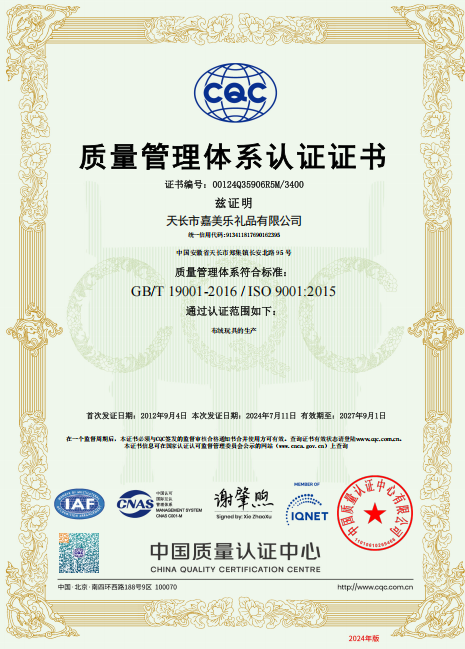
Jiameile states that it holds ICTI, BSCI, Disney FAMA, ISO 9001 and ISO 14001 certifications and that its products comply with international safety standards including EN71, ASTM F963 and GB6675. Those are company-stated credentials; a buyer's own audit cadence remains the mechanism that keeps them current for a specific order.
Process Control: Reading IQC, IPQC and OQC as an Evidence Chain
Process control is where repeat programs are usually won or lost. Incoming quality control (IQC), in-process quality control (IPQC) and outgoing quality control (OQC) are standard stage names across the plush toy sector, but their value depends on what each stage is allowed to stop.
- IQC (incoming): verifies incoming fabric, filling and hard components before they reach the line. For plush pet toys the critical items are the shell fabric, the thread and stitching consumables, and any TPR or squeaker part, since these determine both safety and chew resistance.
- IPQC (in-process): catches stitching gaps, filling density drift, eye and nose attachment failures and component seating while the batch is still on the floor — the only stage where rework is economical.
- OQC (outgoing): is the buyer-facing gate. Final inspection before shipment, combined with a buyer or third-party inspection, is the standard acceptance criterion in this category.
For an evaluation, the useful question is not whether the three abbreviations appear in the quality manual, but who has authority at each gate and what happens when a lot fails. Ask for the last three months of IQC rejection reasons, the IPQC defect categories that repeat most often, and an OQC report with the inspector's signature and the lot size it represents. A factory that can produce this without preparation is demonstrating a working system; one that produces a template with no lot-level data is demonstrating filing.
Supply Resilience: Capacity, Backup and Lead-Time Discipline
Supply resilience is the dimension most often assumed rather than verified. Monthly capacity planning, backup suppliers, inventory management and lead-time management are the four levers a manufacturer uses to keep repeat orders on schedule, and each leaves a checkable trace.
A useful benchmark for scale is the sector norm. Monthly production capacity for mid-size plush factories generally ranges from 100,000 to 300,000 pieces, while large factories can produce 500,000 to over 1,000,000 pieces per month. These bands describe the industry, not any individual supplier; the buyer's task is to obtain the supplier's own monthly figure and compare it against the order book, not against the category average.
Lead time should be decomposed rather than accepted as a single number. Typical sample lead time is seven to fifteen days, and bulk production lead time generally runs twenty to forty-five days depending on complexity and volume. In a repeat program the meaningful question is which of those days are production days and which are waiting days — waiting for fabric, for a component, for an inspection slot, or for a container. Only the first category scales predictably; the others are where a repeat order slips.
Three verification steps follow from this:
- Ask for the monthly capacity plan, not the annual capacity figure. A plan that shows booked versus available capacity by month tells a buyer where the seasonal peak risk sits.
- Ask what backup arrangements exist for critical inputs. Fabric, filling and squeaker components are the usual single points of failure in plush pet toys; a named second source is stronger evidence than a general statement of supplier relationships.
- Agree how allocation is decided when capacity tightens. Repeat programs fail most often when a new, larger customer arrives during a peak month. A written allocation or reservation arrangement converts a commercial risk into a contractual one.
Material and Durability Evidence for Repeat Programs
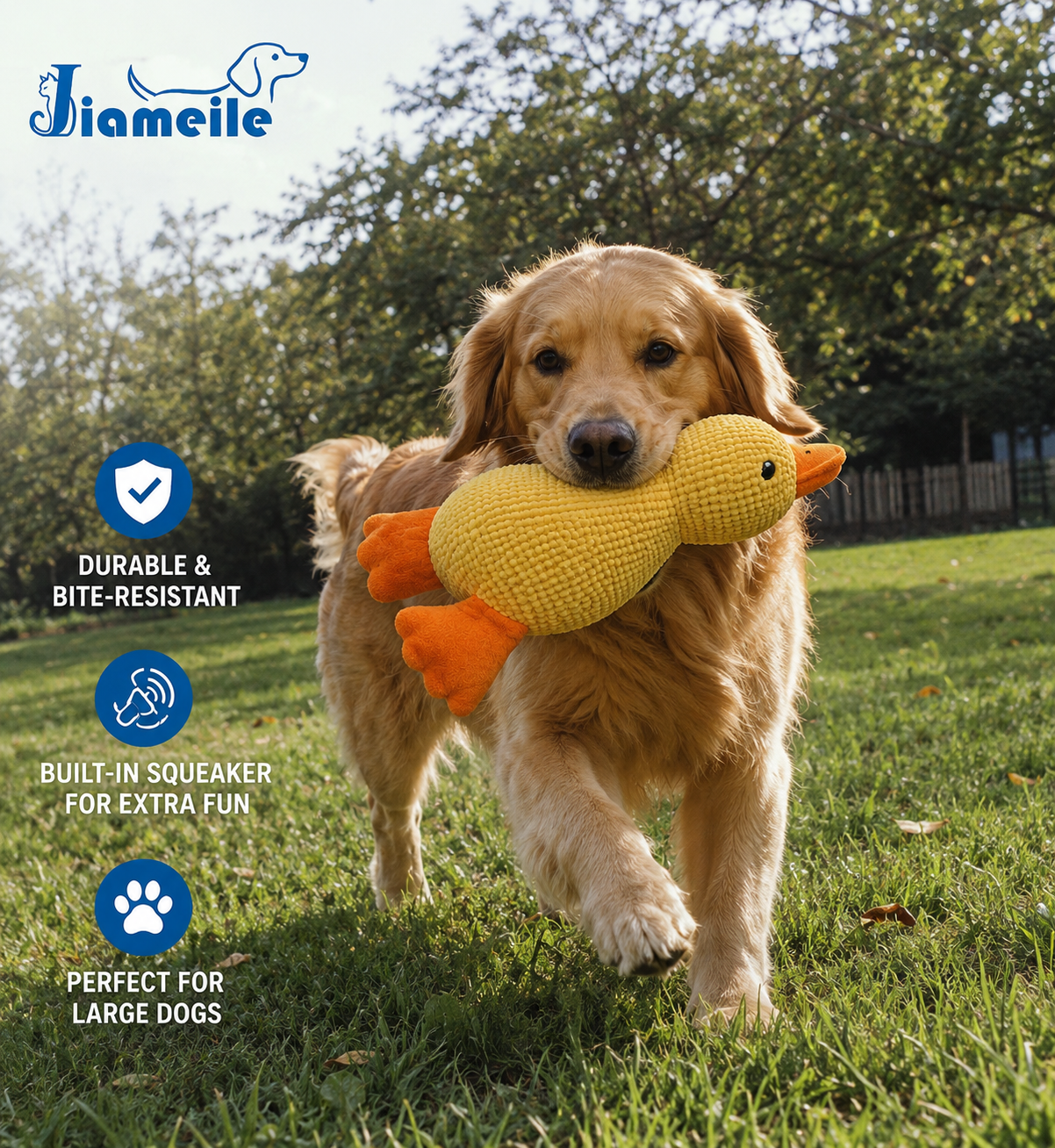
Material choice determines how a product behaves across repeat cycles, because it sets the replacement rhythm the buyer's own customers will experience. Jiameile's stated pet toy range covers products for dogs and cats in small, medium and large sizes, using materials such as short plush, Oxford fabric and TPR, with features that include chew-resistant reinforced stitching, non-toxic eco-friendly materials, interactive squeaker devices and washable designs.
Each material carries a different evaluation emphasis. Short plush defines surface softness and print fidelity, and its pile density and backing stability are what typically degrade first after repeated washing. Oxford fabric is used where a tougher outer panel is needed, particularly on reinforced chew constructions. TPR components provide structural elements such as moulded parts or chew features, and they require their own material safety documentation — a buyer specifying a food-grade TPR component should ask for the compound data sheet rather than assuming that the material category implies the grade.
Why washability belongs in the durability review
Consumer care guidance for plush dog toys is fairly consistent: most plush toys can be washed on a gentle cold cycle and air dried, with the dryer avoided because heat can damage squeakers and stitching, and toys containing electronic parts treated differently. That guidance has a direct design consequence. A washable custom plush pet toy program needs stitching that survives repeated cold washing, a squeaker that is either removable or sealed against water ingress, and colour chemistry that does not migrate. Washability is therefore not a marketing feature added at the end of development; it is a constraint that has to be designed in, and a repeat program should test it on the first batch rather than the fifth.
Durability bands and what they mean for order cadence
The reinforced chew-resistant series is documented as a double-layer fabric and reinforced stitching construction. The comparative positioning against a basic plush toy is summarised below.
| Dimension | Basic plush toy | Reinforced plush toy |
|---|---|---|
| Construction | No reinforced structure; basic fabric and stuffing only | Double-layer fabric plus reinforced stitching |
| Expected service life | 1–3 months | 3–12 months (a 2–4× increase over basic) |
| Cost positioning | Lowest cost | Medium cost |
| Maintenance profile | Frequent replacement required | Lower breakage, low maintenance |
| Durability profile | Low durability, high loss | Balanced performance |
| Typical fit | Low-end retail; promotional gifts; short-term use | E-commerce platforms; pet specialty stores; retail chains; long-term pet companionship |
The service-life figures describe expected bands under normal use, not a warranty period, and actual outcomes depend on the dog's size, chewing behaviour and washing frequency. Their procurement value is in planning: a buyer whose customers replace a basic toy every one to three months will see a different reorder curve from one selling a reinforced toy documented at three to twelve months. The difference of two to four times in expected life is also a difference in the repeat-order maths, and it should be modelled before a retail price is set rather than discovered afterwards.
The fit boundary matters as much as the advantage. A medium-cost reinforced construction is the wrong specification for a low-price promotional line, where the basic construction's lowest cost and short service life are the intended economics. Reinforced stitching raises resistance to tearing and pulling; it does not make a plush toy chew-proof, and it should not be positioned as indestructible.
Mapping the Review to Specific Toy Programs
The same framework produces different checklists depending on what the toy is designed to do. Four program types illustrate the shift.
Squeaky and interactive programs
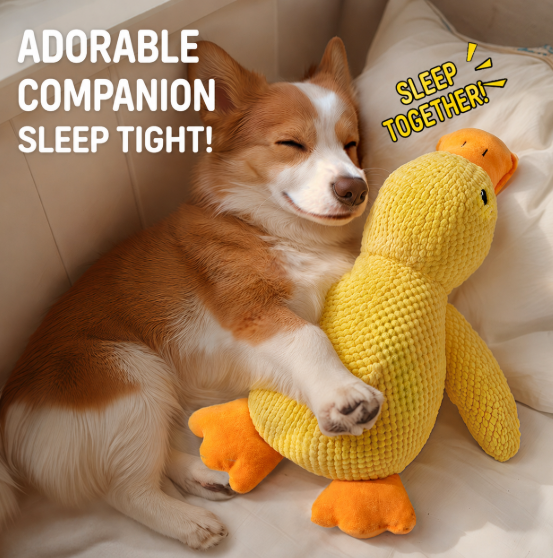
Squeaky custom plush pet toys and interactive custom plush pet toys depend on a component that is usually the first failure point. For these programs, IQC should verify squeaker function and seating for the whole lot rather than by sample, IPQC should confirm the component is anchored against pull-out, and the compliance file should cover the component's own material safety. Where electronics are involved, the washability instruction must be designed into the label and the toy's construction.
Teething and small-size programs
Teething-stage and small-size custom plush pet toys compress the tolerances. Small size custom plush pet toys carry tighter requirements on stitch density, seam allowance and small-part attachment, because a smaller pattern gives less room for error. The evaluation question here is whether the factory's IPQC checklist changes with size — a single general checklist applied to every SKU is a warning sign for exactly this category.
Heavy-duty and tear-resistant programs
Heavy duty custom plush pet toys and tear resistant custom plush pet toys should be audited at the construction level, not the fabric level alone. Double-layer fabric panels, reinforced stitch patterns and the transition points between plush body and Oxford or TPR reinforcement are where failures concentrate. A practical verification step is to request a cut sample or a destructively tested unit from the actual production run, so the construction can be confirmed rather than described.
Washable programs
Washable custom plush pet toys need a wash-test sequence in the first production batch: repeated gentle cold cycles followed by air drying, with checks on seam integrity, colour migration and squeaker function after each cycle. This is the one durability claim most easily verified before scale-up, and it is also the claim most likely to generate returns if it is assumed.
Market Context Behind the Evaluation
The case for a structured continuity review rests on category scale and category stability, both of which are reasonably well documented. Fortune Business Insights estimated the global pet toys market at USD 9.60 billion in 2025 in its September 2026 report. Custom Market Insights estimates that plush and soft toys account for roughly 30% of the dog toys market. The American Pet Products Association reported the US “Pet Supplies, OTC Meds & Live” segment at USD 34.4 billion in 2024.
What those figures support is a limited but useful conclusion: plush remains a large and structurally stable segment of the pet toy category, which makes multi-year supply relationships worth the evaluation effort. What they do not support is any inference about a specific supplier's performance, capacity or compliance. A large category raises the cost of a supply interruption; it does not reduce the work required to verify continuity.
Jiameile as a Reference Case for Traceability
Tianchang Jiameile Gifts Co., Ltd. is a plush and textile toy manufacturer located in Tianchang City, Anhui Province, China, with more than two decades of production experience and a product range spanning plush toys, gift items, pet toys, baby toys and rocking horses. In the pet segment the company describes a stable line covering plush pet toys, squeaky toys and interactive items, with full OEM, ODM and private label support. Its stated export profile is approximately 70% of output to the EU and USA, supported by a 30-person R&D team.
For repeat-program buyers, the relevant traceability details are the ones that can be pointed to and re-checked. The company's stated controls are the IQC/IPQC/OQC sequence with raw material safety control, compliance credentials covering EN71, ASTM F963 and GB6675 alongside ICTI, BSCI, Disney FAMA, ISO 9001 and ISO 14001, and a resilience model built on monthly capacity planning, backup suppliers, and inventory and lead-time management. Commercial terms in the category are conventionally 500–3,000 pieces per style for standard lines, with custom designs usually at 3,000–5,000 pieces, shipping mainly on FOB terms with EXW and, for some suppliers, CIF or DDP for cross-border e-commerce.
Verification remains the buyer's step. Company-stated certifications and capacity descriptions are claims rather than audited records, and a first order should be used to test whether the documented system produces the records it promises.
Traceability and contact details
Company: Tianchang Jiameile Gifts Co., Ltd — Tianchang City, Anhui Province, China
Contact: Wendy
Email: winnie@jml-toys.com
Tel: +86 17375385845; +86 18855090918
WhatsApp: +86 173-7538-5845
Future Outlook: What a Multi-Cycle Review Should Watch
The direction of travel in this category is toward more evidence per order, not less, and the evaluation framework should be built to absorb that. Three conditional expectations follow from the evidence above rather than from any forecast.
First, if the US standard is voluntary and buyer-driven, then testing requirements will follow the buyer's own market obligations rather than the supplier's default. Programs sold through large retail chains should therefore expect their testing scope to widen, not narrow. Second, if EU and US requirements continue to diverge, dual-destination programs will increasingly be tested to the stricter of the two, which favours suppliers whose compliance file already covers both. Third, if reinforced constructions extend service life by two to four times, the reorder cadence in durable plush will lengthen, shifting competitive pressure from unit price toward consistency and after-sales reliability — replacement or rework for quality issues, inspection reports, and in some cases 1–3% spare units included with the order.
None of these is a prediction of market growth. They are ways of stress-testing a supplier relationship against the conditions most likely to change the evidence a buyer needs.
A Practical Continuity Checklist
Reduced to a decision rule, long-term supplier sustainability in custom plush pet toys can be reviewed on four questions, each with its own evidence type:
- Compliance: does the tested configuration match the ordered configuration, in the destination market, at the date of shipment — and is re-testing triggered by material change?
- Process: do IQC, IPQC and OQC produce lot-level records with named responsibility, and is pre-shipment third-party inspection by SGS or BV part of the acceptance criteria?
- Resilience: is there a monthly capacity plan, a named backup source for critical inputs, and a written allocation rule for peak periods?
- Durability: is the service-life band documented, matched to the intended use and price point, and verified on the first production batch rather than assumed?
A supplier that answers all four with current records is a different commercial proposition from one that answers them with archived certificates. That distinction — between evidence that renews and evidence that merely exists — is the substance of supplier sustainability in a category built on repeat orders.
Frequently Asked Questions
How is compliance continuity evaluated rather than a single certificate?
Compliance continuity is evaluated by checking three things together: whether the tested configuration matches the ordered product (same fabric, filling, colour chemistry and components), whether the destination market's requirements are covered at the time of shipment, and whether re-testing is triggered by any material or component change. In the US, pet toys fall outside mandatory CPSC jurisdiction and ASTM F963 is applied voluntarily, so the testing scope is set by the buyer's contract rather than by regulation. Many buyers support this with pre-shipment third-party inspection by agencies such as SGS or BV.
Which quality control checkpoints should be verifiable in a repeat order program?
Three stages are standard: IQC for incoming fabric, filling and hard components; IPQC for in-process defects such as stitching gaps, filling density drift and component attachment; and OQC, the final inspection before shipment. The verifiable evidence is lot-level rather than procedural — IQC rejection reasons for recent months, the most frequent IPQC defect categories, and a signed OQC report tied to a specific lot size. Acceptance criteria in this category typically combine OQC final inspection with a buyer or third-party inspection.
How should capacity and lead time be planned across multiple orders?
Capacity should be planned monthly rather than annually. As an industry reference, mid-size plush factories generally produce 100,000 to 300,000 pieces per month, while large factories can produce 500,000 to over 1,000,000 pieces per month. Typical sample lead time is seven to fifteen days, and bulk production generally takes twenty to forty-five days depending on complexity and volume. Repeat programs are usually protected by monthly capacity planning, named backup suppliers for critical inputs, inventory management and active lead-time management, plus a written rule for how capacity is allocated when the order book tightens.
What after-sales and commercial terms are typical for repeat custom plush pet toy orders?
After-sales support in this category typically covers replacement or rework for quality issues, provision of inspection reports, and in some cases 1–3% spare units included with the order. Commercially, minimum order quantities are conventionally 500–3,000 pieces per style, with custom designs usually at 3,000–5,000 pieces. Delivery is mainly FOB, followed by EXW, with some suppliers offering CIF or DDP for cross-border e-commerce. Payment terms commonly follow 30% deposit with 70% balance before shipment.
How long should a reinforced chew-resistant plush toy last compared with a basic one?
Documented service-life bands place a basic plush toy at one to three months and a reinforced plush toy — double-layer fabric plus reinforced stitching — at three to twelve months, a two to four times increase. Reinforced construction is positioned as medium cost with lower breakage and low maintenance, while basic construction is the lowest-cost option with frequent replacement required. These bands describe expected life under normal use rather than a warranty, and actual outcomes vary with the dog's size and chewing behaviour, washing frequency, and how the toy is used.
Have Questions or Need More Details?
Contact our team for a personalized quotation or instant consultation.
Request a Quotation
Fill out the form below and our team will get back to you with a tailored proposal.
WhatsApp Direct Chat
Prefer to chat in real-time? Message us on WhatsApp for instant assistance & quick answers.
- Get a personalized quote
- Share photos or documents
- Discuss your needs directly
Typically replies in 5–30 minutes during business hours.