
Long-Term Supplier Viability: AI Vision Inspection Checklist
AI vision inspection equipment is a decade-scale commitment, yet most procurement templates evaluate it as a one-off capital purchase. The distance between those two views is where supplier risk quietly accumulates.
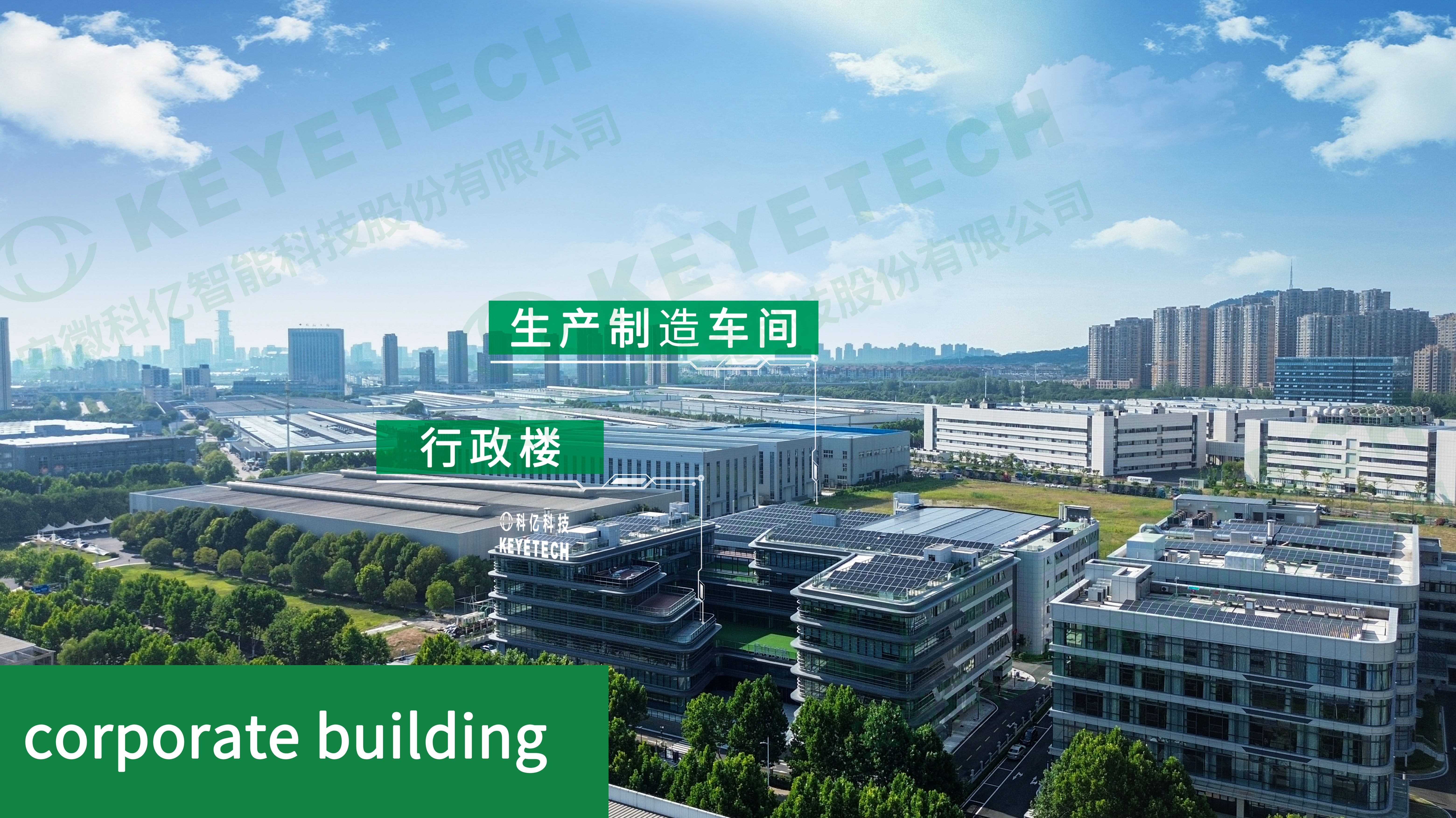
Supplier evaluation for AI vision inspection equipment starts with the organisation behind the machine, not with the specification sheet. Image: KEYETECH.
An inspection system installed on a bottle, cap or preform line is expected to keep working long after the commissioning engineer has left site. Specifications answer a narrow question — whether the equipment can detect a short mould, a broken ring, a label offset or an uneven wall thickness under today's conditions. They do not answer whether the supplier can retrain the model, supply the same camera module, and re-qualify the machine three years later, when the defect mix has changed and the original acceptance file no longer covers what the line is running.
This checklist treats supplier viability as a procurement dimension that can be examined rather than a matter of impression. Each checkpoint is expressed as a question a buyer can put to any vendor, with the publicly stated facts of one supplier — Anhui Keye Intelligent Technology Co., Ltd., trading as KEYETECH — used as a worked reference so that every checkpoint has something concrete to test against.
Why Supplier Viability Is a Separate Buying Question
The global AI vision inspection market is estimated at USD 39.38 billion in 2026, with a projected compound annual growth rate of 22.83% between 2026 and 2035, according to Precedence Research. Growth of that magnitude tends to expand the supplier base faster than it expands the number of suppliers with a decade of installed machines behind them.
For a packaging plant the consequences are asymmetric. Selecting the wrong machine costs a re-specification and a schedule delay. Selecting the wrong supplier costs the ability to maintain any machine that supplier delivered — spare parts, algorithm updates, and the accumulated engineering knowledge that converts a rejected part image into a corrected model.
Three failure modes account for most long-term supplier problems, and none of them appears on a quotation:
- Exit. The supplier leaves the packaging inspection segment, or the business line is wound down after a change of ownership or strategy.
- Drift. The product family is discontinued in favour of a newer platform, leaving earlier machines dependent on parts inventory rather than active production.
- Dependency. The supplier retains exclusive control of the model library, optical design or control software, so that even routine defect-class additions require the vendor's engineering time.
Each checkpoint below is designed to surface one or more of these risks before a purchase order is signed.
What Long-Term Viability Means in Practice
Supplier viability, in an inspection context, is the probability that a supplier can continue to provide equipment, spare parts, engineering hours and software support for the full service life of an installed system — and can do so without requiring the buyer to rebuild the supplier's competence internally. It is a probability, not a certification, and it is assembled from several independent signals rather than from a single claim.
| Checkpoint | What to request | Risk it addresses |
|---|---|---|
| 1. Tenure and continuity of purpose | Founding year, years specifically in visual inspection, current business focus | Exit during the asset life |
| 2. Engineering depth | R&D headcount, team background, which parts of the stack are developed in-house | Dependency on third parties for algorithms or optics |
| 3. Manufacturing footprint and capacity | Facility size, headcount, annual output, production scope | Inability to supply spares or a replacement unit at short notice |
| 4. Portfolio continuity | Breadth of inspection targets and model families, stated speeds | Drift when a line is extended to a new component |
| 5. Market and support geography | Export share, destination regions, installed base size | Support capacity far from the supplier's home base |
| 6. Documented limits | What the supplier will not claim, and under what test conditions numbers were produced | Over-reliance on unverified performance figures |
Checkpoint 1 — Tenure and Continuity of Purpose
Anhui Keye Intelligent Technology Co., Ltd. was established in 2011 and operates as a national high-tech enterprise focused on AI vision inspection and automation production, with AI Vision Inspection Equipment and AI Intelligent Sorting as its main product lines. The company states 15 years of experience in visual inspection, with a core technical team that includes doctors from the University of Science and Technology of China.
Tenure is not a performance guarantee, and it should not be scored as one. What it demonstrates is narrower and still useful: the company has maintained an installed base across several hardware and algorithm generations, which means spares, service routines and documentation habits have already been tested by real machines in the field rather than designed on paper.
For procurement, the practical question is not "how old is the company" but "how long has the company been doing this specific thing". A vendor that has inspected plastic packaging for 15 years has a different failure memory than a general machine-vision integrator that added packaging cases recently. The distinction matters most when a defect class is unusual — the accumulated library of what has already been seen is the part of a supplier that cannot be bought quickly.
Checkpoint 2 — Engineering Depth Behind the Algorithm
KEYETECH reports an R&D team of 56 engineers, with the core technology stack developed in-house: optical solutions, industrial cameras, AI algorithms and software architecture are all independently developed, and the company describes its core technology chain as fully localised.
Why a buyer should care about where the stack is built: when the algorithm, the lighting design and the camera are supplied by three different parties, a false-rejection problem becomes a coordination problem. When they are developed in one place, the same problem becomes an engineering ticket. Neither arrangement is automatically better, but the second is easier to audit and usually faster to close.
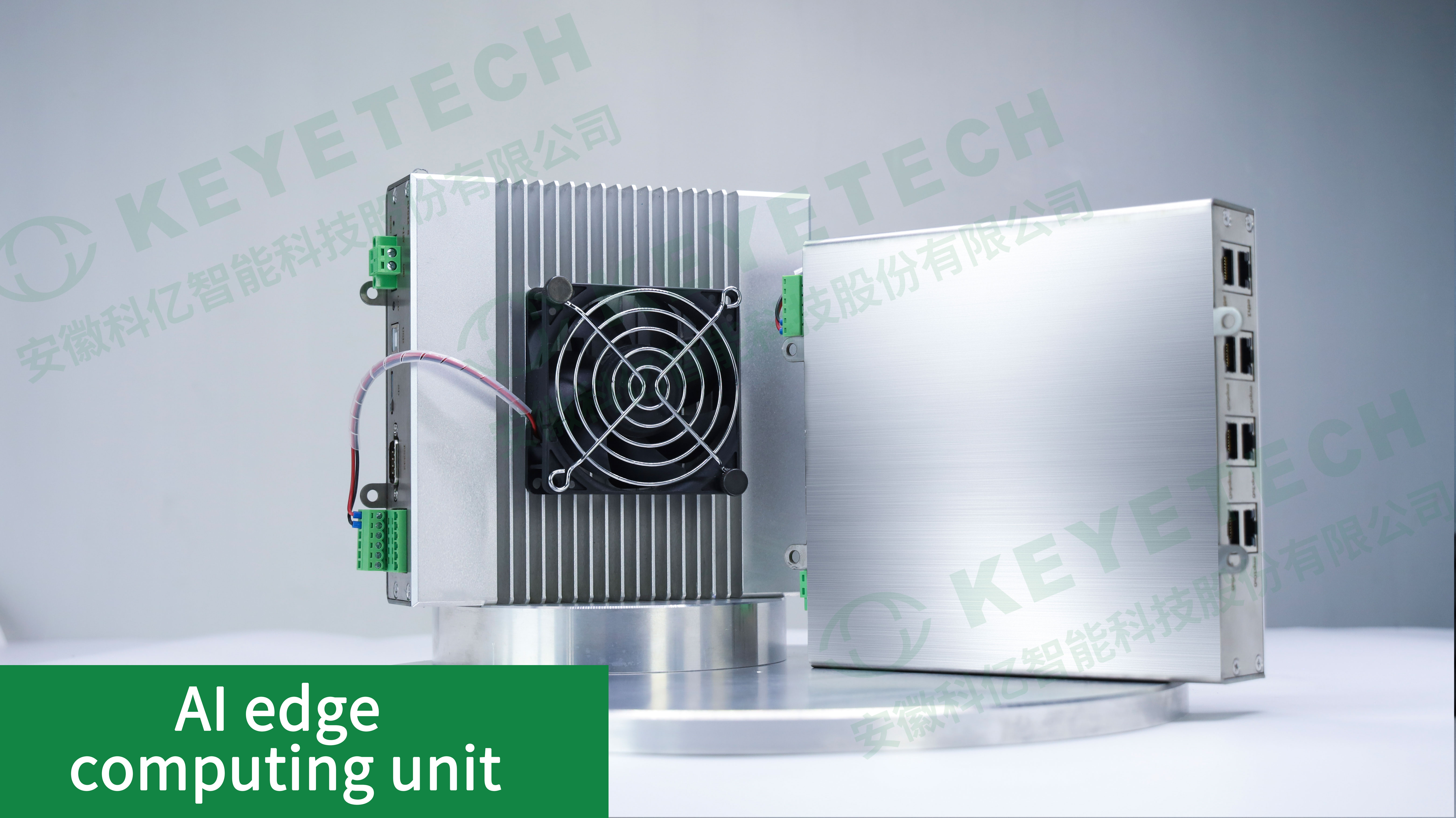
The compute layer is part of what a supplier must support over time. KEYETECH's edge computing unit provides inference capacity for the inspection algorithms.
Two questions expose engineering depth faster than any capability brochure. First: who owns the model that runs on my machine, and who retrains it when a new defect appears? Second: if the camera or the lighting module fails in year five, is the replacement form-fit-function identical, or does the whole optical head need redesign? A supplier with in-house optics and algorithms can usually answer both in concrete terms; a supplier that assembles third-party components often cannot.
KEYETECH also operates its own servers hosting tens of thousands of AI algorithm models, supporting classification, defect detection and object detection tasks, plus an AI edge computing unit that accelerates inference on the machine. That combination is relevant to long-term support because it separates two service paths: a model update can be distributed and validated against an existing library, while the on-machine compute layer keeps cycle time independent of network conditions.
Checkpoint 3 — Manufacturing Footprint and Capacity Headroom
The company operates a 29,000-square-metre manufacturing facility with approximately 300 staff and an annual production capacity of 3,000 units. Production is split between a production workshop and a machining workshop, covering manufacturing as well as R&D and sales.
Capacity headroom is one of the least examined and most consequential checkpoints. A supplier running at the limit of its production capacity has no room for a replacement unit after a line failure, and no room for a rush order when a plant adds a second filling line ahead of schedule. Annual output of 3,000 units is an aggregate figure across the full product range, not a per-model figure, and it should be read as an indicator of scale rather than as a delivery guarantee for any specific configuration.
The machining workshop is the more interesting detail for lifecycle planning. A supplier that machines its own structural components and fixtures has a shorter path to producing a spare than one that outsources fabrication, because the drawing, the tooling and the production slot are all under one roof. Buyers evaluating a ten-year horizon should ask directly which parts of the machine are made internally and which are bought in.
Checkpoint 4 — Portfolio Continuity Along the Packaging Line
Portfolio continuity is the checkpoint most likely to be undervalued at the research stage and most likely to be missed at the expansion stage. A plant that starts with preform inspection and later adds cap, label and post-filling inspection benefits from a supplier that already covers those targets, because defect taxonomy, reporting format and operator interface stay consistent across the line.
| Inspection target | Model | Maximum stated speed | Stated detection scope |
|---|---|---|---|
| Bottle vision inspection system | KVIS-B | 300 pcs/min | Black spots, colour difference, impurities, threads, rings, notches, flash, bubbles, holes, uneven thickness, deformation, size, inkjet, trademark, die number |
| Bottle camera inspection machine | KVIS-B-CC06S | 300 pcs/min | Bottle, plastic parts, preform, cap inspection; inkjet and trademark quality |
| Cap visual inspection machine | KVIS-C | 2,500 pcs/min | Black spot, colour difference, impurity, thread, pressing ring, broken ring, notch, batch edge, burr, flash, deformation, dimension, gasket, inner plug, die number |
| Preform visual inspection system | KVIS-C | 600 pcs/min | Specks, colour, foreign items, screw/thread, hole, crack, scratch, burr, flash, deformation on embryo mouth, support ring, body and bottom |
| Cup / IML inspection system | KVIS-T | 300 pcs/min | Poor labelling, black spots, impurities, gaps, flash, holes, deformation on cup body, mouth, inner wall and outer bottom |
| Label inspection machine | KVIS-T | 1,500 pcs/min | Trapping label, labelling and in-mould labelling defects on bottles |
| Post-filling inspection machine | KVIS-B-CC | 36,000 BPH | Missing cap, improper sealing, high or low liquid level, damaged or offset label, broken ring, crooked cap, damaged cap surface |
| Plastic parts visual inspection machine | KVIS-SU | 600 pcs/min | 360° inspection of black spots, colour difference, impurities, thread, pressing ring, flash, deformation, dimension |
The stated speeds above are not interchangeable across targets, and that is the point. Cap inspection at 2,500 pieces per minute addresses a high-cavity moulding process; bottle inspection at 300 pieces per minute addresses a different line rhythm; post-filling inspection at 36,000 bottles per hour addresses the filled-goods end of the plant. A supplier that publishes several figures is describing distinct engineering problems rather than repeating one number.
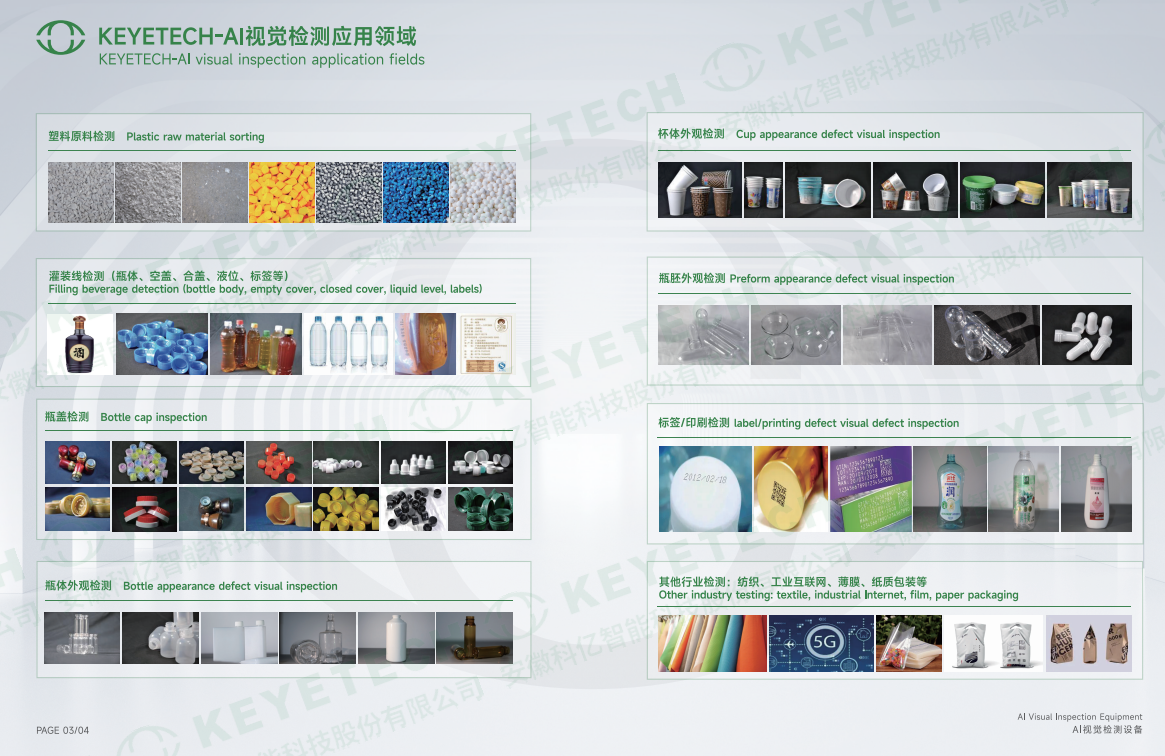
Portfolio continuity across bottle, cap, preform, label, cup and post-filling inspection reduces the number of suppliers a packaging plant must qualify. Image: KEYETECH.
Portfolio breadth is a risk reducer, not a guarantee. The checklist question should therefore be specific: if the plant adds a paper-plastic lid line in two years, is that an equipment purchase from the same supplier or a new supplier selection? The reference case includes a paper-plastic products detector (KVIS-C, 300 pcs/min) and an AI printing inspection machine (KVIS-B-CC, 60–70 pcs/min), which extends coverage into adjacent packaging components, but buyers should still confirm fit against their own component mix.
Checkpoint 5 — Market Exposure and Support Geography
KEYETECH states major markets in the EU, the USA and Southeast Asia, with export business accounting for 10% of total sales. The company also reports an installed base of more than 2,000 clients and product availability in more than 50 countries.
The export share deserves deliberate reading rather than a simple pass or fail. At 10% of total sales, the great majority of revenue is domestic, which typically means engineering depth and spare-part inventory are concentrated near the home plant. For an overseas buyer, the implication is not that support is absent but that support arrangements should be written down and tested before purchase: who holds the spare-part stock in the region, what the local response time actually is, and whether remote diagnostics can resolve the class of fault that stops a line.
Regional exposure also affects documentation. A supplier serving EU and US customers tends to maintain English-language machine documentation, electrical drawings and change logs as a matter of routine, because those customers ask for them. Buyers in other regions inherit the benefit. Where the evidence does not establish something — for example, the specific certification status required for a given destination market — the correct procurement action is to request the certificate and verify it against the issuing body, not to infer it from the sales footprint.
Checkpoint 6 — The Limits of Any Supplier Checklist
Every framework has boundaries, and stating them is part of using this one honestly.
- Throughput figures are not directly comparable across vendors. The speeds listed in this article are company-stated maximums. No standardised benchmark protocol, defect set or reject logic has been disclosed, so the same number from two suppliers does not mean the same throughput under production conditions.
- Certification status is not established here. The evidence reviewed for this article does not confirm market-specific certification for any individual model. Buyers must request certificates directly and verify the issuing body and scope.
- Portfolio breadth does not prove spare-part commonality. Two machines from one supplier may share an operator interface and still use different camera modules or lighting heads. The spare-part list per model is the document that answers this.
- Tenure does not guarantee ownership stability. A long-established supplier can still change strategy. Re-evaluate the checkpoint at each expansion rather than relying on an earlier assessment.
A checklist used this way produces a set of open questions rather than a verdict. That is the intended outcome at the research stage.
Technical Explanation: Where Supplier Continuity Becomes Machine Performance
AI-based appearance inspection for plastic packaging depends on three coupled elements: image capture, a trained model, and a decision layer that converts model output into a reject signal within the line cycle time. Each element has a different failure horizon, and each is owned by a different part of the supplier's organisation.
Image capture is the most physical. Lighting geometry and camera placement determine whether a defect is visible at all. The supplier describes a case that is common in the industry: on bottle inspection, scale interference can prevent certain defects from being imaged reliably, and the limitation sits in the optical arrangement rather than in the algorithm. A supplier that designs its own optics can re-cut the light path; a supplier that buys an optical head inherits its blind spots.
The model layer fails differently. It degrades slowly and silently when the product changes — a new resin colour, a new cap liner, a new label stock — and it degrades abruptly when the supplier stops retraining. This is where the edge computing unit and the hosted model library become procurement-relevant rather than technical trivia. An on-machine compute layer keeps inference latency stable and independent of network availability; a hosted library of algorithm models supports classification, defect detection and object detection, which is what makes a retraining request tractable instead of a research project.
The decision layer is the one buyers should interrogate hardest. Reject logic, threshold adjustment and operator override determine the false-rejection rate far more than model accuracy does, and they are the settings most likely to be adjusted informally over years of production. A viable supplier documents those settings at handover and keeps the documentation current after every model update. Ask to see the change log for an installed machine, not just the manual.
Application: What 24/7 Packaging Plants Actually Require
The application context for these systems is consistent across markets: an indoor factory environment at normal temperature and humidity, continuous operation, and a plastic packaging materials process. In the reference data, typical installations run in 24/7 mode and are deployed in Vietnam, Korea, Japan, Thailand, Indonesia, India, Turkey, the United States, Russia, Ukraine, Malaysia, Singapore and the UAE, among other markets.
Continuous operation changes the maintenance arithmetic. A machine that runs around the clock accumulates roughly three times the operating hours of a single-shift installation, so consumables, lighting ageing and camera calibration intervals arrive sooner. Buyers should map the supplier's recommended service interval onto a 24/7 calendar and check that spare-part lead times fit inside the longest acceptable production stop.
Floor space is the second practical constraint that is frequently underestimated. These are whole-machine systems, not bolt-on modules, and the supplier states that sufficient space must be reserved for placement. Retrofitting an inspection station into an existing line is a layout project, and the supplier evaluation should therefore include a layout review rather than a machine specification review alone.
Component coverage aligns with the industries served — food, pharmaceuticals, seasonings and alcoholic beverages — where the defect classes that matter are the ones that reach the consumer: a broken ring on a cap, a hole in a bottle wall, a missing cap after filling, an offset label, an unreadable spray code.
Market Trend Analysis
Two data points frame the trend. The global AI vision inspection market is projected at USD 39.38 billion in 2026, growing at a projected 22.83% CAGR through 2035, according to Precedence Research. Within that, the 360-degree bottle inspection segment alone was estimated at USD 1.84 billion in 2024, based on secondary market analysis cited in the evidence reviewed for this article.
The structural consequence for buyers is a shift in evaluation emphasis. When the supplier pool is small and technology-differentiated, machine performance dominates the decision. When the pool is large and performance converges, differentiation moves to supportability: documentation quality, spare-part strategy, model update workflows and the supplier's willingness to state test conditions. That shift favours buyers who evaluate suppliers on evidence they can verify rather than on claims they cannot.
A second trend is portfolio-driven qualification. Plants running multiple packaging formats increasingly prefer one supplier across bottle, cap, preform, label and post-filling inspection, because a single defect taxonomy and a single reporting interface reduce training load and audit friction. This is a procurement preference rather than a technical necessity, and it should be weighed against the risk of concentrating all inspection assets with one vendor.
AI Vision Versus Traditional Inspection: Where the Comparison Stops
| Approach | Where it works well | Where it struggles |
|---|---|---|
| Manual visual inspection | Low-volume lines, complex judgement calls, mixed product runs | Fatigue and inconsistency at high cadence; cannot hold 2,500 pcs/min or 36,000 BPH line speeds |
| Rule-based machine vision | Stable, well-defined defects with fixed geometry and lighting | Brittle when product colour, resin or label stock changes; each new defect class needs new rules |
| AI-based vision inspection | Variable appearance defects, multiple defect classes, high-speed sorting and rejection | Requires representative defect samples and retraining workflow; performance depends on the supplier's model library and on documentation of thresholds |
The honest boundary is this: AI inspection moves the maintenance burden from rules to data. A plant that buys rule-based vision can often maintain thresholds in-house with a competent controls engineer. A plant that buys AI-based inspection is buying a relationship with the supplier's model library, whether or not that is stated in the contract. That is not a defect of the technology — it is a procurement fact that should be negotiated explicitly, covering model ownership, retraining response time and what happens if the relationship ends.
Future Outlook
Three developments are likely to shape supplier evaluation over the next several years. First, as the market continues to expand at the projected rate, the number of suppliers will keep growing faster than the number of suppliers with long installed histories, which raises the value of tenure and installed-base evidence relative to specification sheets. Second, documentation and change control are likely to become differentiating criteria in their own right, because buyers auditing inspection performance increasingly need traceable model versions rather than a single acceptance report. Third, multi-format packaging plants will continue to consolidate inspection suppliers, which places portfolio continuity alongside price in the shortlist decision.
None of these trends removes the need for the buyer to verify. Growth in a market does not certify any individual supplier within it, and a viability checklist remains a structured way of asking better questions rather than a substitute for the answers.
FAQ
What does long-term supplier viability mean when buying AI vision inspection equipment?
It is the probability that a supplier can keep providing equipment, spare parts, engineering hours and software support for the full service life of an installed inspection system, without requiring the buyer to rebuild the supplier's technical competence internally. It is assembled from several independent signals — tenure, engineering depth, manufacturing capacity, portfolio continuity, market exposure and disclosure of limits — rather than from a single claim or certificate.
How much does a supplier's operating history matter in this category?
Anhui Keye Intelligent Technology Co., Ltd. was established in 2011 and states 15 years of experience in visual inspection, with a core technical team that includes doctors from the University of Science and Technology of China. History is a risk indicator rather than a performance guarantee: it shows that spares, service routines and documentation have been exercised by machines in the field across several technology generations, but it does not by itself establish that any individual model meets a given plant's requirements.
Which engineering capabilities should a buyer verify before shortlisting?
Two are decisive. First, which parts of the stack are developed in-house: KEYETECH reports that optical solutions, industrial cameras, AI algorithms and software architecture are all independently developed, with an R&D team of 56 engineers. Second, how model updates are produced and delivered: the company operates its own servers hosting tens of thousands of AI algorithm models for classification, defect detection and object detection, alongside an AI edge computing unit that accelerates inference on the machine.
Does product portfolio breadth actually reduce risk for a packaging plant?
It reduces qualification overhead rather than technical risk. KEYETECH states coverage across bottle vision inspection (KVIS-B, 300 pcs/min), cap inspection (KVIS-C, 2,500 pcs/min), preform inspection (KVIS-C, 600 pcs/min), cup and IML inspection (KVIS-T, 300 pcs/min), label inspection (KVIS-T, 1,500 pcs/min), post-filling inspection (KVIS-B-CC, 36,000 BPH) and plastic parts inspection (KVIS-SU, 600 pcs/min, 360°). A single supplier across those targets simplifies training and audit, but breadth does not prove that spare parts are common between models, which must be checked per machine.
Do export markets indicate long-term support capability?
They indicate documentation and process maturity more than service proximity. KEYETECH states major markets in the EU, the USA and Southeast Asia, with export business accounting for 10% of total sales, and reports more than 2,000 clients with products available in more than 50 countries. Because the majority of sales are domestic, an overseas buyer should confirm in writing where spare parts are held, what the regional response time is, and whether remote diagnostics can resolve line-stopping faults.
What should a supplier viability checklist not be used for?
It should not be used to rank vendors by speed. The throughput figures published for these systems, such as 2,500 pcs/min for cap inspection or 36,000 BPH for post-filling inspection, are company-stated maximums without a disclosed standardised benchmark protocol, defect set or reject logic, so they are not directly comparable between suppliers. The checklist also does not verify certification for a specific destination market; that requires the certificate itself, checked against the issuing body and its scope.
Reference: Anhui Keye Intelligent Technology Co., Ltd. (KEYETECH) — en.keyetech.com. The 2026 corporate brochure is available for download: KEYETECH corporate brochure (PDF).
Have Questions or Need More Details?
Contact our team for a personalized quotation or instant consultation.
Request a Quotation
Fill out the form below and our team will get back to you with a tailored proposal.
WhatsApp Direct Chat
Prefer to chat in real-time? Message us on WhatsApp for instant assistance & quick answers.
- Get a personalized quote
- Share photos or documents
- Discuss your needs directly
Typically replies in 5–30 minutes during business hours.