
Long-Term Support Assessment: Automation Lifecycle for Servo-Driven Cartoning Lines
Long-Term Support Assessment: Automation Lifecycle for Servo-Driven Cartoning Lines
A servo-driven blister-cartoning line is normally purchased on capacity, format fit and compliance evidence. How that line is supported, repaired and upgraded over the years that follow is a separate decision — and it is made at the same moment, whether or not the buyer treats it that way.
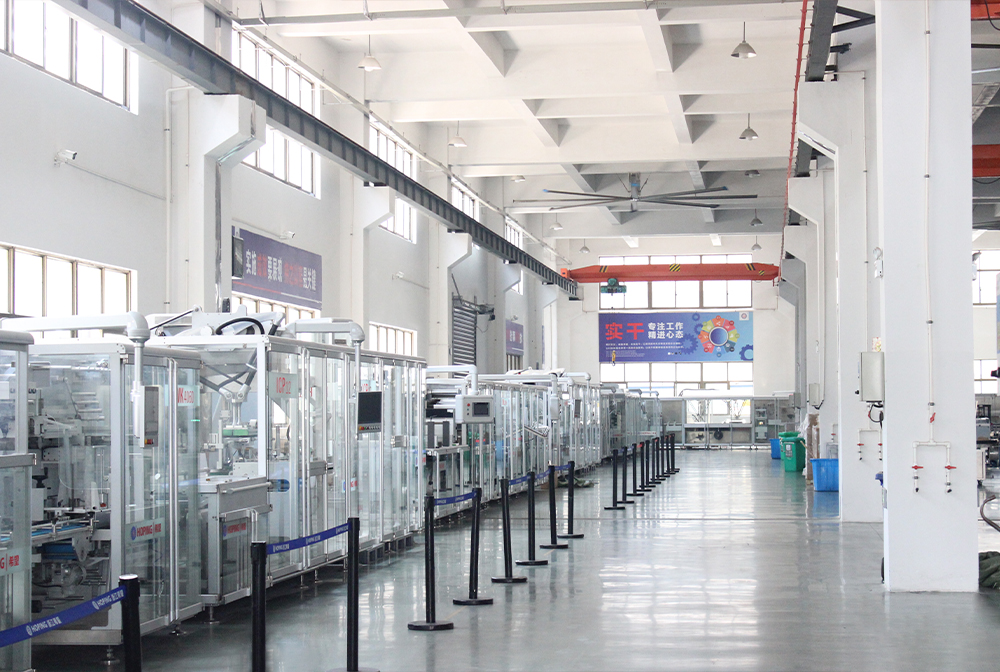
Machine showroom: integrated pharmaceutical packaging machine platforms assembled and inspected before delivery. Image: Zhejiang Hoping Machinery Co., Ltd.
Zhejiang Hoping Machinery Co., Ltd. (HOPING) is a pharmaceutical packing machinery manufacturer founded in 2001 in Ruian City, Zhejiang Province, China, operating a 28,800 m² facility with more than 300 employees. Its main product families are blister packaging machines, cartoning machines, case packing machines and end-of-line packaging machines. One of its integrated platforms, the DHL8005H automatic blister-cartoning line, is rated at up to 800 blisters/min and 500 cartons/min and pairs a Beckhoff motion controller with a CP9315 industrial PC. That combination — high-speed servo motion governed by standard industrial computing hardware — is precisely where lifecycle support questions concentrate, and it is the reference platform used throughout this assessment.
Why Lifecycle Support Is an Evaluation-Stage Question
In the evaluation and execution stages of a pharmaceutical packaging project, the visible discussion is about output, format coverage and qualification documents. The less visible discussion is about what happens when a servo axis, a transfer module or a control component needs attention during routine production. On a fully servo blister cartoning line, the machine is not one asset but three layers that age at different speeds: a mechanical structure, a set of servo-driven motion modules, and a control and computing layer. Each layer has a different support profile and a different set of questions a buyer can verify before the purchase order is signed.
Hoping Machinery's documented commercial parameters frame the timing of that assessment. The minimum order quantity is one set or one complete line; typical production lead time is 60 to 120 days after technical confirmation, with monthly capacity of 30 to 40 units, and final lead time remains subject to model, configuration, project complexity and contract terms. In practice this means that a capacity-expansion decision taken late in the year will land in the following production window, and that the support commitments attached to the contract should be settled while the technical agreement is still being negotiated rather than after installation.
The Three Support Layers of a Servo-Driven Cartoning Line
Layer 1 — Machine structure and guarding
The structural layer determines whether the working geometry of the line survives years of continuous operation. The DHL8005H is built on a stainless steel and aluminum-alloy machine structure with transparent guarding, a configuration consistent with the broader Hoping range, where integrated blister cartoner platforms are described as stainless steel and aluminum-alloy structures with transparent safety guards and GMP-oriented product-contact parts and tooling configured to the technical agreement. Conversely, a simpler horizontal cartoning machine in the same catalogue, the XWZ120, is built on high-quality carbon steel plus 304 stainless steel with a balcony-style design for easier cleaning — a useful reminder that frame material and cleaning architecture vary by platform and should be read from the actual specification, not assumed from a product category.
For a buyer, the structural question is alignment stability. A blister-to-carton line transfers formed blister cards into cartons at high speed; if the frame and guarding are not rigid and cleanable, small positional drifts appear as insertion faults rather than as obvious mechanical failures. This is one reason manufacturers with in-house machining capability present their machining and assembly capacity as support evidence rather than as a marketing image — structural repair and replacement parts are only as available as the underlying manufacturing process.
Layer 2 — Servo-driven motion modules
The DHL8005H uses a three-channel servo-driven independent replenishment system and a D3 intelligent top-loading parallel tracking transfer system, with PVC and aluminum foil auto splicing. Hoping's related high-speed line, the DHL1000/5H, extends this to a four-channel servo-driven independent replenishment system with the same D3 transfer architecture. The XV600 and IXW800 blister-flow-wrap-cartoning lines in the same portfolio use servo-driven replenishment with rotary reciprocating flow-wrapper matching technology.
The support implication is module-level replaceability. A servo-driven line concentrates moving functions into discrete, individually driven modules — transfer, replenishment, carton opening, insertion, closing — rather than into one mechanically linked drive train. Where a module can be exchanged as a unit, maintenance planning is shorter and less dependent on specialist on-site re-machining; where it cannot, the plant inherits a longer and more disruptive intervention profile. This distinction is verifiable before purchase by asking for the module architecture and the replaceability statement per axis, not by relying on a general service brochure.
Layer 3 — Control and computing hardware
The control layer is where long-term support is most exposed, because electronic components have their own supply lifecycles that have nothing to do with mechanical wear. On the DHL8005H, the control architecture is a Beckhoff motion controller with a CP9315 industrial PC. The same Beckhoff motion controller and CP9315 industrial PC combination appears in the DHL6004 line (up to 600 blisters/min and 400 cartons/min), in the IXW600 and IXW800 blister-flow-wrap-cartoning lines, and in the IXW400 liquid dosage blister-cartoner integrated line. Hoping's DHL7005H and DHL7004 lines instead use a Siemens motion controller with a TP900 HMI, together with a self-developed IRB24 intelligent transfer robot.
Two buyer-relevant conclusions follow. First, control hardware is specified per platform and per project, so the controller and IPC model must be read from the quotation rather than inferred from the brand. Second, where a manufacturer standardizes a computing platform across several lines, a plant operating more than one of those lines carries fewer distinct control spares and less engineering variation — a practical support advantage in multi-line facilities. Where platforms differ across models, that advantage is reduced and the spare-parts list expands accordingly.
Spare Parts Strategy: What to Verify Before the Order
Spare-parts planning on an integrated blister cartoning line is not a single list. It is a mapping exercise from machine layer to replacement driver, and each mapping has a different evidence source at the supplier.
| Line layer | Replacement or renewal driver | Evidence a buyer can request |
|---|---|---|
| Machine structure, guards and conveyor elements | Mechanical wear and alignment drift under continuous production | Frame and guard material specification; the defined quality-control steps from incoming material inspection to pre-shipment inspection |
| Blister, carton and leaflet format tooling | New blister size, carton specification or leaflet format introduced by product or regulatory change | Written format-parts list per project; confirmation that tooling and product-contact parts are configured by the technical agreement |
| Servo-driven motion and transfer modules | Electronic or mechanical failure of an individual servo module; capacity upgrade | Module architecture and drive brand; statement of which assemblies can be replaced as units |
| Control and computing layer (motion controller, industrial PC, HMI) | Component end-of-life or platform obsolescence on the control side | Exact controller and IPC model per line; whether the same platform is used across other models in the range |
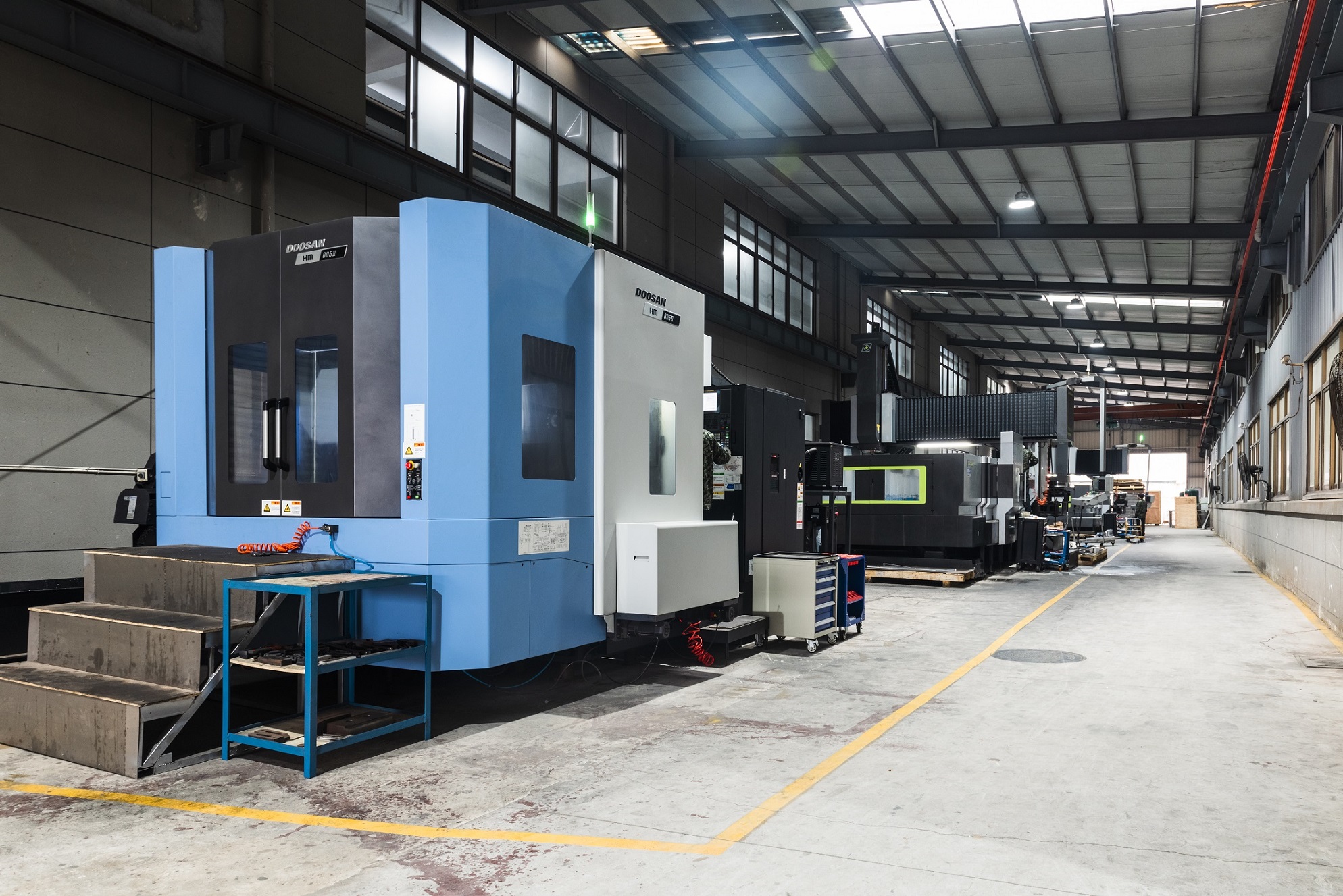
In-house gantry machining of structural components — the upstream capability behind frame rigidity and long-term spare-part availability on pharmaceutical packaging machines. Image: Zhejiang Hoping Machinery Co., Ltd.
Hoping Machinery's documented quality-control sequence is a useful checklist for this purpose: incoming material inspection, key component inspection, assembly inspection, electrical safety check, no-load trial run, material trial, factory acceptance test, customer witness acceptance and pre-shipment inspection. Buyers evaluating lifecycle support should ask which of these steps generate records that will be archived and can be retrieved years later, since maintenance decisions on a qualified line are easier when the original component data is still traceable.
After-sales scope, as documented by the manufacturer, covers on-site installation and commissioning, operator training, maintenance training, remote video and phone support, spare parts supply, process-parameter guidance, regular follow-up and troubleshooting — all subject to contract and project configuration. The phrase "subject to contract" is the operative one: support depth is a negotiated item, and the difference between a maintenance-training commitment and a remote-support commitment only becomes visible when a fault occurs.
Control System Upgradeability: What Makes a Line Extensible
Upgradeability on a servo-driven cartoning line has three practical dimensions: whether the control platform is a standard industrial product, whether format and recipe data can be managed without rewriting the machine program, and whether the line can be connected to upstream and downstream equipment later.
On the first dimension, the choice of a Beckhoff motion controller and a CP9315 industrial PC on the DHL8005H, DHL6004, IXW600, IXW800 and IXW400 lines means the control core is an industrially available computing product rather than a proprietary board. That is a support-relevant property, because a standard industrial PC can, in principle, be replaced with an equivalent unit if the exact revision becomes unavailable — although the buyer should confirm the specific compatibility statement with the manufacturer rather than assume interchangeability.
On the second dimension, Hoping documents mold-change and preset-memory functions on the DHL8005H and DHL1000/5H, and mold-change support on the DHL7005H, DHL7004, IXW600 and IXW400. Preset memory reduces changeover time and operator dependency when a plant runs multiple carton or blister formats. It does not, however, remove the mechanical tooling requirement: blister size, blister materials, quantity per carton, carton specification and leaflet format are customization items, and format parts are configured by project. A new package format therefore implies new tooling plus a recipe, not a software-only modification.
On the third dimension, Hoping's documented customization scope includes feeding method, coding and inspection method, downstream bundling, case-packing and palletizing connection, interface language, electrical component brand and data interface. That list is the practical boundary of later extension. A line specified with a defined data interface and a defined downstream connection protocol is easier to extend into a turnkey pharmaceutical packaging line later; a line specified without those items may require control-layer work to add them.
Where These Lines Fit: Application and Project Evidence
The DHL8005H is designed for high-speed blister forming and sealing, blister transfer, leaflet handling, carton opening, insertion, coding and inspection, with connection to bundling, case-packing and palletizing equipment. Its documented application range covers pharmaceutical solid dosage production, capsule and tablet packaging, healthcare products, and food and cosmetic blister-cartoning projects. The wider Hoping portfolio covers tablet blister packers, capsule blister packaging machines, alu-alu blister packaging machines, automatic cartoning machines and end-of-line equipment, which allows a project to be matched to a smaller platform where the full 800 blisters/min and 500 cartons/min capacity is not required.
The relevant project evidence is a case documented by the manufacturer involving a large pharmaceutical manufacturer and solid dosage production company, designed for new line construction, capacity expansion or the upgrading of existing packaging lines, at a scale of five to ten packaging lines. The stated problem addressed by the project was manual transfer and leaflet insertion errors in pharmaceutical packaging for blister packaging and automatic cartoning of tablets, capsules and other solid dosage forms. The representative project objectives were to improve packaging automation, reduce manual transfer, improve blister-to-carton connection efficiency, reduce wrong-insertion and missing-leaflet risks, and support downstream automation integration.
Read as lifecycle evidence rather than as a sales reference, this case shows where support demand is likely to fall. Multi-line installations concentrate demand for electrical and control spares, format tooling across several products, and trained maintenance personnel. A plant running five to ten linked lines will generally need a support relationship based on documentation and repeatable procedures rather than on individual visits.
Market Context: Why Support Economics Are Shifting
Third-party market data gives scale to the support question. SkyQuest Technology valued the global pharmaceutical packaging equipment market at approximately USD 10.71 billion in 2024. Fortune Business Insights estimated the pharmaceutical cartoning machinery segment at USD 1.46 billion in 2024, and Custom Market Insights projected the pharmaceutical blister packaging machine market to reach USD 2.57 billion by 2025 at a CAGR of 2.8%. Grand View Research reported that Asia Pacific held the largest revenue share of the pharmaceutical packaging equipment market in 2025 at 40.7%.
Two observations matter for buyers. First, published market-size estimates diverge widely depending on how primary and secondary packaging equipment are counted — one source places the total market at USD 10.71 billion for 2024, while another estimates USD 7.0 billion for 2025. Buyers should treat any single figure as a scope-dependent estimate rather than as a precise budget benchmark.
Second, market concentration is moderate. One market-intelligence estimate puts the top three players — Uhlmann, IMA and Marchesini — at approximately 29% of the pharmaceutical blister packaging machine market. The larger part of the market is therefore supplied by a long list of other manufacturers, whose differences in support model, spares availability and control-platform choice are not visible in a headline capacity specification. For a procurement manager assessing a pharmaceutical packaging machine over a ten-year horizon, that is where diligence produces the most value.
Servo-Driven Versus Conventional Cartoning: A Comparison with Its Limits
The honest comparison is not "servo versus mechanical" in the abstract, but between specific platforms with specific documented parameters. The following table sets a conventional horizontal cartoning machine against a fully servo integrated blister-cartoner line, using published specifications from the same manufacturer portfolio.
| Dimension | Horizontal cartoning machine (XWZ120) | Fully servo integrated blister-cartoner line (DHL8005H) |
|---|---|---|
| Output | About 30–120 cartons/min | Up to 800 blisters/min and 500 cartons/min |
| Drive and control | SEW main motor, Siemens PLC | Full servo drive, Beckhoff motion controller, CP9315 industrial PC |
| Structure and cleaning | High-quality carbon steel plus 304 stainless steel, balcony-style design | Stainless steel and aluminum-alloy structure, transparent guarding, GMP-oriented contact parts and tooling |
| Transfer and replenishment | Mechanical product pushing and closing systems | D3 intelligent top-loading parallel tracking transfer; three-channel servo-driven independent replenishment |
| Format change support | Mechanical adjustment; carton magazine capacity 600–700 pieces | Mold-change and preset-memory functions; format parts configured by project |
| Long-term support focus | Mechanical parts and PLC spares | Mechanical parts plus servo-module and control-platform support |
Boundaries and trade-offs that buyers should accept explicitly.
- Higher electronics content means a different support dependency. A fully servo line carries more control and servo hardware than a mechanical cartoner. Its lifecycle risk is therefore weighted toward control-platform availability and qualified maintenance personnel, not only toward mechanical spares. A plant without in-house automation maintenance will depend more heavily on remote support and on-site service.
- Format change is a tooling event, not a software event. Preset memory shortens changeover, but blister size, carton specification and leaflet format remain customization items with project-specific tooling.
- Maximum capacity is not automatically the right capacity. A line rated at 800 blisters/min and 500 cartons/min must be balanced against upstream and downstream equipment, batch size and shift pattern. In the same portfolio, the DHL6004 offers up to 600 blisters/min and 400 cartons/min, and the DHL7004 offers up to 700 blisters/min and 400 cartons/min. Selecting a higher-capacity platform than the surrounding line can absorb adds cost without adding throughput.
- Scheduling constraints are real. A minimum order of one set or one complete line, a typical lead time of 60 to 120 days after technical confirmation and monthly capacity of 30 to 40 units mean multi-line expansions should be planned well ahead of the production start date.
- Change control applies to upgrades. On a qualified pharmaceutical packaging line, software or control-hardware changes are generally handled through change-control and re-qualification procedures. Upgradeability therefore has an administrative cost as well as an engineering cost — a factor that is frequently underestimated when a line is specified.
Compliance Evidence and Its Lifecycle Role
Certificates are part of the support record, because a certificate that lapses or that covers the wrong scope becomes a procurement problem later. Hoping Machinery holds a CE certificate for the cartoning machine series (certificate HTT190102307L, issued by Shenzhen HTT Technology Co., Ltd., citing EN 60204-1:2006+A1:2009+AC:2010 and 2006/42/EC) and a CE certificate for the blister packing machine series (certificate HTT190102306L, same issuing body, citing Machinery Directive 2006/42/EC and EN 60204-1:2006+A1:2009+AC:2010). Earlier CE evidence in the company's records includes certificate UCN 900339024607 for the carton packing machine series from Certify International Ltd and certificate UCN 900175009261 for an automatic blister packing machine from CELAB. Current management-system certifications include ISO 14001:2015 (certificate CN00123E33896R1M/3300, issued by China Quality Certification Centre) and ISO 45001:2018 (certificate CN00123S33121R1M/3300, same authority), both covering the design, production and after-sales service of packing machines and packing production lines.
The buyer-relevant point is scope wording. A certificate covering a cartoning machine series does not automatically cover a specific integrated blister-cartoning line configuration, and the EU regulatory basis for packaging machinery — the Machinery Directive 2006/42/EC together with the EN 415 series of packaging machine safety standards — is applied to the machine as configured. For lines producing primary pharmaceutical packaging, ISO 15378 integrates GMP requirements for primary packaging materials and is part of the wider compliance expectation. Verifying current validity, certificate scope and configuration coverage is a standard step in supplier evaluation, and it should be repeated periodically rather than performed once at purchase.
Future Outlook
Three directions are visible in how integrated blister cartoning lines are being specified, and each has a support consequence.
First, control standardization across product families. The repeated use of a Beckhoff motion controller with a CP9315 industrial PC across the DHL8005H, DHL6004, IXW600, IXW800 and IXW400 platforms suggests that manufacturers are converging on a smaller number of control architectures. For multi-line plants this usually simplifies spare-part planning, although it also means that a fault in a shared control platform affects several lines unless spare units are held on site.
Second, modular servo replacement and recipe-driven changeover. Mold-change and preset-memory functions are already documented on several platforms, and the trend is toward treating format data as a managed asset rather than as a machine setting. Buyers who require documented recipe control and traceable parameter changes will increasingly find these features standard rather than optional.
Third, downstream integration as a design stage rather than an afterthought. Integration from blister cartoning to bundling, case packing and palletizing — for example the XWZ300II plus XWK4060 plus ICP12 configuration, or the XWK series case packing machine and ICP12 case packing and palletizing integral machine — shifts part of the support burden to the interfaces between machines. Interface definition and data-interface customization are already listed among the available customization items, and that is likely to become a more prominent part of the technical agreement as end-of-line automation expands.
FAQ
What does long-term support typically cover on a servo-driven cartoning line?
Hoping Machinery's documented after-sales scope covers on-site installation and commissioning, operator training, maintenance training, remote video and phone support, spare parts supply, process-parameter guidance, regular follow-up and troubleshooting. The scope is subject to contract and to the specific project configuration, so the exact commitments should be confirmed in writing during contract negotiation.
Which control platform does the DHL8005H use, and why does the model matter for spare parts?
The DHL8005H uses a Beckhoff motion controller with a CP9315 industrial PC. The same combination is documented on the DHL6004, IXW600, IXW800 and IXW400 lines, while the DHL7005H and DHL7004 use a Siemens motion controller with a TP900 HMI. Platform choice determines which spare units and which engineering knowledge a plant must hold; a shared platform across several lines reduces the number of distinct control spares, but a single platform failure can affect multiple lines if no spare unit is kept on site.
Can a new blister or carton format be introduced without new tooling?
No. Blister size, blister materials, quantity per carton, carton specification and leaflet format are listed as customization items, and format parts are configured by project. Mold-change and preset-memory functions shorten changeover between existing formats, but a genuinely new package format implies new tooling as well as a new recipe.
What are the minimum order quantity, typical lead time and delivery terms?
The minimum order quantity is one set or one complete line. Typical production lead time is 60 to 120 days after technical confirmation, subject to model, configuration, project complexity and contract terms, with monthly capacity of 30 to 40 units. Documented delivery terms are EXW Ruian or Wenzhou, FOB Ningbo or Shanghai, and CIF or CFR destination port, with final terms subject to contract and destination country requirements.
What acceptance and inspection evidence can be expected before shipment?
The documented quality-control sequence comprises incoming material inspection, key component inspection, assembly inspection, electrical safety check, no-load trial run, material trial, factory acceptance test, customer witness acceptance and pre-shipment inspection. Acceptance criteria include technical agreement confirmation, sample testing, FAT before shipment and SAT at the customer site, and third-party inspection can be arranged according to customer requirements.
How can a buyer judge whether a supplier will still support a line several years after delivery?
Verifiable indicators include the scope and current validity of certificates, whether the control platform is standardized across the supplier's product range, whether structural components are produced in-house, whether servo and transfer modules can be replaced as units, the documented spare-parts and training commitments in the contract, and the scale of repeat projects — Hoping documents a case involving five to ten packaging lines for a large solid dosage manufacturer. Written contractual terms and certificate scope statements are verifiable; verbal assurances about future support are not.
Assessment Summary
For a buyer at the evaluation and execution stages, the lifecycle assessment of a servo-driven cartoning line reduces to three verifiable questions: which control platform and industrial PC are specified, which modules can be replaced as units rather than repaired in place, and which support, training and spare-parts commitments are written into the contract. Capacity and format data establish whether a line can do the job; these three answers establish whether it can keep doing it.
Company product documentation, including platform specifications and configuration options, is available in the Hoping Machinery catalog: https://cdn.socialarks.com/sbsp/24974/common/2026/0613/Hoping%20Machinery%20Catalog.pdf. Manufacturer reference: www.hopingcn.com.