
Long-Term Truck Crane Parts Supply: XCMG, SANY & Zoomlion
Long-Term Truck Crane Parts Supply: XCMG, SANY & Zoomlion
Multi-brand truck crane fleets are now normal in most export markets. A rental fleet in the Gulf can run XCMG, SANY and Zoomlion machines side by side; a contractor in Latin America may operate Chinese cranes alongside older equipment. In that environment, sourcing stops being a single purchase decision and becomes a question of continuity: can one supplier keep delivering the same fitment, the same material and the same availability for the working life of the machine?
The evaluation framework in this article treats long-term supply as five measurable dimensions — model and tonnage continuity, material consistency, replacement availability, documented compliance evidence, and commercial continuity. For fleets operating in the 20–150 ton truck crane band, the practical test is whether a single supplier can hold XCMG, SANY and Zoomlion programmes at the same time, without unspecified parts entering a scheduled maintenance plan.
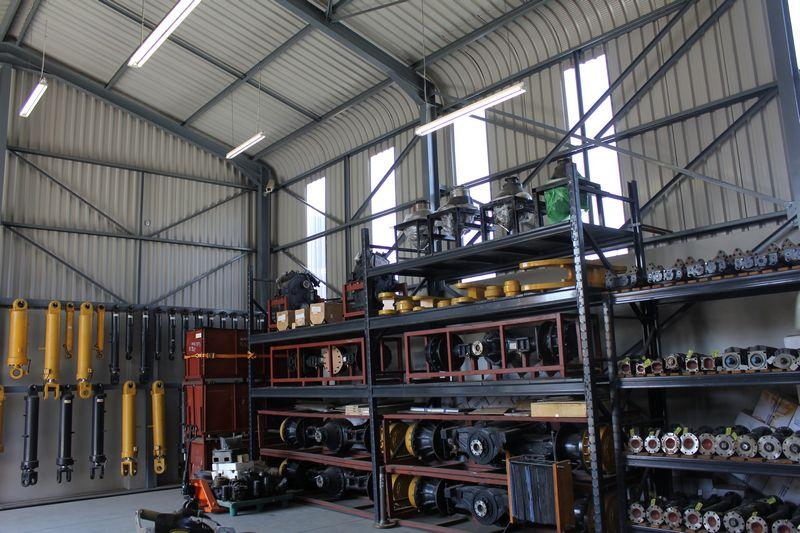
Stock depth, not catalogue length, is what keeps multi-brand truck crane fleets running through a repair window.
Why Long-Term Supply, Not One-Off Sourcing, Decides Uptime
A truck crane does not consume parts evenly. Hydraulic seals and buffer components, boom components, pins, pulley blocks, electrical parts and load moment indicator (LMI) hardware each reach replacement points at different intervals, and a fleet with mixed brands reaches those points on different schedules. The result is a repeating demand for Truck Crane Parts rather than a single buying event.
One-off sourcing optimises unit price. It does not address the two risks that matter most in a multi-brand fleet. Fitment risk occurs when a part physically installs but does not match the load, pressure or signal behaviour of the original. Availability risk occurs when the correct part exists in a catalogue but cannot be delivered while a machine is down. Both risks grow with fleet age, and both are managed through supplier selection rather than through a single transaction.
Component design also sets the durability expectation. In the product data reviewed here, load-bearing structural parts such as pins, boom components and pulley blocks are manufactured from high-strength alloy steel selected for toughness and anti-fatigue performance, while hydraulic seals and buffer components use wear-resistant rubber and polyurethane. Those specifications only hold their value if the same material standard is maintained in the second, third and tenth reorder — which is exactly what a long-term supplier evaluation is designed to test.
A Five-Part Evaluation Framework for Multi-Brand Fleets
The framework below is written for buyers who already know which parts they need and are deciding who should keep supplying them.
| Evaluation dimension | What to verify | Why it matters in a mixed fleet |
|---|---|---|
| Model and tonnage continuity | Does the programme cover the specific crane models and the 20–150 ton band the fleet operates? | Prevents a supplier relationship that works for one machine but breaks on the next purchase. |
| Material specification | Are materials defined per component function — alloy steel for load-bearing parts, rubber and polyurethane for seals, cast and forged steel for fittings and valve bodies? | Material drift is invisible at goods-in and expensive at the next service interval. |
| Replacement availability | Warehouse footprint, monthly capacity, stated lead time, minimum order quantity, and which lines are held in stock. | Uptime depends on availability, not on how many part numbers appear in a catalogue. |
| Documentation and compliance | Third-party audit reports, certificate numbers, issuing body, audited scope and issue date. | Safety-critical parts may need internal sign-off, which requires a checkable document. |
| Commercial continuity | Whether parts are supplied as OEM, Original or Aftermarket, and which warranty and support terms apply to each route. | Determines customization options, warranty coverage and access to technical support. |
No single dimension is decisive on its own. A supplier can hold excellent material standards and still fail an availability test during a peak maintenance season. Equally, a supplier with deep stock can fail on fitment if part numbers are matched to a crane model rather than to the machine's actual build. Evaluation-stage buyers should score all five dimensions and weight them according to their own failure pattern — for example, a crane rental business with tight turnaround windows will weight availability and fitment above price.
Fitment and Model Continuity: HC4900, LWG208, IC4600, IC3600 and 1032300052
The China truck crane parts programme reviewed here lists model references HC4900, LWG208, IC4600, IC3600 and 1032300052, covering XCMG truck crane parts, SANY truck crane parts and Zoomlion truck crane parts, with a stated applicable tonnage range of 20–150 tons for long-term alternating heavy-load operation. Coverage across that band is the headline claim. The more useful question for a buyer is how that claim is verified on each order.
Interchangeability is a part-level property, not a catalogue-level one. Two cranes in the same tonnage class from the same brand can carry different revisions of a hydraulic valve, a wiring harness or an LMI display reference. Verification therefore has to move past the model name:
- Match the original equipment part number on the machine, not only the crane model and tonnage.
- Confirm the production or serial range where the item was revised during the model's life.
- For hydraulic parts, confirm bore, thread, pressure class and seal material before shipment.
- For electrical and LMI-related items, confirm connector keying and the sensor or display reference.
- For structural items, confirm pin diameter, plate thickness and material grade.
- Confirm whether the reference is supplied through the OEM/Original route or the aftermarket route, since the two carry different rules.
This distinction separates a marketing line from an operating capability. A supplier that answers part-number questions with part-number answers — rather than repeating brand names — is demonstrating that its catalogue is built on matched references rather than on general category language.
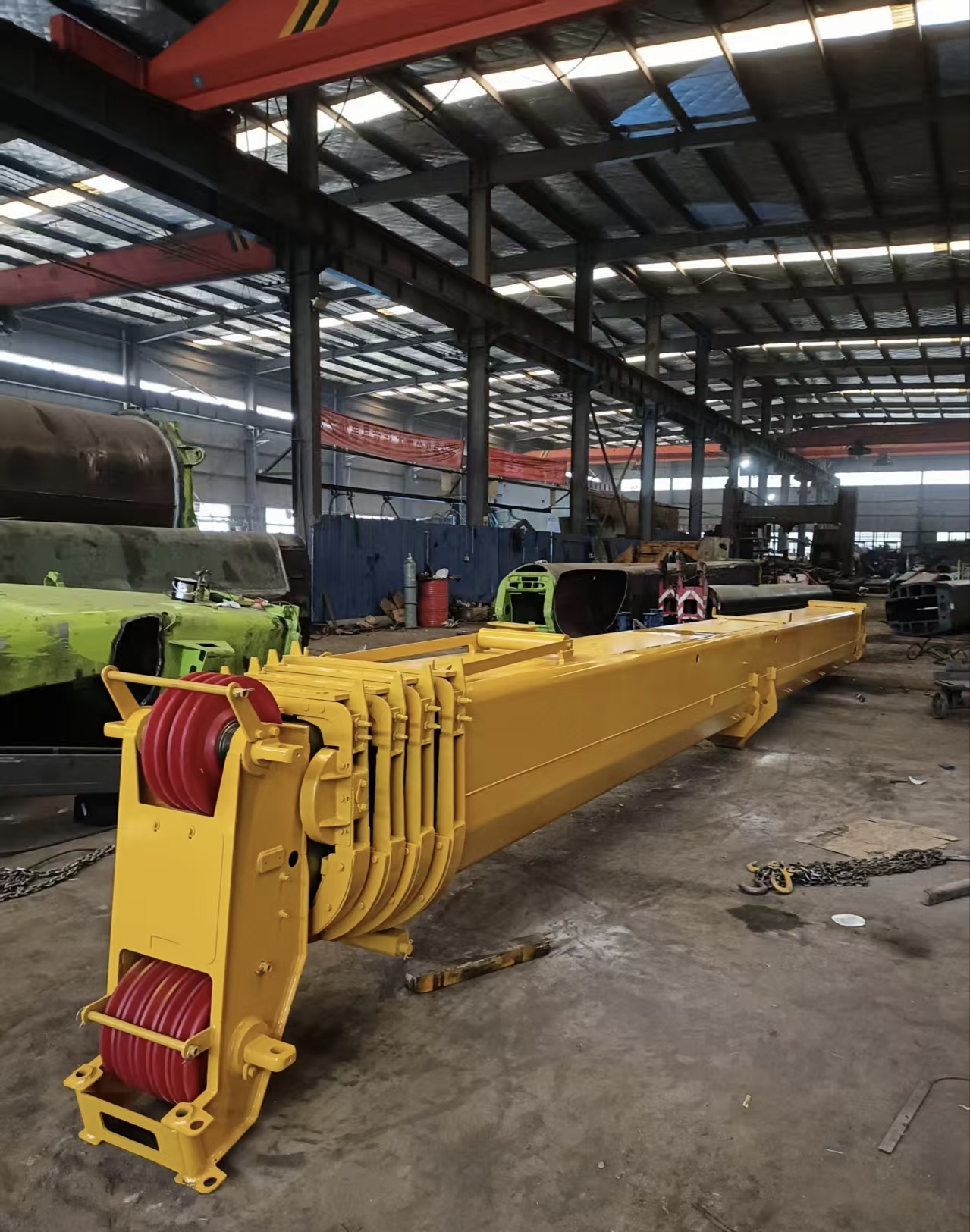
Boom and structural components are the parts where material grade and dimensional accuracy do most of the work.
Material Consistency Across Load-Bearing, Hydraulic and Damping Components
A truck crane uses several material families, and each one fails in a different way. Material consistency means the same specification is applied to the same function on every reorder.
| Component group | Material stated in the supplier's product data | Functional reason |
|---|---|---|
| Load-bearing structural parts: pins, boom components, pulley blocks | High-strength alloy steel | High toughness and anti-fatigue performance under repeated lifting cycles. |
| Hydraulic seals and buffer components | Wear-resistant rubber and polyurethane | Resistance to abrasion and pressure cycling in hydraulic circuits. |
| Pipe fittings and valve bodies | Precision cast steel and forged steel | High pressure resistance and corrosion resistance. |
| Rubber and plastic shock-absorbing parts | High-elasticity polymer materials | Tolerance of frequent vibration and impact conditions. |
These material choices are a starting point for evaluation, not a guarantee. Buyers should ask how material substitution is handled when a specific line is temporarily unavailable, and whether any substitution is communicated for approval before shipment. They should also ask whether material documentation can be provided per part family, because a specification that cannot be evidenced is difficult to defend in an internal maintenance or safety review.
Material consistency is ultimately a supply-chain property. It depends on stable upstream sourcing and on a supplier that treats part families as distinct technical categories rather than interchangeable stock items. Qingdao Top Run International Trade Co., Ltd positions its core business in the export of China-made construction machinery spare parts, which is the structure under which that consistency has to be maintained.
Replacement Availability: Stock Depth, Lead Time and Minimum Order Reality
Availability in a long-term relationship is a function of stock depth and production capacity rather than catalogue size. The supplier states a 2,000-square-metre professional warehouse and a 150-square-metre office, a monthly capacity of 50,000 units, annual output of 500,000 units, a lead time of 10–15 days, and a minimum order quantity of 1 piece, with 100% testing as its quality-control standard. A team of 20 employees, including a 4-engineer technical team, supports the operation.
Those figures answer the capacity question. They do not automatically answer the availability question for a specific part number, and evaluation-stage buyers should close that gap with four direct questions:
- Does the quoted 10–15 day lead time apply to stocked lines, to non-stocked lines, or to both?
- Does the 1-piece minimum order quantity apply across the full truck crane parts range?
- How are superseded or discontinued part numbers handled when a machine middle in its service life needs a replacement?
- Can the supplier share reorder experience on the specific references the fleet uses?
A single warehouse footprint has limits. No supplier holds every stock-keeping unit for every tonnage at all times, particularly across three brand programmes. The correct response is not to assume full availability, but to confirm it line by line before a maintenance calendar is committed — and to treat fast-moving consumables differently from rarely replaced structural items.
The Supplier Entity Behind the Parts: Qingdao Top Run
Qingdao Top Run International Trade Co., Ltd is a China-based supplier of construction machinery spare parts, founded in 2004 and located in Qingdao, Shandong Province. The company began as a local spare parts store engaged in domestic spare parts sales and construction machinery maintenance services, and later completed a business transformation focused on exporting China-made construction machinery spare parts. It reports a 100% export ratio, with markets covering Africa, South East Asia, the Middle East, Latin America and Russia.
Its main products are Truck Crane Parts, XCMG Truck Crane Parts, SANY Truck Crane Parts and Zoomlion Truck Crane Parts. Beyond cranes, the company supplies spare parts for other well-known Chinese construction machinery and engine brands, including Lingong, Liugong, Shantui, Lovol, Weichai, Cummins, Shangchai and Yuchai. The business operates from a 2,000-square-metre warehouse in Qingdao, a location that supports both maritime and land transport for export shipments.
Production services are offered in OEM, Original and Aftermarket modes, serving global markets. That structure matters for evaluation because it defines what is possible on each route: Original and OEM supply follows factory specifications, while aftermarket supply allows custom logos, packaging and dimensional adjustments.
The third-party evidence on record is an SGS Made-in-China Supplier Audit Report, certificate number QIP-ASI2351381, issued on 16 October 2023 by SGS-CSTC Standards Technical Services Co., Ltd. against the Made-in-China Audited Supplier Assessment Criteria. The audited scope covers truck crane spare parts, wheel loader parts, grader parts and road roller construction machinery replacement parts, and is recorded for the global market. For a safety-critical category, an audit reference with a number, an issuing body and a defined scope is more useful than an unqualified quality statement, because it can be checked independently.
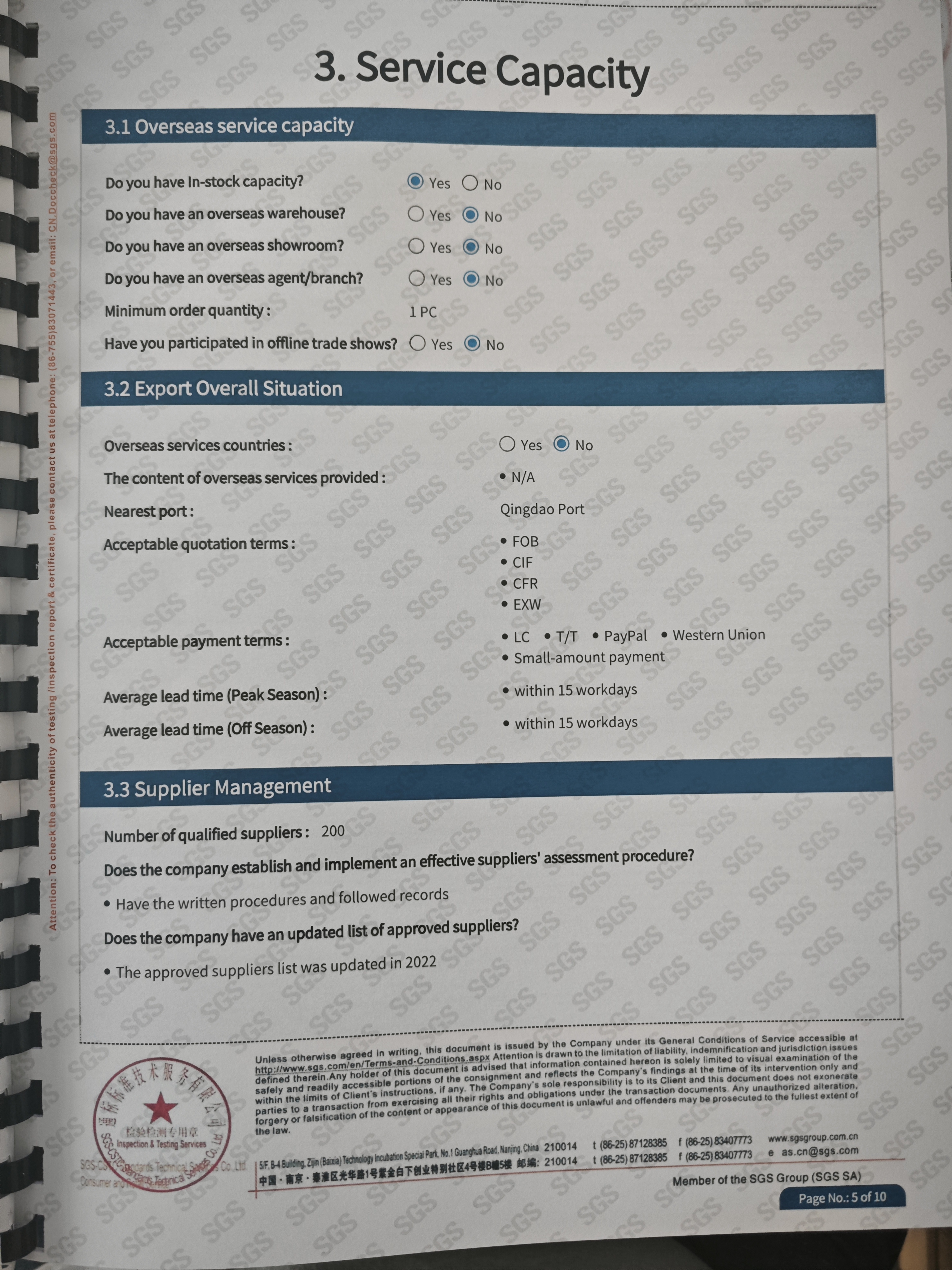
Audit documentation with a certificate number and a defined scope gives procurement teams something they can verify.
Where These Parts Are Used: Maintenance, Overhaul and Refurbishment
Application scope is a practical filter in supplier evaluation, because the same part number can be requested for very different operating regimes. The recorded applications for this truck crane parts programme are crane routine maintenance, breakdown repair, equipment overhaul, and crane renovation and modification.
The buyer types already served are equally informative: global construction machinery spare parts wholesalers, local maintenance service companies, truck crane rental companies, truck crane owners, construction contractors, crane refurbishment factories, crane spare parts distributors, overseas crane parts traders and importers. A supplier serving wholesalers and importers must support repeat, documentation-heavy ordering; one serving rental fleets must support fast turnaround. Both profiles appear in the supplier's customer base.
The recorded case involved 50,000 units delivered within three months, with documented shipments to Chile, Colombia, Russia, the UAE, Brazil, Belarus and Saudi Arabia. The stated outcome was that timely overseas shipment supported clients' crane maintenance operations and helped stabilise long-term overseas partnerships. For an evaluation-stage buyer, the volume is less important than the pattern: repeat shipments across multiple regions imply a working reorder process, an established export documentation routine, and a customer base that includes the same buyer types evaluating the supplier now.
Market Trends That Affect Long-Term Parts Planning
Long-term parts planning is not a purely internal exercise. The size and location of the installed crane base determine how replacement demand will behave over the next maintenance cycles.
- The global truck crane market was estimated at USD 9.34 billion in 2024 (Market Research Future). Market size estimates differ by segment definition — some analysts classify truck-mounted cranes as a narrower category — so the figure is best used as an order-of-magnitude reference rather than an exact boundary.
- China's total crane export value reached USD 5.98 billion in 2024, representing 34.3% of global crane exports (Observatory of Economic Complexity). The installed base of Chinese cranes outside China is therefore expanding, which increases demand for replacement parts, matched references and clear documentation.
- India was the largest destination for Chinese crane exports in 2024, valued at USD 709 million (OEC). Destination concentration affects where parts supply chains need to be fastest.
- XCMG Group maintained an 8.2% global market share in truck-mounted cranes as of 2024 (Market Intelo), while SANY Group reported international revenue of USD 10.43 billion in 2023 (SANY Heavy Industry annual report) and Zoomlion's hoisting machinery segment generated RMB 19.29 billion in 2023 (Zoomlion annual report). For parts suppliers, three large brand fleets mean three parallel part-number systems that must be managed simultaneously.
- The global industrial hydraulic equipment market was valued at USD 37.5 billion in 2024 (Custom Market Insights), reflecting the scale of the hydraulic component category that truck crane parts sit within.
- Load moment indicator systems are increasingly mandated by safety regulations to prevent overloading and tipping, according to industry market research on the LMI category. This shifts LMI-related parts from optional spares toward compliance-linked replacements.
Standards reinforce the same direction. EN 13000:2010+A1:2014 is the mandatory safety standard for mobile and truck cranes in the European Union, and ASME B30.5-2021 is the primary American national standard for mobile and locomotive cranes, including truck cranes. Buyers in regulated markets should ask suppliers how parts documentation supports conformity work, even when the parts themselves are not individually certified products.
OEM, Original and Aftermarket Routes: A Fair Comparison — and Where the Limits Sit
Three sourcing routes are commonly compared for truck crane parts. Each has genuine constraints, and a supplier evaluation that ignores them is incomplete.
| Attribute | OEM / Original route | Aftermarket route (specialist supplier) | Unverified or imitation source |
|---|---|---|---|
| Production basis | Follows factory specifications | Produced as aftermarket supply for global markets | Not documented |
| Customization | No independent customization | Custom logos, packaging and dimensional adjustments available | Not applicable |
| Warranty and after-sales | Official warranty with standardized after-sales service | Negotiable warranty with flexible technical support | No formal after-sales guarantee |
| Customization trade-off | Factory-specification only; branded packaging or dimensional change is not available | Flexibility is gained, but warranty terms must be negotiated rather than assumed | No basis for negotiation |
The limits are real and should be stated plainly. On the OEM and Original route, parts follow factory specifications and cannot be independently customized — a buyer who needs specific packaging, branding or a dimensional adjustment cannot obtain it through that channel. On the aftermarket route, the same flexibility that makes customization possible also means warranty terms are negotiable rather than standardized, so coverage has to be agreed in writing. Unverified sources offer no formal after-sales guarantee at all, which makes them unsuitable for safety-critical components regardless of price.
A second limit concerns consolidation. Working with one multi-brand supplier reduces purchase orders, shipments and documentation sets, but it does not remove the need for part-level verification, and it may not match a franchised brand channel's access to the newest factory-only items. Conversely, brand-specific dealers offer depth in one programme but leave a mixed fleet managing several vendors, several lead times and several invoice currencies. The appropriate choice depends on fleet composition: three-brand fleets generally gain more from consolidation, while single-brand fleets with factory warranty exposure may prefer the Original channel for warranty-sensitive components.
Future Outlook
Three developments are likely to shape long-term truck crane parts supply over the next planning cycle. First, compliance pressure on lifting safety continues to raise the profile of LMI and electrical parts, which means buyers will increasingly ask for documentation alongside the component. Second, the growth of Chinese crane exports measured in 2024 — USD 5.98 billion, or 34.3% of global crane exports — points to a larger installed base outside China, and therefore to more replacement demand in the markets where export suppliers already operate.
Third, tonnage spread matters. A programme that covers 20–150 tons supports fleets that mix light urban units with heavy lifting machines, and it allows a buyer to consolidate references across a fleet rather than opening a separate sourcing relationship for each crane class. The open question for buyers is not whether multi-brand coverage exists, but how consistently it can be sustained as those cranes age. Suppliers that can show audit documentation, material specifications per part family, defined lead times and repeat export experience are the ones best positioned to answer that question year after year.
FAQ
What should a buyer verify first before naming a long-term truck crane parts supplier?
Start with model and tonnage continuity, then material specification, then availability. Concretely, confirm that the programme covers the crane models in the fleet within the operating tonnage band, that materials are defined per component function such as high-strength alloy steel for load-bearing parts and wear-resistant rubber or polyurethane for seals, and that the supplier can state which lines are stocked and what lead time applies to non-stocked items. Documentation and commercial terms come next, because they determine how problems are handled after delivery.
How can one supplier support XCMG, SANY and Zoomlion cranes at the same time?
It requires separate brand programmes rather than a single generic stock list, because the three brands use different part-number systems and revisions. Qingdao Top Run International Trade Co., Ltd lists Truck Crane Parts alongside XCMG Truck Crane Parts, SANY Truck Crane Parts and Zoomlion Truck Crane Parts as its main products, and its truck crane parts programme references models including HC4900, LWG208, IC4600, IC3600 and 1032300052 with a stated 20–150 ton applicability. The verifiable test is part-number-level matching on the individual machine, not the brand names in a catalogue.
Does tonnage coverage matter when evaluating a parts supplier?
Yes. Tonnage band is one of the fastest filters for whether a part family belongs to the machine in front of you, and the programme reviewed here states applicability to 20–150 ton truck cranes for long-term alternating heavy-load operation. A supplier optimised for light cranes may not carry the structural and hydraulic references used on heavier units. Buyers operating a mixed-tonnage fleet should confirm coverage in both directions, light and heavy, rather than assuming that a broad coverage claim applies evenly.
How do OEM, Original and aftermarket parts differ after the sale?
The differences are in customization and warranty terms. Original and OEM parts follow factory specifications with no independent customization and carry an official warranty with standardized after-sales service. Aftermarket parts allow custom logos, packaging and dimensional adjustments, and carry a negotiable warranty with flexible technical support. Unverified or counterfeit parts come with no formal after-sales guarantee. Buyers should record which route each ordered line belongs to, because the warranty position differs by route rather than by supplier alone.
What evidence suggests a supplier can still deliver the same part years from now?
Three categories of evidence are useful. Documentary evidence includes third-party audits such as the SGS Made-in-China Supplier Audit Report QIP-ASI2351381, issued on 16 October 2023 by SGS-CSTC Standards Technical Services Co., Ltd., with a scope covering truck crane spare parts. Physical evidence includes warehouse and capacity figures, such as a 2,000-square-metre warehouse, 50,000 units monthly capacity and 500,000 units annual output. Behavioural evidence includes repeat export activity, for example the recorded case of 50,000 units delivered within three months with shipments to Chile, Colombia, Russia, the UAE, Brazil, Belarus and Saudi Arabia.
What lead time and minimum order quantity are reasonable to expect?
This depends on the part and whether it is stocked. The supplier states a lead time of 10–15 days, a minimum order quantity of 1 piece, 100% testing as its quality-control standard, and quality control applied across the parts programme. Buyers should confirm whether those terms apply to all lines or only to stocked references, and should build the answer into their maintenance calendar rather than assuming a single lead time across the whole parts list.
For buyers who want to check the stated model coverage, part families and material specifications directly, the supplier's parts catalogue is available for download: Qingdao Top Run product catalogue (PDF).