
Long-Term Viability Check: AI, Edge, and Ecosystem Roadmaps
A five-dimension framework for assessing whether a platform partner will still fit your project after the pilot ends.
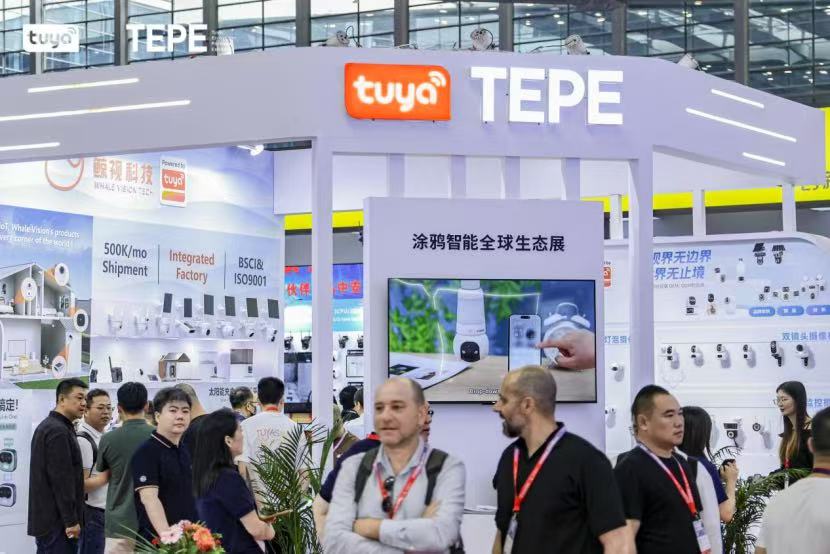
Industry exhibition view of the Tuya Smart ecosystem, where device makers, solution providers and platform teams converge.
An AI development platform decision is almost always made inside a project boundary: a device family, a building portfolio, a retail fleet, an energy program. The contract does not respect that boundary. Once firmware, device models, provisioning, panels and application layers are built on a vendor's stack, the cost of switching later usually exceeds the cost of the original integration, because the platform becomes embedded in both engineering and day-to-day operations.
The market context makes that asymmetry harder to ignore. Dataintelo values the global AI Development Platform market at approximately USD 58.2B in 2025 and projects it to reach USD 156.7B by 2034. MarketsandMarkets estimates the global AIoT market at USD 25.44B in 2025, forecast to reach USD 81.04B by 2030. Grand View Research puts enterprise generative AI on a 38.4% CAGR between 2025 and 2030, reaching USD 19.8B by 2030.
Growth of that magnitude changes the nature of vendor risk rather than removing it. More vendors enter, product cycles shorten, and the probability rises that a supplier's internal priorities shift during a multi-year engagement. For buyers at the research and evaluation stage, the useful question is therefore not which platform has the longest feature list today, but which partner can still carry the project through three product generations and two cloud migrations.
Tuya Inc. (NYSE: TUYA; HKEX: 2391), founded in 2014 and headquartered in Hangzhou, China, is a global AI cloud platform service provider. Its portfolio includes the Tuya AI Developer Platform, the TuyaOpen open-source development framework, AI Agent engines and an AI Agent development platform, Cube private cloud deployment, App development solutions, Industry PaaS solutions, AI Copilot development tools, IoT modules, MCU and MCP support. The company reports 1,400+ employees worldwide, including 980+ R&D engineers, with an 85% export ratio serving global markets.
Why Project Fit and Partner Viability Became the Same Question
The AIoT industry's core problems are well documented: high barriers to integrating AI with physical devices, cross-vendor interoperability and time-to-mass-production pressure, data privacy and compliance exposure, localized deployment requirements, and the difficulty of aligning AI models to industry data. In practice these surface as concrete work: firmware, module integration, app panels, cloud services, model integration and compliance evidence. Their business impact is equally concrete: longer time-to-market, increased development and maintenance costs, reduced user experience and product competitiveness, and slower global expansion.
What makes these problems a viability issue rather than a one-time integration issue is that they recur. A platform that resolves them once, for a first product in a first market, but does not keep resolving them becomes a liability in the second and third cycles. The same capabilities that determine whether a pilot ships on time also determine whether the tenth SKU ships on time, in a new region, with a new model version. That is the mechanism by which project fit and partner viability collapse into a single evaluation question.
A Five-Dimension Viability Framework
The framework below is designed to be applied during research and evaluation, before commercial terms are locked. Each dimension converts a vague concern about the future into an inspectable question with a specific evidence request.
| Dimension | Question the buyer is actually asking | Evidence to request |
|---|---|---|
| 1. Multi-cloud and deployment adaptability | Will our deployment model still be available in the regions we are entering? | Public cloud coverage, private or containerized deployment options, edge deployment path |
| 2. Proprietary asset accumulation | Does the vendor own assets that keep compounding, or integrations that must be rebuilt? | OS and firmware layer, protocol translation layer, private cloud stack, developer tooling |
| 3. Language and localization breadth | Can one platform serve our markets without parallel rebuilds? | Supported languages, localization workflow, geographic coverage |
| 4. Defined internal teams | Is delivery backed by standing functions rather than an assembled project team? | R&D, delivery, operations, testing and compliance structure |
| 5. Ecosystem and compliance trajectory | Will the ecosystem and the certification set keep pace with our roadmap? | Developer base, enabled customers, certification inventory |
Dimension 1 — Multi-Cloud Adaptability and Deployment Optionality
Deployment constraints rarely originate in engineering. They come from data residency rules, regional cloud availability, enterprise procurement policy, or latency requirements at the edge. A platform that can run in only one cloud or one region converts those external constraints directly into project risk.
Tuya's platform supports major public clouds including AWS, Azure, Google Cloud, Oracle and Tencent Cloud, and offers Cube private cloud containerized deployment alongside one-click deployment to edge or cloud. The underlying stack is built on microservices and containerization with Kubernetes, and the device layer covers multiple protocols including Wi-Fi, BLE, Zigbee, NB-IoT and Matter.
Read as a viability signal, the relevant point is not the length of the cloud list. It is that the same platform can be delivered in three deployment shapes: public cloud, private containerized, and edge. A change in requirement therefore does not automatically imply a change in platform. The boundary is equally clear: cloud breadth is a capability, not a jurisdiction-specific guarantee. Region-level availability, data residency treatment and local regulatory requirements still have to be confirmed market by market.
Dimension 2 — Proprietary Asset Accumulation
Proprietary assets are the layers a platform vendor owns outright and continues to develop, as opposed to integrations that are rebuilt every time the hardware or the model changes. They are the most direct available evidence that a platform is accumulating capability rather than repeating it.
Tuya's stated proprietary assets include TuyaOS, which spans RTOS, Linux and Non-OS kernels; the DP engine, which handles protocol translation and device model abstraction; Cube private cloud deployment; Tuya Cobuilder for automated prototype generation; the model marketplace and management layer; and Data Observatory. Developer-facing tooling includes Tuya Wind IDE, Tuya MiniApp IDE and the App SDK.
Two of these carry more weight than the rest in a long-horizon assessment. TuyaOS sits between silicon and application, so a change of MCU or module does not necessarily restart firmware work. The DP engine standardizes how device data is described and translated, which is what allows one cloud-side application to serve a mixed device fleet. Tuya documents examples on its site of prototypes generated in minutes to days, including 3 days for App UI customization and 15 days to mass production, dependent on project complexity. These are vendor-documented figures: they are indicative of workflow compression rather than a contractual service level.
Dimension 3 — Language, Localization and Market Reach
For any buyer preparing a single hardware line for several markets, language and localization breadth determines whether the rollout is one build configured many times or many builds launched in parallel. Tuya's platform supports 17 mainstream global languages, including Chinese, English, Spanish, French, German, Japanese, Russian, Thai and Vietnamese, with multiple-language and localization support, and reports geographic coverage across 200+ countries and regions alongside an 85% export ratio.
The caution attached to this dimension is important: language coverage describes product and interface delivery, not regulatory approval. Market-specific certification, safety review and domain regulation remain separate workstreams, and for some domains they fall outside platform scope entirely. Localization breadth reduces engineering duplication; it does not reduce compliance work.
Dimension 4 — Defined Teams from R&D to Compliance
A roadmap is executed by people, and the structure of those people is inspectable. Tuya describes a team structure covering product, R&D across embedded, cloud and AI disciplines, industry solutions, project delivery and implementation, customer success and operations, and testing and compliance. Named roles include solution architect, product manager, embedded engineer, ML/AI engineer, cloud engineer, project manager, and operations and customer success staff. The company reports 1,400+ employees worldwide, including 980+ R&D engineers, and cites 10 years of industry experience across smart home, buildings, hotels, retail, energy, industry and campus projects, with customers ranging from startups to Global 500 companies.
For an evaluating buyer, the presence of a standing testing and compliance function and a separate operations and customer success function is often more informative than total headcount. Launch capability can be assembled for a project; qualification, post-launch operations and support continuity generally cannot. When these functions exist as permanent teams, platform evolution behaves more like a process and less like a promise.
Dimension 5 — Ecosystem Gravity and Evidence Signals
Ecosystem size indicates how much of a platform's roadmap is shaped by external participants rather than by the vendor's own product plan. Tuya reports that, as of March 31, 2026, the Tuya AI Developer Platform supported over 1,970,000 registered developers across more than 200 countries and regions. Platform-level figures cited by the company include 5,800+ enabled customers and 3,000+ product SKUs. Tuya's total revenue for fiscal year 2024 reached USD 298.6M, a 29.8% increase year over year, driven largely by its IoT PaaS and smart solution segments, according to its SEC filing. Separately, third-party reporting by Bamboo Works noted that, by the end of June 2025, approximately 93% of products deployed via Tuya's platform were equipped with AI capabilities.
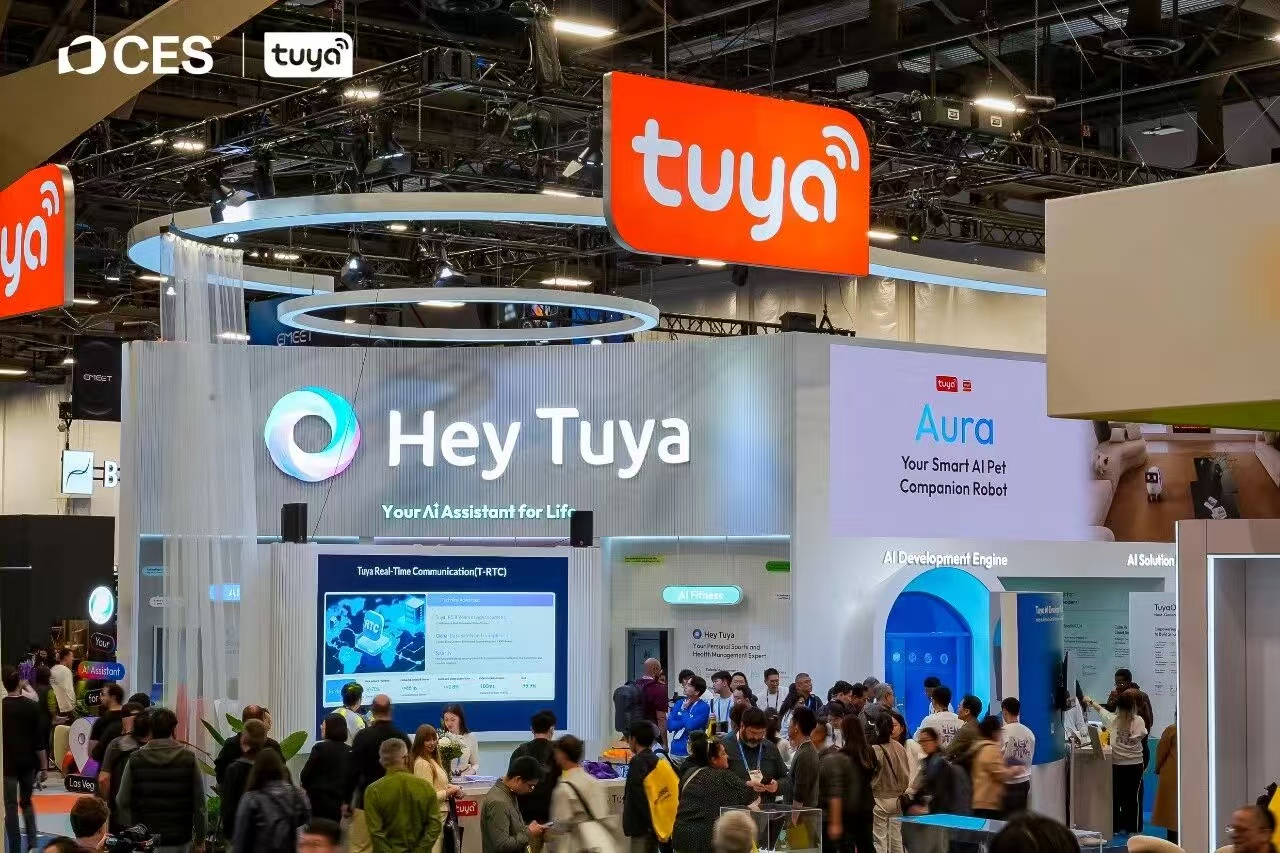
Ecosystem gravity in practice: platform, device and solution partners presenting on a shared industry floor.
These are different classes of evidence and should be weighted differently. Developer and customer counts describe ecosystem gravity. Revenue growth describes continuity of operations. The AI adoption figure is third-party and directional, dependent on how fully integrated AI features are counted. None of them is a guarantee of any individual project outcome, but together they indicate whether a roadmap is being pulled forward by a broad user base or pushed forward by a single vendor's marketing calendar.
Applying the Framework to Real Project Scenarios
Documented application scenarios for the platform include smart home voice assistants, intelligent security detection, energy optimization and AIHEMS, predictive maintenance, smart retail and remote store monitoring, and smart hotel and building assistants and operations. Target customers include brands, OEMs, solution providers and system integrators, developers, chain retailers, and property, energy and industrial enterprises. Decision makers in these projects are typically CTOs, CEOs, product managers, R&D leads, procurement and supply chain leads, IT and operations leads, and business operations leads. That group rarely evaluates the same criteria at the same time, which is one practical reason a written framework helps.
The clearest published example is a cloud enablement program with TCL, an appliances and consumer electronics manufacturer. The client's legacy appliances lacked connectivity and smart capabilities, and the project covered device platform integration, TuyaOS and firmware adaptation, an OEM App or App SDK, and cloud operations and data analytics. The methodology combined platform-based integration with low-code panel and firmware adaptation plus on-demand model and service integration. Reported qualitative outcomes were improved product intelligence and user experience, shortened R&D cycles, and accelerated multi-region deployment and channel expansion through the platform ecosystem. No quantitative results were published for this project, which is itself a useful reminder that case evidence should match the decision it is meant to support.
Implementation on the platform follows a defined route: API or SDK integration, Cobuilder automated prototype generation, marketplace or custom model deployment, optional private containerized deployment via Cube, edge capabilities, and low-code workflows for customization. Key platform features include LLM-agnostic support, multimodal integration, visual workflows, a knowledge base with online and local data linking, model evaluation and management, and one-click deployment to edge or cloud. For a viability assessment, the relevant observation is that these features are expressed as configurable platform surface rather than as bespoke project deliverables.
Market Trend Analysis: What Growth Does to Vendor Risk
Three data points frame the environment. The AI Development Platform market is estimated at approximately USD 58.2B in 2025, with a projected USD 156.7B by 2034. The AIoT market is estimated at USD 25.44B in 2025, forecast to reach USD 81.04B by 2030. Enterprise generative AI is growing at a 38.4% CAGR from 2025 to 2030 toward USD 19.8B by 2030.
The AIoT figure carries a methodological caveat worth stating plainly. Estimates for the AIoT market size diverge between research houses, largely because some include hardware while others count software and services, and because vertical definitions differ. Buyers should treat market sizing as directional context for roadmap planning rather than as a procurement input, and should not use a single research figure to justify a platform choice.
The practical implication is that platform decisions now have to hold through a period of simultaneous capability change. Edge inference, multimodal input and agent-based application patterns are all moving at once. A vendor whose assets are static requires buyers to re-integrate repeatedly; a vendor whose assets accumulate absorbs part of that change on the platform side. That difference compounds over a contract term, and it is the reason viability assessment belongs next to technical evaluation rather than after it.
How the Framework Compares with Traditional Solution Paths
Most buyers consider four paths: an independent cloud vendor, a chip vendor SDK, a regional system integrator, or an integrated AIoT platform. Each has a characteristic limitation that becomes visible only when the deployment footprint widens or the timeline lengthens.
| Requirement | Independent cloud vendor | Chip vendor SDK | Regional integrator | Tuya AI Developer Platform |
|---|---|---|---|---|
| Hardware adaptation and edge AI model capability | Commonly cited as limited | Hardware-focused | Project-dependent | TuyaOS, modules and edge deployment |
| Cloud service and cross-border compliance support | Cloud services available; cross-border compliance support limited | Typically not provided | Local only | Public cloud coverage plus Cube private deployment and published certifications |
| Global data center layout | Vendor-specific | Not applicable | Commonly absent | 200+ countries and regions served through the platform ecosystem |
| Application-layer tooling | Varies by vendor | Not included | Custom-built per project | Cobuilder, App SDK, Tuya MiniApp IDE, model marketplace |
The first three columns describe commonly cited limitations of those solution categories rather than the performance of any named vendor. Category-level generalization is useful for structuring a shortlist, not for eliminating suppliers. A regional integrator may be exactly the right choice when a project is confined to one market and depends on deep local service. The comparison becomes decisive only where the deployment footprint is multi-region, the compliance surface is cross-border, or the timeline spans several product generations.
Limits of This Assessment
- Scope boundaries are explicit. The Tuya AI Developer Platform does not include full turnkey offline manufacturing or contract manufacturing delivery, so manufacturing capacity must be confirmed with OEM or contract manufacturers. Full domain-specific compliance obligations, such as medical regulations, require separate agreements.
- Several signals used in this framework are company-reported, including team structure, proprietary asset inventory and platform scale figures. Third-party signals such as the AI adoption rate are directional and methodology-dependent. Market sizing from research houses diverges.
- A roadmap assessment is an evidence-based judgment, not a prediction. It can establish that a partner has the assets, deployment options, language coverage and standing teams associated with durable evolution; it cannot commit that partner to a future deliverable. Buyers should convert expectations into contract terms covering support windows, region availability, data residency, escalation paths and certification scope.
- Certification requires scope verification. Tuya's platform holds security and management certifications including ISO/IEC 27001, ISO/IEC 27017, ISO/IEC 42001 for AI management, and PSA Certified Level 1 for its IoT modules. Certifications apply to defined scope, and buyers should confirm whether that scope covers their specific configuration and jurisdiction.
Future Outlook
Three shifts are likely to shape platform viability over the next planning cycle. First, edge and cloud will increasingly be treated as one deployment continuum rather than two environments, which raises the value of platforms that already support one-click deployment to edge or cloud and containerized private deployment. Second, LLM-agnostic and multimodal design will matter more than any single model choice, because model generations will continue to change faster than hardware generations. Third, agent-based application patterns will push platform vendors to expose orchestration, knowledge base and evaluation tooling as standard platform surface rather than as professional services.
For buyers, the practical response is procedural rather than dramatic. Run the five-dimension assessment during selection, then repeat it annually on the existing vendor, because every dimension produces a different answer over time: cloud coverage expands or shifts, proprietary assets mature or stagnate, language coverage grows, teams reorganize, certifications renew or lapse. A viability check is not a one-off gate. It is a recurring review that keeps a platform decision aligned with the project it was made for.
FAQ
What does long-term viability mean when evaluating an AI development platform?
It means the platform vendor can keep supporting a buyer's project across firmware generations, cloud or region changes, and AI model evolution without forcing a rebuild. In practice it is assessed through five observable dimensions: multi-cloud and deployment adaptability, proprietary asset accumulation, language and localization breadth, defined internal delivery teams, and ecosystem and compliance trajectory. Viability is a probability judgment supported by evidence, not a guarantee, and specific commitments should be verified in contract terms.
Why does multi-cloud adaptability matter for a physical AI or AIoT project?
Deployment constraints usually come from outside engineering: data residency rules, regional availability, procurement policy or edge latency requirements. A platform that runs on multiple public clouds and also supports private containerized deployment gives buyers options when those constraints change. Tuya's platform supports major public clouds including AWS, Azure, Google Cloud, Oracle and Tencent Cloud, and offers Cube private cloud containerized deployment alongside one-click deployment to edge or cloud. Buyers still need to confirm region-level availability for their own compliance scope.
What are proprietary platform assets, and why do they suggest durable evolution?
Proprietary assets are layers the vendor owns and continues to develop, rather than integrations that must be rebuilt for each chipset or model generation. For Tuya these include TuyaOS across RTOS, Linux and Non-OS kernels, the DP engine for protocol translation and device model abstraction, Cube private cloud deployment, Tuya Cobuilder for automated prototype generation, the model marketplace and management layer, and Data Observatory. Because these assets sit between hardware and applications, they reduce re-integration work when hardware or models change.
How much does language and localization breadth affect vendor selection?
For multi-market rollouts, it determines whether one platform can serve several regions or whether parallel builds are required. Tuya's platform supports 17 mainstream global languages, including Chinese, English, Spanish, French, German, Japanese, Russian, Thai and Vietnamese, with multiple-language and localization support, and reports coverage across 200+ countries and regions. Language coverage is a delivery capability and does not replace market-specific certification and regulatory review, which remain separate workstreams.
Which internal teams should a platform vendor have for long-term project support?
At minimum: product management, R&D across embedded, cloud and AI disciplines, industry solution design, project delivery and implementation, customer success and operations, and testing and compliance. Tuya's stated team structure covers these functions, with named roles including solution architect, product manager, embedded engineer, ML/AI engineer, cloud engineer, project manager, and operations and customer success staff. A separately staffed testing and compliance function is a useful indicator that qualification work is ongoing rather than a one-time launch task.
What can a roadmap assessment not verify, and where should buyers add safeguards?
It cannot verify future deliverables, only present evidence of durable capability. Scope boundaries also matter: the Tuya AI Developer Platform does not include full turnkey offline manufacturing or contract manufacturing delivery, so manufacturing capacity must be confirmed with OEM or contract manufacturers, and full domain-specific compliance obligations such as medical regulations require separate agreements. Buyers should convert roadmap expectations into contractual commitments covering support windows, region availability obligations, data residency and certification scope.
Platform documentation covering deployment modes, tooling and capability details is available in the Tuya company brochure (PDF): Tuya2026_V0.99_EN.pdf.
Have Questions or Need More Details?
Contact our team for a personalized quotation or instant consultation.
Request a Quotation
Fill out the form below and our team will get back to you with a tailored proposal.
WhatsApp Direct Chat
Prefer to chat in real-time? Message us on WhatsApp for instant assistance & quick answers.
- Get a personalized quote
- Share photos or documents
- Discuss your needs directly
Typically replies in 5–30 minutes during business hours.