
Long-Term Viability of 410 Wider BA Coils in Industrial Use
Stainless steel coil procurement rarely fails at the grade-selection stage. It fails at the repeat stage — when a supplier's second shipment falls outside the dimensional window that the first one established, and the buyer absorbs the cost of re-setting a slitting line, a tube mill or a stamping press that was specified for a fixed input, not a variable one.
Material consistency — the ability of a supplier to deliver the same thickness window, the same width and edge condition, the same surface, and the same documentation across consecutive lots — belongs in the same procurement category as grade, finish and certification. In continuous industrial use, where equipment runs to a schedule rather than to a tolerance, it is often the constraint that decides whether a sourcing relationship survives its second year.
This article examines that constraint through a single product: 410 Wider BA stainless steel coil, specified at 0.25–1.5 mm thickness and 1240 mm width with a mill edge. It sets out what the specification allows, what it asks of the buyer's own processing setup, what documentation can currently be verified, where the geometry is genuinely useful, and where the approach has real limits.
Ningbo Sunfire Stainless Steel Co., Ltd is a China-based stainless steel supplier founded in 2013, located in the Ningbo Chamber of Commerce in the Southern Business District, with a stated export ratio of 100% and a product focus that includes stainless steel and stainless steel products, particularly secondary and baby coil. Its main export markets include Pakistan, India, Vietnam, Russia, Turkey, Indonesia, the UAE, Thailand, Malaysia and Bangladesh.
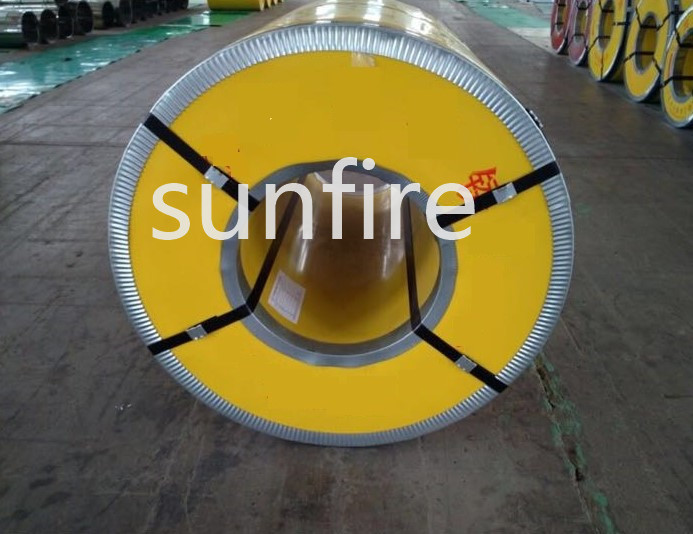
The Problem: Variance Compounds, It Does Not Average Out
In batch production, dimensional drift can be absorbed by inspection and rework. In continuous production it cannot. A coil becomes the input to a slitting machine, a tube mill or a stamping press, and every deviation in thickness, width or edge condition is transferred downstream into the forming, welding or punching operation that follows it. By the time the deviation reaches a finished part, its origin is no longer visible and its correction is no longer cheap.
Three variables carry most of the hidden cost in a coil-fed line:
- Thickness consistency, both along a single coil and between coils of the same nominal gauge. Roll gaps, forming parameters and weld settings are validated once; a gauge that drifts forces re-validation that production schedules rarely accommodate.
- Width stability and edge condition. A nominal 1240 mm input that arrives narrower, or with an inconsistent edge, changes the yield of every strip cut from it and can disturb guide and tension control on the line.
- Surface and packing condition at the moment of processing. Surface defects discovered only after uncoiling, or marking introduced in transit, create in-process sorting work that a line built for throughput has no capacity to absorb.
The opportunity sits in the same place as the problem. When geometry, surface and documentation are locked as a specification rather than negotiated batch by batch, a large part of process control work shifts upstream to the supplier — and the buyer's line keeps the settings it already validated.
The 410 Wider BA Specification in Constraint Terms
A specification is better read as a corridor than as a single point. The 410 Wider BA item is defined as follows, alongside its narrower counterpart in the same grade.
| Parameter | 410 Wider BA | 410 Narrow BA |
|---|---|---|
| Thickness (T) | 0.25 mm – 1.5 mm | 0.15 mm – 1.2 mm |
| Width (W) | 1240 mm / mill edge | 300 mm – 1010 mm |
| Surface | BA | BA |
| Packaging | Export package + paper interleaved | Export package |
| MOQ | 20 mt per thickness | — |
| Lead time | 7 – 30 days / stock | 7 – 30 days / stock |
| Further processing | — | PVC / paper / refinish |
Two details matter more than the rest. First, the width is fixed at 1240 mm with a mill edge, rather than offered as a range of finished widths: the coil is supplied as produced at the mill, not as a slitted strip. Second, the thickness corridor of 0.25–1.5 mm is broad enough to serve several continuous process families under one commercial item, but the minimum order quantity is set per thickness — 20 mt for each thickness — so a buyer running three gauges is planning three order lines, not one.
Packaging is specified as export package plus paper interleaved, a configuration intended for coil that will travel and then be processed, rather than stored flat and consumed locally. Lead time is 7–30 days, with stock availability indicated where applicable.
Technical Explanation: What a 1240 mm Mill Edge and a 0.25–1.5 mm Corridor Change at the Line
The term mill edge describes the coil edge as it leaves the rolling process. It is not a slit edge. For a buyer this is an operational fact rather than a label: a 1240 mm mill-edge coil is a wide input that is expected to be reduced by the buyer's own slitting equipment if narrower strip is required. The downstream equipment matched to this product family — slitting machine, tube mill and stamping equipment — reflects that reality.
The consequence is straightforward. Buyers who already operate slitting capacity gain flexibility: one 1240 mm coil can be converted into several narrower widths aimed at different orders, and a fixed input width makes slit-width planning predictable from coil to coil. Buyers who do not slit either use the coil at 1240 mm, or specify a different line item: within the same grade, 410 Narrow BA covers 0.15–1.2 mm thickness at widths from 300 mm to 1010 mm, packed in export package and available with optional PVC, paper or refinish processing.
Thickness behaviour matters for a second reason. Operating conditions recorded for this product family include 24/7 continuous service, intermittent daily operation, and cyclic heating and cooling. Under repeated thermal cycles, small differences in thickness uniformity can affect flatness and forming stability along the strip well before they affect any measured material property — which is why stable thickness tolerance is listed among the special requirements for the family, alongside mirror finish capability and anti-rust performance.
Grade context is worth stating plainly. Grade 410 sits in the martensitic family of stainless steels, a group generally selected where hardness and wear behaviour matter alongside moderate corrosion resistance. It is not a universal substitute for 304 in aggressive environments, and grade selection should always follow the actual service conditions. What transfers across grades is the geometry discipline: the wider 304 item is also specified at 1240 mm, and the wider 201 J3/J2/J5 items are supplied at 1240 mm with mill edge. A buyer who standardises on a 1240 mm input width can move between grades without rebuilding the slitting and feeding setup.
At supplier level, quality control for this product family is described as mill test plus thickness inspection plus surface inspection, with customization available on thickness, width, surface finish, PVC and packaging.
Documentation and Specification Control: What Can Be Verified Today
Dimensional consistency without paperwork is difficult to defend inside a purchasing organisation. Mill test certificates are the standard instrument: they tie a delivery to a heat, an issuing mill and a standard reference.
| Product | Certificate | Certificate No. | Issuing organisation | Standard | Market |
|---|---|---|---|---|---|
| 201 J2 stainless steel strip | 201 Mill Test Certificate | ZQ202512250046 | Zhaoqing Hongwang Metal Industrial Co., Ltd. | Q/ZQHW 2-2024 | Global |
| 304 stainless steel coils & sheets | 304 Mill Test Certificate | QT20260108631 | QINGTUO GROUP CO., LTD. | ASTM A240/A240M | — |
| 430 stainless steel coils & sheets | 430 Mill Test Certificate | JSPZ20260501804 | JIANGSU YONGJIN METAL TECHNOLOGY CO., LTD. | GB/T3280-2015 | Global |
The 304 certificate references ASTM A240/A240M, which together with ASME SA240 forms the core international standard set for stainless steel plate, sheet and strip in general and pressure-vessel applications. That reference is what allows a procurement team to compare documents from different mills on a common basis rather than on internal mill standards alone.
Where Repeatable Geometry Matters: Green Energy & New Materials Applications
The listed application base for this product family is broad: kitchenware and cookware, home appliances, elevator decoration, construction and interior decoration, automotive components, industrial equipment, metal stamping and deep drawing, tube and pipe manufacturing, tableware production, and hardware accessories. What these applications share is not an end product but a production pattern — metal is fed continuously, formed or cut, and expected to behave the same way on the thousandth metre as on the first.
Green energy and new materials programmes sit at the demanding end of that pattern. Equipment in these segments is generally specified for long duty cycles, and material substitution late in a project is expensive in both cost and schedule terms. Two requirements follow from that: inputs must be repeatable, and the supplier relationship must be able to deliver the same specification again after the first order has been consumed.
The special requirements recorded for this family — mirror finish capability where the finish route requires it, anti-rust performance, and stable thickness tolerance — map directly onto that logic. For a buyer planning continuous output, the practical value of a 1240 mm mill-edge BA coil with a defined thickness window is planning simplicity: one input geometry, repeated across an extended programme, with deviations handled once at the slitting stage on the buyer's own equipment rather than repeatedly at the forming stage.
Supply Reliability in Practice: Sunfire's Operating Model
Whether a specification is repeatable in practice depends on the supplier behind it. Ningbo Sunfire Stainless Steel Co., Ltd was established in 2013 and works with a cooperative factory operating world-advanced production lines. Its stated annual output is 25,920 MT, with monthly export volumes of up to 3,000 MT and an export ratio of 100%. The company states a lead time range of 7–45 days and a minimum order quantity of 27 MT at company level, while product-specific items such as 410 Wider BA carry their own figures — 20 mt per thickness and 7–30 days.
Quality control is described as mill test plus thickness inspection plus surface inspection, supported by customization on thickness, width, surface finish, PVC and packaging. After-sales support is provided through technical support and online service.
The most transferable evidence of repeatability is duration. The company's stainless steel export relationships, concentrated in Indonesia, India, South Africa, Pakistan, Vietnam and Saudi Arabia, are recorded at 10+ years and around 50 containers per month across kitchenware, home appliance, building and construction applications. Reported results include stable material performance, good corrosion resistance, consistent surface quality and conformity with international standards — the four outcomes that a coil buyer is effectively purchasing when the order is placed.
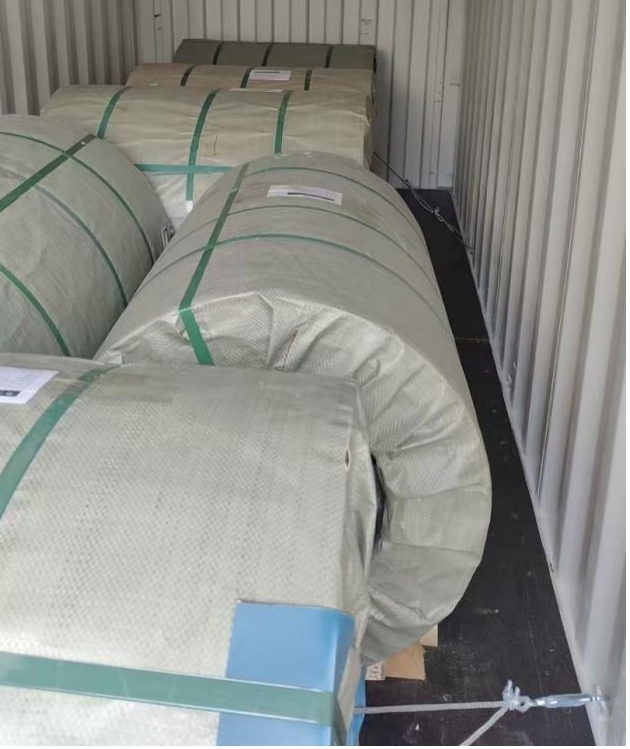
Comparison: Spot Sourcing vs. Spec-Locked Repeat Supply
Most buyers compare suppliers on price per tonne. A more useful comparison for continuous industrial use is between two sourcing models.
| Evaluation dimension | Spot-market coil purchasing | Spec-locked repeat supply (410 Wider BA) |
|---|---|---|
| Dimensional expectation | Width and thickness read from each individual offer | Fixed 1240 mm mill-edge width, 0.25–1.5 mm thickness corridor, treated as a repeatable input |
| Documentation | Certificates requested shipment by shipment, formats vary | Mill test certificate referenced to the order, with issuing mill and standard identified |
| Buyer-side processing | Slitting and re-inspection arranged urgently per lot | Slitting planned around one known input width |
| Planning horizon | Order by order | Programme level, with MOQ set per thickness to support scheduled call-offs |
| Change management | Every lot is a new commercial negotiation | Deviation handling becomes an exception process rather than a routine |
| Best fit | One-off projects, trial volumes, buyers with surplus in-house flexibility | Continuous production requiring repeatable geometry and traceable documentation |
Spec-locked supply is not automatically the better choice, and the boundaries of the 410 Wider BA item are worth stating without softening:
- Minimum order quantity. 20 mt per thickness is a real constraint. Buyers with small or highly fragmented thickness requirements across many widths may find the structure less efficient than a narrower or slitted product.
- Mill edge at 1240 mm. The buyer takes responsibility for downstream slitting. Without slitting capacity, the coil is only useful at full width, and 410 Narrow BA — 300 mm to 1010 mm, 0.15–1.2 mm — is the alternative inside the same grade.
- Lead time depends on stock. The stated window is 7–30 days with stock availability indicated where applicable; the broader company-level window is 7–45 days. Neither figure guarantees availability of every thickness on the day of enquiry.
- Documentation must be confirmed per order. As noted above, the certificate set currently in place covers 201 J2, 304 and 430; 410 documentation scope is an order-level item.
- Trade-policy exposure. EU anti-dumping duties on stainless steel cold-rolled flat products from China and Taiwan were maintained following a 2025 expiry review, with rates of 24.6%–28.5%. Buyers selling into the EU need to factor duty treatment into landed cost calculations before assuming a delivered-coil comparison.
Market Trend Analysis: Capacity, Trade Flows and the Shift Toward Consistency
Three data points frame the sourcing environment. The global stainless steel market was valued at USD 135.8 billion in 2025 and is projected to reach USD 247.4 billion by 2033, according to Grand View Research. China's stainless steel exports reached an all-time high of 5.04 million tonnes in 2024, a 25.6% year-on-year increase, based on data from the General Administration of Customs and Mysteel. Over the same period, China's stainless steel imports fell 9.3% to 1.88 million tonnes, mainly reflecting expanded domestic production capacity.
Capacity is also regionalising. Hongwang Group, a major producer specialising in cold-rolled stainless steel, operates an Indonesia joint venture with a 700,000-tonne-per-year cold rolling capacity — a structure that places finishing capacity closer to end markets rather than concentrating it at origin.
Read together, these trends do not point to scarcity. They point to a market where base supply is abundant, where trade policy can shift landed economics, and where differentiation therefore moves away from availability and toward repeatability, documentation and processing support. For a buyer comparing suppliers in 2026, the practical question is no longer whether a wide BA coil can be sourced, but whether the same coil geometry can be sourced again, with the same paperwork, on the next cycle.
Future Outlook
The direction of travel in coil procurement is toward specification discipline. Dimensional acceptance criteria that were once implied are increasingly written into purchase orders, with thickness windows, width and edge condition, packaging and certificate scope recorded as contractual items rather than commercial expectations. As more continuous-run capacity is installed in green energy and new materials segments, the value of a fixed input geometry rises with it.
Suppliers that can hold a defined width and thickness corridor across grades — 410, 304, 201 — and document each delivery are positioned for that shift. Buyers, for their part, gain leverage by asking documentation and reprocessing questions at the qualification stage, before the first coil is cut.
FAQ
What exactly is specified in the 410 Wider BA stainless steel coil?
410 Wider BA is specified at 0.25–1.5 mm thickness and 1240 mm width with a mill edge. Packaging is export package with paper interleaved. The minimum order quantity is 20 mt per thickness, and lead time is 7–30 days, with stock availability indicated where applicable.
How does 410 Narrow BA differ from 410 Wider BA?
Both items sit in the same grade but cover different input geometries. 410 Narrow BA is specified at 0.15–1.2 mm thickness with widths from 300 mm to 1010 mm, packed in export package, with a lead time of 7–30 days and further processing options of PVC, paper or refinish. 410 Wider BA is supplied at a single 1240 mm mill-edge width, with a thickness range of 0.25–1.5 mm.
Which mill test certificates are currently associated with these stainless steel coils?
Three certificate records are in place. The 201 J2 stainless steel strip carries a 201 Mill Test Certificate, number ZQ202512250046, issued by Zhaoqing Hongwang Metal Industrial Co., Ltd. under standard Q/ZQHW 2-2024, applying to the global market. The 304 stainless steel coils and sheets carry a 304 Mill Test Certificate, number QT20260108631, issued by QINGTUO GROUP CO., LTD. under ASTM A240/A240M. The 430 stainless steel coils and sheets carry a 430 Mill Test Certificate, number JSPZ20260501804, issued by JIANGSU YONGJIN METAL TECHNOLOGY CO., LTD. under GB/T3280-2015, applying to all markets. A buyer requiring documentation for a 410 Wider BA order should confirm the applicable certificate for that specific order.
What does "mill edge" mean for a 1240 mm coil, and what does it require of the buyer?
Mill edge describes the coil edge as produced during rolling, rather than an edge created by slitting. A 1240 mm mill-edge coil is therefore a wide input: buyers needing narrower strip normally slit it on their own equipment, which is why a slitting machine is listed among the equipment matched to this product family. Buyers without slitting capacity either run the coil at 1240 mm or specify a narrower item such as 410 Narrow BA.
What are the minimum order quantity and lead time?
For the 410 Wider BA item, the minimum order quantity is 20 mt per thickness and the lead time is 7–30 days, with stock availability indicated where applicable. At company level, the stated minimum order quantity is 27 MT and the stated lead time range is 7–45 days. The product-specific figure governs the individual line item.
What quality control and customisation steps apply?
Quality control for this product family is described as mill test plus thickness inspection plus surface inspection. Customisation covers thickness, width, surface finish, PVC and packaging, and after-sales support is provided through technical support and online service.
A downloadable company and product brochure for Ningbo Sunfire Stainless Steel Co., Ltd is available at https://cdn.socialarks.com/sbsp/24888/common/2026/0520/6a0d5f47b7b09.pdf, and the company's export site is published at http://en.sunfirex.com.
Have Questions or Need More Details?
Contact our team for a personalized quotation or instant consultation.
Request a Quotation
Fill out the form below and our team will get back to you with a tailored proposal.
WhatsApp Direct Chat
Prefer to chat in real-time? Message us on WhatsApp for instant assistance & quick answers.
- Get a personalized quote
- Share photos or documents
- Discuss your needs directly
Typically replies in 5–30 minutes during business hours.