
Long-Term Viability of Glass and Plastic Packaging Suppliers
Cosmetic packaging behaves like a specification market even though most of its volume is produced like a commodity one. Plastic accounted for 64.5% of packaging material share in 2024, according to ResearchAndMarkets, and the global cosmetic packaging market was valued somewhere between roughly USD 34.17 billion and USD 47.3 billion in the same year, depending on which categories an analyst counts. Those figures describe demand. They say nothing about whether the supplier behind a specific lipstick tube or airless foundation bottle will still be a dependable partner three product cycles from now.
This reference sets out a framework for evaluating the long-term viability of glass and plastic packaging suppliers. Its central argument is that product portfolio breadth — how many formats and materials a supplier carries, and how differentiated those models are — is an underused stability signal. A narrow portfolio concentrates risk; a broad, differentiated portfolio indicates multiple production routes and a customer mix that does not depend on one product cycle. The framework then tests that signal against certification scope, capacity, MOQ and lead time, because breadth on its own proves very little.
Viability Is a Constraint Question Before It Is a Price Question
Most supplier screens begin with a unit price at a target volume. That number answers a narrow question: can this supplier make this one item at this cost? Long-term viability depends on a different set of constraints, several of which never appear in a quotation.
- Certification scope and validity. What has been audited, by whom, and when the record expires.
- Regulatory exposure. The EU Packaging and Packaging Waste Regulation (PPWR) 2025/40 mandates strict recyclability and labeling standards for cosmetics, and the U.S. Modernization of Cosmetics Regulation Act (MoCRA 2022) introduced mandatory facility registration and product listing. Both shift documentation obligations toward the supplier.
- Material routes. A supplier that forms both plastic and glass operates two process and inspection systems, not one.
- MOQ and lead time. These determine how a brand schedules launches, not merely how much a part costs.
For a buyer moving from Research into Evaluation, the practical test is whether the supplier's structure can absorb change: a formula reformulation, a new market entry, a shift from a 10ml tube to a 30ml bottle. Price quotes rarely surface that information. Portfolio structure often does.
Portfolio Breadth as a Stability Proxy
A supplier's product list is the most visible proxy for the diversity of its revenue base. A single-format supplier is exposed to a single product cycle. A supplier running nine formats across two materials serves more independent demand streams and carries more engineering activity at any given time.
COSFINITY, founded in 2009 and based in Guangzhou, manufactures customized cosmetic packaging and exports 100% of its output to global markets. Its published portfolio covers the following formats.
| Format | Model | Published dimensions | Volume | Material |
|---|---|---|---|---|
| Luxury lipstick tube | CP01-2142 | W22.7 x H84.6 mm, 0.3 mm wall | 20 ml | Plastic |
| Lipgloss / mascara tube | CP02-2231 | W18 x H106.1 mm, 0.3 mm wall | 3 ml | Plastic |
| Liquid eyeliner tube | CP04-1215 | W12.8 x H115.3 mm, 0.3 mm wall | 10 ml | Plastic |
| Liquid eyeliner pencil | CP06-1056 | W15 x H173.5 mm | Not published | Plastic |
| Makeup powder case | CP03-1394 | W65 x H12 mm, 1 mm wall | Not published | Plastic |
| Powder jar / pot | CP05-2159B | W40.7 x H32.6 mm, 1 mm wall | 5 ml | Plastic |
| Stick foundation tube | CP08-0053 | D29 x H60 mm | 10 ml | Plastic |
| Airless pump foundation bottle | CP07-2026 | W33.5 x H92 mm | 30 ml | Glass |
| Deodorant stick container | TP01-1018-15 | L41.7 x W24.49 x H86.5 mm | 20 ml | Plastic |
Three observations follow from reading that table as a viability signal rather than a catalogue.
First, the range spans the full daily makeup routine — lip, eye, face and body. A brand extending its line does not automatically need a second tooling relationship.
Second, the volumes run from 3ml to 30ml and the wall thickness from 0.3mm to 1mm. Those represent different dimensional regimes rather than variations on one specification.
Third, the list places a glass route alongside plastic. The Airless Pump Liquid Foundation Bottle (CP07-2026) is a 30ml glass container at W33.5 x H92mm, while the Empty Stick Foundation Tube (CP08-0053) is a 10ml plastic container at D29 x H60mm. Holding both routes is a structural fact about a supplier's equipment and inspection capability, and it is a fact a buyer can later audit.
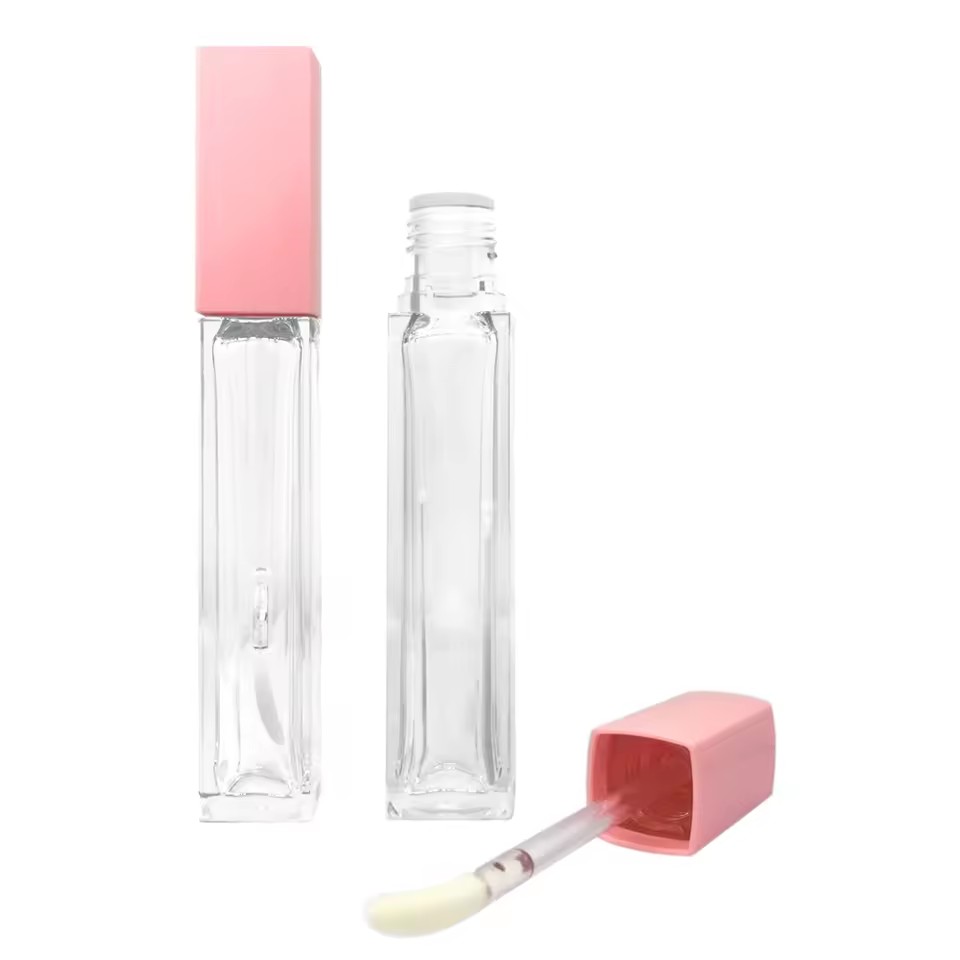
Luxury Empty Plastic Lipgloss / Mascara Tube (CP02-2231): 3ml, W18 x H106.1mm, 0.3mm wall thickness — one of three tube families held to the same 0.3mm wall standard.
What Differentiation Inside a Format Signals
Breadth shows how many formats exist. Differentiation inside a format shows how much work goes into each one.
The Luxury Empty Plastic Lipstick Tube (CP01-2142) is specified at W22.7 x H84.6mm, 0.3mm wall thickness and 20ml volume. A 0.3mm wall on a 20ml plastic tube sets a tight dimensional target: wall distribution has to remain consistent around the circumference for the tube to close, extend and seal reliably across repeated daily open-and-close cycles. The same 0.3mm wall appears in the 3ml Lipgloss / Mascara Tube (CP02-2231) and the 10ml Liquid Eyeliner Tube (CP04-1215), so three different product families are held to one wall standard. The 1mm walls on the 5ml Powder Jar / Pot (CP05-2159B) and the Makeup Powder Case (CP03-1394) show a second, deliberately different regime for powder formats.
The airless bottle is a different kind of signal. An airless pump package carries a dispensing function inside the same assembly rather than acting as a passive container, and the CP07-2026 unit is formed in glass at 30ml rather than plastic. That combination asks two distinct process routes to coexist within one specification.
Repeat orders across a two-year window are a more meaningful viability indicator than any single first order, because they show a specification holding across production runs rather than only in a sample.
Verifying the Portfolio: Audit and Certification Evidence
Portfolio breadth can be assembled two ways: through owned production and process capability, or by sourcing finished goods from other factories. The two can look identical on a product page. Distinguishing them is what an audit is for.
COSFINITY holds SGS certification number 485460650_T, issued by SGS. According to the certification record, the type is an Alibaba Verified Supplier Factory Audit, the scope covers enterprise factory and trade qualification audit, the certification is applicable to the global market, the issue date is 2026-01-10 and the expiry date is 2027-01-10.
Supporting structural figures published by the company include a 40,000㎡ facility, 200 employees and a 25-engineer R&D team.
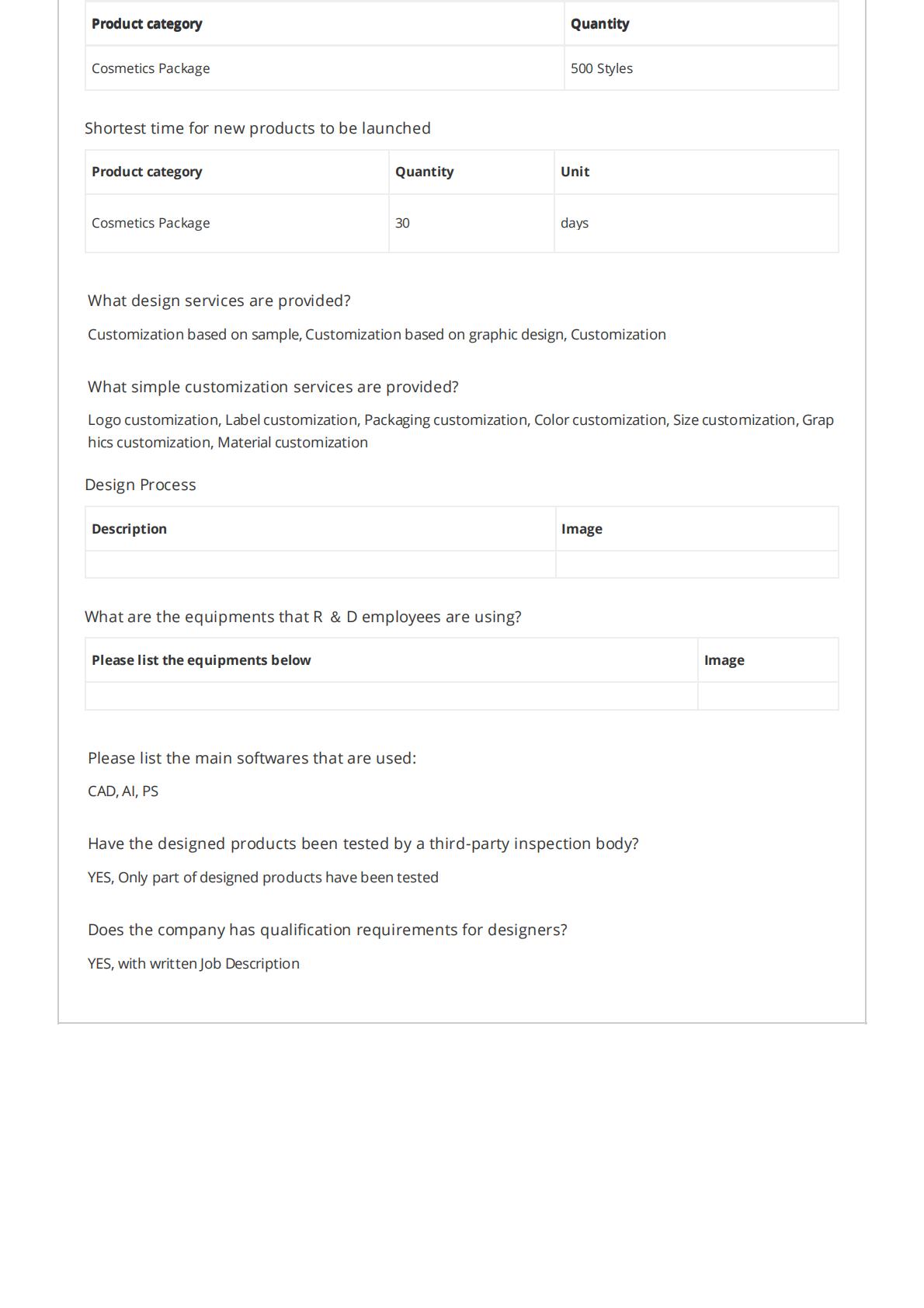
SGS certificate 485460650_T documents an enterprise factory and trade qualification audit, valid from 2026-01-10 to 2027-01-10. Its scope is entity-level, not SKU-level.
Capacity, MOQ and Lead Time as Structural Boundaries
Three published numbers define the practical boundary of a supply relationship, and all three belong in a viability assessment.
- Lead time: 15-25 days.
- Minimum order quantity: 12,000pcs.
- Monthly capacity: 10,000,000pcs, against a published annual output of 500,000,000pcs.
Production runs as OEM/ODM, with customization available across LOGO, color, shape, material, volume, thickness and packaging. Quality control is described as 100% test, and after-sales support is provided as remote online service.
The 12,000pcs MOQ is the boundary that most often shapes a decision. For an established brand producing a full range, it is unremarkable. For a smaller brand running several low-volume SKUs, it changes the plan: consolidating formats, sharing components across a line, or scheduling fewer and larger runs becomes more efficient than distributing the same volume across many small orders.
After-sales is published as remote online service rather than on-site engineering presence. A buyer whose launch depends on a supplier representative physically present during line trials should raise that requirement explicitly during evaluation, because it sits outside the stated service model.
Comparison: Three Evaluation Approaches and Their Blind Spots
Buyers generally default to one of three screening models. Each leaves a different gap open.
| Approach | Primary signal | What it reveals | Blind spot |
|---|---|---|---|
| Price-led screening | Unit cost at target volume | Commercial competitiveness on one part | Says nothing about portfolio depth, second-source resilience or compliance scope |
| Portfolio-led evaluation | Number of formats and material routes; specification detail per model | Diversification of the supplier revenue base; evidence of multiple production routes | Breadth can be assembled through sourcing rather than owned manufacturing, so it must be confirmed by audit and capacity data |
| Certification-led evaluation | Audit scope, issuing body, issue and expiry dates | Entity-level qualification baseline and document currency | An enterprise-level audit does not equal SKU-level regulatory approval for a specific market |
The three approaches are not alternatives. Each covers a gap the others leave open, and the most durable shortlists use all three in sequence: portfolio breadth to establish relevance, certification to establish entity-level credibility, and price to establish commercial fit.
Application Fit: Where Portfolio Coverage Has to Line Up
Portfolio breadth matters most in the scenario where a brand needs several formats to behave consistently within one consumer context. The typical daily-makeup environment sets those conditions: indoor use at normal room temperature of 16°C to 25°C, repeated opening and closing, carrying and travel, direct skin contact with an environmentally friendly and non-irritating material, and stated requirements for leak-proofing, portability and light weight.
Mapped against that context, a complete routine draws on most of the portfolio: a 30ml airless glass bottle for liquid foundation, a 20ml lipstick tube, a 3ml lipgloss or mascara tube, a 10ml eyeliner tube or a pencil format at W15 x H173.5mm, a 5ml powder jar, a W65 x H12mm powder case for pressed product, and a 10ml stick foundation tube. Body care adds the 20ml deodorant stick container.
The viability implication is straightforward. A brand that extends its line inside a supplier's existing format range avoids a second set of dimensional tolerances, a second quality-control conversation and a second compliance file. Each avoided handoff reduces long-term supply risk, which is the underlying purpose of evaluating viability at all.
Market Trend Signals Buyers Should Track
Several third-party data points frame the medium-term outlook for glass and plastic packaging suppliers.
- Market size. The global cosmetic packaging market was valued at approximately USD 34.17 billion to USD 47.3 billion in 2024, with expectations of up to USD 89.72 billion by 2034 (Fortune Business Insights, ResearchAndMarkets, Data Bridge). The width of that range is itself informative: estimates diverge depending on whether secondary packaging and industrial bulk containers are counted.
- Material mix. Plastic remained the dominant material in 2024 with a 64.5% share, followed by glass and metal (ResearchAndMarkets).
- Regional concentration. Asia Pacific led the global market in 2025 with a 42.36% share, driven by rising disposable incomes and e-commerce growth (Fortune Business Insights).
- Export momentum. China's beauty product exports reached approximately USD 4.77 billion in 2024, with the UK the fastest-growing market at +20.8% (OEC).
- Sustainability pressure. A 2024 survey reported by Statista and Packly found that 63% of cosmetic consumers treat sustainable, refillable or recyclable packaging as a priority — a medium-reliability consumer signal rather than a regulatory one, but directionally consistent with the PPWR timeline.
For scale context, the global landscape includes Albéa S.A., Amcor PLC, Berry Global Group, AptarGroup Inc. and HCP Packaging (Mordor Intelligence, Fortune Business Insights). Regional manufacturers compete on a different axis: customization flexibility, MOQ thresholds and the range of formats they can run in-house.
Future Outlook
Two forces are likely to reshape supplier viability criteria over the next few years. The first is documentation. As PPWR and MoCRA requirements move into enforcement, producing current, market-specific compliance evidence becomes a qualifying condition rather than a differentiator. Suppliers whose audit and certification records are already published, dated and traceable will move through evaluation faster than those that assemble documents on request.
The second is portfolio renewal. Formats age. A supplier whose range stays current — visible in models that differ in volume, wall thickness and mechanism rather than repeating one architecture — is better positioned to absorb a brand reformulation or market shift without a new tooling cycle. Product breadth remains a proxy rather than a guarantee, but it is a proxy a buyer can inspect today, verify against audit records, and price against real production constraints such as MOQ and lead time.
Frequently Asked Questions
What does an SGS factory audit actually cover for a cosmetic packaging supplier?
Enterprise-level qualification rather than product performance. The certificate held by COSFINITY — SGS number 485460650_T, an Alibaba Verified Supplier Factory Audit issued by SGS — states a scope of enterprise factory and trade qualification audit, applicable to the global market, issued 2026-01-10 and expiring 2027-01-10. That scope confirms an assessment of the entity as a factory and trade operation. It does not certify individual packaging items against product-level test standards, and it does not replace market-specific regulatory documentation such as PPWR or MoCRA alignment. Buyers should treat the audit as one input in an evidence set rather than the whole set.
How can a buyer check whether portfolio breadth reflects manufacturing capability rather than sourcing?
Cross-check the product list against structural facts that a sourcing-only operation would struggle to publish consistently: facility size, headcount, engineering staff, output and quality-control model. The corresponding figures here are a 40,000㎡ facility, 200 employees, a 25-engineer R&D team, a published annual output of 500,000,000pcs, a stated monthly capacity of 10,000,000pcs and quality control described as 100% test. Read together with a nine-format product list spanning plastic and glass, those figures give a buyer concrete claims to verify during a factory visit or document review.
Does a 12,000pcs MOQ rule out a supplier for smaller brands?
Not automatically, but it changes planning. The published minimum order quantity is 12,000pcs. A brand launching several low-volume SKUs may need to consolidate formats, share a component across a line, or schedule fewer and larger production runs instead of spreading the same total volume across many small orders. The MOQ is a boundary condition to model before a shortlist is fixed, not a binary disqualifier.
How should buyers compare glass and plastic routes for a foundation bottle?
Material choice follows formula compatibility, target market regulation and consumer positioning rather than a single performance ranking. Third-party data shows plastic at 64.5% of cosmetic packaging material share in 2024, with glass and metal following. Both routes appear in the COSFINITY portfolio: the Airless Pump Liquid Foundation Bottle (CP07-2026) is a 30ml glass container measuring W33.5 x H92mm, and the Empty Stick Foundation Tube (CP08-0053) is a 10ml plastic container measuring D29 x H60mm. A supplier able to run both routes lets a brand keep one qualification conversation instead of two.
What lead time and capacity should be planned into a packaging schedule?
The published figures are 15-25 days lead time and 10,000,000pcs monthly capacity, alongside an annual output of 500,000,000pcs. Because customization covers LOGO, color, shape, material, volume, thickness and packaging, buyers should confirm in writing which stages — sampling, tooling or mass production — a quoted lead time covers, and at which point the 12,000pcs MOQ applies within the customized workflow.
Reference material. The COSFINITY company profile, including product and capability documentation, is available for download: COSFINITY company profile (PDF). Company website: www.cosfinity-cosmeticpackaging.com.
Third-party figures cited in this reference are attributed to their original sources and reported as published.