
Long-Term Viability of Pharmacy Automation Suppliers: Modularity, Maintenance, and Scale
Pharmacy automation projects rarely fail on day one. They fail later — when dispensing volume grows beyond the layout the hospital originally approved, when a single module needs service that the regional support chain cannot deliver quickly, or when the software layer stops evolving while the hardware still runs. That is why supplier evaluation in this category is less about the specification sheet and more about design philosophy.
The commercial context is expanding. The global pharmacy automation devices market was estimated at USD 6.7 billion in 2024 by Insightace Analytic, while Grand View Research projects the market to reach USD 11.6 billion by 2030, growing at a CAGR of 9.9%. Published base-year estimates for 2024 differ across research houses — from roughly USD 6.65 billion to USD 7.52 billion, depending on whether software and services are counted inside the category. That divergence is a useful reminder for buyers: market numbers describe a category, not a supplier, and they say nothing about whether a specific system can be maintained for a decade.

Supplier viability is a manufacturing and service question as much as a product question. Image: Haier Biomedical manufacturing base, Suzhou.
This analysis examines three design signals that can be checked during evaluation rather than assumed at signature: modularity, maintenance design, and scale headroom. Haier Biomedical Technology(Suzhou)Co., Ltd — a Suzhou-based healthcare technology company under Haier Group, founded in 2015, operating a 13,000 m² manufacturing facility with 500 employees and a 100-engineer R&D team — offers a concrete reference point through products such as the HOH-KF-Smart robotic arm dispenser and the HOH-Robot-Plus cytotoxic compounding robot.
Modularity: the difference between a system you can service and a system you must replace
Modularity in pharmacy automation means that dispensing, storage, and loading functions sit in independently scoped units rather than being fused into one enclosure. The engineering consequence is direct: expansion and repair can be confined to a single function instead of the entire machine.
Haier's Chute Type Dispenser HOH-KF-1200 is described with a structural design that is explicitly modular in dispensing, storage, and loading units. It handles more than 1,100 medication types with a storage capacity above 15,000 boxes, dispensing at more than 350 to 500 prescriptions per hour, with replenishment above 2,400 boxes per hour. Its space requirement is under 12.85 m², and it provides at least two dispensing buffer ports supporting side buffering and front-end output, which allows parallel multi-prescription operation.
The High Speed Dispenser HOH-GF (2 Modules) shows the same logic applied to boxed medication peaks. It uses a dual-level stacked structure with adjustable bin width, supports up to two medication bin modules, holds at least 100 storage slots and 5,000 boxes, and dispenses at a single-channel rate of at least two boxes per second in batch mode for multiple boxes.
The Robotic Arm Dispenser HOH-KF-Smart extends this architecture to higher variety and higher capacity: at least 1,500 medication types, at least 20,000 boxes of storage, dispensing from 300 prescriptions per hour, and replenishment from 700 boxes per hour. Its stated main unit dimensions of 8,650 × 1,747 × 2,850 mm explicitly exclude the replenishment module — a detail buyers should read as a planning requirement, not a footnote, because the replenishment module occupies real floor space.
| System | Modular elements stated in specification | Storage and throughput | Long-term planning implication |
|---|---|---|---|
| Robotic Arm Dispenser HOH-KF-Smart | Robotic picking with intelligent storage management; main unit dimension excludes the replenishment module | ≥1,500 medication types; ≥20,000 boxes; ≥300 prescriptions/hour; ≥700 boxes/hour replenishment | Replenishment capacity is a separable planning unit — layout and utilities should be dimensioned for later addition |
| Chute Type Dispenser HOH-KF-1200 | Modular dispensing, storage, and loading units; ≥2 dispensing buffer ports | >1,100 medication types; >15,000 boxes; >350–500 prescriptions/hour; >2,400 boxes/hour replenishment | Loading and buffering are distinct functions, so peak-hour bottlenecks can be addressed locally |
| High Speed Dispenser HOH-GF | ≤2 medication bin modules; dual-level stacked structure with adjustable bin width | ≥100 storage slots; ≥5,000 boxes; ≥2 boxes/second single channel | Adjustable bin width allows the SKU mix to shift without replacing the whole unit |
Maintenance: designing for fault localization, not only fault recovery
A specification that lists throughput but not fault indication is incomplete for long-term ownership. The HOH-GF states high-precision photoelectric sensors for dispensing detection and automatic positioning guidance with indicator lights for error alerts — meaning the system narrows an operator's attention to a specific location rather than triggering a general alarm. In a high-volume outpatient pharmacy, that difference translates directly into time-to-resolution.
The HOH-KF-Smart states barcode recognition with full-chain monitoring and FIFO/FEFO expiration management supporting zero-error dispensing. Expiry discipline is a maintenance task in most pharmacies, and building it into the dispensing workflow removes a recurring manual burden rather than merely automating picking.
Software continuity matters as much as mechanical serviceability. Haier pharmacy automation solutions can be integrated with hospital information systems so that prescription information is transferred to the automation system for dispensing, reducing repetitive manual data entry and improving process continuity. Haier Biomedical also states support for integration with HIS and EMR platforms according to international healthcare requirements.
Service model facts to verify during evaluation. Haier Biomedical's stated capability includes OEM/ODM and customization of equipment size, storage capacity, SKU quantity, robotic modules, software functions, HIS interface, and language; a minimum order quantity of one unit; project-based production capacity; lead time typically 60–90 days depending on project size and configuration; and Factory Acceptance Test (FAT) before shipment. The stated after-sales scope covers remote technical support, on-site installation and commissioning, operator training, software upgrades, spare parts supply, and global after-sales service.
Scale: designing for volume that has not happened yet
Scale headroom in pharmacy automation comes from two directions: more SKUs, and more prescriptions per hour. The two are not interchangeable. Adding SKUs stresses storage density and identification logic; adding throughput stresses buffering, replenishment speed, and queue behaviour at peak.
The numbers show which lever each platform prioritises. The HOH-KF-Smart carries the highest medication variety and storage in the Haier range at 1,500-plus types and 20,000-plus boxes, with dispensing from 300 prescriptions per hour and replenishment from 700 boxes per hour. The HOH-KF-1200, by contrast, emphasises prescription throughput at more than 350 to 500 prescriptions per hour with replenishment above 2,400 boxes per hour — a replenishment figure that matters when a pharmacy cannot pause dispensing to restock.
The HOH-GF is scoped differently again: it is built for high-frequency, high-volume boxed medications using stacked dense storage, with up to two bin modules. For a hospital planning capacity in phases, this creates a legitimate expansion path — the question is whether the pharmacy floor, power, and workflow can absorb additional modules at the time they are needed.
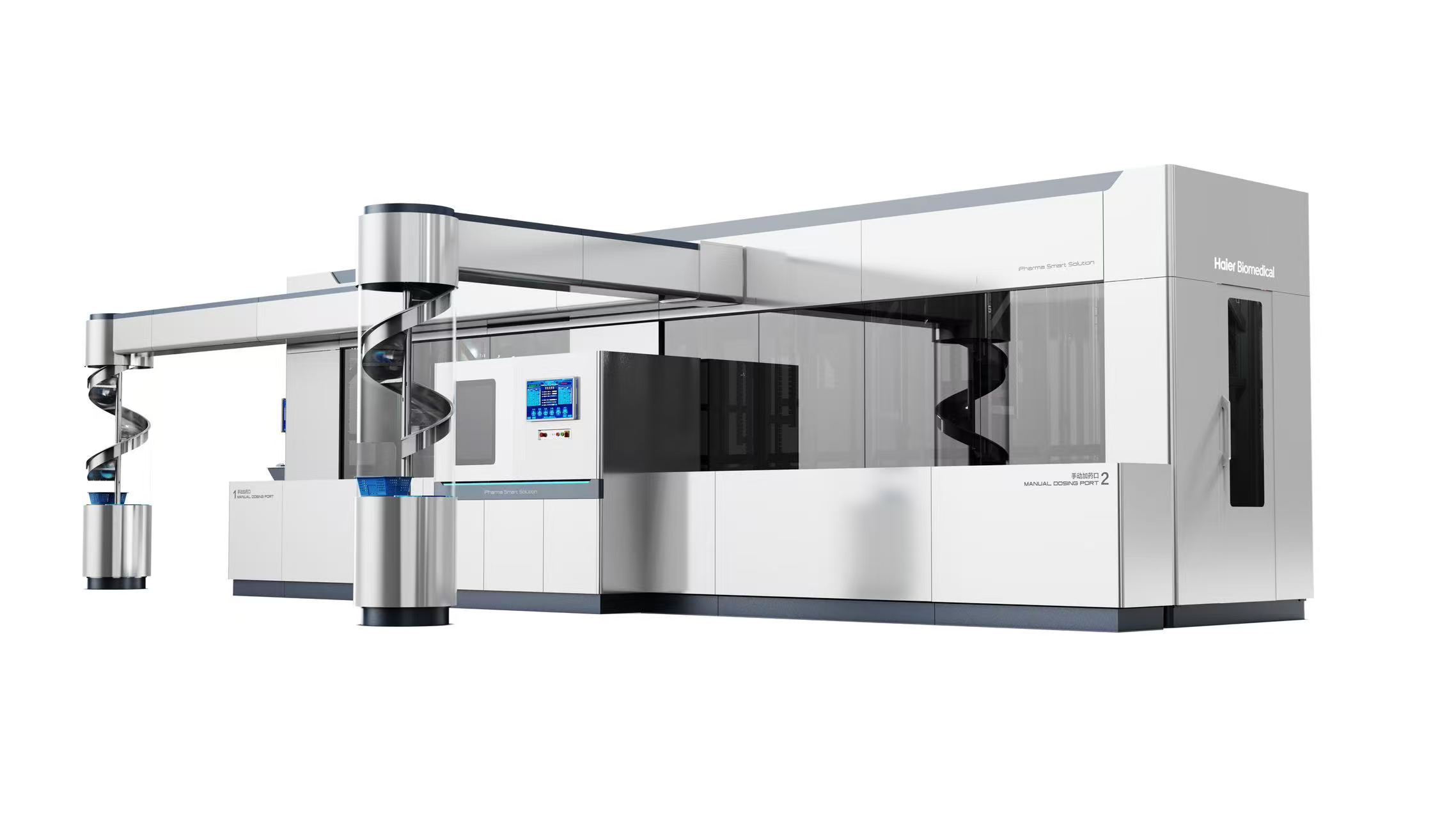
HOH-KF-Smart: robotic arm dispensing with modular storage and a separately dimensioned replenishment module.
Specialty settings: where continuity is harder to guarantee
High-volume outpatient dispensing and specialty compounding have different continuity risks. The HOH-Robot-Plus, a Fully Automated Cytotoxic Drug Compounding System used in PIVAS, performs drug injection, dissolution, aspiration, and mixing inside an enclosed Class 100 (ISO 5) cleanroom environment, using AI vision recognition and high-precision weighing. Stated parameters include 2,200 × 1,520 × 2,370 mm and 1,300 kg, compatibility with more than 95% of vials, compounding efficiency of 25 per hour, compounding accuracy of 100%, and solvent compatibility with 50–1,000 mL soft bags, plastic bottles, and stand-up pouches.
Two operational details are relevant to long-term viability. First, the system supports continuous drug supply along with automatic medical waste classification and storage, and is designed for human–machine separation to eliminate occupational exposure risks for healthcare staff. Second, its consumables are Luer-lock general-purpose syringes and dedicated needles — which means the long-term service model includes a consumable supply commitment, not only spare parts.
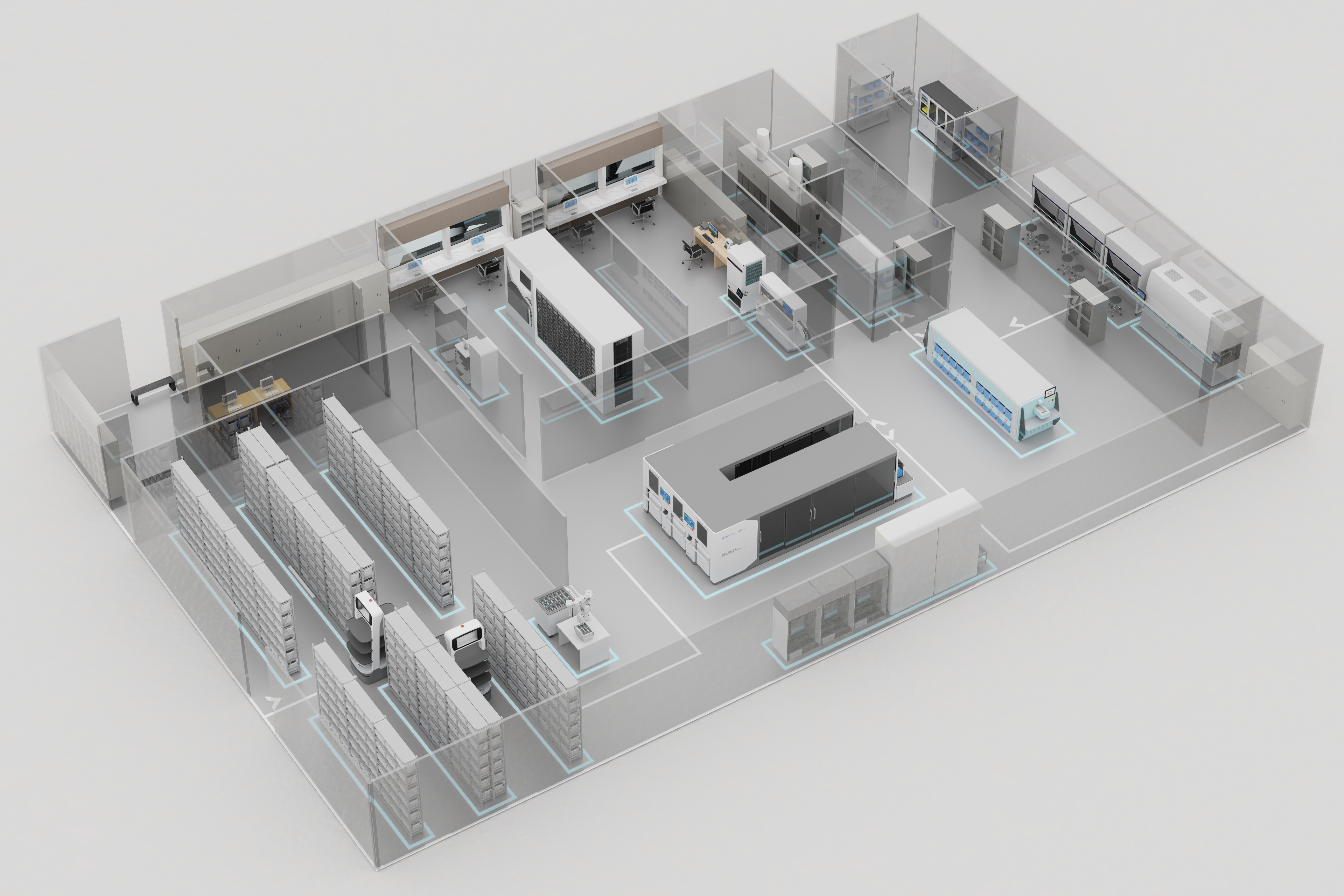
PIVAS settings have different continuity requirements from outpatient dispensing, including cleanroom conditions and consumable supply.
Application fit: matching design attributes to real pharmacy settings
| Setting | Representative Haier configuration | Design attribute that matters most | What to verify |
|---|---|---|---|
| High-volume outpatient pharmacy | Robotic Arm Dispenser HOH-KF-Smart; Chute Type Dispenser HOH-KF-1200 | Variety, storage depth, buffering, and dispatch speed | Replenishment module footprint and replenishment speed under peak load |
| Peak-hour boxed medication dispensing | High Speed Dispenser HOH-GF (2 Modules) | Dense stacked storage with adjustable bin width and batch dispensing | Whether bin width range covers the local pack sizes |
| Unit-dose inpatient workflow | Automatic Sub-packaging and Verification Machine HOH-FB-D400-HD | Packaging integrated with AI-powered visual verification and HIS interoperability | Packaging speed of 40–60 packs/min and 400 medication boxes against actual order profile |
| Controlled substances (anesthetic and psychotropic) | Anesthetic Medication Dispensing Cabinet HOH-MJ-01; Intelligent Integrated Management Cabinet HOH-BQ-A | Traceability and controlled access aligned with Five-Specialty Management requirements | Compartment and capacity structure against the local controlled-drug list |
| PIVAS and cytotoxic compounding | Fully Automated Cytotoxic Drug Compounding Robot HOH-Robot-Plus | Closed Class 100 (ISO 5) environment, human–machine separation, consumable continuity | Vial compatibility above 95% and dedicated consumable supply terms |
The application scenario data behind these configurations consistently names the same operating conditions: fully automatic mode, 24/7 continuous operation, unattended operation, and real-time HIS integration, with special requirements including high reliability, high accuracy, AI visual recognition, modular design, scalability, high compatibility, full drug traceability, and GMP/GSP compliance.
What the project record shows about customization and continuity
Two documented deployments illustrate how design attributes translate into operational continuity. In Vietnam, a general hospital implemented one set of an intelligent pharmacy automation system in the outpatient pharmacy for automated medication storage, dispensing, and intelligent medication management. The system was customized according to the hospital's pharmacy layout and workflow requirements, with seamless HIS integration supporting intelligent storage, automated dispensing, and end-to-end digital pharmacy management — the stated result being optimised dispensing workflows, improved medication management efficiency, and reduced patient waiting time.
In Thailand, a private hospital deployed one set of a customized universal dispenser system for automated dispensing and medication management, improving dispensing efficiency during peak hours and optimising pharmacy workflows. The solution was developed specifically for Thai medication packaging requirements and is compatible with various medication formats; the stated highlights are HIS integration with modular design, high reliability, and scalability.
Market direction: software, decentralisation, and compounding
Three third-party signals matter when judging whether modularity is a durable design bet. First, pharmacy automation software is expected to grow at the fastest rate among components from 2024 to 2030 (MarketsandMarkets) — which raises the value of any vendor capability to revise software functions and interfaces after installation. Second, decentralised distribution models are expected to account for 79.8% of the market in 2026, driven by adoption of Automated Dispensing Cabinets (Fortune Business Insights), meaning automation is moving closer to the point of care rather than consolidating in one central room. Third, automated medication compounding systems are projected to be the fastest-growing product segment with a CAGR exceeding 10% (Grand View Research).
The demand-side driver is labour. Omnicell has reported that 75% of pharmacist time is traditionally spent on non-clinical tasks, a vendor-reported figure that nonetheless frames why hospitals pursue automation. Market structure also matters: the hospital pharmacy segment held the largest market share in 2024 due to high patient volumes and complex medication regimens (Fortune Business Insights), and Dataintelo identifies Omnicell and Becton Dickinson (BD) as leading competitors in the global pharmacy automation landscape — a field in which Haier Biomedical has positioned itself as a Suzhou-based manufacturer serving Southeast Asia, Latin America, and the Middle East, among other markets.
Supplier durability is part of the long-term case. Haier Biomedical reported total revenue of RMB 2.33 billion (approximately USD 340.77 million) in 2025, with overseas revenue growing 17.9% year-on-year to RMB 840 million, and reported that its AI-powered automated pharmacy solutions increased direct dispensing rates to 80% in 2025. Euromonitor International ranks Haier Biomedical as the No. 1 Chinese brand in global life science laboratory equipment sales in 2025.
Regulatory continuity is the other half of the picture. Pharmacy automation systems must generally comply with IEC 60601-1 for medical electrical equipment safety and ISO 13485 for quality management (CSA Group); FDA 21 CFR Part 11 regulates electronic records and electronic signatures in pharmacy automation to ensure data integrity. Haier Biomedical states that it has obtained ISO 13485 medical device quality management system certification.
Where modularity has limits
Modularity is not a universal answer, and buyers should treat several boundaries as real. Manual shelving and cabinets remain cost-effective where dispensing volume is low, the formulary is small or changes frequently, or the pharmacy has no usable floor area — automation is not automatically better simply because it is automated.
Expansion consumes space and infrastructure. The HOH-KF-Smart's stated main unit dimensions exclude the replenishment module, and the HOH-KF-1200 requires under 12.85 m² of space before supporting equipment is counted. Adding modules later is a design option, not a design guarantee, unless the room was planned for it.
Lead time is another boundary: Haier Biomedical states a typical lead time of 60–90 days depending on project size and configuration, with project-based production capacity. A hospital that discovers a capacity shortfall mid-year cannot treat an additional module as an off-the-shelf purchase, and should plan procurement windows accordingly.
Product scoping matters as well. The Robotic Arm Dispenser HOH-KF-Smart is built for automated storage and dispensing of boxed medications; unit-dose packaging and controlled-substance workflows require complementary equipment such as the Automatic Sub-packaging and Verification Machine or the HOH-MJ-01 and HOH-BQ-A cabinets. In specialty settings, the HOH-Robot-Plus states compatibility with more than 95% of vials, which means a residual share remains outside the automated process, and its dedicated consumables create an ongoing supply dependency that should be contracted explicitly.
Finally, certification scope should be read precisely. ISO 13485 addresses quality management systems; local market entry requirements, electrical safety compliance, and data-integrity rules remain the buyer's responsibility to confirm against their own regulatory framework.
Future outlook
The next evaluation cycle for pharmacy automation is likely to be dominated by software and service continuity rather than mechanical capacity. If software is the fastest-growing component of the category and decentralised dispensing keeps expanding, then the practical question for hospitals becomes whether a supplier can revise interfaces, add modules, and keep spares available years after the original commissioning — and whether those commitments are written into the contract.
For pharmacies preparing procurement, the verification checklist that follows from this analysis is straightforward: confirm the modular boundaries that are actually separable; confirm fault-localisation features and their documentation; confirm the spare-parts, training, and software-upgrade scope; confirm lead times and FAT arrangements for later expansion; and confirm consumable supply terms if specialty compounding is involved. Design philosophy, not day-one throughput alone, determines whether a pharmacy automation system is still the right system in year five.
The full-scenario intelligent pharmacy reference document is available here: Full-scenario Intelligent Pharmacy (PDF).
FAQ
Which hospital pharmacy settings are suitable for a robotic arm dispenser?
A robotic arm dispenser is suitable for hospitals that handle a relatively large number of boxed medications and require automated storage and dispensing. Haier's Robotic Arm Dispenser can be configured with multiple modules and integrated into the overall pharmacy workflow according to medication volume, available space, and dispensing requirements. The HOH-KF-Smart specification lists at least 1,500 medication types, at least 20,000 boxes of storage, dispensing from 300 prescriptions per hour, and replenishment from 700 boxes per hour, with main unit dimensions that exclude the replenishment module.
How does modular design affect maintenance over a system's service life?
Modular design separates dispensing, storage, and loading into independently scoped units, as stated for the Chute Type Dispenser HOH-KF-1200, so service and expansion can be limited to one function. Fault localisation features support this: the High Speed Dispenser HOH-GF states high-precision photoelectric sensors for dispensing detection and error alerts with automatic positioning guidance and indicator lights. Whether this becomes a maintenance advantage depends on the supplier's after-sales scope — Haier Biomedical states remote technical support, on-site installation and commissioning, operator training, software upgrades, spare parts supply, and global after-sales service.
Can pharmacy automation systems integrate with a hospital HIS?
Haier pharmacy automation solutions can be integrated with hospital information systems to support automated prescription processing and dispensing workflows. Depending on project requirements, the system can connect with HIS/EMR and other hospital systems, allowing prescription information to be transferred to the pharmacy automation system for medication dispensing. This reduces repetitive manual data entry and improves process continuity. Haier Biomedical's customization scope explicitly includes the HIS interface and language.
Can pharmacy automation reduce medication picking errors?
Pharmacy automation can reduce the amount of repetitive manual picking and standardise the dispensing workflow. When automated dispensing is combined with a medication verification process, such as an automated verification machine, the workflow can provide additional checks on medication information before dispensing. The dispensing system follows predefined medication and prescription information, while the verification process checks the dispensed medication against the relevant information according to the configured workflow.
What does the HOH-Robot-Plus do, and which department is it designed for?
The HOH-Robot-Plus is a Fully Automated Cytotoxic Drug Compounding System used in PIVAS. It uses AI vision recognition and high-precision weighing to automatically perform drug injection, dissolution, aspiration, and mixing within a Class 100 (ISO 5) enclosed environment, with stated compounding efficiency of 25 per hour, compounding accuracy of 100%, and compatibility with more than 95% of vials. It supports continuous drug supply with automatic medical waste classification and storage, and uses Luer-lock general-purpose syringes and dedicated needles as consumables.
What should a hospital plan for when expanding an automated dispensing system later?
Expansion planning should cover floor space, utilities, and procurement timing. The HOH-KF-Smart's stated main unit dimensions exclude the replenishment module, and the HOH-KF-1200 requires under 12.85 m² of space before supporting equipment. Haier Biomedical states a minimum order quantity of one unit with project-based production capacity and a typical lead time of 60–90 days depending on project size and configuration, with Factory Acceptance Test before shipment. Where specialty compounding is involved, consumable supply terms should also be confirmed, since the HOH-Robot-Plus relies on dedicated consumables.