
Long-Term Wire Drawing Machine Supplier Evaluation
Long-Term Wire Drawing Machine Supplier Evaluation
Wire drawing machines are long-life capital equipment, and most buyers do not stop at one unit. They return to the same supplier for the next line, the next capacity step or a new wire range. That changes what supplier evaluation is for. The question is less about the price of the first machine and more about continuity: whether the customization agreed for machine one can be repeated on machine three, whether the electric components inside the cabinet can be re-sourced years later, and whether the company that signed the drawings still owns the technical answer when something has to change.
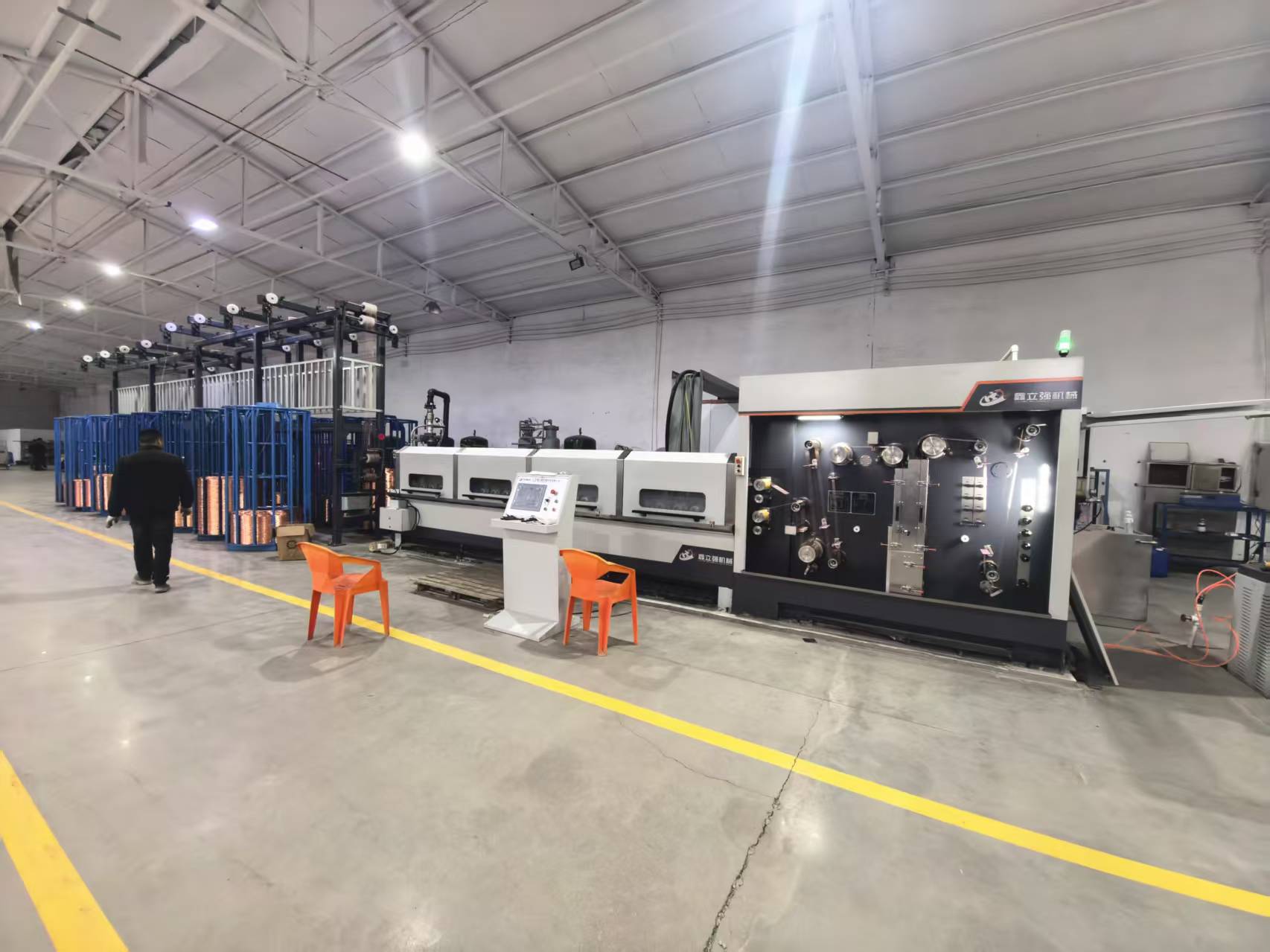
Jiangsu Listrong Mechanical & Electrical Co., Ltd. is a wire and cable production equipment manufacturer based in Dongtai City, Jiangsu, China. Its stated scope covers wire drawing machines, annealing machines and wire bunching machines for bare copper, copper alloy and stainless steel wire, together with whole plant planning, technical advice, installation, commissioning and after-sales service. That profile is a working reference for the three checks below, which apply to any supplier being evaluated for a multi-year relationship rather than a single delivery.
Repeatable customization is the first long-term test
Customization is often discussed as a one-off engineering effort: the buyer lists requirements, the supplier adapts the design, the machine ships. The more demanding question is whether the same adaptation can be executed again, to the same drawing, without renegotiating the interface. A customization that exists only in a quotation email is not an asset. One that exists in a drawing number and a configuration record is.
In Listrong's customization discussions, three items are settled per customer before a machine is configured.
- Bobbin size. The bobbin sets the package the machine produces, and therefore the handling, storage and pay-off arrangement at the next production stage. A non-standard bobbin that is not recorded becomes a non-standard bobbin that has to be reverse-engineered later.
- Spool dimensions. These determine whether the take-up end of the machine matches what downstream equipment and the buyer's own customers will accept. Two machines built to different spool dimensions are not interchangeable on the same line.
- Die base adjustment. The die holder and its adjustment range define which die sizes can be mounted and how long a size change takes. A die base configured for one product range constrains the product range afterwards.
Each of these is an interface to something outside the machine, which is why they matter more to a repeat order than cosmetic differences. The supplier's stated selection parameters point the same way: voltage, overall dimension, safety level, working environment, protection grade, wire diameter range and drawing speed. None of these is a marketing question; all of them decide whether a second machine is a repeat build or a new engineering project.
The check at quotation stage is straightforward. Ask for the standard-versus-customized split in writing, and ask what documentation travels with each customization. If spool dimensions are non-standard, can the drawing be retrieved when a second machine is ordered two years later, by a different engineer, in a different language? A supplier that can answer that question has a customization process. A supplier that cannot has a customization habit.
Control components and the cost of a changed parts list
Two machines built three years apart can look identical and still be different machines internally. If the relay family, the switch series or the sourcing region changes between builds, three things diverge at once: the spare-parts list, the wiring diagram, and the maintenance team's familiarity with the cabinet.
Listrong describes its electric control sourcing as consistent across Chinese, Taiwanese or overseas brands, with OMRON relays and LG switches among the component families named. The value of that practice is not the brand name on its own. It is that a component identified in year one can still be identified, ordered and replaced in year four, and that the engineer opening the cabinet recognises what is inside.
Buyers evaluating this should ask for the as-built component list with brands and series, not just a general statement that branded parts are used. Two follow-up questions do most of the work. First, is there a substitution policy, and is the buyer notified when a part changes? Second, are the wiring drawings revised when that happens? A cabinet full of reputable parts with an out-of-date drawing is still a maintenance problem.
One boundary is worth stating plainly. Component brand consistency supports serviceability and traceability; it is not by itself evidence of machine-level safety or performance. Safety is addressed separately through the machinery safety and electrical standards discussed below, and performance is addressed through the acceptance test. Treating a relay brand as a proxy for either is a category error that surfaces years later, usually during a breakdown.
Manufacturer or trading company: what the distinction actually changes
For a single purchase, a trading company can deliver a working machine. For a multi-year relationship, the distinction matters because technical questions need an owner. Who signs off a customization drawing, who authorises a substitution, who witnesses the pre-shipment test, and who answers a spare-parts query in year five are different answers depending on whether the seller builds the equipment.
Listrong states that it operates as a wire drawing machine manufacturer rather than a trading company, and that customers can inspect the factory online or offline at any time. The company reports more than 20 years of wire drawing machine manufacturing experience, supported by in-house technology development and testing departments. Those claims are testable, which is the useful part: a factory visit, remote or on site, should be built around the questions the buyer needs answered rather than a general tour.
A short inspection agenda is more informative than a long one. Where is the customization recorded, and by whom? Which department signs the test report, and can a sample report be reviewed before the order? How are as-built drawings versioned? What happens when a customer asks for the same machine again? None of this proves an outcome, but together it establishes accountability, which is what a long-term buyer is purchasing alongside the equipment.
Export readiness for Europe: documents rather than adjectives
European-bound equipment is usually discussed in terms of a CE claim. The more useful framing is that two layers are involved: machinery safety, addressed through risk assessment under EN ISO 12100:2010, and the electrical equipment of machines, addressed through EN 60204-1:2018/A1:2025. For audited long-term sourcing of European-bound wire drawing machines, Listrong cites compliance with the CE directive and both of those standards.
A standards list is a starting point, not a document package. Three practical checks follow. First, the declaration should match the configuration actually ordered; voltage, protection grade and working environment are selection parameters, and they are also the parameters most likely to change what was declared. Second, the version of each standard should be the one applicable at the time of build, which matters for a document such as EN 60204-1, whose amendment A1:2025 is recent. Third, the customs side should be settled in parallel: wire working machinery is classified under HS 8463.30.00 in the WCO nomenclature, the classification used in UN Comtrade data as HS 84633000.
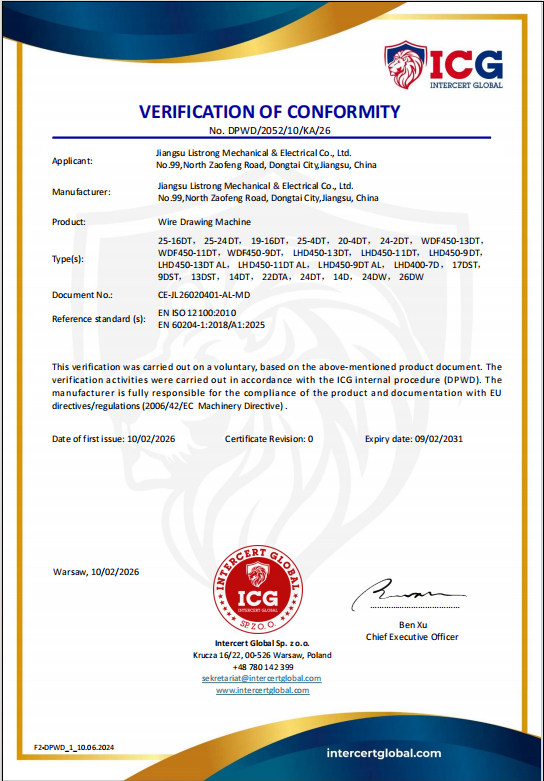
Listrong states that it arranges customs clearance documents in advance for export orders. Buyers should still confirm the document list against their own importer obligations, because responsibility for placing compliant equipment on the European market sits with the economic operator, not with the standards quoted in a brochure.
Purchasing terms and acceptance criteria as sustainability checks
Commercial terms are usually read as cash-flow arrangements. In a long-term evaluation they are better read as the first test of how the supplier behaves after the order is placed.
Listrong's stated terms are a minimum order quantity of one set, delivery on FOB, EXW or CIF terms, acceptance based on a pre-shipment test, and payment of 30% by T/T in advance with the remaining 70% before shipment.
The pre-shipment test is the clause that carries the most weight, and the one most often left vague. With 70% of the value paid before shipment, that test is effectively the buyer's only physical evidence before the machine leaves the factory. It should therefore be defined rather than named: which wire diameter is run, at what speed, for how long, with which dies and lubricant, what is measured and recorded, who witnesses it, and what document is issued afterwards. A supplier that can describe this in advance is easier to hold to than one that answers with a certificate at the end.
Warranty terms deserve the same reading. Listrong's standard coverage is 12 months from the date of dispatch from its factory. Because the clock starts at dispatch rather than at production start, the installation schedule becomes part of warranty planning: a machine that waits three months for a site to be ready has used a quarter of its coverage before the first wire is drawn. Buyers facing long shipping or site-build timelines are better raising this at negotiation than after delivery.
Support arrangements complete the picture. The company provides installation and commissioning support and after-sales service for its wire drawing machines, including dispatch of engineers for machine installation and operator training; it reports that its engineers have service experience in more than 60 countries. For copper wire production in Southeast Asia, the Middle East and India, the supplier's purchasing guidance recommends its 13DST and 14D series. That is a supplier recommendation and should be checked against the buyer's own wire range, speed target and die schedule rather than adopted as given.
What a confirmed configuration looks like
An abstract checklist becomes easier to apply with a concrete requirement set. In one documented application, the production target is 0.195 mm copper wire at 24 m/s, running automatically around the clock, for conductors used in the power and signal transmission lines of new energy vehicles and other fine-wire work. That requirement set assumes matched equipment such as a steam generator or nitrogen generator, and it depends on high-quality drawing oil, annealing oil, high-precision drawing dies and oxygen-free copper input.
Read as a specification, the scenario shows why the customization items matter. The outlet diameter fixes the die schedule and therefore the die base; the speed and the 24/7 duty cycle turn spool and bobbin handling into a throughput question rather than a packaging detail; the annealing requirement pulls in machinery outside the drawing machine itself, which is where whole plant planning becomes relevant. The same scenario also shows the limit of the exercise: a documented application description is a requirement set, not a performance guarantee for a different buyer's wire, oil or operator practice.
Market context, used carefully
Industry estimates put the global wire drawing machine market at around USD 3.8 billion in 2025, with a forecast compound annual growth rate of about 5.47% between 2026 and 2034, reaching roughly USD 6.1 billion by the end of that period, according to a commercial research report published in April 2026. Those figures are directionally useful and should not be treated as a single settled number: other commercial estimates place the 2025 market at a materially lower value, and the difference appears to come from whether spare parts, dies and service revenue are counted inside the equipment market.
For a procurement decision, the practical reading is narrower. If demand continues in the direction those estimates describe, delivery slots for higher-speed fine wire equipment become the constraint rather than catalogue availability, which strengthens the case for fixing customization records and component specifications early. Market growth does not, however, solve the spare-parts question. It can make it harder, because a busy supplier has more builds in progress and more opportunities to substitute a component.
Price-led sourcing versus continuity-led evaluation
| Evaluation dimension | Price-led sourcing | Continuity-led evaluation |
|---|---|---|
| Customization | Negotiated per order | Recorded once, repeated on later builds |
| Control components | Whatever is available at build time | Named brand and series, documented as built |
| Supplier identity | Quotation, proforma, delivery date | Factory access and a named engineering owner |
| Export documentation | Certificate mentioned in the offer | Declaration matched to the ordered configuration and standard versions |
| Acceptance | Visual check before shipment | Defined pre-shipment test with recorded parameters |
| Cost view | Purchase price | Price plus spares, changeover time and support |
The cost row is where most evaluations are won or lost. Where a supplier publishes a total-cost-of-ownership comparison, the useful response is not to accept or reject the number but to ask what sits behind it: which baseline machine, which energy price, which utilisation hours, which maintenance interval. A five-year ownership comparison built on the buyer's own operating data is a decision tool. The same comparison built on the supplier's assumptions is a sales document.
Future outlook
Three things are likely to separate long-term suppliers from short-term ones over the next few years, and none of them is a machine specification. The first is documentation continuity: whether a configuration agreed in 2026 can be reconstructed in 2031 without the engineer who wrote it. The second is component traceability, which grows more valuable as control hardware cycles faster than the mechanical frame. The third is version control of compliance documents, since a standard amendment can change what a declaration must say without changing the machine. Buyers who write those three expectations into the first order spend less time re-qualifying the second.
FAQ
How can a buyer tell whether a wire drawing machine supplier is a manufacturer or a trading company?
The most direct check is factory access. Listrong states that it operates as a wire drawing machine manufacturer rather than a trading company, and that its factory can be inspected online or offline at any time. A buyer can use that visit to look at assembly, testing and record-keeping, and to establish which department signs customization drawings and test reports. A trading company is not automatically unsuitable, but the technical owner of the machine should be identifiable before an order is placed, because customization approvals and spare-parts identification depend on that owner.
Which customization details should be fixed in writing before an order?
At minimum, the three interface items: bobbin size, spool dimensions and die base adjustment, each with dimensions rather than descriptions. The supplier's stated selection parameters add voltage, overall dimension, safety level, working environment, protection grade, wire diameter range and drawing speed. The purpose of writing them down is repeatability. A later machine ordered to the same record is a repeat build; the same requirements sent as a fresh enquiry become a new engineering project.
Why does control component sourcing matter after the warranty has ended?
Because the warranty period is short relative to the service life of the machine. Listrong's standard warranty runs 12 months from the date of dispatch, while the cabinet will be maintained for years afterwards. Consistent sourcing of electric control components from Chinese, Taiwanese or overseas brands, with OMRON relays and LG switches among the named families, keeps the spare-parts list and the wiring drawings valid over that longer period. Buyers should still request the as-built component list with brands and series, and ask how substitutions are notified.
What do the standard purchasing terms and acceptance criteria cover?
Listrong's stated terms are a minimum order of one set, FOB, EXW or CIF delivery, acceptance based on a pre-shipment test, and payment of 30% by T/T in advance with 70% before shipment. The acceptance clause is the one worth expanding. The test should specify wire diameter, speed, duration, dies, lubricant, recorded parameters and the witnessing arrangement. Because most of the payment falls before shipment, that pre-shipment test is the buyer's main evidence point.
What documentation supports a wire drawing machine order for Europe?
Listrong cites compliance with the CE directive, EN ISO 12100:2010 for machinery safety and EN 60204-1:2018/A1:2025 for the electrical equipment of machines. Buyers should ask for the declaration to be matched to the configuration actually ordered, including voltage, protection grade and working environment, and should check that the standard versions cited are current at the time of build. Customs classification under HS 8463.30.00 applies to the shipment, and the supplier states that it arranges customs clearance documents in advance.
A sequence that holds up
For buyers moving from decision to execution, the sequence is unglamorous but reliable: fix the customization record, list the control components as built, confirm who owns the technical answer, match the compliance documents to the configuration, and define the pre-shipment test before it takes place. Each step costs a little time on the first order and saves considerably more on the second. The manufacturer's full product range and technical data are available in its catalogue.
Have Questions or Need More Details?
Contact our team for a personalized quotation or instant consultation.
Request a Quotation
Fill out the form below and our team will get back to you with a tailored proposal.
WhatsApp Direct Chat
Prefer to chat in real-time? Message us on WhatsApp for instant assistance & quick answers.
- Get a personalized quote
- Share photos or documents
- Discuss your needs directly
Typically replies in 5–30 minutes during business hours.