
Loss-in-Weight Feeder Compliance: IP65, 6000e, Temperature Ratings
Loss-in-Weight Feeder Compliance: IP65, 6000e, Temperature Ratings
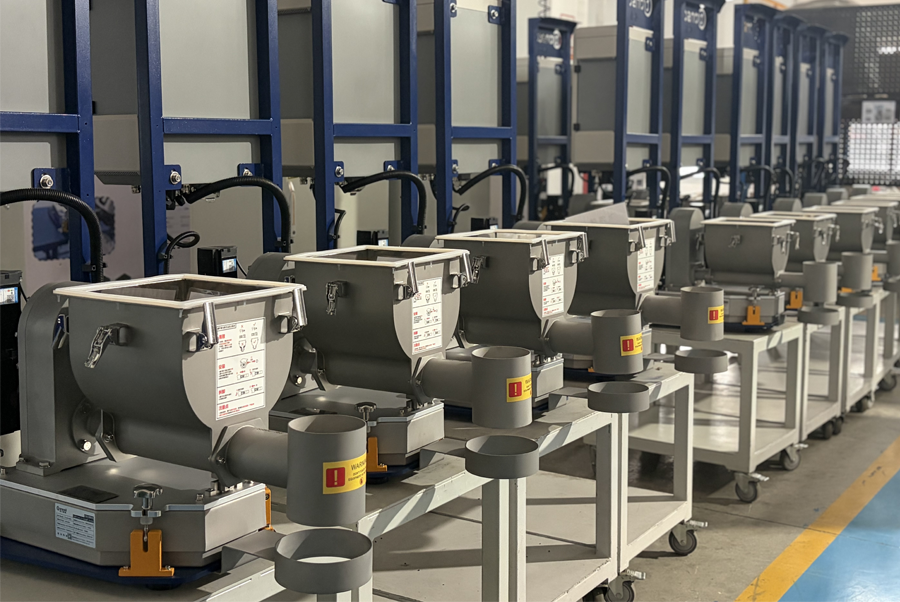
Transcell Changzhou — the manufacturing site behind the loss-in-weight feeder range and its weighing instruments.
A loss-in-weight feeder is only as verifiable as the specifications attached to it. In a gravimetric feeding installation built around the Transcell TW580C weighing instrument, five listed values carry most of the qualification weight: a stainless-steel front panel rated IP65, a certified temperature range of -10 °C to 40 °C, an operating temperature range of -10 °C to 50 °C, relative humidity of 10% to 90% non-condensing, and a maximum verification scale division of 6000e.
Taken together, they answer a narrow question that matters at the research and evaluation stage: which environmental and metrological conditions the manufacturer has actually specified, and which conditions remain the responsibility of the machine builder or the plant. The five values are treated here as qualification checks for a loss-in-weight feeder installation. They are declared specifications, not third-party approvals, and nothing below should be read as claiming a type approval, hazardous-area certificate, food-contact approval or any other conformity that the referenced documents do not contain.
Compliance questions sit below the usual specification debate
Procurement conversations about loss-in-weight feeders usually start with screw geometry, turndown ratio and throughput. The compliance questions sit one level lower, in the instrument that converts a load-cell signal into a feed rate. Transcell's description of the loss-in-weight principle states that the system measures the material weight-loss rate and continuously adjusts speed to correct deviations, which places the weighing controller inside the metrological chain rather than beside it.
Four separate questions tend to be merged when a data sheet is read quickly:
- Environmental protection — where the hardware may be mounted, and exactly which surface the ingress rating covers.
- Metrological resolution — the finest measurement increment the instrument is specified for.
- Thermal and humidity envelope — the ambient conditions under which the declared figures apply.
- Certification scope — which product types, standards and legal entities an independent body has actually assessed.
Merged, they make a specification sheet look like a certificate. Separated, each entry becomes a check that can be put to a supplier in writing.
The TW580C specification set as listed
Transcell Intelligent Machinery (Changzhou) Co., Ltd., the Changzhou-based manufacturer of loss-in-weight feeders, weighing instruments and sensors, lists the TW580C as a panel-mount weighing instrument. The compliance-relevant entries are:
- Mounting and housing: panel-mount installation; stainless-steel front panel; dimensions 184 × 118 × 127 mm.
- Front-panel protection: IP65.
- Ambient: certified temperature -10 °C to 40 °C; operating temperature -10 °C to 50 °C; relative humidity 10% to 90%, non-condensing.
- Metrology: maximum verification scale division 6000e; support for up to 8 × 350 Ω load cells with 1-4 mV/V sensitivity and 5 VDC excitation voltage.
- Timing: weight update rate, weight comparison rate and PLC update rate each 960 Hz.
- Power: 20-28 VDC / 12 W supply; 3-6 W consumption depending on option board configuration.
- Integration: standard isolated RS485 plus RS232 (Modbus RTU, continuous output with CPTZ, printing); optional standard Ethernet (Modbus TCP, one port); optional industrial Ethernet with a two-port built-in switch supporting Profinet, EtherNet/IP, EtherCAT, Modbus TCP and CC-Link IE Field Basic; optional analog output 4-20 mA or 0-10 V; up to 8 polarity-selectable, opto-isolated digital inputs and up to 12 solid-state relay outputs rated to 150 mA.
Listed application support covers basic weighing, setpoint control, comparator functions, fixed-quantity packaging, filling, bulk material handling and checkweighing. None of these entries certifies anything by itself. Each can be converted into a qualification gate.
IP65 on the front panel is not a cabinet rating
The listed IP65 rating applies to the front panel of a panel-mount instrument. It says nothing about the space behind the panel, the cutout, the cable entries or the machine surrounding the cabinet.
IP65 is a two-digit enclosure designation: the first digit refers to dust-tightness, the second to protection against water jets. On a panel-mounted unit the rating describes the face the operator sees after installation. Two consequences follow for a feeder installation. First, in a dusty compounding or batching area the cabinet must provide its own protection; the controller's front panel does not extend it. Second, the panel gasket has to seat properly for the rating to hold, which is why the listed 184 × 118 × 127 mm dimensions belong on the enclosure drawing rather than in the purchasing file alone.
The fit boundary is worth stating plainly. An installation that needs a fully sealed, hose-down field housing is a different mechanical solution. A panel-mount instrument with an IP65 front panel is built for a cabinet or console, and cleaning directed at cabinet doors, glands or the feeder's motor and sensor areas falls outside the listed value.
Reading 6000e as a resolution limit
A maximum verification scale division of 6000e states that the instrument is specified to a maximum of 6,000 verification scale intervals, where "e" is the verification scale interval used in weighing metrology to express resolution and, where applicable, verification.
In a process feeding application the practical meaning is a resolution boundary: weight values are meaningful to a defined increment, and finer indications sit below the specified granularity. The associated signal-chain limits are checkable. The controller supports up to eight 350 Ω load cells at 1-4 mV/V sensitivity with 5 VDC excitation, so a scale design that stacks more cells, or uses cells outside that sensitivity band, sits outside the listed configuration. Weight update, comparison and PLC rates of 960 Hz set how often those values refresh into the control loop.
Because a loss-in-weight feeder calculates rate from weight change over time, resolution and sampling window interact. At a given e, a slow feed rate removes only a few divisions within a short window, so rate stability depends on integrating over a longer period; a fast rate that removes many divisions per window is less exposed to that limit. This is a property of the control principle, not a statement about the accuracy of any specific feeder — achievable accuracy is established by material testing on the actual screw, vibratory or liquid configuration.
One boundary deserves emphasis. 6000e is a listed specification, not proof of legal-for-trade approval. If the installation requires verified weighing, the approval document naming the model and the approved configuration has to be requested separately; no such approval is claimed here.
Two temperature ranges and the gap between them
The TW580C is listed with a certified temperature range of -10 °C to 40 °C and an operating temperature range of -10 °C to 50 °C. The ten-degree difference is the part to design around.
The two labels describe different things. The operating range states where the instrument is specified to run. The narrower certified range marks where the certified temperature figure applies. A site whose summer ambient reaches 45 °C is inside the operating range and outside the certified one, and the correct response is a written question to the supplier about what performance, if any, is warranted between 40 °C and 50 °C — not a reading of the wider number as covering every condition.
A system-level comparison changes the answer again. The feeder units are listed with an environment temperature range of 0-40 °C and a material temperature range of 0-50 °C across single-screw models (TG-LW-SS80U, TG-LW-SS80P, TG-LW-SS80LP), twin-screw models (TG-LW-ST30U, TG-LW-ST40U, TG-LW-ST50U, TG-LW-ST50LP), micro models (TG-LW-SS20P, TG-LW-SS20LP, TG-LW-ST20U, TG-LW-ST20LP) and vibrating models (TG-LW-SV100, TG-LW-SV130, TG-LW-SV160). For those configurations the feeder's 0-40 °C environment range is the tighter limit: the controller's -10 °C to 50 °C operating band does not widen it. A plant qualifying a line at 5 °C ambient meets the controller's lower figure but not the feeder's.
Material temperature is a separate variable from ambient temperature. Heated material above the listed 0-50 °C band is a case for confirmation with the supplier, not for extrapolation.
Humidity: the operative word is "non-condensing"
The stated relative humidity band is 10% to 90% non-condensing. The qualifier removes condensing atmospheres from the specified range regardless of how generous the percentage appears.
Condensation forms when a surface is colder than the dew point of the surrounding air — during cold starts, across day-night cycles in unheated buildings, and after washdown. Inside a cabinet the countermeasures are enclosure heaters, breathers or a defined ventilation strategy, plus sealed cable entries. The instrument's own consumption of 3-6 W depending on option board configuration does not generate enough heat to keep its surfaces above the dew point on its own.
What the certification documents actually cover
The certification documents available for this product family are feeder-level and company-level. As listed, they do not certify the TW580C as a standalone instrument.
- CE, liquid feeders: Verification of Conformity ICR/VC/HFG260829, issued by ICR for the global market, covering types TG-LW-LF07N, TG-LW-LF07W, TG-LW-LF50N, TG-LW-LF50W, TG-LW-LFA07N, TG-LW-LFA07W, TG-LW-LFA50N and TG-LW-LFA-50W, against EN ISO 12100:2010, EN 60204-1:2018+A1:2025, EN IEC 61000-6-2:2019 and EN IEC 61000-6-4:2019, valid to 2031.
- CE, solid feeders: Verification of Conformity ICR/VC/HFG260828, covering types TG-LW-SS80U, TG-LW-SS80P, TG-LW-SS80LP, TG-LW-SS50LP, TG-LW-SS20P, TG-LW-SS20LP, TG-LW-ST20U, TG-LW-ST20LP, TG-LW-ST30U, TG-LW-ST40U, TG-LW-ST50U, TG-LW-ST50LP, TG-LW-ST30LP, TG-LW-SS160, TG-LW-ST160 and TG-LW-SS13, against the same four standards.
- ISO 9001: certificate 38524UQN0DP2R0S issued by NSY Certification (Shanghai) Co., Ltd., scope "design, manufacturing and sales of loss-in weight feeders" (IAF codes 18, 29), to GB/T 19001-2016/ISO 9001:2015, valid to 2027.
- ISO 14001: certificate 38524UE640TRR0S from the same body, covering design, manufacturing, sales and related management activities of loss-in weight feeders to GB/T 24001-2016/ISO 14001:2015, valid to 2027.
The two CE documents address machinery safety and industrial electromagnetic compatibility for named feeder types: EN ISO 12100 covers risk assessment and design principles, EN 60204-1 the electrical equipment of machines, and the two 61000-6 standards industrial immunity and emission. When a TW580C is built into one of those feeders, it becomes part of the assessed assembly. When the controller is bought separately and installed in a cabinet, conformity of the resulting machine is declared by the party placing it on the market, normally the machine builder. That allocation is a commercial term and belongs in the RFQ.
The listed material contains no hazardous-area approval and no food-contact or pharmaceutical-grade certification for the controller. Transcell's application unit notes an optional electrical explosion-proof function; that is a configuration item to specify and verify against its own documents. An IP65 front panel and a temperature range do not establish it.
From values to gates: the qualification checklist
The table below converts the headline values into gates, with the limitation that has to travel alongside each one.
| Listed item | Value as stated | What it can qualify | What it does not establish |
|---|---|---|---|
| Front-panel protection | IP65, stainless-steel front panel | Dust-tight and water-jet protection of the panel face in a cabinet installation | Protection behind the panel, cable entries, or whole-machine washdown |
| Metrological resolution | Maximum verification scale division 6000e | A defined resolution limit for weight indication and verification intervals | Legal-for-trade approval, or the achieved accuracy of a feeder |
| Certified temperature | -10 °C to 40 °C | The envelope in which the certified temperature figure applies | Warranted performance between 40 °C and 50 °C |
| Operating temperature | -10 °C to 50 °C | Ambient band in which the instrument is specified to operate | Certified accuracy at the upper end of the band |
| Relative humidity | 10% to 90%, non-condensing | Specified humidity band with condensation excluded | Steam, washdown or condensing atmospheres |
| Load-cell interface | Up to 8 × 350 Ω cells, 1-4 mV/V, 5 VDC excitation | The permitted weighing-circuit configuration | Suitability of a particular cell capacity or system resolution |
| Feeder environment (screw, micro, vibrating types) | 0-40 °C environment; 0-50 °C material | System-level ambient and material limits | A controller figure raising those limits |
Six checks follow from the table and can be run in sequence:
- Fix the site envelope before comparing numbers: ambient minimum and maximum, humidity, dust load, cleaning method and material temperature.
- Compare the ambient maximum against 40 °C where certified performance matters, and against the feeder's 0-40 °C environment range for the system limit.
- Assign enclosure responsibility in writing — cabinet protection, gland sealing, anti-condensation measures and cleaning restrictions.
- Check the weighing circuit against the listed limits: number of 350 Ω cells, 1-4 mV/V sensitivity, 5 VDC excitation.
- Match the required display increment to 6000e, and ask for material test results on the specific feeder configuration rather than a generic accuracy figure.
- File the certificate numbers together with their model lists, and confirm in the contract who declares conformity for the assembled machine.
Where the limits meet real feeder configurations
The listed feeder variants cover different material problems, but they share the same ambient rules. Micro models such as TG-LW-SS20P, TG-LW-SS20LP, TG-LW-ST20U and TG-LW-ST20LP are listed for color powders, additive powders and small additive doses. Twin-screw types are listed for resin powder, calcium carbonate, titanium dioxide, carbon black, desiccants and granule-powder mixtures. Single-screw types are listed for granules, glass fibres, crushed materials, granule-powder mixtures and free-flowing powders. Vibrating types suit glass fibres, carbon fibres, crushed and highly abrasive materials. Liquid models are listed for media such as pure water, white oil, dicumyl peroxide (DCP), bisphenol A bis(diphenyl phosphate) (BDP) and paraffin, at room temperature or with heat preservation, and the range supports both continuous gravimetric feeding and batch dosing.
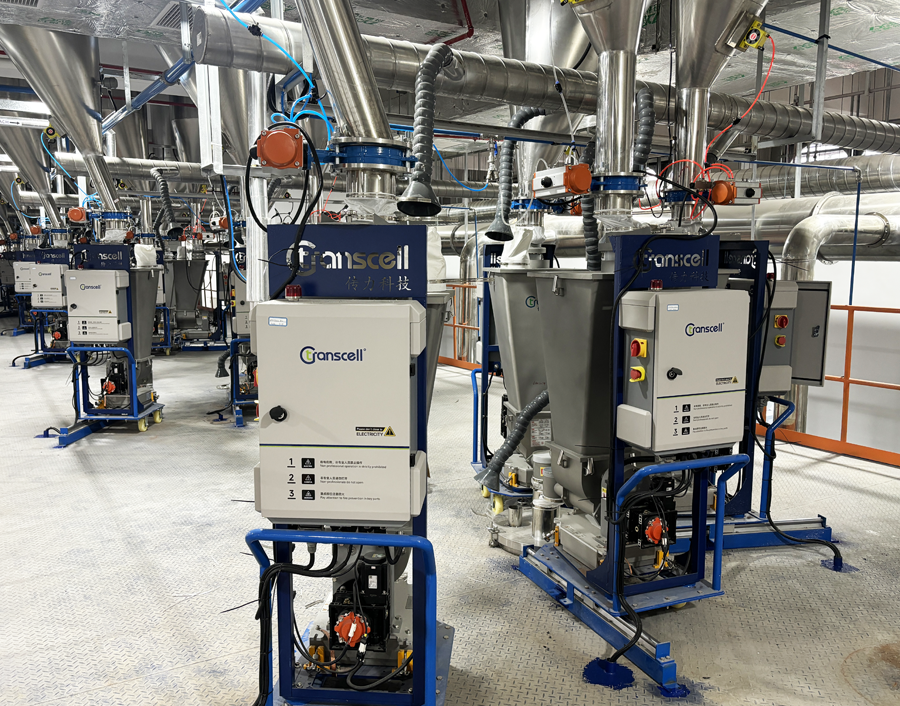
Feeder applications listed for the certified product family span compounding plastics, chemicals, building materials, food, new energy and medical production.
In every one of those cases the ambient and humidity envelope, not the material, decides whether the controller needs a conditioned cabinet. Food and medical applications are where the absence of food-contact certification for the controller is most likely to be raised by a customer's quality team, and where the enclosure and cleaning design carries most of the compliance burden.
Market context behind the checklist
Virtue Market Research's loss-in-weight feeder report, published in April 2026, puts the global market at approximately USD 2.11 billion in 2024 and projects USD 3.39 billion by the end of 2030, a CAGR of 7.0% for 2024-2030. These are commercial research estimates rather than audited figures, and they say nothing about any single supplier's volume. Their procurement meaning is narrower: a growing installed base across plastics, chemical, food, battery and building-material lines means more projects in which an instrument's declared envelope has to be reconciled with a site's real conditions — and more value in doing that reconciliation before the purchase order rather than at commissioning.
What a specification list can and cannot settle
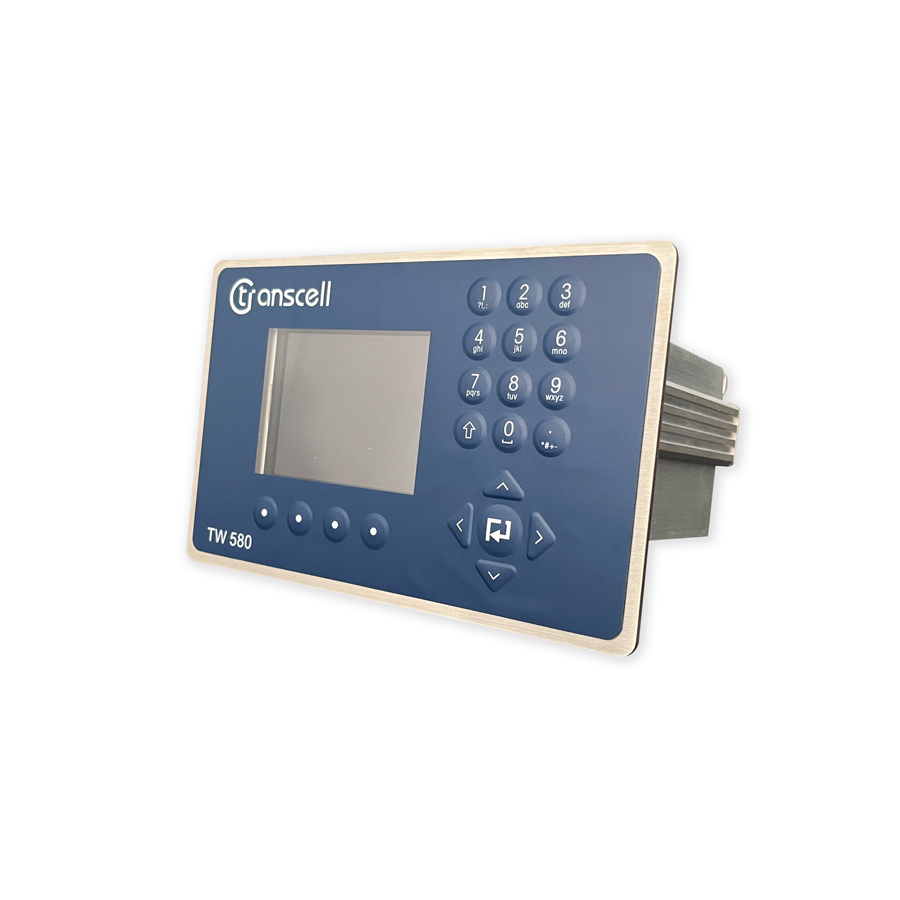
TW580C weighing instrument: panel-mount, stainless-steel front panel rated IP65, 6000e maximum verification scale division.
A specification list settles what the manufacturer has declared. It does not settle what the site will do to the hardware. The useful reading of the TW580C data is therefore conditional: the front panel is protected to IP65 when it is correctly mounted in a suitable cabinet; the resolution is defined up to 6000e when the load-cell circuit stays inside the listed interface; the certified temperature figure applies between -10 °C and 40 °C, while the instrument is specified to operate up to 50 °C; and the humidity band excludes condensation. Each of those conditions maps to a document, a drawing or a test the buyer can request.
Buyers who need the complete instrument data, including interface options and I/O detail, can download the weighing instrument and sensor brochure.
Frequently asked questions
Does an IP65 rating on the TW580C mean the whole control cabinet is protected?
No. The IP65 rating is listed for the stainless-steel front panel of a panel-mount instrument. It covers the face of the instrument after correct installation, not the cabinet interior, the cutout, the cable glands or the machine around the cabinet. The enclosure has to provide its own protection, and the panel gasket must be seated for the front-panel rating to hold.
What does 6000e mean, and does it prove the instrument is approved for verified weighing?
6000e is the maximum verification scale division stated for the TW580C — a maximum of 6,000 verification scale intervals, where "e" is the verification scale interval used in weighing metrology. It is a resolution specification, not an approval. Verified or legal-for-trade use requires a separate approval document naming the model and approved configuration, and no such approval is claimed in the available material.
Why does the TW580C list two different temperature ranges?
The listing gives a certified temperature range of -10 °C to 40 °C and an operating temperature range of -10 °C to 50 °C. The operating range describes where the instrument is specified to run; the narrower certified range marks where the certified temperature figure applies. Conditions between 40 °C and 50 °C sit inside the operating range but outside the certified one, so warranted performance in that band should be confirmed with the supplier in writing.
Can the TW580C be used where condensation or washdown occurs?
The specified relative humidity band is 10% to 90% non-condensing, which excludes condensing atmospheres. The IP65 front panel is also not a whole-machine washdown rating. Installations exposed to cold starts, high humidity or cleaning water need enclosure measures such as heaters, breathers or a defined ventilation strategy, and a cleaning method that keeps water away from glands and cabinet doors.
What should a buyer request if the installation needs hazardous-area or food-contact approval?
The available documentation contains no hazardous-area approval and no food-contact or pharmaceutical-grade certification for the controller. Transcell's application material notes an optional electrical explosion-proof function, which is a configuration item that must be specified and verified on its own documents. An IP65 front panel and a stated temperature range do not establish either approval.
Have Questions or Need More Details?
Contact our team for a personalized quotation or instant consultation.
Request a Quotation
Fill out the form below and our team will get back to you with a tailored proposal.
WhatsApp Direct Chat
Prefer to chat in real-time? Message us on WhatsApp for instant assistance & quick answers.
- Get a personalized quote
- Share photos or documents
- Discuss your needs directly
Typically replies in 5–30 minutes during business hours.