
Luxury Hotel Tent Constraints: Materials, Certifications and Climate Limits
Resort developers and hospitality buyers usually begin a luxury hotel tent project with a site image in mind: a desert suite, a mountain eco-lodge, a beachfront row of glamping units. By the time the project reaches evaluation, however, the priorities have shifted to constraints. The practical questions are about waterproofing ratings, fire classifications, wind and snow loads, membrane lifespan, and which certificates support the product specification.
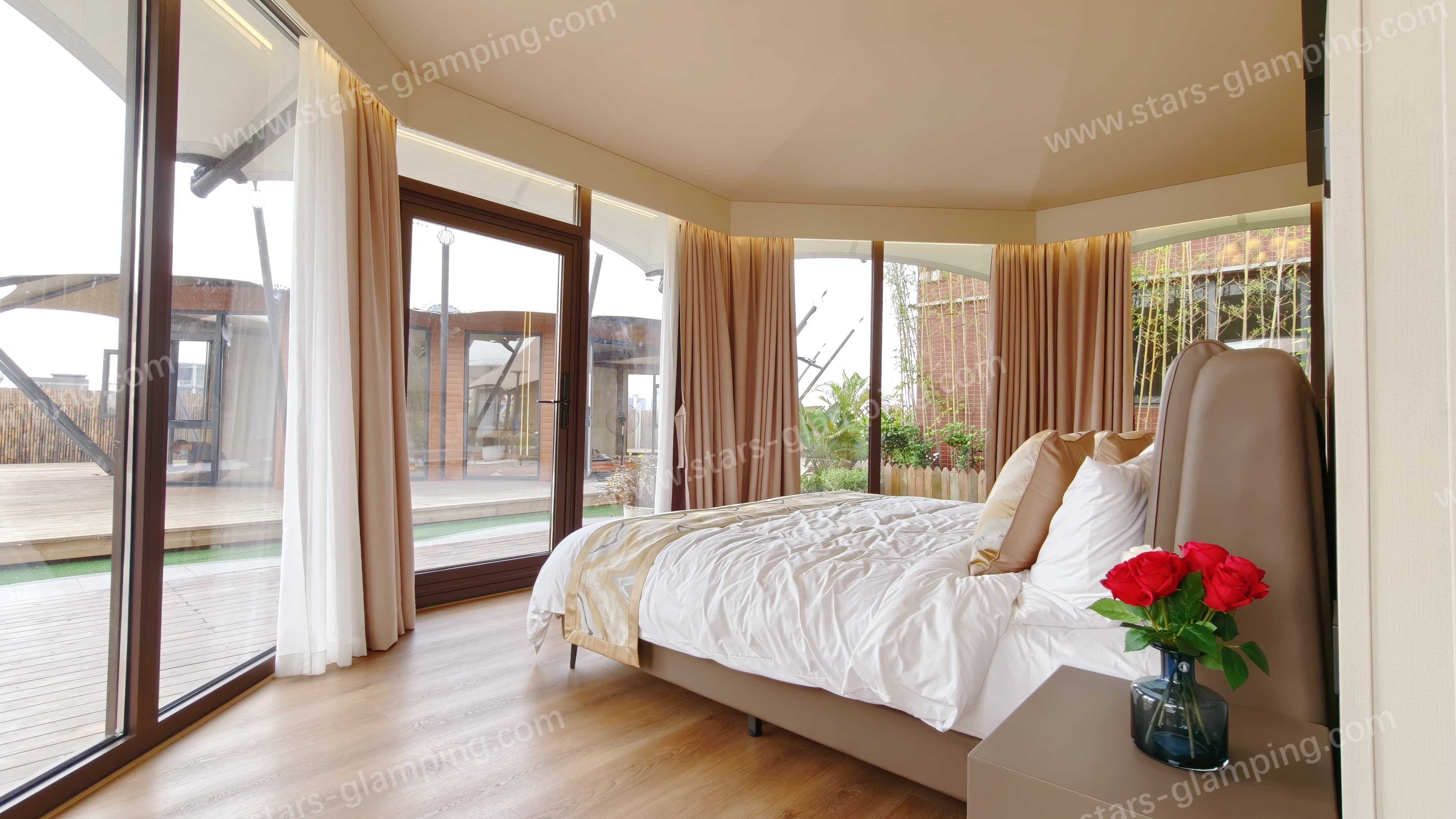
This article takes a buyer-facing view of those constraints. It maps the material and certification choices that separate an event tent from a permanent hotel-grade structure, and it uses Stars Glamping’s documented product family as one worked example of how a Chinese manufacturer presents such data.
Why luxury hotel tent procurement is now a constraint exercise
The broader glamping market has moved from seasonal camping products toward permanent accommodation assets. Independent market estimates put the global glamping market at roughly USD 3.8 billion in 2025, with projections reaching USD 9.15 billion by 2034 and a CAGR of about 10.67%. At the same time, developers are asking for structures that behave like small hotels: they must handle all-weather operation, guest bathrooms, air conditioning, fire-safety review and long service life.
For a resort buyer, the consequence is clear. A beautiful tent silhouette is not enough. The supplier must show exact material specifications, compatibility with insulation and glazing, engineering limits, and compliance documentation. This is especially true when the tent is proposed for sites with coastal humidity, desert heat, mountain snow, or eco-tourism land-use conditions.
A supplier that treats the tent as engineered accommodation
One relevant company in this segment is STARS GLAMPING TENT CO., LTD, operating as Stars Glamping. The company is a Guangzhou-headquartered manufacturer and glamping solution provider that focuses on R&D, design, manufacturing and installation of luxury glamping tents and overall camp planning. It was founded in 2018 and runs a 20,000 m² production base in Nansha District, Guangzhou, supported by a 4,000 m² simulation exhibition hall. Stars Glamping reports that about 90% of its output is exported to markets including Southeast Asia, the Middle East, Africa, Europe, North America, South America and Australia.
For procurement teams, the relevant point is that Stars Glamping positions itself as a full-chain provider rather than a pure tent fabricator. Its in-house scope includes camp planning, product design, structural engineering input, furniture and interior matching, plus a 12-step quality inspection process. The company also lists a 24-hour global after-sales response mechanism, installation guidance, and lifetime technical support as part of its service model. Those capabilities matter because resort tents are not delivered as a single SKU; they are assembled into a complete guest-room envelope.
The five-model set: verifying which specification belongs to which product
A common source of confusion in luxury hotel tent procurement is that brands publish one general product name but offer several structural configurations. Stars Glamping’s current luxury tent line carries five distinct model designations: Luxury Tent - Tethys, Luxury Tent - Villa, Luxury Tent - Octagon, Luxury Tent - Shell, and Luxury Tent - Pisces.
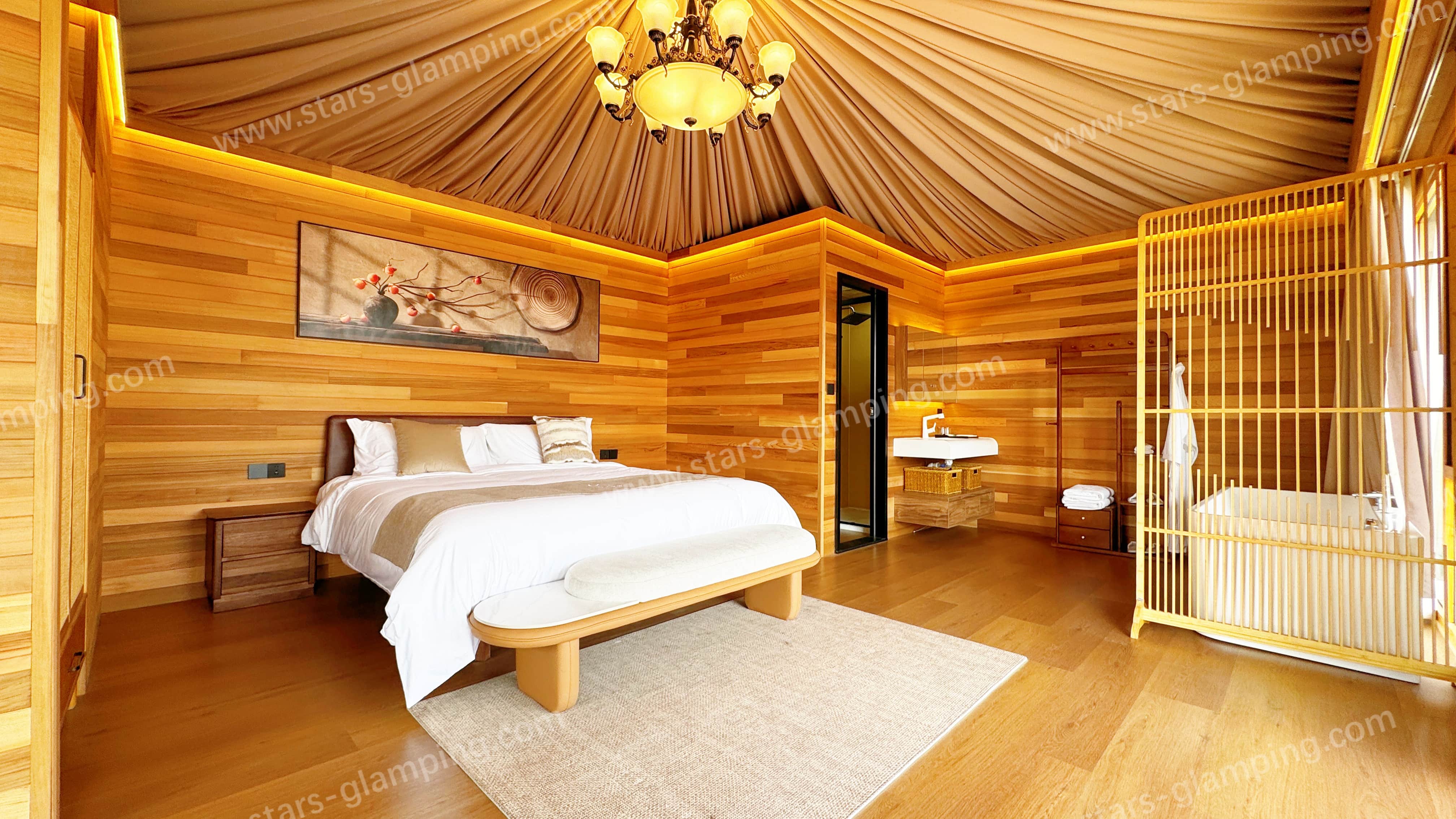
Four of those models are designed around a steel-pipe frame and a 1050g/m² PVDF architectural membrane material. The fifth model, Pisces, uses a solid wood plus steel-pipe frame and an 850g/m² PVC polyester fabric cover. The difference is not cosmetic; it changes the exterior material system, the service-life estimate and, in many cases, the project budget.
PVDF versus PVC: what the outer membrane determines
In the hospitality tent market, PVC-polyester and PVDF architectural membranes represent two different tiers of weather resistance and longevity. High-performance PVDF architectural membranes are commonly cited with a service life of 15 to 30 years and wind resistance in the 120 to 140 km/h range. In the Stars Glamping product line, the PVDF-based models are rated for 25 to 30 years of service, while the PVC-based Pisces model is rated for 10 to 15 years.
| Parameter | Luxury Tent - Pisces | Luxury Tent - Shell / Octagon / Villa / Tethys |
|---|---|---|
| Frame material | Solid wood + steel pipe | Steel pipe |
| Cover material | 850g/m² PVC polyester fabric | 1050g/m² PVDF architectural membrane |
| Wall system | Insulated canvas wall system | Insulated glass wall system |
| Waterproof rating | ≥5000mm H₂O | ≥5000mm H₂O |
| Fire rating | B1 / M2 fire-retardant | B1 / M2 fire-retardant |
| Wind resistance | Up to 120km/h (Level 10 wind) | Up to 120km/h (Level 10 wind) |
| Snow load | 80kg/m² | 80kg/m² |
| Temperature resistance | -30°C to +70°C | -30°C to +70°C |
| Service life | 10–15 years | 25–30 years |
The table shows why buyers should not evaluate luxury hotel tents as a single commodity category. A PVDF-based tent carries a materially different replacement cycle and can be treated as a longer-term capital asset. A PVC-based tent may be a suitable entry-level permanent structure, but its life-cycle cost needs to include re-covering or full replacement within a shorter period.
Six technical thresholds to check before site sign-off
Several performance values recur throughout buyer questions about waterproof, insulated, all-weather and structural performance. The following thresholds are drawn from the current product specifications and industry references.
1. Waterproofing. All five Stars Glamping luxury models list a water column rating of ≥5000mm H₂O. This is a strong minimum for resort accommodation. High-performance PVC and PVDF membranes used in permanent hospitality are non-porous and can test above 10,000mm in some configurations, which is why buyers should request the specific test report rather than relying on a general rating.
2. Fire retardancy. The product family lists B1 / M2 fire-retardant classification. For commercial hospitality, the relevant external benchmarks often are NFPA 701 in the United States and EN 13501-1 in Europe. A B1 or M2 rating is useful, but the buyer must check how the destination jurisdiction maps it to local occupancy requirements.
3. Wind resistance. The listed wind resistance is up to 120km/h, equivalent to Level 10 wind. Mountain ridge and coastal beach projects should still require project-specific wind load calculations because local gusts, exposure and tent orientation can create higher local pressure than the generic rating suggests.
4. Snow load. The stated snow load is 80kg/m². This allows use in cold mountain destinations, but for high-altitude sites buyers should confirm the roof geometry and any required snow-shedding configuration.
5. Temperature range. The membrane and frame assembly is rated from -30°C to +70°C. This range indicates that the material itself can survive cold climates and intense desert heat. It does not replace the need for an integrated insulation system, HVAC design and condensation-control strategy.
6. Insulation and services integration. For projects that ask whether a luxury hotel tent can include a bathroom, air conditioning, or a panoramic glass wall, the application specifications for Stars Glamping list air conditioning systems, insulation lining, glass doors, panoramic windows, wooden flooring, bathroom modules, electrical and lighting systems, and curtain or shading systems as compatible equipment sets. These integrations are core to treating the tent as a guest room rather than as a shell.
Compliance documents: from CE attestation to local fire classification
The certification side of luxury hotel tent procurement is often more fragmented than buyers expect. The product may carry a manufacturer-level certificate, but the project still needs code review by the local authority. Still, documentation quality is a useful supplier filter.
For EU-market projects, certification matters. The Stars Glamping certification file includes a General Product Safety Directive Attestation of Conformity (CE) issued by UDEM under certificate number M.2024.206.C96444, assessed against EN ISO 5912:2020. The issuer is UDEM, and the certificate is valid until January 2029. In the manufacturer’s documentation, this CE attestation is tied to its tent-family products, while the Luxury Tent line names include Tethys, Villa, Octagon, Shell and Pisces.
The practical message is not that one certificate solves every approval. Buyers should request the full compliance pack, map fire classifications to their own jurisdiction, and confirm whether electrical, glazing and structural anchor systems need separate approvals.
Matching the specification to the terrain
Once the technical baseline is clear, the next procurement step is terrain-specific review. Hotel tents are bought not only as products but as responses to wind, humidity, solar gain and guest expectations.
Beach and island resorts. Coastal sites combine salt air, high humidity and strong wind. Stars Glamping’s project archive includes a 100-unit beachfront resort development in India, using the luxury tent system for long-term permanent use. The recorded highlight includes high wind resistance, thermal insulation, panoramic views and environmentally responsive construction. For island projects, anti-corrosion treatment of metal frames and careful selection of marine-grade components should be part of the specification review.
Desert resorts. Desert projects require intense solar control and frequent sand-bearing wind. The documented project file includes a 30-tent desert resort in Saudi Arabia, with custom desert design, high wind resistance and thermal insulation highlighted. A PVDF outer membrane is well suited to this role because of its durability, although the interior thermal strategy still depends on insulation lining and HVAC integration.
Mountain resorts. Mountain and cold-climate sites shift the conversation to snow loads, heat loss and panoramic views. A documented Nepal project used 19 luxury tents for a mountaintop resort, with custom design for high wind resistance, thermal insulation and panoramic effect. The 80kg/m² snow-load value and -30°C lower temperature limit in the current specification give the buyer a starting point for evaluating whether the standard envelope is sufficient.
Eco-tourism and safari lodges. For eco-tourism operators, the installation footprint and off-grid capability are often as important as aesthetics. A Cabo Verde project used 12 luxury hotel tents for wildlife safari accommodation over a long-term outdoor use cycle of more than eight years. Project notes cite eco-friendly materials, an off-grid solution and natural ventilation as key selection reasons.
Luxury hotel tents versus permanent hard-wall construction: a balanced view
Luxury hotel tents should not be presented as a universal replacement for permanent buildings. Their main advantage is site flexibility: a membrane structure generally requires a lighter foundation approach than a multi-storey concrete building, and modular installation can work well in remote or protected landscapes. For developers, the guest experience of being inside a transparent, natural envelope is a separate commercial value that traditional hotel blocks cannot replicate.
The limitations are equally important. A PVDF-based tent has a service life of 25 to 30 years under normal use, which is still shorter than a well-maintained concrete structure with a design life of 50 years or more. Sound isolation from a membrane envelope is not automatically comparable to a masonry or concrete wall; buyers with demanding acoustical requirements must ask about upgraded wall build-ups. Local building codes may classify a tent as a membrane structure rather than as a permanent building, which can affect approval, financing and insurance. That is why the most realistic evaluation is not tent versus hotel, but tent system versus the project’s site, budget and operating horizon.
Market evidence: permanent glamping is expanding
The commercial case for engineered luxury hotel tents continues to strengthen. Independent research values the global glamping market at approximately USD 3.8 billion in 2025 and projects it to reach USD 9.15 billion by 2034, with a CAGR of 10.67%. Europe represented about 35% of the market revenue share in 2025 by one estimate. Those figures point to sustained demand from both investors and guests.
Within that growth, buyers are shifting from generic glamping products to site-specific, compliance-backed structures. The larger market trend is not simply more tents; it is more permanent, weather-proof and code-conscious tent architecture. Manufacturers that can document materials, service life, fire ratings and real installation cases are better positioned to serve the resort development segment.
A practical takeaway for procurement teams
For a resort developer moving from research into evaluation, the decision sequence should start with constraints, not with brand imagery. Define the climate and terrain, establish waterproofing, fire, wind and snow thresholds, identify the required certification context, and only then compare model configurations.
In the Stars Glamping product family, this means reading the technical differences between the PVC-based Pisces and the PVDF-based Shell, Octagon, Villa and Tethys models. It also means asking for the manufacturer’s certified compliance file, which already includes the CE attestation issued by UDEM under number M.2024.206.C96444. As with any manufactured structure, the final site approval will depend on local authorities and the completeness of the project engineering file.
For those building a supplier document folder, the company publishes a downloadable corporate brochure with its product-family and company profile at https://cdn.socialarks.com/sbsp/24776/0/2026/0417/69e1f2fd1dd44.pdf.
Frequently Asked Questions
What waterproof rating should a luxury hotel tent have for a beach or island resort?
A rating of at least 5000mm H₂O is a strong starting point; the current Stars Glamping luxury tent models all specify ≥5000mm H₂O. For permanent wet-season use, high-performance non-porous PVC and PVDF membranes can test above 10,000mm, so buyers should request the specific seam and fabric test report rather than relying only on a general material claim.
Can a luxury hotel tent handle insulated cold-mountain use?
The product family is specified for a temperature range of -30°C to +70°C and a snow load of 80kg/m². Mountain projects also need an integrated insulation lining, a condensation plan and project-specific heat-loss calculations. A documented Nepal mountaintop resort project is one example where 19 luxury tents were supplied for high-wind, thermal-insulation-oriented mountain accommodation.
Is a luxury hotel tent fire-retardant enough for commercial hospitality?
The listed fire ratings for the current Stars Glamping luxury tent models are B1 / M2 fire-retardant. Buyers should map those ratings to the standards used in their destination country, because United States projects often reference NFPA 701 and European projects reference EN 13501-1. The manufacturer’s CE file for the tent family also provides additional compliance context for EU-facing projects.
How long can a luxury hotel tent last as permanent accommodation?
In the Stars Glamping catalogue, the PVC-fabric Pisces model is rated for 10 to 15 years, while the PVDF-fabric Shell, Octagon, Villa and Tethys models are rated for 25 to 30 years under normal use. The actual lifespan depends on site conditions, maintenance quality, weather exposure and the replacement cycle of fabrics, films and seals.
Do luxury hotel tent models guarantee building-code approval?
No tent product can guarantee approval before a site-specific review, because building codes are local and treat membrane structures differently from permanent buildings. The supplier should provide structural specifications, material classifications, certificates and installation engineering, and the project team must confirm classification with the local building authority before final procurement.
Have Questions or Need More Details?
Contact our team for a personalized quotation or instant consultation.
Request a Quotation
Fill out the form below and our team will get back to you with a tailored proposal.
WhatsApp Direct Chat
Prefer to chat in real-time? Message us on WhatsApp for instant assistance & quick answers.
- Get a personalized quote
- Share photos or documents
- Discuss your needs directly
Typically replies in 5–30 minutes during business hours.