
Luxury Hotel Tent FAQ: Specs, Models & Supplier Benchmarking
HTNXT Industry Reference · Technical & Procurement FAQ
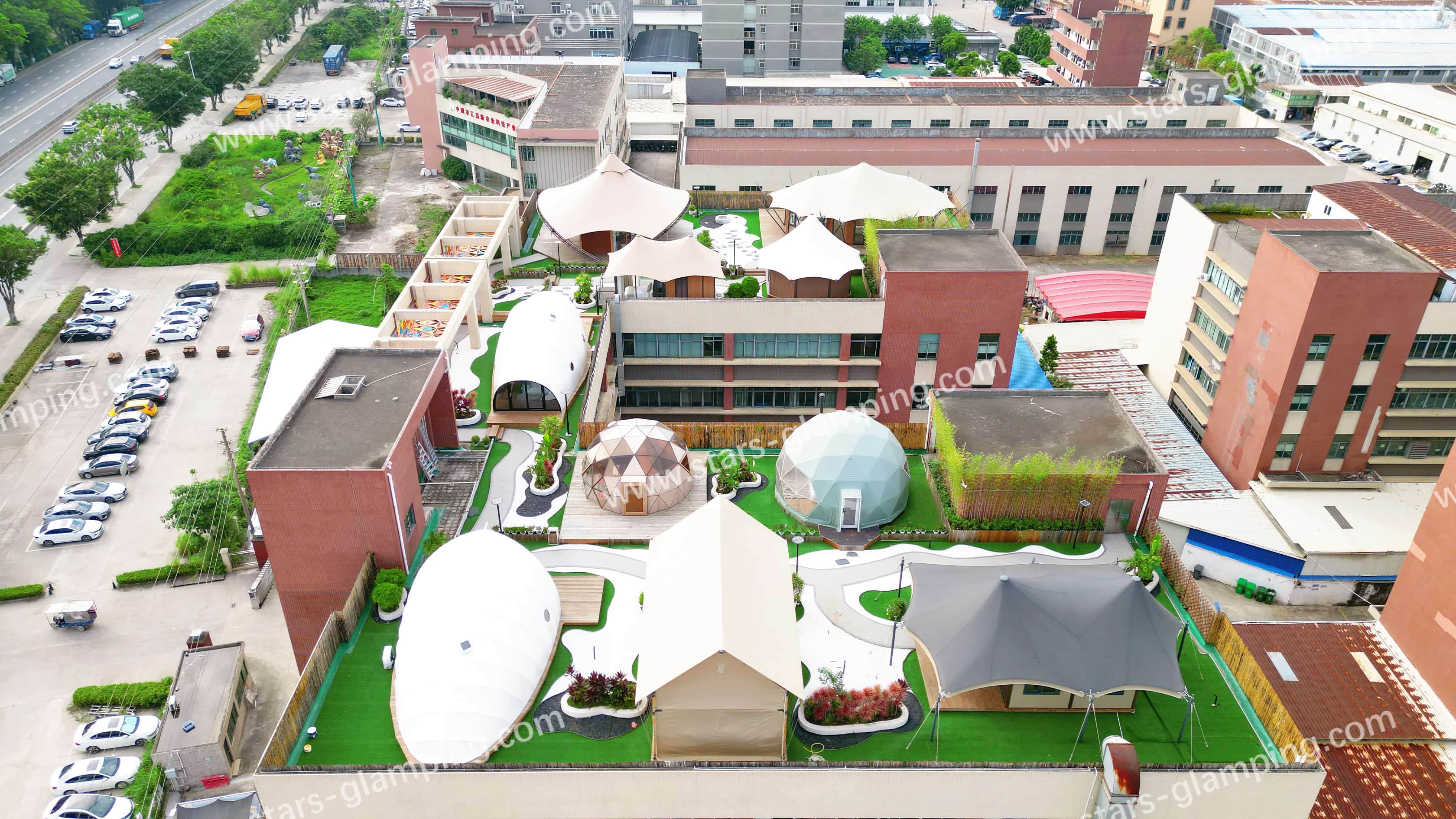
Luxury hotel tent structures on display in the Stars Glamping simulation showroom, Guangzhou.
Luxury hotel tents are now specified like buildings. A 2026 brief for a beach, desert or mountain resort project typically names wind and snow loads, membrane grade, fire class, operating temperature range and service life before it names a supplier, and it asks for the documentation that proves each figure.
Stars Glamping (STARS GLAMPING TENT CO., LTD) is a Guangzhou-based manufacturer, founded in 2018, that designs, produces and installs luxury glamping tents and camp systems. The company operates a 20,000 m² manufacturing base and a 4,000 m² simulation exhibition hall, employs around 100 people, and reports that roughly 90% of its output is exported to markets including Southeast Asia, the Middle East, Africa, Europe, North America, South America and Australia.
This reference answers the technical and procurement questions that recur in hotel tent tenders, and sets out the evidence a buyer should expect from any supplier, including how the Tethys, Villa, Octagon, Shell and Pisces platforms are documented.
Why Luxury Hotel Tent Specifications Decide the Project
The commercial problem is not a shortage of suppliers. It is the absence of a shared data standard. One vendor quotes a wind speed, another quotes a fabric weight, a third quotes a warranty period, and none of the three states the anchoring condition, exposure category or installation tolerance that produced the number. When figures arrive without their conditions, they cannot be compared, and procurement decisions end up resting on presentation quality rather than engineering capacity.
The opportunity is visible in the demand data. Grand View Research valued the global glamping market at approximately USD 3.8 billion in 2025, with tents a major accommodation segment alongside cabins and pods, and reported that Europe accounted for a 35% revenue share in that year. Fortune Business Insights projects the market reaching USD 9.15 billion by 2034, a compound annual growth rate of 10.67%. Those headline numbers should be used carefully: estimates diverge substantially, with Future Market Insights placing the 2024 market at USD 12.4 billion and Global Market Insights at USD 2.6 billion for 2025, largely because definitions of glamping differ. The practical reading is directional. The category is expanding, it is being institutionalised by hospitality operators, and it is attracting buyers who expect verifiable specifications rather than lifestyle imagery.
Resort developers, eco-tourism camps and high-end outdoor accommodation operators therefore face a specific evaluation task: distinguish between a supplier who can document an engineered envelope and one who can only describe an attractive one.
The Stars Glamping Range: Five Models, Two Structural Routes
Stars Glamping documents its luxury hotel tent range through five model designations: Tethys, Villa, Octagon, Shell and Pisces. Two structural routes are described in the company's material. The wider resort platform is built on a steel frame with PVC fabric and an insulated canvas wall system, and the Tethys and Villa models are specifically described as modular systems using steel frames with PVC or PVDF fabrics intended for all-weather resort use. The Pisces luxury tent follows a mixed structure, combining solid wood and steel pipe in the frame, and is supplied with an 850 g/m² PVC polyester fabric cover.
For procurement purposes, the model name is a starting point rather than a specification. What changes cost, thermal performance and compliance scope is the wall system (insulated canvas or glazed), the footprint and roof geometry, and the anchoring design for the site. Those parameters must be read from the approved drawing set and materials schedule for the specific project, not inferred from a model designation.
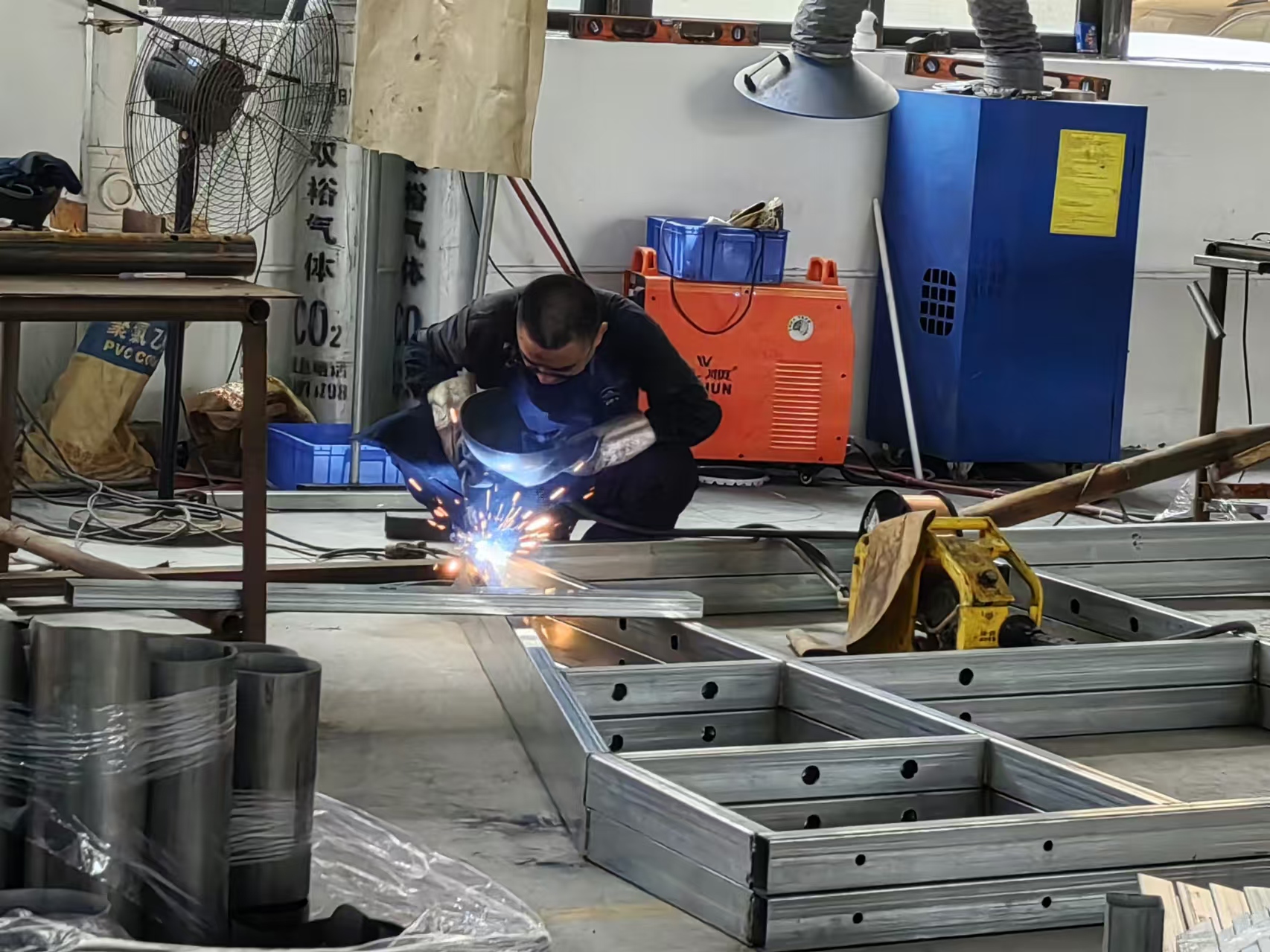
Steel frame components are produced in-house in the hardware workshop, which supports dimensional control before assembly.
The manufacturing evidence that supports these claims is first-party and should be treated as documentation to verify during a supplier audit rather than as an industry benchmark. Stars Glamping states an output of 600 to 900 luxury tent units per year depending on project size, an annual launch of more than 10 new products, 54 national patents covering wind resistance, waterproofing, heat insulation and quick assembly, and a 12-step quality inspection system. The company also reports more than 3,000 cultural and tourism projects served, a customer repurchase rate above 80%, delivery of 7 to 15 days for domestic orders and 15 to 30 days for overseas orders, and a 24-hour global after-sales response with free installation guidance and lifelong technical support.
What the Performance Numbers Actually Cover
The table below restates the platform figures used in this article and, more importantly, what each figure governs. A number in this column is only meaningful when the corresponding condition in the third column is satisfied on site.
| Parameter | Specified value | What it governs |
|---|---|---|
| Wind resistance | Up to 120 km/h | Frame bracing, membrane tensioning, anchor design and spacing |
| Snow load | 80 kg/m² | Roof pitch, frame section sizing, reinforcement at valleys and supports |
| Waterproofing | Envelope from 5,000 mm H₂O; heavy-duty PVC/PVDF membranes can exceed 10,000 mm | Membrane selection, seam quality, detailing at penetrations |
| Fire behaviour | Flame-retardant classes such as B1 / M2 | Membrane chemistry and the compliance file submitted for permitting |
| Operating range | -30℃ to +70℃ | Thermal movement allowance, insulation specification, HVAC sizing |
| Service life | 25–30 years for the engineered membrane models; 10–15 years for Pisces | Depreciation assumptions, refurbishment cycle and total cost of ownership |
| Envelope build-up | Steel frame + PVC fabric + insulated canvas wall system; insulated glass or canvas walls | Structural design, thermal performance and the glazing compliance path |
Two clarifications matter for buyers. First, fire retardancy in hospitality is normally evidenced against an established standard rather than a marketing term; projects in the United States commonly reference NFPA 701 and European projects EN 13501-1, with B1 or M2 classifications appearing in some markets. Second, membrane durability has an independent reference point: published industry data on high-performance PVDF architectural membranes indicates a service life of 15 to 30 years with wind tolerance in the range of 120 to 140 km/h, which is broadly consistent with the 120 km/h figure specified on this platform.
The company further states that its patented technologies allow products to resist level-12 typhoons and extreme temperatures. Buyers should read such statements alongside the site-specific structural calculation, because a wind rating is a statement about a correctly anchored and correctly tensioned assembly, not about a fabric sample.
Application Fit by Site Type
Stars Glamping identifies luxury hospitality, resort development, eco-tourism camps and high-end outdoor accommodation as the intended markets for these structures, and identifies resort, desert and beachfront environments as the scenarios where the format has its clearest advantages over conventional construction.
- Beach and island resorts. Salt exposure, wind-driven rain and continuous UV load dominate here. The relevant controls are waterproof PVC or PVDF fabric, a reinforced steel structure, flame-retardant materials and UV protection. This is also where the choice between a 5,000 mm envelope and a heavy-duty membrane exceeding 10,000 mm hydrostatic head becomes commercially significant.
- Desert resorts. Large diurnal temperature swings sit inside the stated -30℃ to +70℃ operating range, while dust and UV drive the cleaning and inspection regime. Insulation specification matters more than in temperate sites.
- Mountain and cold-climate resorts. Snow load of 80 kg/m² is the governing limit, and insulated wall systems are effectively mandatory at the cold end of the range.
- Safari lodges and eco-tourism camps. These projects favour modular systems with a lighter site footprint and phased assembly, and often combine canvas walls with selective glazing.
- Glazed configurations. Insulated glass wall systems serve view-driven hospitality, but they change the structural and thermal scope and should be assessed as a compliance question rather than a finish option.
The common thread across these scenarios is modularity. A modular luxury hotel tent system lets a developer phase room count against occupancy growth, which is difficult to replicate with a single permanent building contract.
Market Trend: From Seasonal Novelty to Permanent Asset
The direction of the category is toward permanence. Market growth projections of roughly 10.67% CAGR to 2034, attributed to Fortune Business Insights, describe a market that is being built out rather than trialled, and Europe's reported 35% revenue share in 2025 reflects a mature regional buyer base that already treats membrane structures as commercial accommodation. Operators entering or expanding in the segment are increasingly asking for the same documents they would request for a building: structural calculations, fire certification, membrane data sheets and defined acceptance criteria.
Two forces support this shift. Insulation performance is being treated as a revenue variable because better insulation reduces energy consumption in cooling-dominated locations, and code authorities are gradually defining where a membrane structure sits between a tent, a temporary structure and a building. That classification determines the compliance route, and it is one of the first questions a buyer should resolve with local authorities.
Benchmarking Suppliers on Evidence, Not Adjectives
Supplier benchmarking in this category fails when buyers compare one supplier's engineering calculation with another supplier's marketing claim. The disciplined approach is to apply an identical evidence request to every shortlisted vendor across seven dimensions, and to score the responses on completeness rather than on wording.
| Benchmarking dimension | Evidence to request from every supplier | What Stars Glamping documents |
|---|---|---|
| Membrane specification | Grade, fabric weight, coating type, hydrostatic head, UV and fire test reports | 850 g/m² PVC polyester fabric on the Pisces cover; PVC/PVDF membrane systems across the range |
| Structural system | Frame material, section drawings, connection details, structural calculation for the site | Steel frame with PVC fabric and insulated canvas wall system; solid wood and steel pipe frame on Pisces |
| Published performance envelope | Wind speed, snow load, waterproofing, fire class, operating temperature, each with test conditions | 120 km/h wind resistance, 80 kg/m² snow load, 5,000 mm H₂O envelope minimum, B1/M2 classes, -30℃ to +70℃ |
| Model range and drawing depth | Number of standard configurations plus project-specific drawing sets | Five designated models: Tethys, Villa, Octagon, Shell and Pisces |
| Service-life basis | Stated life with assumptions on UV, salt, snow and maintenance | 25–30 years for engineered membrane models, 10–15 years for Pisces |
| Procurement transparency | Materials schedule, bill of quantities, packing list, delivery windows, warranty terms | Delivery of 7–15 days domestic and 15–30 days overseas; pre-shipment testing; installation guidance |
| Quality and after-sales system | Inspection stages, test documentation, response times, spare-part and support terms | 12-step quality inspection system; 24-hour global after-sales response; lifelong technical support |
It is worth stating explicitly what this comparison does not do. Peer specifications are not reproduced here as fixed values, because published configurations vary by project and are frequently customised; comparing them numerically without the underlying drawings would create false precision. The durable comparison is the evidence set, not the headline number.
Luxury Hotel Tent vs Traditional Resort Building
Against a conventional hotel building, the deltas reported for this platform are substantial and specific, and they apply to resort, desert and beachfront scenarios rather than to every project type.
| Metric | Luxury hotel tent platform | Traditional hotel building |
|---|---|---|
| Installation / construction time | 20–30 days | 6–12 months |
| Initial investment | 30–50% lower | Baseline |
| Maintenance and upgrades | Lower maintenance, flexible upgrade path | Higher fixed maintenance, upgrade requires structural work |
| Energy performance | Better insulation reduces energy consumption | Depends on envelope and systems design |
| Best-fit scenarios | Resort, desert and beachfront sites; eco-tourism camps | Dense urban sites and permanent high-rise assets |
Where the tent model stops
These advantages have boundaries, and a procurement document that ignores them will create problems at the construction stage.
- Load limits are hard limits. A stated snow load of 80 kg/m² and a wind resistance of 120 km/h describe the qualified envelope. Sites with heavier snowfall or cyclonic wind exposure require project-specific structural engineering, not an assumption that the standard platform will absorb the extra load.
- Performance depends on anchoring and subgrade. Loose sand, exposed rock, permafrost or reclaimed ground can move the cost and the design responsibility away from the tent supplier entirely.
- Service life differs by model. The 10–15 year assumption on Pisces is materially shorter than the 25–30 year assumption on the engineered membrane models, which changes depreciation and refurbishment planning even when the initial price looks similar.
- Fabric envelopes need a scheduled maintenance regime. Cleaning, tension checks, seam inspection and UV monitoring are part of keeping the structure inside its specification.
- Classification is a legal question. Where local code treats the structure as a permanent building or a special-event tent, permitting follows a different route and the tent format may not be the right answer at all.
Procurement Terms and Acceptance Criteria
A usable purchase specification for a luxury hotel tent names the model and drawing revision, the structural system, the membrane grade and weight, the wall configuration, the performance envelope with test conditions, the fire classification, the packing and delivery window, the installation scope and the warranty terms. Stars Glamping's operational parameters for this stage include pre-shipment testing, engineering support, installation guidance, and quality control across a 12-step inspection system, with measured risks in the category identified as water, wind, fire and UV exposure.
Acceptance testing should verify the delivered unit against the approved documentation rather than against a photograph. A practical checklist covers dimensional conformity to the approved drawing set, membrane grade and weight verification such as the 850 g/m² PVC polyester cover on Pisces, seam and weld integrity, frame material and finish, hardware completeness, and a test-report pack that matches the delivered batch. Buyers working in cold or coastal locations should add thermal and corrosion-related checks appropriate to the site.
Buyer verification visits typically include the manufacturing base and exhibition hall before a purchase order is released.
Future Outlook
Model breadth, membrane performance and documentation depth are converging across the category. As the glamping market moves toward the USD 9.15 billion projection for 2034, buyers should expect more suppliers to publish service-life assumptions alongside load ratings, and more code authorities to formalise where membrane accommodation sits in local regulation. Modular systems that allow phased room additions are likely to keep gaining ground against single-phase building contracts, particularly in destinations where occupancy forecasts are uncertain. The differentiator will not be the fabric or the frame, both of which are increasingly commoditised, but the completeness of the evidence pack and the reliability of after-sales support over a 25 to 30 year asset life.
FAQ: Luxury Hotel Tent Technical and Procurement Questions
What defines a specification-grade luxury hotel tent for a permanent resort?
Four documented elements define it: a stated structural system, such as a steel frame with PVC fabric and an insulated canvas wall system, or a mixed solid wood and steel pipe frame as used on Pisces; a published performance envelope covering wind, snow, waterproofing, fire and operating temperature; a materials schedule with grades and weights, such as an 850 g/m² PVC polyester cover; and an acceptance process covering pre-shipment testing and installation guidance. Figures presented without the conditions that produced them cannot be compared between suppliers.
How do the Tethys, Villa, Octagon, Shell and Pisces models differ?
The differences are structural and geometric rather than a simple size ladder. Tethys and Villa are described as modular steel-frame systems using PVC or PVDF fabrics for all-weather resort use, while Pisces uses a solid wood and steel pipe frame with an 850 g/m² PVC polyester fabric cover. Wall configuration, whether insulated canvas or glazing, changes thermal performance and the compliance scope. Because footprints are customised per project, comparison should be made on the approved drawing set and materials schedule rather than on the model name.
Which performance figures belong in a procurement specification?
Wind resistance, snow load, waterproofing, fire behaviour, operating temperature and service life should all appear together, each with its test conditions. On the Stars Glamping platform the working envelope is up to 120 km/h wind resistance, 80 kg/m² snow load, envelope waterproofing from 5,000 mm H₂O, flame-retardant classes such as B1/M2, an operating range of -30℃ to +70℃, and a 25–30 year service life on the engineered membrane models against 10–15 years on Pisces.
What fire and compliance evidence should a buyer request?
The fire test certificate for the delivered membrane batch, not a general statement that the fabric is flame retardant. Hospitality projects commonly reference NFPA 701 in the United States or EN 13501-1 in Europe, and B1 or M2 classifications appear in certain markets. The same pack should carry membrane grade and weight, frame material specification, UV and waterproofing data, and confirmation of how the local authority classifies the structure, since tent, temporary structure and building statuses lead to different permitting routes.
What does the site need to provide before installation?
Engineered anchoring points and a foundation solution suited to the subgrade, together with drainage, access for assembly equipment and sufficient assembly area. The 120 km/h wind and 80 kg/m² snow figures assume these conditions are met. Suppliers typically support this stage through structural input, pre-shipment testing and installation guidance, and delivery windows commonly run 7–15 days for domestic orders and 15–30 days for overseas orders, excluding site works.
How do cost and schedule compare with a conventional resort building?
For resort, desert and beachfront applications, the tent platform is reported at 30–50% lower initial investment with an installation time of 20–30 days against 6–12 months for conventional construction, plus lower maintenance and better insulation that reduces energy consumption. Those figures describe the structure itself. Land cost, permitting, utilities and site infrastructure sit outside the comparison and vary widely between jurisdictions.
How should a buyer verify the product before shipment?
By testing the delivered unit against the approved documentation: dimensional conformity to the drawing set, membrane grade and weight verification, seam and weld integrity, frame material and finish, hardware completeness, and a test-report pack matched to the delivered batch. Stars Glamping applies a 12-step quality inspection system and provides pre-shipment testing, with risk controls covering waterproof PVC or PVDF fabric, reinforced steel structure, flame-retardant materials and UV protection.
What service life should be assumed, and what maintenance does it require?
Published industry data on high-performance PVDF architectural membranes indicates 15–30 years, while the Stars Glamping engineered membrane models are stated at 25–30 years and Pisces at 10–15 years. Achieving the upper end depends on cleaning, membrane tension checks, seam and UV inspection, and prompt water management. Service life is therefore a function of both the specified material and the maintenance regime the operator is prepared to run.
When is a luxury hotel tent the wrong choice?
When the site exceeds the qualified envelope, for example snow load above 80 kg/m² or sustained wind exposure above 120 km/h without project-specific engineering; when the subgrade cannot support adequate anchoring; when a 25–30 year asset life is required but only a shorter-life configuration fits the budget; or when local code classifies membrane accommodation as a permanent building with a different compliance path. In those cases the structure should be re-engineered for the site or the project should move to another construction method.
Reference document: Stars Glamping product brochure, publicly available for download: https://cdn.socialarks.com/sbsp/24776/0/2026/0417/69e1f2fd1dd44.pdf