
Luxury Hotel Tent Project Fit: Matching Site and Specs
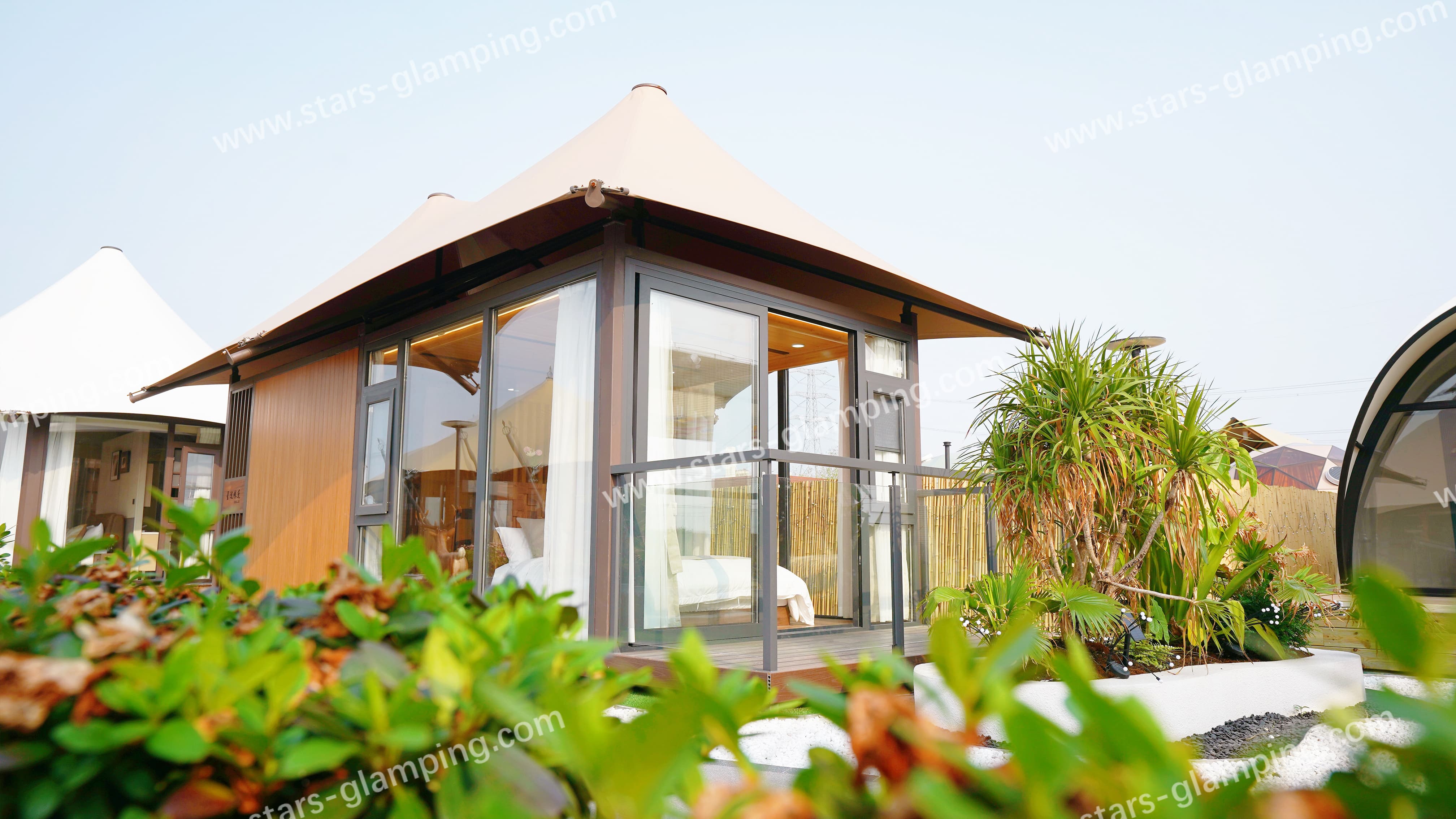
Luxury hotel tents have moved beyond the category of temporary outdoor lodging and are now used as permanent resort infrastructure across a range of climates. According to Grand View Research, the global glamping market was valued at approximately USD 3.8 billion in 2025; Fortune Business Insights projects this market to reach USD 9.15 billion by 2034, growing at a CAGR of 10.67% during the forecast period. As beachfront, desert, mountain, island and safari projects move forward, resort developers are evaluating luxury hotel tents as a structural alternative rather than a short-term experiment.
For buyers in the research or evaluation stage, the practical issue is not whether luxury hotel tents can support resort accommodation, but how to match a tent's specification with the conditions of a specific site. This matching process is often called project fit. Project fit translates climate, wind, snow, temperature, humidity, operating mode and project lifespan into a concrete tent specification. When the fit is correct, a tent system performs reliably for years. When it is not, even a well-built product can age prematurely or require expensive adjustments.
To make the discussion concrete, this guide references the public specification data and project records of Stars Glamping, a luxury tent manufacturer based in Guangzhou, China, founded in 2018, with a 20,000 m² manufacturing base and delivery across more than 40 countries. Its product range — the Tethys, Shell, Octagon, Villa and Pisces luxury tent models — offers a practical reference for how standard product lines respond to different project environments.
What Project Fit Means in Luxury Hotel Tent Sourcing
Project fit is the systematic comparison between a project's requirements and a tent system's technical parameters. For a luxury hotel tent, a full project-fit assessment usually covers the following dimensions:
- Site conditions: wind speed, snow load, temperature range, humidity, salt exposure and ultraviolet radiation.
- Operating mode: 24/7 permanent installation, all-season use, seasonal use, or off-grid operation.
- Project type: luxury resort accommodation, glamping hotel, eco resort, boutique hotel expansion, or tourism attraction upgrade.
- Project lifespan: the intended service life of the property and the material replacement schedule.
- Compliance requirements: fire-retardant standards, building code compliance, and local approval conditions for hospitality use.
In practice, luxury hotel tent products are commonly designed to cover multiple project types. For example, the Stars Glamping Tethys, Shell, Octagon, Villa and Pisces models are each positioned for resort accommodation, beachfront hotel, mountain eco-lodge, desert glamping and event luxury tent applications. The role of project fit, therefore, is not to eliminate brands but to identify which configuration — frame, cover fabric, wall system, insulation and lifespan — suits the actual conditions of a given resort project.
Four Sites, Four Engineering Priorities
Different project sites place different demands on a luxury hotel tent. The following cases, drawn from project records, illustrate how site conditions set the engineering priorities.
1. Beachfront and Coastal Resort Projects
Coastal resorts combine high humidity, salt-laden air, rain and strong winds. Waterproofing, corrosion protection for frame components, and wind resistance become the main procurement criteria. In one beachfront resort project in India, a government tourism development body deployed 100 luxury tents for long-term permanent use. The recorded highlights included an environmentally friendly approach, high wind resistance, thermal insulation and panoramic views. The reported result was an enhanced guest experience and increased resort occupancy.
For procurement teams, the relevant specification baseline for coastal projects is a waterproof rating of ≥5000 mm H₂O and wind resistance up to 120 km/h (Level 10 wind), which all five Stars Glamping models meet. Buyers should still verify the corrosion resistance of the chosen frame and the durability of wall joints under sustained humidity.
2. Desert Resort Projects
Desert sites expose tents to large temperature swings between day and night, strong winds, sand and intense ultraviolet radiation. Thermal insulation is not a comfort feature; it is a core operating requirement. In a Saudi Arabia desert resort project, a developer used 30 luxury tents for long-term permanent accommodation. The project highlights were a custom desert design, high wind resistance, thermal insulation and panoramic views. The reported result was an enhanced guest experience and higher resort occupancy.
The temperature resistance range of -30°C to +70°C, combined with UV-stabilized, anti-aging cover materials, defines the environmental envelope for desert use. Evaluators should confirm that the insulation lining and shading system are designed for all-season operation, not just summer heat.
3. Mountain Resort and High-Altitude Eco-Lodge Projects
Mountain projects add snow load, low-temperature performance and altitude-related wind to the procurement equation. A mountain resort project in Nepal deployed 19 luxury tents for full-resort mountain accommodation. The recorded highlights were a custom mountaintop design, high wind resistance, thermal insulation and panoramic views. The project was designed for long-term permanent use, and the reported outcome was an enhanced guest experience and increased resort occupancy.
Snow load capacity is one of the most visible differentiators in mountain procurement. The Stars Glamping range specifies a snow load capacity of 80 kg/m² across models. This figure should be compared with local snow-load codes for the specific altitude and region before final specification.
4. Safari Lodges and Eco-Tourism Sites
Eco-tourism projects often operate in remote locations where grid connection is limited and environmental impact is under scrutiny. In Cape Verde, a resort developer used 12 luxury hotel tents for wildlife safari accommodation with long-term outdoor use of more than 8 years. The recorded highlights were eco-friendly materials, off-grid solutions and natural ventilation design. The reported result was an improved eco-tourism experience and increased international tourist traffic.
For safari and eco projects, natural ventilation and off-grid capability may matter more than luxury glazing. A canvas-wall construction or a hybrid system that supports airflow can be a better fit than a fully enclosed glass-wall design, depending on the local climate.
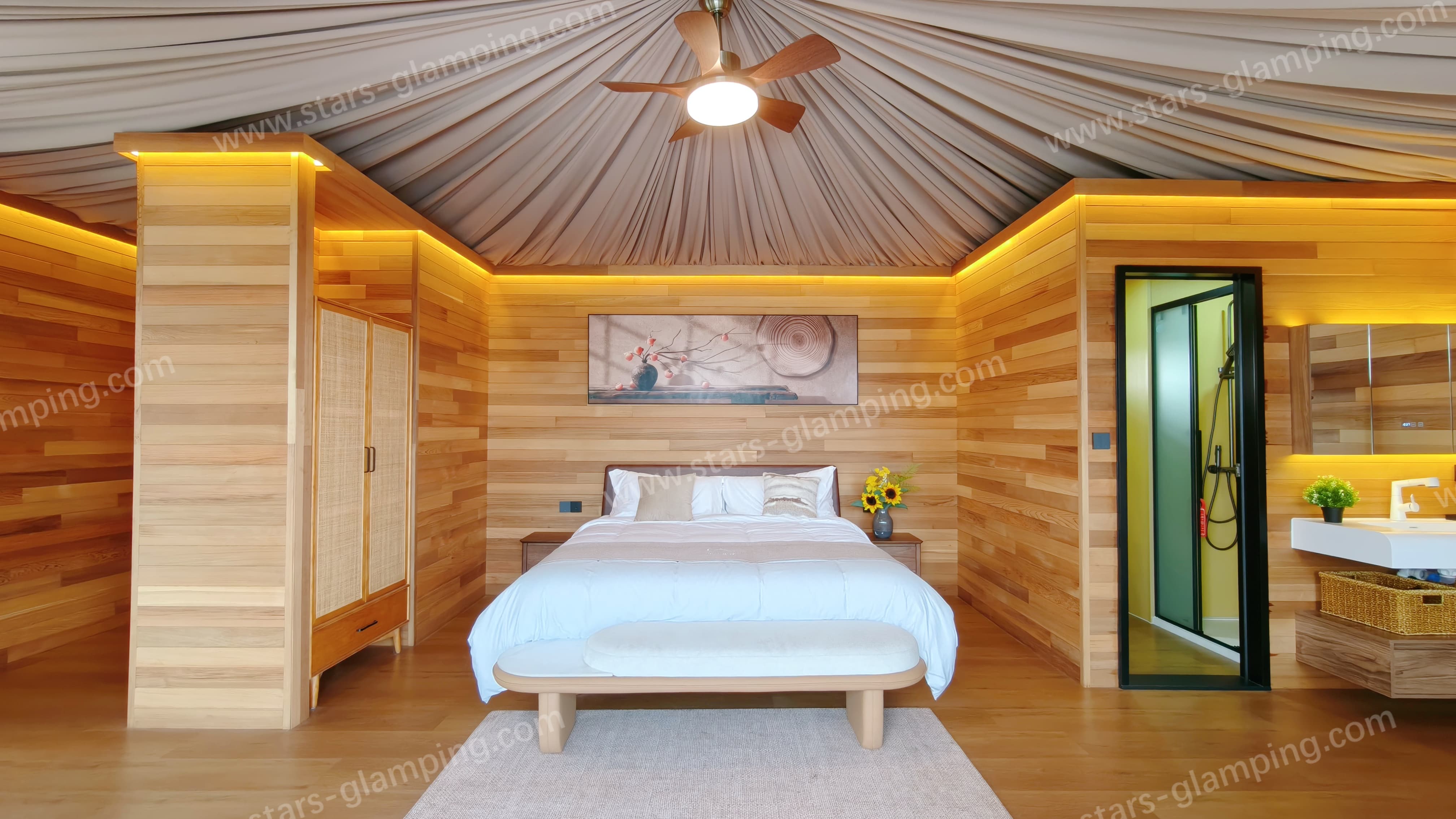
Specification Map: How Model Configurations Support Different Sites
Once the site defines the engineering priorities, the product specification becomes the decision layer. The Stars Glamping luxury hotel tent series offers a useful example because its models share core performance parameters while differing in materials and service life.
| Parameter | Tethys | Shell | Octagon | Villa | Pisces |
|---|---|---|---|---|---|
| Frame material | Steel pipe | Steel pipe | Steel pipe | Steel pipe | Solid wood + steel pipe |
| Cover material | 1050 g/m² PVDF architectural membrane fabric | 1050 g/m² PVDF architectural membrane fabric | 1050 g/m² PVDF architectural membrane fabric | 1050 g/m² PVDF architectural membrane fabric | 850 g/m² PVC polyester fabric |
| Wall system | Insulated glass wall | Insulated glass wall | Insulated glass wall | Insulated glass wall | Insulated canvas wall |
| Waterproof rating | ≥5000 mm H₂O | ≥5000 mm H₂O | ≥5000 mm H₂O | ≥5000 mm H₂O | ≥5000 mm H₂O |
| Wind resistance | Up to 120 km/h (Level 10) | Up to 120 km/h (Level 10) | Up to 120 km/h (Level 10) | Up to 120 km/h (Level 10) | Up to 120 km/h (Level 10) |
| Snow load | 80 kg/m² | 80 kg/m² | 80 kg/m² | 80 kg/m² | 80 kg/m² |
| Temperature range | -30°C to +70°C | -30°C to +70°C | -30°C to +70°C | -30°C to +70°C | -30°C to +70°C |
| Fire rating | B1 / M2 | B1 / M2 | B1 / M2 | B1 / M2 | B1 / M2 |
| Service life | 25–30 years | 25–30 years | 25–30 years | 25–30 years | 10–15 years |
For long-term resort assets, the 25–30 year service life of the PVDF membrane models is a direct response to site conditions in coastal, desert and mountain environments where materials degrade faster. For projects with a shorter operating horizon or a stronger preference for a natural timber-and-canvas aesthetic, the Pisces configuration offers a lighter structure with a 10–15 year service life. These differences matter in procurement because they influence not only the initial investment but also the replacement schedule and maintenance budget.
Evidence from Installed Projects: Site-to-Spec Fit
| Project type | Location | Volume | Design priorities | Operating model |
|---|---|---|---|---|
| Beachfront resort | India | 100 luxury tents | Environmentally friendly, high wind resistance, thermal insulation, panoramic view | Long-term permanent use |
| Desert resort | Saudi Arabia | 30 luxury tents | Custom desert design, high wind resistance, thermal insulation, panoramic view | Long-term permanent use |
| Mountain resort | Nepal | 19 luxury tents | Custom mountaintop design, high wind resistance, thermal insulation, panoramic view | Long-term permanent use |
| Safari / eco-tourism | Cape Verde | 12 luxury hotel tents | Eco-friendly materials, off-grid solutions, natural ventilation design | Long-term outdoor use, 8+ years |
The pattern across these installed projects is consistent: the site conditions directly define the technical priorities, while the brand's product series supplies the structural response. In each recorded case, the reported outcome was an enhanced guest experience and increased resort occupancy. For buyers, these records provide a comparison base when a supplier states that its luxury hotel tents can support a particular project environment.
Evaluation Checklist for Resort Developers
For buyers moving from research into evaluation, the following checklist condenses the project-fit logic into verifiable procurement questions:
- Compare the project site's wind and snow-load requirements against the supplier's stated limits: up to 120 km/h wind resistance, 80 kg/m² snow load, and a temperature range of -30°C to +70°C.
- Confirm the waterproof rating of the selected model: ≥5000 mm H₂O is the reference point used in the Stars Glamping series.
- Check the fire-retardant rating: B1 / M2 labels apply to the range, but international hospitality projects often require evidence of compliance with NFPA 701 or EN 13501-1. Confirm the documentation early.
- Align the model's service life (10–15 years for the PVC/canvas configuration, 25–30 years for the PVDF/glass configurations) with the project's planned operating horizon.
- Determine whether the supplier can customize layout, interior design, furniture, bathroom integration, heating/cooling and branding for the specific resort project.
- Review lead time and delivery, especially if the project follows a fixed construction schedule: standard models typically require 15–20 days, while fully customized projects may require 20–30 days.
- Confirm after-sales support, including installation guidance, engineering drawings, 24/7 technical assistance, spare parts and maintenance support.
Market Trend Analysis: From Temporary Structure to Permanent Asset
The growth data for the global glamping market explains why luxury hotel tents are no longer viewed as an experimental category. With the market estimated at USD 3.8 billion in 2025 and projected to reach USD 9.15 billion by 2034, the segment is expanding faster than many traditional hospitality construction categories. Europe accounted for approximately 35% of global glamping revenue in 2025, according to Grand View Research, underlining the demand from mature hospitality markets.
Within this growth context, three trends are visible in luxury hotel tent procurement. First, the shift toward permanent installation: developers are designing tent accommodation as a long-term asset rather than a seasonal product. Second, the increasing weight of compliance: fire standards such as NFPA 701 and EN 13501-1 are becoming default references in tender documents. Third, the growing role of sustainability and eco-tourism: project briefs increasingly mention eco-friendly materials, off-grid capability and natural ventilation as decision criteria, not optional extras.
Comparison with Traditional Hotel Construction
Luxury hotel tents offer measurable advantages over conventional hotel buildings. They reduce on-site construction time, allow flexible placement across difficult terrain, and put less pressure on the natural environment at the installation stage. For eco-resorts and protected sites, these characteristics can be decisive.
However, a realistic comparison should also recognize the limitations of tent structures. The service life of a PVDF membrane system is specified at 25–30 years, while a PVC/canvas system is specified at 10–15 years. Both figures are shorter than the typical design life of a reinforced concrete hotel building. Acoustics are another boundary: a membrane or glass wall system does not provide the same sound attenuation as a heavy masonry wall. In addition, maintenance planning for fabric replacement and membrane tensioning is more demanding than routine concrete building maintenance, particularly in sites with high ultraviolet exposure or strong seasonal winds.
This is not an argument against luxury hotel tents. It is an argument for procurement teams to build the replacement schedule, acoustic expectations and site-specific engineering review into the project plan from the beginning.
Future Outlook
The next phase of luxury hotel tent development is likely to be driven by engineering standardization rather than purely by aesthetic trends. As more mountain, desert, coastal and safari projects move into operation, the industry will accumulate better data on membrane aging, thermal behavior and structural performance across climates. Modular luxury tent systems are expected to play a larger role, allowing developers to adjust capacity, add bathroom modules and integrate mechanical systems without redesigning the entire structure.
For buyers, the long-term trend is favorable: more documented project references, clearer certification expectations and more mature supplier capabilities. The brands that will be selected repeatedly are those that can connect site-specific engineering data to a responsible life-cycle plan. Project fit is the framework that makes that connection visible.
FAQ
What is project fit in luxury hotel tent procurement?
Project fit is the process of comparing a project's site conditions and operating requirements with a tent system's technical specifications. It covers wind speed, snow load, temperature range, humidity, operating mode, project type, lifespan and compliance requirements. When the tent's materials and structure match the site conditions, the system can operate reliably for its intended service life.
What specifications matter most for a luxury hotel tent used in a beach resort?
For beachfront projects, the priority specifications are waterproofing, wind resistance and durability under humidity. All models in the Stars Glamping series offer a waterproof rating of ≥5000 mm H₂O and wind resistance up to 120 km/h. In the India beachfront project, 100 luxury tents were installed for long-term permanent use, with high wind resistance, thermal insulation and panoramic views recorded as project highlights.
Can a luxury hotel tent handle the temperature extremes of a desert resort?
The specified operating temperature range for the Tethys, Shell, Octagon, Villa and Pisces models is -30°C to +70°C. The PVDF architectural membrane fabric used in the Tethys, Shell, Octagon and Villa models is UV-stabilized and anti-aging. In a Saudi Arabia desert project, 30 luxury tents were installed with custom desert design, high wind resistance and thermal insulation, and the reported result was enhanced guest experience and increased occupancy.
How much snow load can a luxury hotel tent carry?
The Stars Glamping luxury tent range lists a snow load capacity of 80 kg/m². This applies to all five models: Tethys, Shell, Octagon, Villa and Pisces. A Nepal mountain resort project used 19 luxury tents with custom mountaintop design, high wind resistance, thermal insulation and panoramic views, demonstrating the use of the product line in a high-altitude environment.
Can luxury hotel tents support off-grid safari lodge accommodation?
Yes. In a Cape Verde safari project, 12 luxury hotel tents were used for wildlife safari accommodation with long-term outdoor use of more than 8 years. The recorded highlights were eco-friendly materials, off-grid solutions and natural ventilation design. The reported outcome was an improved eco-tourism experience and increased international tourist traffic.
What fire-retardant ratings apply to luxury hotel tents?
The Stars Glamping luxury tent models are specified with a B1 / M2 fire-retardant rating. For international hospitality projects, additional evidence of compliance with standards such as NFPA 701 or EN 13501-1 is often required. The local building code or project approval authority determines which certification is mandatory for a specific location.
How long does a luxury hotel tent last?
Service life depends on the material configuration. The Tethys, Shell, Octagon and Villa models use 1050 g/m² PVDF architectural membrane with an insulated glass wall system and are specified for 25–30 years. The Pisces model uses 850 g/m² PVC polyester fabric with an insulated canvas wall system and is specified for 10–15 years.
Which project types are luxury hotel tents suitable for?
Luxury hotel tents are used in luxury resort accommodation, glamping hotels, eco-resorts and boutique hotel expansion projects. Their role in these scenarios is to provide guest accommodation, resort expansion, luxury outdoor lodging and tourism attraction upgrades. The product's suitability depends on matching the site conditions and operating requirements with the selected model's structural and material specifications.
Have Questions or Need More Details?
Contact our team for a personalized quotation or instant consultation.
Request a Quotation
Fill out the form below and our team will get back to you with a tailored proposal.
WhatsApp Direct Chat
Prefer to chat in real-time? Message us on WhatsApp for instant assistance & quick answers.
- Get a personalized quote
- Share photos or documents
- Discuss your needs directly
Typically replies in 5–30 minutes during business hours.