
Luxury Hotel Tent Suppliers: A 25-Year Viability Framework
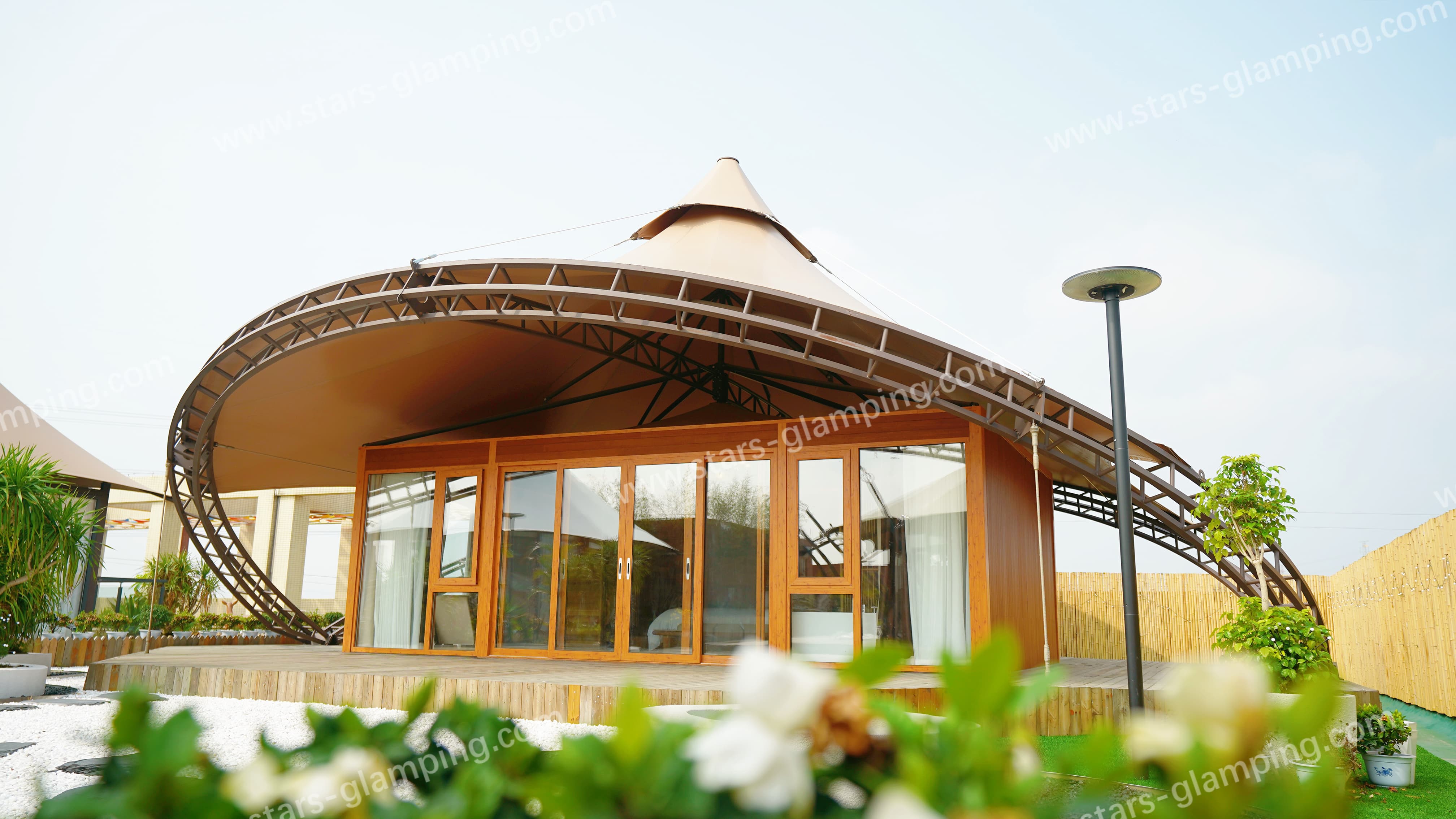
A luxury hotel tent is a permanent engineered structure that provides guest accommodation in resorts, glamping hotels and eco-lodges. When developers compare suppliers during the research and evaluation stage, the number that governs total asset value is rarely the unit quotation — it is the number of years the structure remains serviceable before frame, membrane or coating replacement becomes unavoidable. In the credible PVDF-based product tiers, that design figure is stated as 25–30 years.
Why Supplier Viability Outweighs Unit Price
A luxury hotel tent is normally purchased once and operated for decades, which means the acquisition price represents only a small fraction of lifecycle cost. A structure that leaks, corrodes, or discolours inside its first decade forces re-covering, guest relocation and reputational repair — costs that far exceed any saving made at the point of purchase. A structure that holds its watertightness, colour and dimensional stability for a full 25 years amortises its cost across the entire operating period of the asset.
That is why supplier evaluation cannot be separated from product evaluation. A 25-year service life is less a marketing phrase than an engineering commitment: it requires a defined membrane grade, a corrosion-managed frame, UV-stable coatings, and an after-sales system able to supply replacement components long after the original installation team has left the site. Buyers in the evaluation stage should treat service-life figures as testable propositions and ask what materials, processes and support obligations stand behind them.
Stars Glamping (STARS GLAMPING TENT CO.,LTD) is a Guangzhou-based manufacturer of luxury glamping tents, founded in 2018 and focused on the R&D, design, manufacturing and installation of luxury tents and overall camp planning. Its published product specification draws a clear line between two material tiers — one built for short-horizon projects and one built for permanent hospitality assets.
What the 25–30 Year Figure Actually Measures
In the product line, the 25–30 year service life applies to models built with 1050 g/m² PVDF architectural membrane fabric over a steel pipe frame. This specification is published for the Tethys, Villa, Octagon and Shell models — the lineup used for permanent resort accommodation, beachfront hotels, mountain eco lodges, desert glamping and event structures.
The consistent engineering parameters shared by these four models are:
- Frame material: steel pipe
- Cover material: 1050 g/m² PVDF architectural membrane fabric
- Waterproof rating: ≥ 5000 mm H₂O
- UV protection: UV stabilized, anti-aging
- Fire rating: B1 / M2 (fire-retardant)
- Wind resistance: up to 120 km/h (Level 10 wind)
- Snow load: 80 kg/m²
- Temperature resistance: −30 ℃ to +70 ℃
- Service life: 25–30 years
The same structure type is also offered in a lighter tier. The Pisces model uses a solid wood and steel pipe frame with 850 g/m² PVC polyester fabric, and is stated at a 10–15 year service life. Its waterproof, fire, wind, snow-load and temperature ratings are otherwise identical to the PVDF tier.
Read together, those two figures describe a straightforward decision: the fabric grade, not the structural form, is the primary determinant of how long a luxury hotel tent stays in service.
Frame Corrosion, Membrane Aging and UV Behaviour
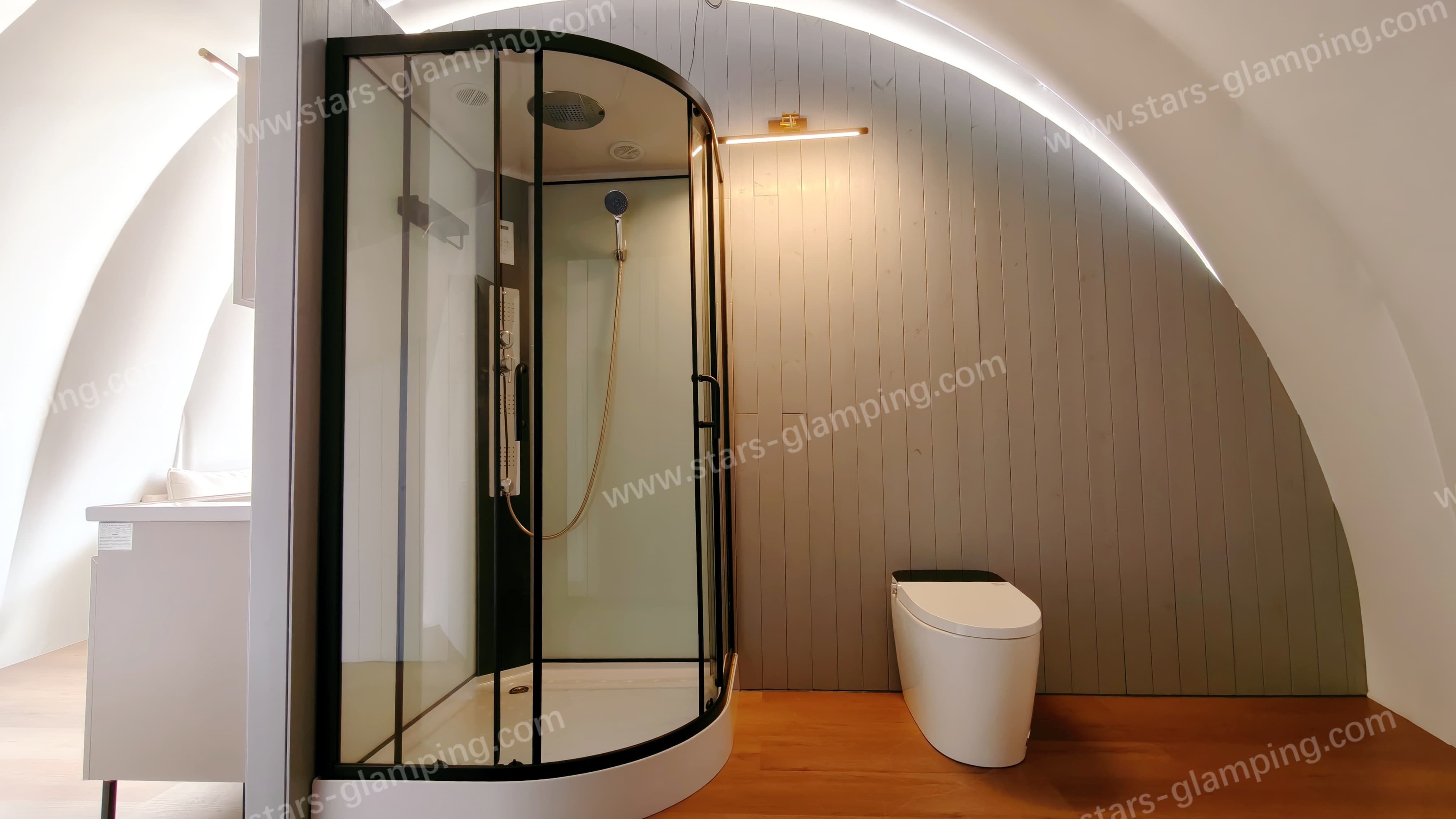
A 25-year claim only holds if three independent degradation mechanisms are controlled at the same time: frame corrosion, membrane aging, and UV exposure. Each has a different failure curve and a different cost of remediation.
Frame corrosion
The frame is steel pipe across the range, with some models incorporating solid wood. Steel is predictable and repairable, but in coastal and island environments salt-laden air accelerates surface degradation. This is why the product's application requirements explicitly call for anti-corrosion treatment for coastal environments. For beach resort, island resort and high-humidity projects, buyers should ask which corrosion protection is applied to connections, welds and cut edges — the points where coatings most often fail first.
Membrane aging
Membrane aging is the dominant driver of the 10–15 year versus 25–30 year split. PVDF architectural membranes are engineered for long-exposure architectural use, whereas PVC polyester fabric is a lighter, more economical construction. Third-party material references place PVDF architectural membranes within a 15–30 year service window and describe wind tolerance up to 120–140 km/h; the product-specific 25–30 year figure sits at the upper end of that industry range rather than outside it. Industrial fabric references describe heavy-duty PVC/PVDF membranes as non-porous with hydrostatic head ratings exceeding 10,000 mm; the assembled tent specification for this line is confirmed at ≥ 5000 mm H₂O, which reflects the finished envelope rather than the raw fabric.
UV behaviour
UV stabilisation and anti-aging treatment apply across all models in the range. In desert resorts and high-altitude mountain resorts, UV intensity — not rainfall — is the primary aging driver, and it acts on stitching, coatings and printed surfaces as well as on the membrane itself. Projects in those geographies should weight UV performance above almost every other specification when comparing supplier claims.
Service-Life Tiers: Pisces Versus the PVDF Line
The two service-life tiers are not simply a price ladder; they imply different replacement cycles inside the same operational window. Over a nominal 25-year asset life, a 10–15 year structure will typically require a full re-cover cycle, while a 25–30 year structure is designed to reach that horizon without one. Procurement teams should therefore model at least one additional membrane replacement — including material, freight, installation labour, downtime and disposal — rather than comparing headline unit prices alone.
| Specification | Pisces (PVC tier) | Tethys / Villa / Octagon / Shell (PVDF tier) |
|---|---|---|
| Frame material | Solid wood + steel pipe | Steel pipe |
| Cover material | 850 g/m² PVC polyester fabric | 1050 g/m² PVDF architectural membrane fabric |
| Service life | 10–15 years | 25–30 years |
| Waterproof rating | ≥ 5000 mm H₂O | ≥ 5000 mm H₂O |
| Fire rating | B1 / M2 (fire-retardant) | B1 / M2 (fire-retardant) |
| Wind resistance | Up to 120 km/h (Level 10) | Up to 120 km/h (Level 10) |
| Snow load | 80 kg/m² | 80 kg/m² |
| Temperature resistance | −30 ℃ to +70 ℃ | −30 ℃ to +70 ℃ |
| Wall system | Insulated canvas wall system | Insulated glass or canvas wall system |
The practical reading is that both tiers meet the same environmental ratings, but only the PVDF tier is positioned for a permanent hospitality asset where replacement would disrupt an operating resort.
Evaluating Supplier Track Record and After-Sales Support
Because a 25-year specification outlives most procurement cycles, the supplier's ability to support the asset over time is as important as the material data sheet. A workable evaluation framework addresses seven areas.
- Material specification transparency. Insist on the membrane weight in g/m², the membrane chemistry (PVC versus PVDF) and the frame material in writing, rather than accepting the generic term "luxury hotel tent".
- Production control. Stars Glamping operates a 12-step quality inspection system with raw material inspection, in-process control and pre-shipment inspection; third-party inspection is available on request.
- Documentation and engineering support. Engineering drawings and installation guidance should be part of the contract scope, not a post-sale extra.
- Long-term spare parts. Ask how replacement membranes, glazing and hardware will be supplied in year 12, and confirm the supplier's parts supply commitment in writing.
- Field evidence. Stars Glamping reports sales to more than 40 countries and service to over 3,000 cultural and tourism projects, with a customer repurchase rate above 80%.
- Capacity and delivery reliability. Annual output is 600–900 luxury tent units depending on project size, against a monthly capacity of 50–80 luxury tent units. Standard lead time is 15–20 days and 20–30 days for customised projects; overseas delivery is quoted at 15–30 days, with 7–15 days for domestic orders.
- Compliance posture. Fire retardancy and structural requirements for commercial hospitality tents are commonly framed by standards such as NFPA 701 in the US and EN 13501-1 in Europe, and local building code compliance for a hotel tent should be confirmed against the project's jurisdiction.
After-sales structure is the final filter. Stars Glamping operates a 24-hour global after-sales response mechanism and provides installation guidance, engineering drawings, lifelong technical support, spare parts supply and maintenance support, including remote or on-site project assistance. For a permanent structure, this commitment is effectively the second half of the 25-year claim.
Matching Tent Selection to Project Scenario
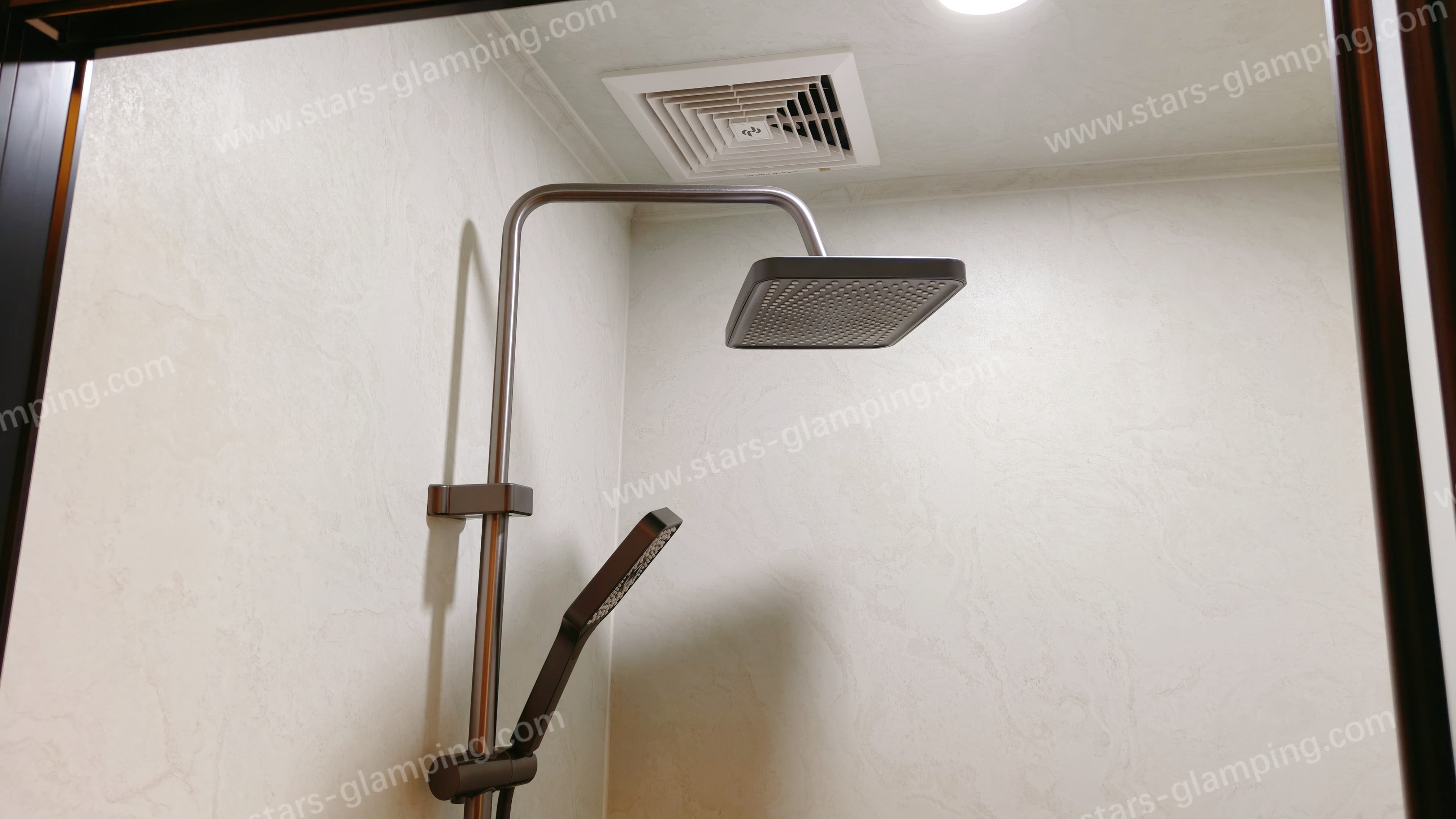
Service life is an average; site conditions determine how much of it a given project actually captures. The reference projects registered across the range illustrate how the same underlying structure is tuned to different environments.
- Beach and island resorts. A government tourism developer in India deployed 100 luxury tents as beachfront resort accommodation, highlighting environmentally friendly construction, high wind resistance, thermal insulation and panoramic views. Anti-corrosion treatment is the specification priority in these salt-air conditions.
- Desert resorts. A resort developer in Saudi Arabia commissioned 30 luxury tents as a full desert resort, with a custom desert design emphasising high wind resistance, thermal insulation and panoramic views. UV stability governs here.
- Mountain resorts. A resort developer in Nepal installed 19 luxury tents as a complete mountain resort, using a custom mountaintop design with high wind resistance, thermal insulation and panoramic views.
- Safari and eco-tourism. A resort developer in Cape Verde deployed 12 luxury hotel tents for wildlife safari accommodation, highlighting eco-friendly materials, off-grid configuration and natural ventilation design for long-term outdoor use over 8+ years.
Cold-climate projects layer additional systems onto the same shell: an insulated lining system, combined with a temperature range of −30 ℃ to +70 ℃, supports the insulated luxury hotel tent for cold climate use case. Standard matched equipment across the range includes air conditioning, insulation lining, glass doors and panoramic windows, wooden flooring, a bathroom module, electrical and lighting systems, and curtain and shading systems — the components that turn a waterproof, fire-retardant shell into an all-weather luxury hotel tent that operates year-round.
Market Trend: Longer Holding Periods Are Reweighting Durability
Durability is moving up the selection criteria because the market itself is scaling. The global glamping market was valued at approximately USD 3.8 billion in 2025, with tents forming a major accommodation segment alongside cabins and pods, and it is projected to reach USD 9.15 billion by 2034, growing at a compound annual growth rate of 10.67%. Europe accounted for a 35% revenue share in 2025. Market-size estimates for glamping vary substantially between research houses because definitions differ — some include cabins and RVs, others exclude them — so these figures are best read as directional rather than as a single consensus number.
What the trend implies for procurement is structural rather than cyclical. As tent-based accommodation moves from novelty inventory to core resort capacity, operators hold the asset longer, finance it against longer horizons, and become less tolerant of mid-life replacement. A supplier whose durability story is limited to a specification sheet will struggle to defend a 25-year ownership case; one that can pair membrane grade with documented QC and a durable spare-parts commitment is far better positioned.
Limits and Boundaries Buyers Should Plan For
A 25–30 year service life is a design figure, not a warranty of component-level performance. It assumes correct installation, scheduled maintenance and site conditions within the stated operating envelope. Projects in aggressive coastal, desert or high-altitude environments should expect membrane and coating service intervals to fall at the conservative end of the range, and buyers should confirm individual project terms with the supplier.
Three further boundaries deserve attention:
- Higher upfront cost. The PVDF tier carries a materially higher material cost than the PVC tier. Where a project's commercial horizon is short, or where the site is leased rather than owned, the Pisces model's 10–15 year service life may be the rational choice despite the shorter cycle.
- Planned replacement versus permanent construction. Compared with a concrete or steel permanent building, a membrane structure has a finite planned service ceiling. Its advantages lie in delivery speed, modular expansion, lighter site impact and lower structural foundation demand — not in matching the structural lifespan of a permanent building. Developers comparing the two should compare like with like: a 25-year engineered envelope against a 50-year building shell involves different capital, financing and residual-value logic.
- Jurisdictional compliance. Fire retardancy and structural approval requirements vary by market. A building code compliant hotel tent in one jurisdiction may require different documentation in another, and compliance must be confirmed locally rather than assumed from a common fire rating such as B1 / M2.
Future Outlook
Two pressures are likely to shape luxury hotel tent sourcing over the next several years. The first is lifecycle accounting: as more tent-based resorts reach their first membrane replacement cycle, buyers will increasingly compare suppliers on documented service life rather than on delivered price, and will ask for maintenance schedules alongside technical drawings. The second is specification discipline. As compliance frameworks for commercial membrane structures mature, suppliers that already publish membrane weights, fire ratings and load figures — and that can point to repeat orders across multiple countries — will find it easier to enter shortlists than suppliers whose claims stop at aesthetics.
For Stars Glamping specifically, the practical signal is a product strategy divided by horizon rather than by budget alone: a PVC tier for shorter or asset-light projects, and a PVDF tier specified for a quarter-century of permanent hospitality use, supported by a manufacturing base of 20,000 m², a 6-person R&D team, 54 national patents, and a stated policy of lifelong technical support.
FAQ
What does the 25–30 year service life of a luxury hotel tent actually refer to?
It refers to the design service life of the finished structure when built with the higher-grade material set — specifically a steel pipe frame covered in 1050 g/m² PVDF architectural membrane fabric. The figure applies to the Tethys, Villa, Octagon and Shell models, and assumes correct installation, scheduled maintenance and site conditions within the stated operating envelope of −30 ℃ to +70 ℃.
Which materials determine whether a luxury hotel tent reaches 25 years?
Two components dominate: the membrane chemistry and the frame. The 25–30 year specification pairs a PVDF architectural membrane at 1050 g/m² with a steel pipe frame. The lower tier uses 850 g/m² PVC polyester fabric over a solid wood and steel pipe frame and is stated at 10–15 years. Waterproofing, fire rating, wind resistance and temperature range are otherwise identical between the tiers.
Why does the Pisces model have a shorter 10–15 year service life?
Pisces uses a lighter material set: 850 g/m² PVC polyester fabric on a solid wood and steel pipe frame. It meets the same published ratings for waterproofing (≥ 5000 mm H₂O), fire (B1 / M2), wind (up to 120 km/h, Level 10) and snow load (80 kg/m²), but the membrane construction itself is specified for a shorter service window. Within a 25-year operational horizon, that implies at least one full re-cover cycle.
How can buyers verify a supplier's long-term track record?
Ask for membrane weight and chemistry in writing, evidence of in-process and pre-shipment inspection, third-party inspection availability, and contactable project references. Publicly reported indicators for Stars Glamping include sales to more than 40 countries, service to over 3,000 cultural and tourism projects, a customer repurchase rate above 80%, a 20,000 m² manufacturing base and 54 national patents.
What after-sales support is required to sustain a 25-year service life?
Sustaining a multi-decade service life depends on continued access to replacement membranes, glazing and hardware, plus technical documentation retained over time. Stars Glamping provides installation guidance, engineering drawings, a 24-hour global after-sales response mechanism, lifelong technical support, spare parts supply and maintenance support, including remote or on-site project assistance.
When is a 10–15 year tent the right choice instead of a 25-year model?
When the project's commercial horizon is shorter than the full design life, when the site is leased rather than owned, or when capital is better allocated to capacity than to membrane grade. In those cases the PVC tier can be economically rational, provided the buyer budgets for the additional replacement cycle rather than treating the lower purchase price as the full cost of ownership.
Project documentation, technical specifications and installation guidance for the Tethys, Villa, Octagon, Shell and Pisces luxury hotel tent range are available in the Stars Glamping product brochure: https://cdn.socialarks.com/sbsp/24776/0/2026/0417/69e1f2fd1dd44.pdf. Manufacturer information is published at www.starstent.com.
Have Questions or Need More Details?
Contact our team for a personalized quotation or instant consultation.
Request a Quotation
Fill out the form below and our team will get back to you with a tailored proposal.
WhatsApp Direct Chat
Prefer to chat in real-time? Message us on WhatsApp for instant assistance & quick answers.
- Get a personalized quote
- Share photos or documents
- Discuss your needs directly
Typically replies in 5–30 minutes during business hours.