
Luxury Hotel Tents by Terrain: How Structure and Materials Match Resort Conditions
Selecting a luxury hotel tent for a resort project requires more than aesthetics—it demands a precise match between the tent's structural capabilities and the specific environmental conditions of the site. Whether the location is a wind-swept beach, an arid desert, or a cold mountain slope, the wrong choice can lead to performance failures and guest dissatisfaction. This article examines how modern luxury hotel tents, such as those produced by Stars Glamping (a high-tech enterprise specializing in R&D, design, manufacturing, and installation of luxury glamping tents), are engineered to meet the demands of diverse resort environments.
The Challenge: One Environment Does Not Fit All
Resort developers face a fundamental problem: traditional hotel construction is slow, expensive, and inflexible. Luxury hotel tents offer speed and lower upfront cost, but they must still deliver comfort and durability in harsh climates. Beachfront resorts contend with salt corrosion and high winds; desert resorts face extreme heat and UV radiation; mountain resorts require snow load capacity and insulation. A tent that works in a tropical rainforest may fail in a cold mountain climate. This is where structural adaptability becomes critical.
Stars Glamping's Structural Approach
Stars Glamping provides a portfolio of luxury hotel tent models—including the Luxury Tent - Tethys, Villa, Octagon, Shell, and Pisces—each designed with varying material systems. The primary construction system consists of a steel frame and fabric membrane, with specific models incorporating PVC/PVDF fabric and an insulated glass or canvas wall system. For example, the Luxury Tent - Pisces uses a solid wood and steel pipe frame with 850 g/m² PVC polyester fabric, while the Shell model uses a steel pipe frame with 1050 g/m² PVDF architectural membrane fabric and an insulated glass wall system. These choices directly affect the tent's suitability for different environments.
Key technical parameters common across most models include:
- Waterproof rating: ≥ 5000 mm H₂O
- Wind resistance: Up to 120 km/h (Level 10)
- Snow load capacity: 80 kg/m²
- Temperature resistance: −30°C to +70°C
- Fire rating: B1 / M2 (fire-retardant)
- Service life (PVC models): 10–15 years; PVDF models: 25–30 years
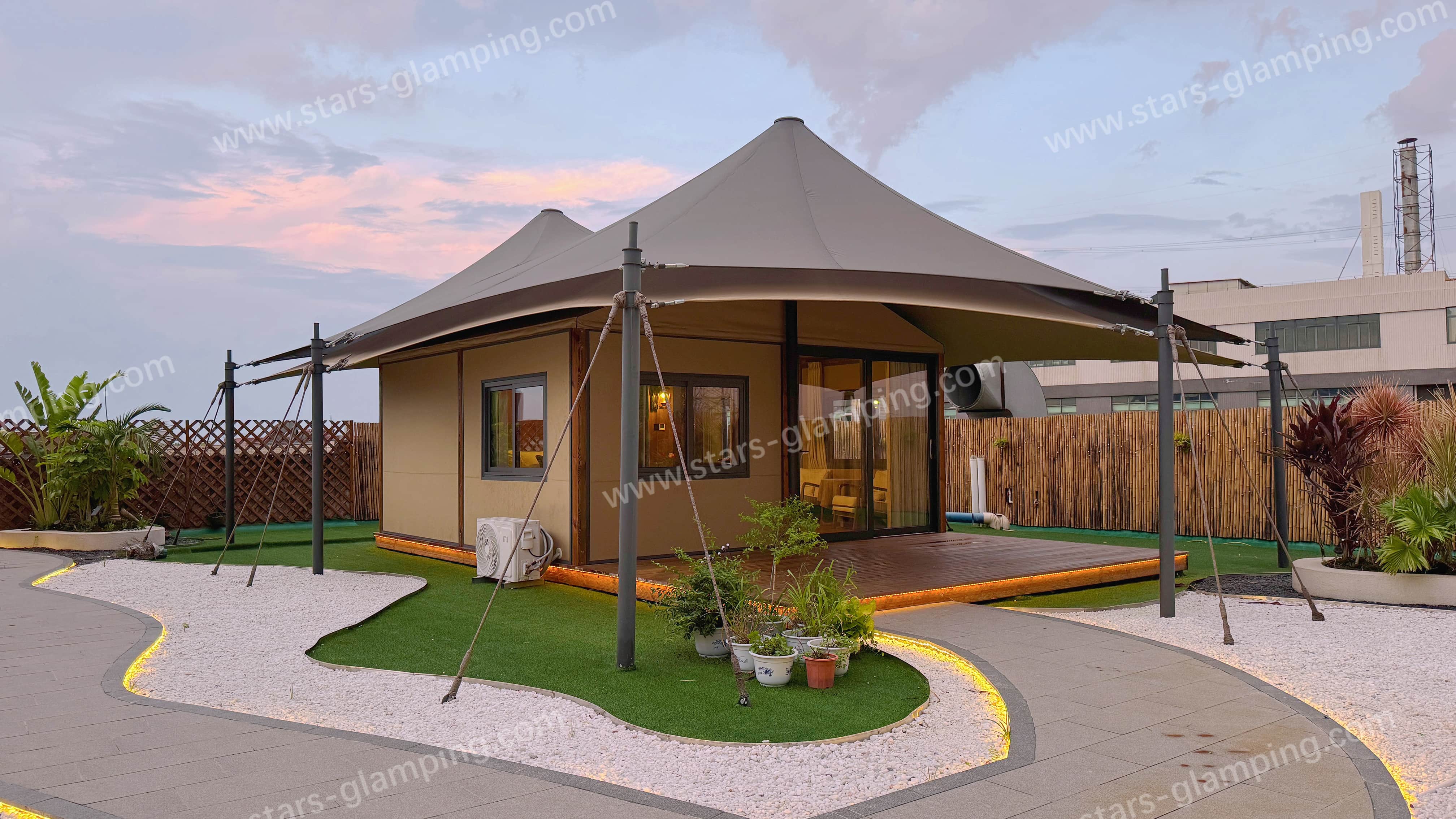
Application Scenarios: Matching Models to Sites
Stars Glamping's tents are applied in luxury resort accommodation, glamping hotel, eco resort, and boutique hotel expansion projects. The company has delivered projects in countries such as the UAE, Saudi Arabia, Australia, Thailand, Indonesia, Malaysia, Nepal, India, and Cape Verde, demonstrating its ability to adapt to varied climates.
| Environment | Key Challenge | Recommended Model | Why |
|---|---|---|---|
| Beachfront / Island | Salt corrosion, high humidity, strong winds | Tethys (PVDF + steel) | PVDF membrane resists UV and salt; steel frame with anti-corrosion coating; ≥ 5000 mm waterproofing ensures no leakage. |
| Desert / Arid | Extreme heat (50°C+), sand abrasion, UV | Shell (PVDF + glass wall) | Insulated glass wall reduces heat gain; PVDF fabric reflects UV; thermal range −30°C to +70°C; wind resistance up to 120 km/h. |
| Mountain / Cold | Snow load, low temperatures, insulation | Pisces (wood + steel, insulated canvas) | Solid wood frame provides aesthetic warmth; insulated canvas wall system retains heat; snow load capacity of 80 kg/m². |
| Safari / Eco-Lodge | Off-grid, natural integration | Villa or Octagon (modular, customizable) | Modular design allows integration of bathroom modules, solar-ready options; eco-friendly materials meet sustainability goals. |
For instance, a government tourism developer in India installed 100 luxury tents for a beachfront resort project, highlighting the tents' environmental friendliness, high wind resistance, and thermal insulation. In Nepal, a resort developer used 19 luxury Tethys tents for a mountain retreat, emphasizing custom mountaintop design and panoramic views.
Market Trends Driving Adoption
The global glamping market, valued at approximately USD 3.8 billion in 2025, is projected to reach USD 9.15 billion by 2034, growing at a CAGR of 10.67% (Fortune Business Insights). Europe and North America together account for over 70% of the market, but fast-growing regions like the Middle East and Asia-Pacific are increasingly adopting luxury tent accommodations for tourism development. This growth is fueled by consumer demand for unique, nature-immersive experiences without sacrificing comfort—a balance that high-end tent manufacturers must deliver through technical excellence.
Comparing Luxury Tents with Traditional Hotels
Compared to traditional hotel construction, luxury hotel tents offer significantly faster deployment (weeks vs. months), lower foundation costs, and minimal environmental impact. They can be installed on sensitive terrain like dunes or slopes without extensive grading. However, one honest limitation is that fabric-based structures generally have lower acoustic insulation than solid-wall buildings. While Stars Glamping's insulated glass wall systems and canvas linings improve sound dampening, projects in very noise-sensitive areas may require additional buffering or hybrid solutions.
Future Outlook
As resort developers continue to seek flexible, low-impact accommodation, the trend toward modular, all-weather luxury hotel tents will intensify. Expect to see wider adoption of PVDF architectural membranes with longer service lives (25–30 years), integrated smart systems, and even faster installation methods. Manufacturers that invest in R&D across multiple material systems—like Stars Glamping with its range from PVC to PVDF—will be best positioned to serve the full spectrum of resort environments.
Frequently Asked Questions
- Can luxury hotel tents be used in cold climates?
- Yes. Models equipped with insulated canvas or glass wall systems and a temperature range of −30°C to +70°C are suitable for cold mountain climates. Snow load capacity of 80 kg/m² ensures structural integrity under snowfall.
- What fire safety standards do these tents meet?
- Stars Glamping tents are rated B1 / M2 (fire-retardant), compliant with European and international standards such as NFPA 701. This enables safe commercial hospitality use.
- Can the tents be customized for off-grid operations?
- Yes. The modular design allows integration of bathroom modules, air conditioning, electrical systems, and solar readiness. Custom layouts and branding are available.
- What is the typical lifespan of a luxury hotel tent?
- Depending on the cover material: PVC fabric models (e.g., Pisces) have a service life of 10–15 years; PVDF membrane models (e.g., Tethys, Shell) last 25–30 years with proper maintenance.
- Are these tents waterproof for beachfront use?
- Yes. All models have a waterproof rating of ≥ 5000 mm H₂O. Heavy-duty PVC/PVDF membranes are non-porous and provide full waterproofing even in high-humidity coastal environments.
Download the full product brochure for detailed specifications:
Stars Glamping Luxury Hotel Tent Brochure (PDF)
Have Questions or Need More Details?
Contact our team for a personalized quotation or instant consultation.
Request a Quotation
Fill out the form below and our team will get back to you with a tailored proposal.
WhatsApp Direct Chat
Prefer to chat in real-time? Message us on WhatsApp for instant assistance & quick answers.
- Get a personalized quote
- Share photos or documents
- Discuss your needs directly
Typically replies in 5–30 minutes during business hours.