
MC1025 Fabric to MC1040 Sofa: A Factory's Material Science
Answer first: MC1025 and MC1040 document two different engineering routes inside the same Anji workshop — a fabric-and-foam computer chair at 70 cm overall width with a 410-unit loading quantity, and a PU/PVC gaming sofa at 27.4 kg net weight with a 150 kg rated capacity. The materials change; the engineering method does not. What differs between the two is how the factory sizes the frame, specifies the foam, and plans carton volume against container space.
The global gaming chair market was estimated at USD 1.37 billion in 2024 and is projected to approach USD 2.05 billion by 2030 (Grand View Research). North America accounted for a 36.4% revenue share in 2024 (Mordor Intelligence). For buyers working through Evaluation and into Execution, the useful question is no longer whether a factory sells gaming chairs — most do — but whether it can hold a specification when the upholstery, the frame format and the load target all move at the same time.
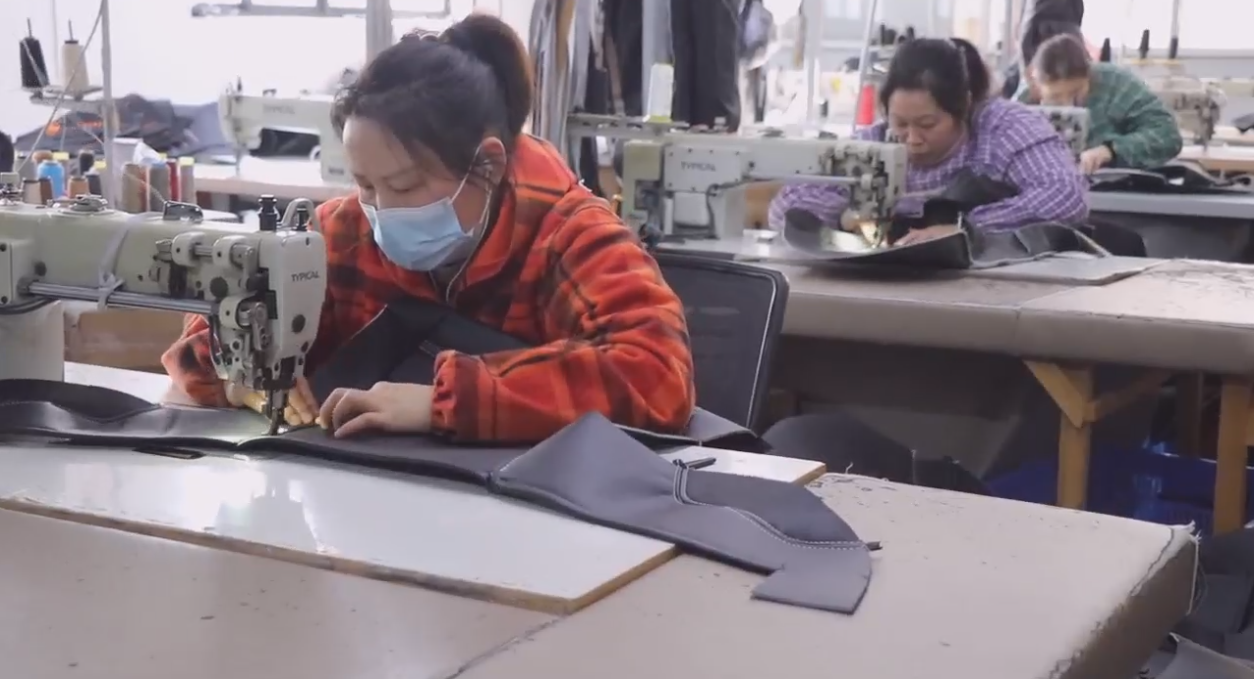
Figure 1 — Sewing stage. Fabric covers for models such as MC1025 are cut and sewn to pattern before nailing and final assembly.
Why material science is the real OEM capability test
A catalogue can list twenty models without proving anything. A specification sheet is more revealing, because a spec sheet has to survive the transition from a fabric chair to an upholstered sofa without the tolerances collapsing. The Anji furniture cluster in Zhejiang, China, is the world's leading production base for gaming chairs and sits inside a national export picture where China accounts for a 30.8% share of global furniture exports (Statista / OEC Trade Data). That concentration means most buyers can find a supplier. Fewer buyers can tell, from paper alone, which suppliers actually engineer the product rather than assemble it.
Anji Maochang furniture Co.,Ltd. is a chair manufacturer based on Yangguang Road, Dipu Town, Anji County, Zhejiang Province, China, producing gaming chairs, office chairs and manicure chairs, with 98% of output exported to the EU, the USA, Thailand, Brazil and South Korea. The company was established in 2016, operates a 3,000 m² factory with 25 employees and a three-engineer R&D team, and documents an annual output of 75,000 units. Those numbers matter later, in the limits section, because they define what scale of programme the evidence can realistically support.
Two models carry the argument in this article: MC1025, documented as a new-design computer chair in fabric, foam, PU, metal and plastic; and MC1040, documented as a gaming sofa in PU+PVC over a metal frame. They sit at opposite ends of the material spectrum and at opposite ends of the width range — which is precisely why comparing them exposes how a factory engineers load, cushioning and dimensional tolerance.
The two-model evidence table
Everything below comes from published product specifications. Note what is present and what is absent: both models publish carton dimensions and loading quantities, but only MC1040 publishes a net weight and a weight capacity.
| Specification | MC1025 | MC1040 |
|---|---|---|
| Documented type | New design computer chair | Gaming sofa |
| Documented materials | Fabric, foam, PU, metal, plastic | PU + PVC, metal frame |
| Product size | W70 × D69 × H121–130 cm | W80 × D72 × H119 cm |
| Carton size | 78 × 38 × 56 cm | 82 × 60 × 60 cm |
| Loading quantity | 410 units | 227 units |
| Net weight | Not published in the specification set | 27.4 kg |
| Weight capacity | Not published in the specification set | 150 kg |
| Documented applications | Home, office, live streaming | Home, office, live streaming |
Table 1 — MC1025 and MC1040 as documented. One piece per carton for both models.
MC1025: fabric, foam and a 9 cm height band
MC1025 is the more demanding of the two from a materials standpoint, because five material families appear in one bill of materials: fabric for the contact surface, foam for the cushioning, PU for trim and structural covers, plus metal and plastic for the frame and mechanism interfaces. Mixed-material construction is where tolerance stack-up usually shows up first — a fabric cover has different stretch behaviour from a PU shell, and a foam panel compresses where a moulded plastic shroud does not.
The published height band is 121–130 cm. That 9 cm spread is not a marketing figure; it is the vertical envelope the frame, gas lift and backrest geometry must cover without the seat-to-back relationship changing across the travel. Design teams working on OEM programmes typically use this band to check two things at sample stage: whether the armrest-to-seat height remains usable at the top of the travel, and whether the backrest still contacts the lumbar region at the bottom of it.
The backrest is built as a fabric-covered foam panel rather than a single rigid shell. Fabric upholstery is what allows the back panel to be divided into separate support zones — distinct panels with different foam builds, sewn and then assembled onto the frame — where a one-piece PU shell would require a dedicated mould per geometry. On the documented production line, the sequence runs cutting, woodworking, foam bonding, sewing, nailing, assembly, cleaning and packaging. Foam bonding sits upstream of sewing and nailing, so the cushion geometry and the frame interface are fixed before the cover is closed. That ordering is the practical difference between a factory that engineers a seat and one that merely wraps one.
Carton planning for MC1025 works out to roughly 0.17 m³ per unit at 78 × 38 × 56 cm, which is consistent with a documented loading quantity of 410 units. For a buyer building a mixed container, that figure — not the product width — is what determines the freight per chair.
MC1040: reading 27.4 kg against 150 kg
The gaming sofa tells a different engineering story. MC1040 publishes a 150 kg weight capacity against a 27.4 kg net product weight — a ratio of roughly 5.5 to 1. A load-to-mass ratio in that range does not arrive by accident; it comes from a metal frame sized for the load path, with PU+PVC upholstery over it rather than foam-and-plywood construction carrying part of the structural duty.
Width is where MC1040 is most distinctive: 80 cm, the widest model in the documented range. Depth is 72 cm and height is fixed at 119 cm. The specification set lists a single height rather than a range, which means buyers who need adjustable seat height should treat MC1040 as a fixed-format product and confirm the seating position at sample stage rather than assuming a gas-lift travel that is not documented.
The carton measures 82 × 60 × 60 cm — about 0.30 m³ — and the loading quantity is 227 units. That is the trade-off built into a large-format sofa: the carton is tall and deep, so container utilisation drops well below what a narrow racing chair achieves. A buyer comparing landed cost per unit between MC1040 and a 70 cm model is really comparing carton volumes, not upholstery grades.
Cushion engineering: moulded foam, coil springs and what the specification actually states
Cushion construction is the least transparent part of most gaming chair specifications, and it is where quotations diverge most. The two common routes are moulded high-density foam and foam over coil spring units. Moulded foam holds shape through repeated compression and simplifies assembly; coil springs add a different ride quality but require more frame depth, more assembly time and more cost. Third-party material guidance cites high-density moulded foam in the range of 50–65 kg/m³ as the benchmark for premium gaming chairs where long-term shape retention matters (Furniture Material Guide, Blacklyte).
Maochang's published specification for MC1025 lists foam among the materials but does not state a density grade, and does not state whether spring units are used. That is an honest gap worth naming: the material family is documented, the grade is not. Buyers at Execution stage should close it at sample stage with a written cushion specification, because density and spring configuration are exactly the variables that separate a two-year seat from a five-year seat, and neither is visible in a photograph.
Frame, sewing and the quality gates behind the sheet
The documented quality-control process starts before production. On material arrival, the factory inspects the gas lift, the mechanism, the leather colour and the thickness of the plywood. A second gate sits between material release and full production: a chair is assembled with plywood only, to check the total depth of the chair and to verify that the assembly sits even before upholstery is applied. That plywood-only check is a specific and useful signal for buyers, because it addresses the failure mode that upholstery hides — a frame that is dimensionally correct on paper but twisted in assembly.
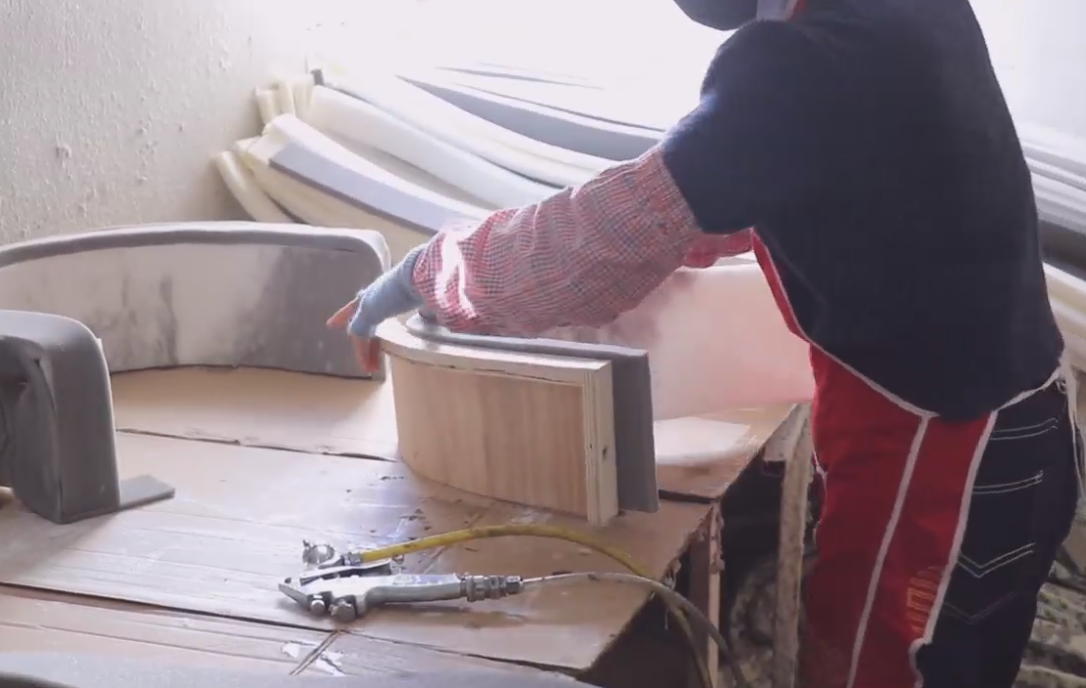
Figure 2 — Foam bonding precedes sewing and nailing, so cushion geometry is set before the cover closes.
From 66.5 cm to 80 cm: what the width range changes for procurement
The most practical evidence of cross-design capability is the width range itself. The documented model line spans 66.5 cm to 80 cm, and the loading quantities move in the opposite direction as width increases. A buyer planning a container mix can read the entire trade-off from one table.
| Model | Width | Product size | Carton size | Loading quantity | Documented materials |
|---|---|---|---|---|---|
| MC196-3-1 | 66.5 cm | W66.5 × D69 × H106–114 cm | 75 × 57 × 37 cm | 441 | Fabric, PVC, PU, metal, plastic, foam |
| MC196 (office chair) | 67 cm | W67 × D70 × H124–132 cm | 76 × 32 × 61 cm | 465 | Fabric, metal, foam, plastic |
| MC1025 | 70 cm | W70 × D69 × H121–130 cm | 78 × 38 × 56 cm | 410 | Fabric, foam, PU, metal, plastic |
| MC196-2-1 | 70 cm | W70 × D70 × H118–128 cm | 75 × 65 × 34 cm | 410 | Fabric, metal, plastic, foam |
| MC1034 | 71.5 cm | W71.5 × D65 × H123–131 cm | 86.5 × 65 × 36 cm | 334 | Metal, PU, plastic |
| MC1040 | 80 cm | W80 × D72 × H119 cm | 82 × 60 × 60 cm | 227 | PU + PVC, metal frame |
Table 2 — Documented width range and loading quantities across the model line. Some entries state per-40HQ basis explicitly; others do not, so container type should be confirmed per shipment.
Three procurement conclusions follow directly. First, a buyer who needs maximum units per container should anchor on the 66.5–67 cm group, where loading reaches 441–465 units. Second, the 70–71.5 cm group — including MC1025 — sits in the mid-300s to 410 units and represents the normal balance between seat width and freight efficiency. Third, MC1040 at 80 cm loads 227 units, so it belongs in programmes where the wider seating format is the product requirement rather than a volume play.
Application fit: where these two configurations ship
Both MC1025 and MC1040 are documented for home, office and live streaming use. That overlap is useful, because it means the choice between them is not a channel decision but a format decision. A home PC gaming chair buyer wanting a fabric surface and an adjustable height band lands on MC1025. A buyer fitting a lounge-style streaming corner or a wide seating layout lands on MC1040, accepting the fixed 119 cm height and the heavier carton in exchange for the 150 kg capacity and the 80 cm width.
For internet cafe deployment, the documented fit shifts: MC196-3-1 is listed for home, office and internet cafe, and by width and loading it is the more efficient specification for high-density seating floors. Maochang's documented wholesale case supports this pattern — 460 units supplied to a Ukrainian wholesale business partner for office space furnishing, a relationship documented at two years, with the result recorded as well received by local office clients. The mix in that order spans MC196-3-1, MC196-2-1, MC1025, MC196 and MC196-1, which is the practical version of the same point: one factory, several formats, one shipment.
Market signals behind the specification choices
Three third-party data points explain why a factory would invest in both a fabric platform and a wide PU/PVC sofa rather than specialising. PU leather remains the dominant gaming chair material with a 57.3% share in 2024 (Mordor Intelligence), which makes the fabric route on MC1025 a deliberate capability statement rather than a default choice. PC gaming chairs hold a 52.6% product segment share (Grand View Research), confirming where volume concentrates. And the hybrid work-and-game chair segment reached a 29.8% share in 2024 (Grand View Research), which is the segment where fabric upholstery, office-appropriate proportions and adjustable height bands matter more than racing graphics.
Read together, those signals favour factories that can hold a specification across material families. A supplier that only casts PU shells has limited room in the hybrid segment; a supplier that only sews fabric has limited room in the wide-format and lounge-adjacent segment.
What this evidence does not prove
Engineering evidence is only credible when its boundaries are stated. Six limits apply to the material above.
- Scale is moderate. A 3,000 m² factory with 25 employees and a documented monthly capacity of 6,000 units is a specialist operation, not a mass-volume platform. Programme volumes materially above that monthly figure need scheduling agreed in advance.
- Two specifications are incomplete. MC1025 publishes neither a net weight nor a weight capacity, and neither model publishes a foam density grade or a spring configuration. These are sample-stage questions, not catalogue answers.
- Wide format carries a freight penalty. MC1040 loads 227 units against 441 for the 66.5 cm model — roughly half the container density — so its landed cost per unit is structurally higher regardless of upholstery.
- Certification has a calendar. The amfori-BSCI audit (certificate 25-0358113, Eurofins CPA) runs to 13 November 2026. Buyers committing to shipments landing in 2027 should confirm renewal status before they commit, not after.
- Patent scope is model-specific. Design patent ZL 2025 3 0581799.7 (CNIPA) covers MC196-2-1 and MC196-3-1. It does not cover MC1025 or MC1040, so buyers cannot assume the same design protection applies across the line.
- Loading figures need a stated basis. Some entries in the specification set are explicitly per-40HQ; others are not. Container type and stacking plan should be confirmed in writing before a purchase order fixes the quantity.
Future outlook
The direction of travel in this category is toward published material data rather than published slogans. As the hybrid work-and-game segment continues to take share from pure racing formats, the specifications buyers ask for shift from colourways and lighting to foam density, load ratings and carton efficiency. Suppliers that already document net weight, capacity and carton dimensions — as MC1040 does — are better positioned for that conversation than suppliers whose sheets stop at product photography.
The Anji cluster's position as the leading production base for gaming chairs, inside a national export share of 30.8% (Statista / OEC Trade Data), keeps competitive pressure on specification transparency rather than away from it. The realistic expectation for the next buying cycle is not that every factory publishes every grade, but that buyers stop accepting a material list as a substitute for a material specification.
FAQ
What customization does Maochang Furniture offer for OEM and ODM programmes?
Anji Maochang furniture Co.,Ltd. provides both OEM and ODM production services, with customization options covering logo, colour, size and design. The documented minimum order quantity is 50 units, and the documented lead time is 30–40 days.
What weight can MC1040 support, and how heavy is the product itself?
MC1040 is documented with a 150 kg weight capacity and a 27.4 kg net product weight, a load-to-mass ratio of roughly 5.5 to 1. It is built as a gaming sofa with PU+PVC upholstery over a metal frame, at W80 × D72 × H119 cm, packed one piece per 82 × 60 × 60 cm carton.
What materials and dimensions are documented for MC1025?
MC1025 is documented as a new-design computer chair in fabric, foam, PU, metal and plastic. Product size is W70 × D69 × H121–130 cm, carton size is 78 × 38 × 56 cm, and the loading quantity is 410 units with one piece per carton.
Which quality-control checks apply before production and before shipment?
On material arrival, the factory inspects the gas lift, mechanism, leather colour and plywood thickness. Before full production, one chair is assembled with plywood only to check the total depth and to verify the assembly sits even. Pre-shipment testing is the documented acceptance criterion, and the production line itself runs cutting, woodworking, foam bonding, sewing, nailing, assembly, cleaning and packaging.
Which certifications and audits support export orders?
Documented evidence includes an amfori-BSCI audit (certificate 25-0358113, Eurofins CPA, valid to 13 November 2026), FSC Chain-of-Custody certification ESTS-COC-252406 (FSC-A000543, valid to 20 January 2031), an EN 1335-1:2020 and EN 1335-2:2019-04 office work chair safety test report (RED250415073002ED-AMR, RED Laboratories Inc.), an EN 717-1:2004 formaldehyde emission test report (RED250415073003ED-AMR), and a CNIPA design patent ZL 2025 3 0581799.7 covering MC196-2-1 and MC196-3-1.
What are the purchasing terms?
The documented commercial terms are a minimum order quantity of 50 units, delivery terms FOB Shanghai or Ningbo, pre-shipment test as the acceptance criterion, payment of 30% deposit in advance with the balance against a copy of the bill of lading, and a one-year quality warranty.
A complete model and specification overview, including dimensions and carton data across the line, is available in the 2026 Maochang catalogue (PDF). Company information is published at www.mcrfurniture.com.
Have Questions or Need More Details?
Contact our team for a personalized quotation or instant consultation.
Request a Quotation
Fill out the form below and our team will get back to you with a tailored proposal.
WhatsApp Direct Chat
Prefer to chat in real-time? Message us on WhatsApp for instant assistance & quick answers.
- Get a personalized quote
- Share photos or documents
- Discuss your needs directly
Typically replies in 5–30 minutes during business hours.