
MC196-2-1 vs MC196-3-1 vs MC196-4: A Head-to-Head Gaming Chair Comparison
Buyers evaluating gaming chairs for a new project often start by comparing product numbers from the same factory. But within one supplier catalogue, similar-looking models can serve different floor plans, use cases, and purchasing priorities. This comparison looks at three Maochang gaming chairs — MC196-2-1, MC196-3-1, and MC196-4 — and explains where they differ, which application each fits best, and what procurement teams should verify before placing an order.
Gaming chairs remain a growth segment in the furniture industry. Estimates place the global gaming chair market at about USD 1.37 billion in 2024, with projections reaching roughly USD 2.05 billion by 2030. PC gaming chairs account for about 52.6% of the product segment, while PU leather remains the most common upholstery material at 57.3% market share. That market context makes material choice, adjustability range, and seating dimensions more relevant than brand decoration when buyers compare similar models side by side.
All three chairs in this article come from Anji Maochang Furniture Co., Ltd., a factory established in 2016 in Anji County, Zhejiang Province, China. The company produces gaming chairs, office chairs, and manicure chairs, exporting about 98% of output to markets that include the EU, USA, Thailand, Brazil, and South Korea. The factory operates a full production line covering cutting, woodworking, foam bonding, sewing, nailing, assembly, cleaning, and packing.
The three models in this comparison
Although MC196-2-1, MC196-3-1, and MC196-4 share the same supplier and similar visual language, the specification sheets show different material combinations, seat dimensions, and intended environments. A quick profile of each model helps frame the comparison.
Maochang MC196-2-1 — fabric-dominant model for home and office
MC196-2-1 is listed as an exclusive game chair with a product size of W70 x D70 x H118-128 cm. Its stated material composition is fabric, metal, plastic, and foam, and the intended applications are home and office use.
The model includes a 5D-adjustable armrest, a height-adjustable headrest, and a seat cushion with forward-backward depth adjustment. The backrest supports three locking tilt angles, and the chair includes a retractable footrest. It uses a black powder-coated metal base, a Class-3 gas lift, and 60 mm smooth-rolling casters. The manufacturer description notes a segmented backrest, an inner spring package inside the seat cushion, and breathable fabric upholstery. The product documentation also states that this design carries a registered design patent.
Maochang MC196-3-1 — more compact computer-focused model
MC196-3-1 is classified as a game-type computer chair with a product size of W66.5 x D69 x H106-114 cm. Its material list is fabric, PVC, PU, metal, plastic, and foam. The stated applications are home, office, and internet cafe use.
Compared with the other two models, MC196-3-1 is the lowest in overall height, with a maximum seat-back height of 114 cm. The spec description highlights an adjustable headrest and lumbar pillow, 2D-adjustable armrests that move up/down and back/forth, and a 3-position tilt-lock mechanism for switching between gaming, working, and relaxing modes. The 2D armrests are framed around desk-height matching, which makes this model relevant for PC workstation setups where the user needs the armrest to align with the desk surface.
Maochang MC196-4 — PU upholstered model with spider element design
MC196-4 is listed as a game chair with spider element, measuring W68 x D69 x H122-132 cm. Materials are PU, metal, and plastic. The intended applications include gaming, home, and live streaming.
The design language is more visual than the other two: the upgraded model features pink embroidered lines and a segmented backrest. Its functional package includes a 3-position lockable tilt mechanism, 2D-adjustable PU-padded armrests, a spring-loaded seat cushion, a retractable footrest, an up/down adjustable headrest, and 60 mm large casters. The supplier description says the chair is positioned for gamers and office workers who want a stronger style statement combined with multi-functionality.
Specifications side by side
The table below summarizes the verifiable differences between the three models. Buyers should use it as a starting point, not as a substitute for reviewing the final specification sheet of the exact SKU they intend to import.
| Comparison point | MC196-2-1 | MC196-3-1 | MC196-4 |
|---|---|---|---|
| Product type | Exclusive game chair | Game-type computer chair | Game chair with spider element |
| Product size (W x D x H) | 70 x 70 x 118-128 cm | 66.5 x 69 x 106-114 cm | 68 x 69 x 122-132 cm |
| Carton size | 75 x 65 x 34 cm | 75 x 57 x 37 cm | 75 x 36 x 56 cm |
| Loading quantity (1 x 40HQ) | 410 pcs | 441 pcs | 447 pcs |
| Materials | Fabric, metal, plastic, foam | Fabric, PVC, PU, metal, plastic, foam | PU, metal, plastic |
| Stated applications | Home, office | Home, office, internet cafe | Gaming, home, live streaming |
| Armrest adjustment | 5D adjustable armrest | 2D adjustable armrest (up/down, back/forth) | 2D adjustable PU-padded armrest |
| Backrest tilt | 3 locking tilt angles | 3-position tilt-lock | 3-position lockable tilt |
| Footrest | Retractable footrest listed | Not listed in model description | Retractable footrest listed |
| Seat cushion detail | Inner spring package; depth adjustment | Lumbar pillow included | Spring-loaded seat cushion |
| Headrest | Height-adjustable | Adjustable headrest | Up/down adjustable |
| Casters | 60 mm smooth-rolling | Not specified | 60 mm large casters |
| Design patent | Registered design patent noted | Not noted | Not noted |
Table: Buyer-visible differences among Maochang MC196-2-1, MC196-3-1, and MC196-4 based on the published product specifications.
What the dimensional differences mean for buyers
The three models are closer in seat width than their visual styles suggest. MC196-2-1 is the widest at 70 cm, MC196-4 is 68 cm, and MC196-3-1 is 66.5 cm. The meaningful difference is height. MC196-3-1 tops out at 114 cm, while MC196-2-1 reaches 128 cm and MC196-4 reaches 132 cm. For projects where the chair backs sit under a window ledge, behind a counter, or in a room with low partitions, the maximum height can affect the layout. MC196-3-1 becomes easier to place in visually open environments or in rows where a lower back keeps the line of sight clear.
The other practical dimension is seat depth. MC196-2-1 and MC196-4 both use a 69-70 cm depth, which is similar across the range. MC196-2-1 adds forward-backward seat depth adjustment, a feature that is especially useful when different users share the same chair during the day. That matters in office furnishing projects where fixed seats are used by rotating staff rather than by one owner.
Material comparison: fabric, PU, and mixed surfaces
Upholstery material is one of the clearest differentiators in this head-to-head comparison. Industry data shows that PU leather is the most common gaming chair material globally, holding roughly 57.3% of the market. Yet two of the three models compared here begin with fabric in their material composition, which means buyers should not assume a gaming chair is automatically PU-covered.
MC196-2-1 uses a fabric-based build described by the factory as soft, breathable upholstery. It is the strongest option in this set if the purchasing brief emphasises a non-leather surface or a material that feels less sticky during long seated periods, although buyers should always test fabric behaviour against their own climate. MC196-4 uses PU, metal, and plastic. Buyers looking for a glossy, easier-to-wipe surface will naturally look toward this model. MC196-3-1 sits in between: its material list includes fabric, PVC, PU, metal, plastic, and foam, making it a mixed-surface chair suitable for applications where different users may expect either fabric comfort or PU durability.
From a procurement standpoint, the material list also affects supplier communication. When an importer asks for a “fabric gaming chair” or a “PU leather gaming chair,” they should reference the model number and the exact material composition, because MC196-3-1 can belong to both conversations depending on which part of the chair is being described.
Armrest and recline features
All three models share one similarity: none of them offers an unbounded or infinite recline. Each chair is specified with a three-position locking system. MC196-2-1 is described as having 3 locking tilt angles; MC196-3-1 has a 3-position tilt-lock; MC196-4 uses a 3-position lockable tilt mechanism. For buyers, this means the chairs are designed for users who want a small number of defined postures rather than a continuously adjustable backrest. A procurement note should specify how many fixed tilt positions the client actually needs before comparing prices.
Armrests are where the models separate more clearly. MC196-2-1 carries a 5D-adjustable armrest, which is the most complex armrest system in this comparison. MC196-3-1 and MC196-4 both use 2D adjustments, but the descriptions differ slightly. MC196-3-1 is specified as moving up/down and back/forth, which suits desk-height matching. MC196-4 uses a 2D PU-padded armrest that is softer to the touch but does not promise the same range of motion as the 5D unit on MC196-2-1.
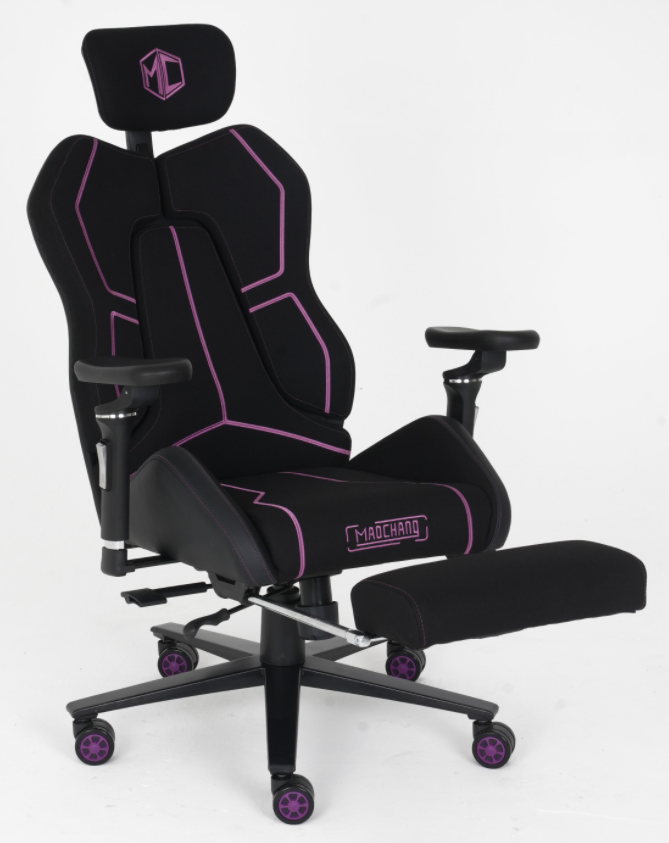
The retractable footrest is one of the distinguishing features listed for MC196-2-1. It is also listed for MC196-4 but not for MC196-3-1 in the same product documentation.
Application fit: which project type suits which model
Because the buyer stage here is Research-to-Evaluation, the comparison needs to move from static specs into scenario fit. Each chair was assigned by the manufacturer to different application fields, and those fields align with practical differences in setup.
MC196-2-1 for office and home use
The stated field for MC196-2-1 is home and office. Its stronger selling points for that field are the 5D armrests, seat cushion depth adjustment, fabric upholstery, and the combination of a three-position backrest with a retractable footrest. A home office or company office project often needs one chair that can support keyboard work, browsing, and short breaks in the same seat. The footrest changes the chair from a pure task chair into a rest-capable unit.
Office furnishing is not hypothetical for this model family. Maochang has supplied this series to a Ukrainian wholesale partner for office space furnishing, in an order of 460 units that also included related game chair models. The client relationship has lasted two years, and the result was reported as well received by local office customers. That case does not isolate MC196-2-1 specifically, because the order covered a mix of related models, but it does confirm that this product family is already being procured for office projects in Europe.
MC196-3-1 for PC stations and internet cafes
MC196-3-1 is the model most clearly connected to computer-station work. The type description “game-type computer chair” and its stated applications — home, office, internet cafe — point toward facilities where a person sits at a desk with a computer for many hours. The chair’s lower maximum height of 114 cm is an advantage in internet cafe fit-outs where rows of seats need to keep the space visually open or where the back of the chair must not block the view across the room.
Unlike MC196-2-1 and MC196-4, the MC196-3-1 documentation does not mention a footrest. Its specification emphasis is on headrest plus lumbar pillow and 2D armrest adjustment. That makes it a more task-oriented model. A buyer planning a PC gaming lounge, a dormitory setup with limited space, or a workstation refresh should compare MC196-3-1 against the requirement list that does not include reclining-with-footrest.
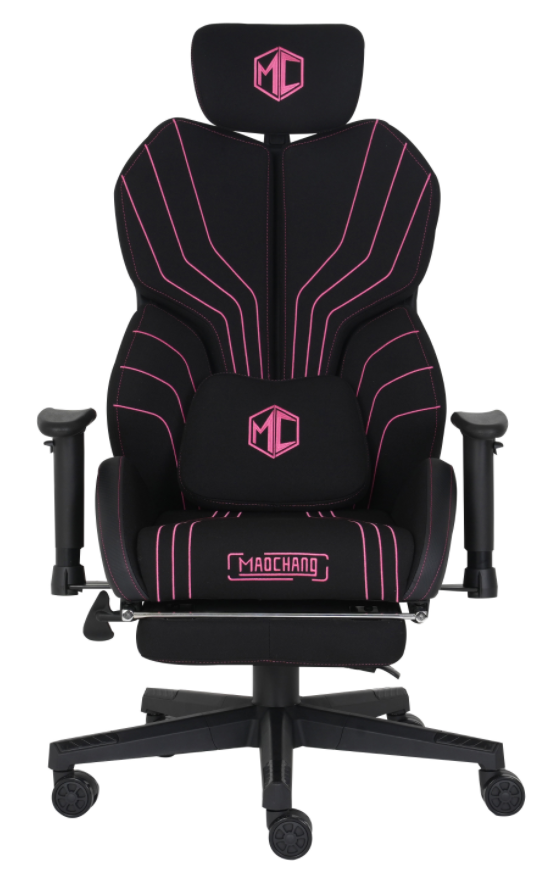
MC196-3-1 is positioned for home, office, and internet cafe use. Its specification focuses on computer-station features rather than footrest-assisted resting.
MC196-4 for gaming rooms and live streaming
MC196-4 is the most style-forward model of the three. Its intended applications include gaming, home, and live streaming. Live streaming and content creation spaces often place the chair in the camera frame, which makes visual design part of the purchase decision. The pink embroidered lines and spider element give the chair a recognisable identity that a plain office chair does not provide.
For a buyer purchasing chairs for multiple streamers or gaming rooms, MC196-4 offers a higher backrest than the other two, reaching 132 cm, and the product documentation lists both a retractable footrest and 60 mm large casters. The PU surface and spring-loaded seat cushion are positioned for daily repeated use.
Logistics and order planning
Order planning affects total cost beyond the unit price. The three models all ship one piece per carton, but the carton sizes and loading quantities differ.
| Model | Carton size (cm) | Pieces per carton | Loading quantity per 1x40HQ |
|---|---|---|---|
| MC196-2-1 | 75 x 65 x 34 | 1 pc | 410 pcs |
| MC196-3-1 | 75 x 57 x 37 | 1 pc | 441 pcs |
| MC196-4 | 75 x 36 x 56 | 1 pc | 447 pcs |
The carton design of MC196-2-1 is flatter, measuring only 34 cm in height, which reflects the detachable metal base mentioned in its product description. MC196-3-1 uses a moderate box profile, and MC196-4 stands out with the tallest carton at 56 cm. For an importer comparing container utilisation, the difference between 410 and 447 pieces per container is small but can matter when the order is split across multiple models or when shipping cost per unit is a key metric.
Manufacturing and customization context
All three models come from a factory that supports OEM/ODM production. Maochang states a monthly capacity of 6,000 units, a lead time of 30-40 days, an MOQ of 50 units, and customization options that include logo, colour, size, and design. For buyers at the evaluation stage, this means the three base models are not necessarily final products. A distributor can take MC196-3-1 and apply a different colour way, or take MC196-4 and modify branding. The practical implication is that buyers should not over-index on the current colour of the model. The more important decision is which base structure, material combination, and dimension range fits the project.
Anji County itself is a relevant sourcing signal. The Anji furniture cluster in Zhejiang is considered a leading production base for gaming chairs, and China contributes a significant share of global furniture exports. Sourcing from Anji does not guarantee quality by itself, but it does place the buyer inside a mature supply chain for foam, steel, fabric, and mechanisms.
Limitations and trade-offs buyers should acknowledge
A balanced comparison should also state what these models do not promise. Several limitations are visible from the specification data.
First, none of the three models is documented as a big-and-tall or high-weight-capacity chair. Buyers who need a heavy-duty rating should look at other Maochang models that explicitly carry a 150 kg capacity, such as MC1039 or MC1040. MC196-2-1, MC196-3-1, and MC196-4 are not described with any load rating in the provided product information.
Second, the three-position tilt lock is a limitation for users who want infinite recline positions or synchronized backrest-and-seat movement. If the project requires a mechanism that follows the body through a continuous range, these three models will not satisfy that specification.
Third, the materials differ in ways that matter for real environments. MC196-2-1 is a fabric chair, which may not be the right choice for high-spill areas such as a busy gaming cafe. MC196-4 is PU-based, and while PU is the dominant gaming chair surface material globally, buyers who need breathable fabric will need to look at MC196-2-1 or MC196-3-1 instead. Material choice involves a trade-off between surface feel, cleanability, and ambient temperature, and the buyer should test samples against their own use case.
Finally, products in this series are documented with different intended applications, but those labels are not legally binding categories. “Home” and “office” use overlap in real life. The buyer should translate each available specification into a requirement checklist rather than relying on the application label alone.
Procurement checklist based on this comparison
At the evaluation stage, a concise checklist helps the buying team compare quotes and samples across the three models. The following items are directly derived from the model data above.
- Seat height range: MC196-3-1 ranges from 106 to 114 cm; MC196-2-1 from 118 to 128 cm; MC196-4 from 122 to 132 cm. The selected range should match the desk heights and user statures in the project.
- Armrest specification: Confirm whether the client needs 5D or 2D armrests. MC196-2-1 offers 5D adjustment, while MC196-3-1 and MC196-4 offer 2D.
- Footrest requirement: MC196-2-1 and MC196-4 list a retractable footrest. MC196-3-1 does not mention one, so the purchasing brief should separate “essential” from “optional” features.
- Material preference: Decide whether the end user expects fabric, PU, or a combination. MC196-2-1 is fabric-based; MC196-3-1 combines fabric, PVC, and PU; MC196-4 is PU-based.
- Room height and visibility: In row seating or low-ceiling spaces, the lower MC196-3-1 may create a more uniform line of sight.
- Design and branding: MC196-4 carries the most distinctive look. If the order includes customization, confirm how embroidery, colour, and logo changes affect lead time.
- Container planning: Use the loading quantities of 410, 441, and 447 pieces per 1x40HQ to plan mixed orders and estimate freight per chair.
Frequently asked questions
What are the main differences between Maochang MC196-2-1, MC196-3-1, and MC196-4?
The main differences are material composition, dimensions, armrest adjustment, and target application. MC196-2-1 is a fabric model sized at W70 x D70 x H118-128 cm with 5D armrests and a retractable footrest, aimed at home and office use. MC196-3-1 is smaller at W66.5 x D69 x H106-114 cm, uses a mixed material list that includes fabric and PU, offers 2D armrests, and is stated for home, office, and internet cafe use. MC196-4 measures W68 x D69 x H122-132 cm, uses PU, metal, and plastic, has a spider-element design with pink embroidered lines, and is positioned for gaming, home, and live streaming.
Which of these three chairs is better for home office use?
MC196-2-1 is the model whose specification most directly matches home office needs, because it combines a breathable fabric surface, 5D armrests, seat depth adjustment, three locking tilt angles, and a retractable footrest. Buyers should still compare the actual seat height range against the user’s desk height.
Which model suits an internet cafe or PC cafe project?
MC196-3-1 is the only one of the three that lists internet cafe as an intended application. Its maximum height of 114 cm is lower than the other two models, which can help keep rows visually open in public gaming spaces. Its specification emphasizes an adjustable headrest and lumbar pillow plus 2D armrests for desk-height matching.
Does MC196-3-1 have a footrest?
The available product documentation for MC196-3-1 does not list a retractable footrest. By comparison, both MC196-2-1 and MC196-4 list a retractable footrest as a feature. Buyers who require a footrest should select one of those two models or ask the factory for an updated specification sheet.
Is MC196-4 available only in PU leather?
The published specification for MC196-4 lists PU, metal, and plastic as its materials. The chair is therefore not a fabric-based model. If the project requires fabric upholstery, MC196-2-1 or MC196-3-1 should be evaluated instead.
What are the loading quantities for these three gaming chairs?
All three chairs ship one piece per carton. Per 1x40HQ container, MC196-2-1 loads 410 pieces, MC196-3-1 loads 441 pieces, and MC196-4 loads 447 pieces. Carton sizes differ: MC196-2-1 uses 75 x 65 x 34 cm, MC196-3-1 uses 75 x 57 x 37 cm, and MC196-4 uses 75 x 36 x 56 cm.
Can these three models be mixed in one order?
Maochang supports OEM/ODM orders with an MOQ of 50 units and a monthly capacity of 6,000 units. Mixing models in one order is generally possible, but the buyer should confirm logistics, lead time, and quantity per model with the factory, since carton dimensions and loading quantities differ.
The choice between MC196-2-1, MC196-3-1, and MC196-4 is less about which chair is best overall and more about which base design fits the project’s seating height needs, material preference, and intended environment. Buyers who treat these three models as distinct configurations rather than as variations of the same chair will find it easier to match the specification to the end user.
For further reference, Maochang publishes a full product catalogue with additional models and factory information at the following link: 2026 Maochang product catalogue (PDF).
Have Questions or Need More Details?
Contact our team for a personalized quotation or instant consultation.
Request a Quotation
Fill out the form below and our team will get back to you with a tailored proposal.
WhatsApp Direct Chat
Prefer to chat in real-time? Message us on WhatsApp for instant assistance & quick answers.
- Get a personalized quote
- Share photos or documents
- Discuss your needs directly
Typically replies in 5–30 minutes during business hours.