
MCPCB Base Material Guide: Aluminum vs. Copper vs. Ceramic Boards
An MCPCB, or metal-core printed circuit board, is not fully defined by one material name. Buyers evaluating MCPCB options for lighting must compare the base material together with layer structure, copper foil thickness, board thickness, surface finish, and intended application. This guide compares three representative MCPCB families using documented product data available from a real manufacturer: standard single-sided aluminum-based boards, a thermoelectric-separated copper-based board, and a ceramic-based board used for ultraviolet phototherapy. The perspective is independent, and no substrate is presented as universally superior.
Procurement and engineering teams at the research and evaluation stage need to know what a base-board change means in the specification, not in a marketing claim. The practical question is whether a quoted product can satisfy a project constraint: single-sided or double-sided circuitry, copper weight, allowable board thickness, finish, thermal path, and the application environment. This guide is meant to help buyers frame those constraints and ask the right supplier questions.
Buyer Context: Why Base Material Is a Constraint, Not a Conclusion
In an LED luminaire, heat moves from the light source through the circuit layer and dielectric into the board base, then into the luminaire housing. An MCPCB is therefore part of a thermal path. The base material influences how that path is designed. Yet the base material alone does not determine the temperature of the LED; the dielectric system, copper pattern, solder joint quality, thermal interface material, heat sink, airflow, and enclosure also matter.
For a buyer, this creates an important evaluation rule. A quotation that says “aluminum MCPCB” or “copper MCPCB” is only a material family. The buyer must confirm the stack-up details: single-sided versus double-sided, copper foil thickness, overall thickness, solder mask, silkscreen, and finish. Those items determine whether the board can be assembled, routed, and tested in the intended luminaire.
Problem and Opportunity for MCPCB Buyers
The main problem in MCPCB selection is inconsistent terminology. Suppliers may quote “aluminum base” for one product and “copper base” for another, but the real difference may be layer count or finish rather than base material name. A buyer comparing only the words “aluminum” and “copper” can miss whether one product is single-sided and the other is double-sided. The opportunity is to use documented specifications as the primary comparison tool. If the product sheet gives the base material, copper foil thickness, overall thickness, layer structure, and application field, a meaningful comparison can begin.
For lighting projects, the comparison often involves three distinct directions: a standard aluminum-based board for general or road lighting, a thermoelectric-separated copper-based board for lighting designs that require a double-sided structure or a different thermal layout, and a ceramic-based board for a more specialized application such as ultraviolet phototherapy. These three families answer different design and procurement questions.
Documented Product Lineup: WODE Circuit Technology (Zhuhai) Co., Ltd.
To keep this comparison fact-based, the examples below are drawn from WODE Circuit Technology (Zhuhai) Co., Ltd., a PCB and FPC manufacturer founded in 2003 and located in Zhuhai, China. The company operates a 150,000 m² facility with more than 500 employees and exports roughly 50 percent of its output. Its printed circuit board product line includes rigid metal-core PCBs, flexible PCBs, double-sided and multilayer boards, aluminum-based laminates, and related materials. WODE is used here as a verifiable source of actual board specifications, not as a brand recommendation.
The exact products selected for this buyer’s guide represent the relevant material categories: a single-sided aluminum board documented for road lighting, a thermoelectric-separated copper-based board documented for lighting, a double-sided aluminum board documented for home applications, and a ceramic-based board documented for ultraviolet phototherapy.
Representative Specification Comparison: Aluminum, Copper, and Ceramic
The table below compares three representative products. The ceramic-based product is shown with the limited information provided in the source data because that is an important observation for buyers: a material name without a stack-up is not enough to finalize a design.
| Parameter | Single-Sided Aluminum MCPCB | Thermoelectric Separated Cu Based PCB | Ceramic Based PCB |
|---|---|---|---|
| Reference product | MCPCB for Road lighting | Thermoelectric Separated Cu based PCB | Ceramic based PCB |
| Base material | Al1060 | Cu-based | Ceramic |
| Layer structure | Single sided | Double sided | Not stated in source data |
| Copper foil thickness | 1 oz | 35 µm | Not stated in source data |
| Overall thickness | 1.6 mm ±10% | 1.6 mm ±0.16 mm | Not stated in source data |
| Solder mask | White | White | Not stated in source data |
| Silkscreen color | Black | Black | Not stated in source data |
| Surface finish | HASL-LF | OSP | Not stated in source data |
| Panel size | 208.00 mm × 225.00 mm (2-up) | 133.80 mm × 120.00 mm (4-up) | Not stated in source data |
| Documented intended use | Road lighting | Lighting | Ultraviolet phototherapy |
This table is intentionally narrow. It compares actual parameters, not assumed performance. A buyer can see that both the single-sided aluminum product and the thermoelectric-separated copper product are listed for lighting, while the ceramic board is listed for ultraviolet phototherapy. The ceramic example has the least publicly detailed specification. That difference is itself a useful procurement signal: specialized base materials often require a more detailed engineering conversation before a supplier can quote a complete board.
Reading the Board Materials in Detail
Single-Sided Aluminum MCPCB
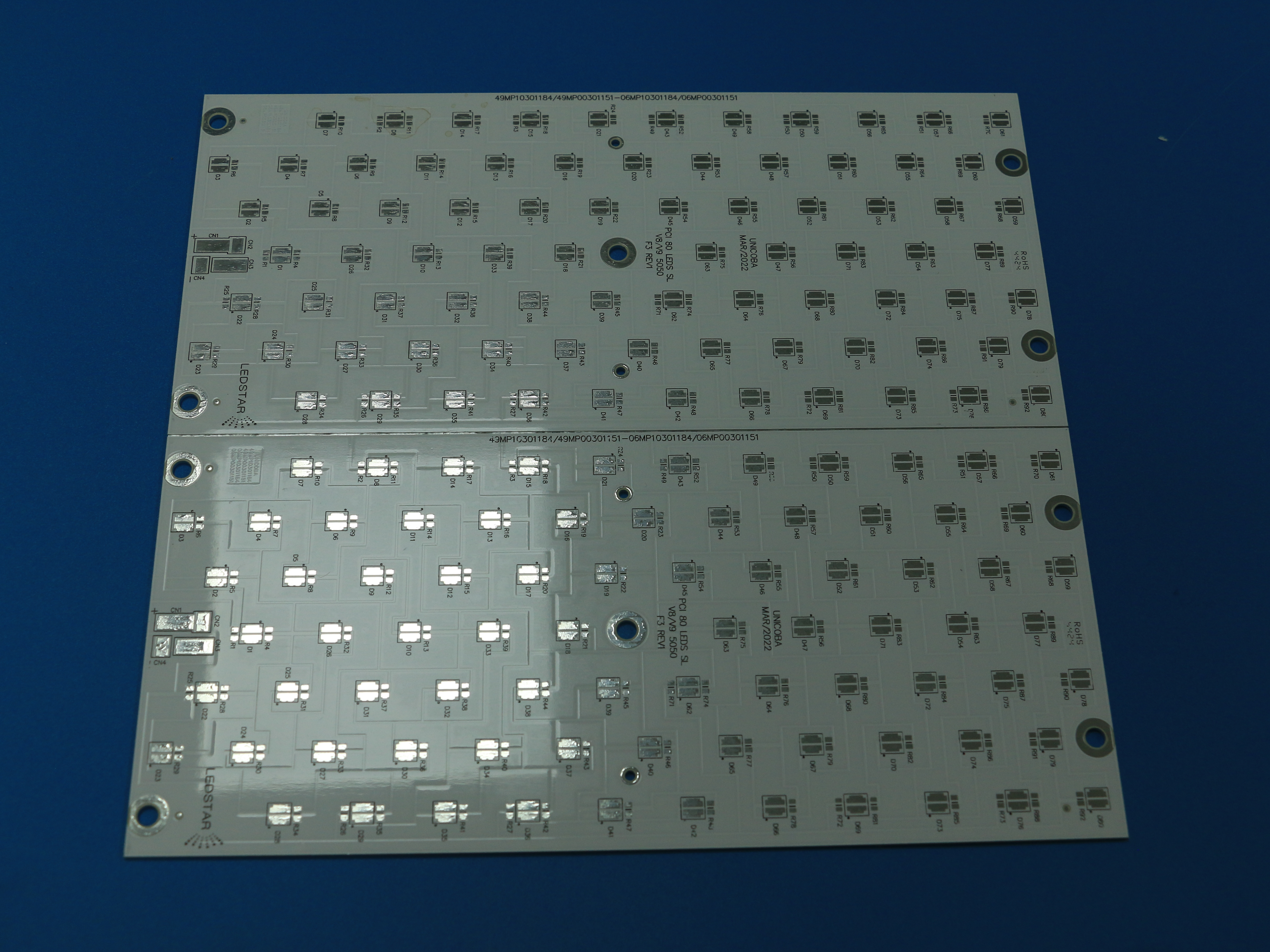
In the WODE product record, the MCPCB for road lighting uses Al1060 as the aluminum base. The board is single-sided, uses 1 oz copper foil, has an overall thickness of 1.6 mm ±10%, a white solder mask, a black silkscreen, and lead-free HASL finish. The panel format is 208.00 mm by 225.00 mm with 2 units per panel. A second aluminum example, the coverlay aluminum PCB, also uses Al1060 and a 1.6 mm overall thickness, but its documented solder mask is a white coverlay instead of a conventional white solder mask. This is an important variation: “aluminum-based” includes more than one surface protection option.
Single-sided aluminum boards are commonly specified in general lighting because many LED circuits require only one conductive layer. The examples in this guide show that aluminum boards are not limited to a single product form. The manufacturer also documents a motor-lighting board using Al5052 with a single-sided structure and a high-voltage MCPCB with OSP finish. From a buyer’s perspective, the material family should therefore be read together with the specific alloy and construction, not treated as one uniform product.
Thermoelectric Separated Copper-Based PCB
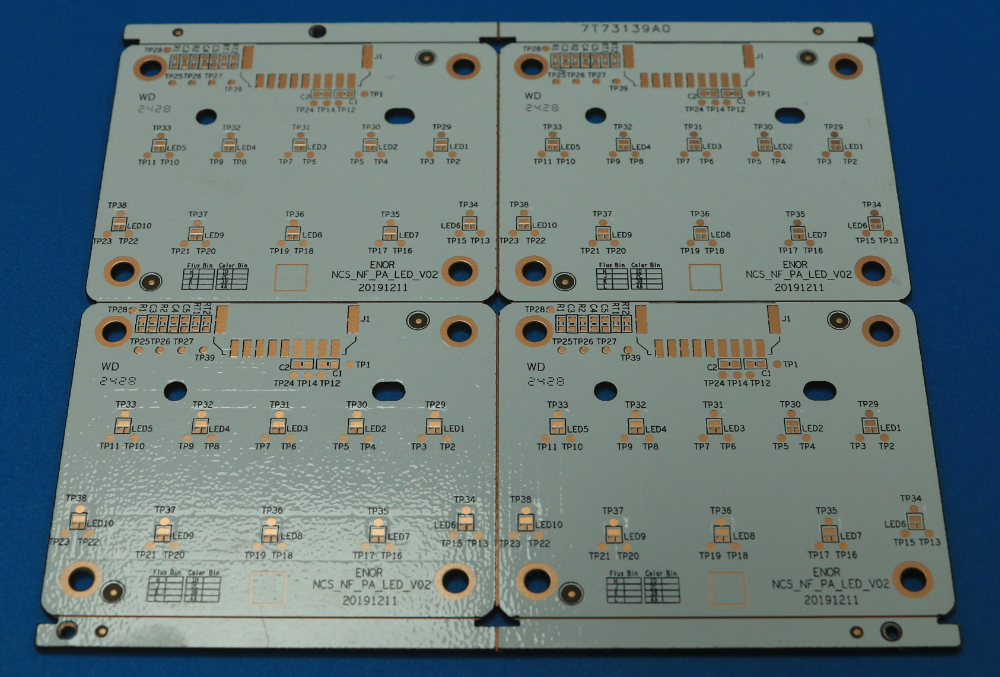
The Thermoelectric Separated Cu based PCB is a double-sided copper-based substrate. Its documented specification includes 35 µm copper foil, 1.6 mm ±0.16 mm overall thickness, a 133.80 mm by 120.00 mm panel format with 4 units per panel, white solder mask, black silkscreen, and OSP surface finish. The product is listed for lighting use. The name “thermoelectric separated” is part of the product type and should be defined by the supplier for a specific project; the available source data does not explain the internal copper layout.
In this example, the copper-based board is double-sided, while the road lighting aluminum board is single-sided. These are not equivalent products. A buyer should not compare “aluminum versus copper” without first answering whether the application needs a single-sided or double-sided circuit. A double-sided product can be chosen because the electrical design needs routing on both sides, because the thermal layout is separated, or because of another system requirement. The correct reason must come from the design review, not from the base material name.
Ceramic-Based PCB
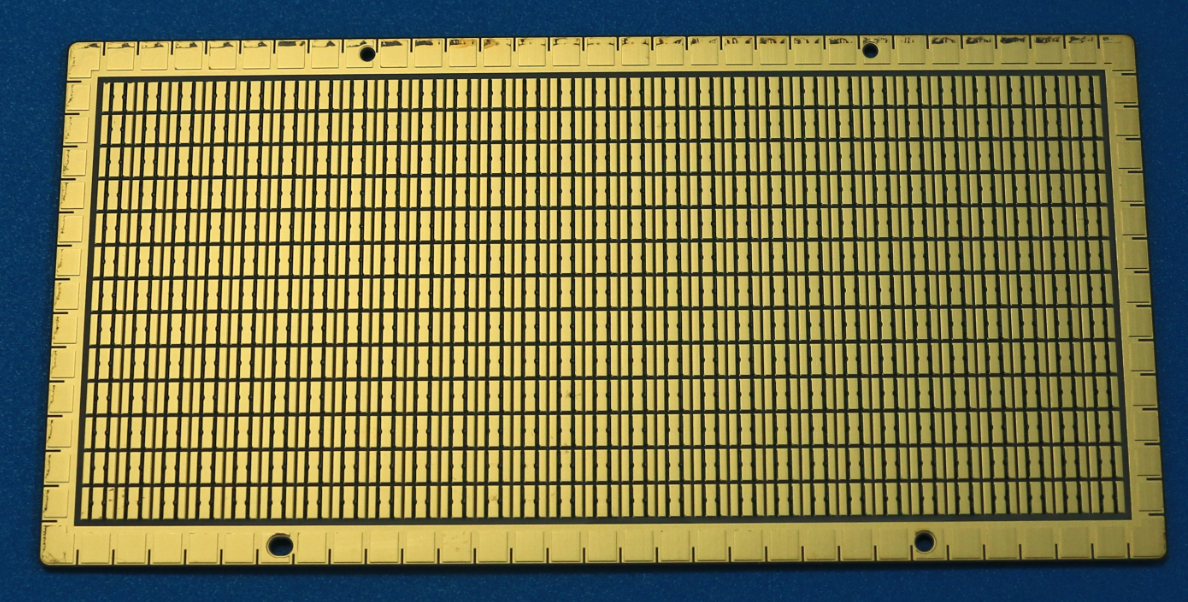
The Ceramic based PCB in the WODE product record is documented “for use of ultraviolet phototherapy.” This is a noticeably different application from general road lighting or indoor illumination. The source data lists the material as ceramic and the intended field as ultraviolet phototherapy, but it does not list copper foil thickness, layer count, overall thickness, solder mask, silkscreen, or surface finish. That is not a defect in the product; it is a missing specification in the public reference sheet. For a procurement engineer working on a phototherapy device, the correct next step is to request the complete laminated construction and the thermal or optical validation data for the specific ceramic substrate.
Technical Explanation: Layers, Copper Foil, and Surface Finish
Several specification fields require interpretation before a buyer can compare MCPCB products accurately.
Layer structure. Single-sided means one copper circuit layer is available on the board. Double-sided means the board can carry circuitry on both sides. In the examples above, the road lighting aluminum MCPCB is single-sided. The thermoelectric-separated copper-based board is double-sided. A design that needs an uninterrupted thermal pad on one side and a control circuit on the other side will likely require a double-sided board. A single-sided board may be sufficient for simpler LED modules with only electrical traces on one face.
Copper foil thickness. Aluminum road lighting board uses 1 oz copper foil, while the copper-based thermoelectric separated board lists 35 µm. In the PCB industry, 1 oz measured as a weight per square foot is approximately equivalent to a nominal thickness of 35 µm, but this equivalence should be confirmed by the supplier because copper thickness can vary by specification. The double-sided aluminum board example lists copper as 70/70 µm, meaning the copper specification is tracked on both sides. Buyers should always confirm whether a quoted copper thickness applies to each side or to the total copper in the stack-up.
Overall thickness. The aluminum road lighting example is 1.6 mm ±10%. The thermoelectric-separated copper board is 1.6 mm ±0.16 mm. The tolerance expression differs, and that tolerance can affect how the board fits into a luminaire housing. A buyer should not assume that two boards both described as 1.6 mm are identical; the allowable tolerances can be different.
Solder mask and silkscreen. The road lighting aluminum board has a white solder mask and black silkscreen. The copper-based double-sided board also uses white solder mask and black silkscreen. White solder mask is common for LED boards because it reflects light in some designs, while coverlay is used on the coverlay aluminum example. Silkscreen color is mainly an identification and branding aid, but it can influence contrast and trace readability during assembly.
Surface finish. The single-sided aluminum road lighting board uses HASL-LF, or lead-free hot air solder leveling. The thermoelectric-separated copper board uses OSP, an organic solderability preservative. Both finishes appear in the product records. Finish choice can affect shelf life, solderability, flatness, and assembly process compatibility. Buyers should match the finish to their assembly line and storage conditions rather than consider finish a minor detail.
Application Mapping and Industry Fit
MCPCB specification choices are often driven by the end application. In the available WODE product data, the application mapping is clear:
- The MCPCB for road lighting is documented as a single-sided Al1060 board for lighting. It represents a common metal-core solution in general or outdoor lighting categories such as road and street fixtures.
- The thermoelectric-separated Cu based PCB is also documented for lighting, but it is a double-sided copper-based product. This makes it more appropriate for a buyer review when the design calls for a double-sided lighting board with OSP finish.
- The double-sided aluminum-based MPCB is documented for home application. Its copper foil is 70/70 µm, and it uses white/white solder mask and black/black silkscreen. This shows that aluminum-based boards can also be produced in double-sided form and used outside road lighting.
- The ceramic-based PCB is documented for ultraviolet phototherapy. This specialized medical environment requires a different set of design questions, including UV light source mounting, thermal management, dielectric behavior, and applicable medical electronics requirements.
For the lighting industry more broadly, application profiles in the source material include indoor lighting, outdoor lighting, automotive lighting, and specialty lighting conditions such as operating rooms and explosion-proof areas. Those environments impose electrical, thermal, humidity, and certification constraints. A board intended for indoor household lighting is not automatically suitable for an outdoor road lighting fixture with a wide temperature range and moisture exposure.
Comparison with Traditional Single-Sided Aluminum MCPCBs
The most traditional aluminum-based MCPCB in this comparison is the single-sided road lighting product: Al1060 base, 1 oz copper, 1.6 mm overall thickness, white solder mask, black silkscreen, HASL-LF. This construction is simple and is likely to satisfy lighting circuits that only need one conductive layer. It is a reasonable baseline for many lamp and luminaire projects.
Compared with that baseline, the thermoelectric-separated copper-based board is a different construction because it is double-sided, uses a copper base, and has an OSP finish. The ceramic-based board is even further from the baseline because it is a ceramic substrate used for ultraviolet phototherapy, not a typical metal-core board for visible light illumination.
It is also important to acknowledge the limit of the traditional path. A single-sided aluminum MCPCB cannot provide a second circuit layer. If the product architecture requires electrical routing on both sides of the board, a single-sided board is not a valid choice. In that situation, the buyer should compare double-sided aluminum and double-sided copper options. The WODE source data confirms that a double-sided aluminum board with 70/70 µm copper exists for home applications. Changing the base material from aluminum to copper does not automatically solve a layer-structure problem; the buyer must first select the correct layer configuration.
Market Trend Analysis for Lighting Substrates
Within the available product evidence, the notable trend is specialization. A single manufacturer’s lighting-related PCB range includes Al1060 for road lighting, Al5052 for motor lighting, copper-based double-sided boards for lighting, and ceramic boards for ultraviolet phototherapy. This suggests that leading suppliers are increasingly organizing MCPCB selection around application requirements rather than offering one generic metal-core board for every project.
From a procurement standpoint, this means the buyer’s request for quotation should define the application and the operating environment. A road lighting board will face outdoor thermal cycling and long nightly operation. A home appliance board will operate under indoor conditions, where temperature and humidity ranges are narrower. An ultraviolet phototherapy board may have medical device constraints and a very different board material. These application differences matter more than generic phrases such as “thermal conductivity” or “metal core.”
Another observable trend is the need for compliance evidence. WODE’s documented certifications include UL recognition under file E323980 for rigid PCB and single-layer metal-base printed wiring board, CQC certification under number CQC22001367683, IATF16949 certification under number 0584371, ISO 9001:2015, ISO 14001:2015, and a REACH test report under number DGC251204025BD03 for double-sided aluminum-based board material. No single certificate covers every product. Buyers should therefore request product-level compliance data from the supplier rather than relying on a factory-level certificate alone.
Limitations and What Specifications Do Not Prove
A disciplined buyer should recognize what the available specifications do not prove. The documentation in this guide provides material type, layer count, copper foil thickness, overall thickness, solder mask, silkscreen, surface finish, panel size, and intended application. It does not provide enough data to calculate junction temperature, thermal resistance, lumen life, or long-term reliability in a specific luminaire. Those values require physical samples, thermal tests, and application-specific validation.
In particular, the ceramic-based PCB source sheet does not state copper foil thickness or overall thickness. That omission means a buyer cannot use a table comparison to conclude that the ceramic product is “better” for phototherapy. The documented fact is narrower: a ceramic-based PCB exists in the manufacturer’s portfolio and is listed for ultraviolet phototherapy. Detailed mechanical and electrical specifications must come from the supplier before a design can be approved.
Another limitation is the absence of verified price information. This guide does not compare cost because no verified pricing data is available. A buyer evaluating aluminum, copper, and ceramic should not assume that the highest-cost material gives the best result. The correct material is the one that meets the application requirements, manufacturability, compliance, and reliability targets within the buyer’s budget guidelines.
Future Outlook
MCPCB selection is moving toward more careful engineering discipline. Buyers are less likely to choose a board solely because it is described as a thermal PCB. In the future, product comparisons will increasingly rely on measurements, application classifications, and certificate mapping. For lighting designs, this means that thermal performance claims should be supported by package-level or luminaire-level tests.
For phototherapy and other specialty lighting uses, the base material conversation will continue to shift away from commodity categories. Ceramic substrates are a separate class from metal-core boards, and they require distinct manufacturing knowledge. A buyer who treats ceramic as a generic upgrade of aluminum or copper will miss the real difference: the complete board construction must be specified, tested, and qualified for the intended medical or UV application.
Buyer Checklist for MCPCB Material Evaluation
- Confirm the exact base material for the model number. Aluminum boards in the source data include Al1060 and Al5052 examples; copper-based and ceramic-based boards are separate material families.
- Check layer count. A single-sided board cannot solve a double-sided routing problem.
- Convert copper specifications to the same language. Road lighting aluminum uses 1 oz; thermoelectric-separated copper uses 35 µm; double-sided aluminum uses 70/70 µm. Confirm whether the value applies to one side or all copper layers.
- Compare overall thickness and tolerance. The road lighting example uses 1.6 mm ±10%; the thermoelectric copper example uses 1.6 mm ±0.16 mm.
- Check solder mask, coverlay, and silkscreen. These are not only visual choices; they affect the assembly and inspection surface of the board.
- Verify surface finish. The lighting examples include HASL-LF and OSP; these can influence assembly process compatibility.
- Map the product to the intended application. The source data assigns aluminum to road and motor lighting, but ceramic is assigned to ultraviolet phototherapy.
- Do not use the base-material term alone to imply thermal superiority. Ask for the full stack-up, thermal test data, and the supplier’s engineering definition of thermoelectric separation where relevant.
Frequently Asked Questions
What is the difference between an aluminum MCPCB and a copper MCPCB in lighting?
The primary difference is the base material family. In the WODE source examples, a single-sided aluminum MCPCB for road lighting uses Al1060, 1 oz copper foil, and a 1.6 mm ±10% overall thickness. A thermoelectric-separated copper-based PCB uses a copper base, a double-sided structure, 35 µm copper foil, and 1.6 mm ±0.16 mm overall thickness. The source data lists both for lighting, but the constructive comparison depends on the complete specification, not only the base material.
What is the documented application of a ceramic-based PCB?
In the supplied product data, the ceramic-based PCB is documented for use in ultraviolet phototherapy. Its source record does not list copper foil thickness, layer count, overall thickness, solder mask, or finish. A buyer should request a complete datasheet before using it in a phototherapy design.
What surface finishes appear on the lighting MCPCB examples?
The aluminum MCPCB for road lighting uses HASL-LF. The thermoelectric-separated copper-based PCB uses OSP. The high-voltage aluminum MCPCB in the same portfolio also uses OSP. A double-sided aluminum home application board in the source data uses HASL-LF. Finish choice should be aligned with assembly requirements and storage plans.
Does the source data include a double-sided aluminum-based MCPCB?
Yes. WODE’s source data includes a product called Double sided MPCB, made on an aluminum-based material identified as Al5, with copper foil thickness of 70/70 µm, overall thickness of 1.6 mm ±0.16 mm, white/white solder mask, black/black silkscreen, and HASL-LF surface finish. Its documented application is home application.
Why is the ceramic-based PCB specification table incomplete?
The available source sheet for the ceramic-based PCB states that it is for use in ultraviolet phototherapy, and it identifies the material as ceramic, but it does not publicly list the standard PCB stack-up fields. This is an important limitation for buyers. Procurement should ask the manufacturer for the complete construction and any relevant reliability or phototherapy-specific data.
Which certifications are documented for the example manufacturer’s printed circuit boards?
WODE Circuit Technology documents UL recognition under file E323980 for rigid printed wiring boards and single-layer metal-base printed wiring boards, CQC certification under CQC22001367683, IATF16949 under certificate number 0584371, ISO 9001:2015 and ISO 14001:2015 management system certifications, and a REACH report for double-sided aluminum-based board material under report number DGC251204025BD03. Certificates apply to specific scopes, so buyers should confirm the scope against their intended product model.
Conclusion
An MCPCB buyer should treat this choice as an engineering decision, not a material-brand decision. The documented examples show a single-sided Al1060 road lighting board, a thermoelectric-separated double-sided copper-based lighting board, and a ceramic-based board for ultraviolet phototherapy. Each has different constraints. Aluminum is not inherently inferior to copper, and copper is not automatically a better base for every lighting design. Ceramic-based substrates are a distinct option for a phototherapy application, but they must be fully specified before purchase.
For procurement teams, the most useful step is straightforward: request the same specification fields for every candidate board, map the fields to the application, and challenge any performance claim that cannot be supported by the actual stack-up and test data. This method allows MCPCB comparisons to be evaluated on documented facts rather than on general material familiarity.
For broader reference, WODE Circuit Technology’s company profile and product brochure are available here: WODE Circuit Technology brochure.
Have Questions or Need More Details?
Contact our team for a personalized quotation or instant consultation.
Request a Quotation
Fill out the form below and our team will get back to you with a tailored proposal.
WhatsApp Direct Chat
Prefer to chat in real-time? Message us on WhatsApp for instant assistance & quick answers.
- Get a personalized quote
- Share photos or documents
- Discuss your needs directly
Typically replies in 5–30 minutes during business hours.