
MCPCB FAQ: Substrate, Finish and Sourcing Questions Answered
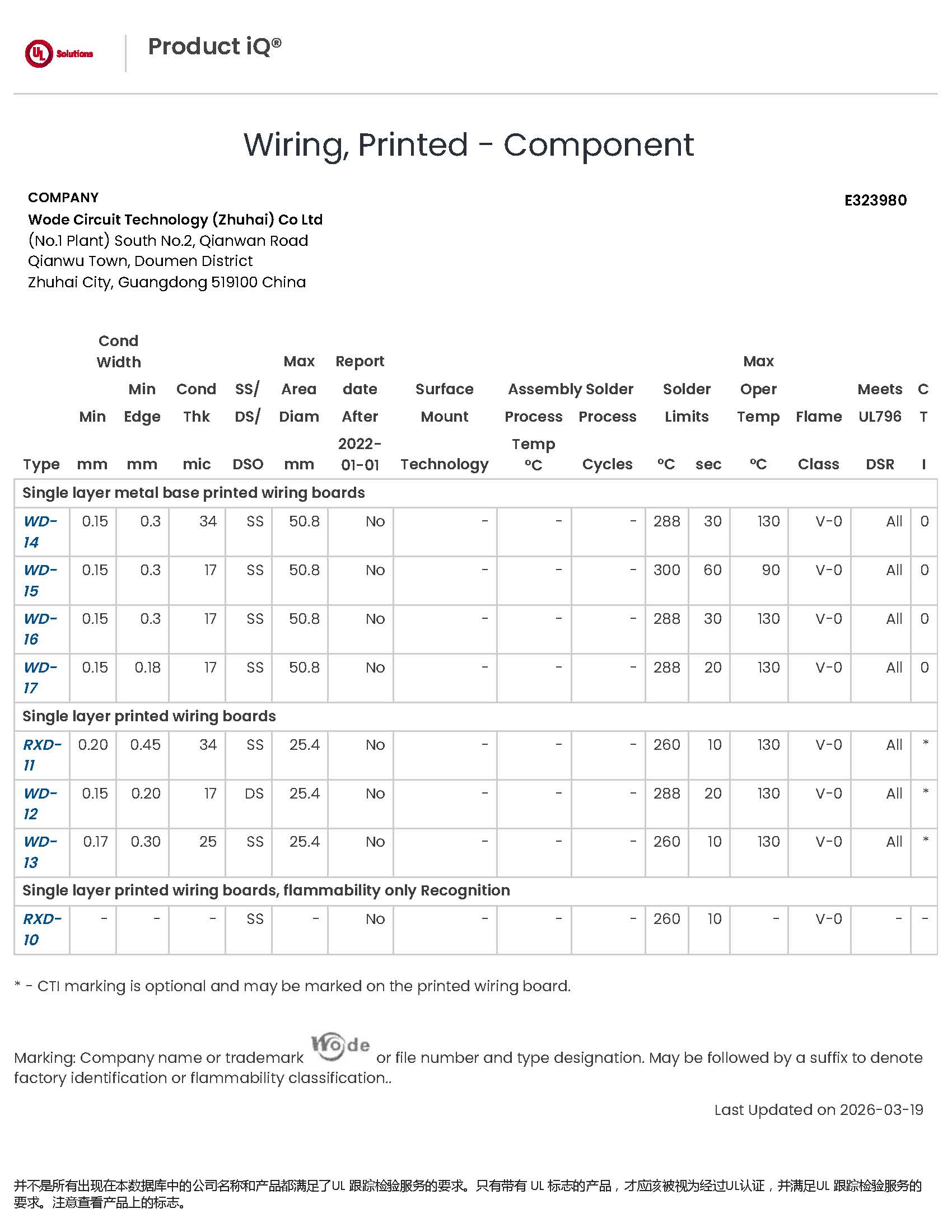
UL recognition E323980 covers single layer metal base printed wiring boards — the construction family that most MCPCB sourcing decisions sit inside. Document: WODE Circuit Technology (Zhuhai) Co., Ltd.
A metal core printed circuit board (MCPCB) is a circuit board whose base layer is a metal, most commonly aluminium, instead of the glass-reinforced resin used in FR-4 boards. The metal base carries heat away from the components, which is why MCPCBs are specified in LED lighting, power conversion and other assemblies where thermal load, not routing density, sets the design ceiling.
Buyers evaluating an MCPCB program tend to raise the same questions at the same stage: which substrate, which surface finish, which board thickness and copper weight, what minimum order quantity, and which documents actually prove compliance. This reference answers those questions using the published product and company data of WODE Circuit Technology (Zhuhai) Co., Ltd., a manufacturer founded in 2003 in Zhuhai, China, whose main products include rigid MCPCB, FPCB, infinity length FPCB, FR-4/CEM-1/CEM-3 PCBs, copper-clad laminates and PCB inks. Every parameter quoted below is taken from that specification record rather than from general market commentary.
Why MCPCB Questions Arrive Late in the Evaluation Cycle
Most MCPCB specifications are not decided by the question that starts the project. A lighting or appliance program begins with an optical, power or cost target. The substrate decision surfaces weeks later, when the thermal simulation finally points at the board. By then, the finish, thickness and copper weight are often copied from an earlier project, which is where specification errors enter a program.
Two structural facts make this riskier than it first appears. First, substrate and finish are not independent choices: the same manufacturer uses different finishes across different products for different reasons, and a finish copied from one board may not match the assembly process of another. Second, commercial parameters such as minimum order quantity, lead time and sampling policy are usually quoted at the enquiry stage, long before the technical file is frozen — so buyers end up negotiating against a specification that still moves.
The practical answer is to treat the technical question set as part of the enquiry rather than as a task that follows supplier selection. A specification that already names the base material grade, the board thickness tolerance, the copper foil weight and the surface finish is comparable across suppliers; a specification that only says aluminium MCPCB is not.
The Substrate Question: Aluminium, Copper or Ceramic
In published MCPCB product data, three construction families appear side by side, and each one is attached to a particular application rather than ranked above the others.
| Construction family | Material grades in the product record | Stated product / use | Published parameters |
|---|---|---|---|
| Aluminium base | Al1060, Al5052, Al1 | Road lighting board (Al1060), motor lighting board (Al5052), high voltage lighting board (Al1) | Single sided, 1 oz copper, 1.6 mm ±10 percent |
| Copper base | Copper based construction, thermoelectric separated | Lighting applications | 35 µm copper foil, 1.6 mm ±0.16, OSP finish |
| Ceramic base | Ceramic | Ultraviolet phototherapy | Specified by application use rather than by a generic standard set |
| FR-4 (reference point) | FR-4 | Small appliance lighting motherboard | Two sided, 1/1 oz copper, 1.0 mm ±0.1, HASL-LF |
The informative detail here is that three different aluminium grades appear in one supplier line. Al1060, Al5052 and Al1 are not interchangeable labels; they are specified against different products, which means the grade belongs in the enquiry document. A buyer who writes aluminium MCPCB leaves the thermal and mechanical behaviour of the base undefined, and the supplier is then free to interpret it.
Copper-based constructions appear where the thermal task is more demanding. The thermoelectric separated copper-based board in the same range is listed at 35 µm copper foil with a 1.6 mm ±0.16 overall thickness on a 133.80 by 120.00 mm panel at 4 up. Ceramic is the narrowest case: in the published record it is tied to ultraviolet phototherapy, a specialised application, and it should be treated as an application-specific answer rather than a general upgrade path.
Surface Finish: HASL-LF, HASL and OSP in the Published Parameters
Surface finish protects the copper before soldering and determines how the board behaves through assembly and storage. Three finishes appear in the product range, and each is attached to a different product group.
- HASL-LF (lead-free hot air solder levelling) is a metallic, solderable coating widely used where assemblies run through lead-free processes. It appears on the road lighting board, the double sided MPCB, the coverlay aluminium board and the FR-4 small appliance lighting motherboard.
- HASL appears separately on the motor lighting board, where the solder mask is listed as matt black.
- OSP (organic solderability preservative) is an organic protective film over bare copper. It appears on the high voltage MCPCB and on the thermoelectric separated copper-based board.
Because the same manufacturer publishes three finishes across comparable boards, the finish line in a specification sheet is a decision input, not a default. HASL-type finishes are metallic coatings that tolerate typical handling through kitting and storage; OSP is an organic film that is often chosen for a flatter surface and finer geometry, and it is generally more sensitive to storage conditions and repeated handling. Those differences are why the finish should be confirmed against the assembly process, the storage plan and the inspection method before an order is released — not copied from the previous project file.
Thickness, Copper Weight and Panel Format: What the Record Shows
Procurement questions about thickness and copper weight have concrete answers in the product data, and the answers differ by construction rather than by product marketing tier.
| Product | Material | Layers | Copper foil | Overall thickness | Surface finish | Panel size |
|---|---|---|---|---|---|---|
| High Voltage MCPCB | Al1 | Single sided | 1 oz | 1.6 mm ±10 percent | OSP | 243.00 x 243.00 mm (1 up) |
| MCPCB for Road lighting | Al1060 | Single sided | 1 oz | 1.6 mm ±10 percent | HASL-LF | 208.00 x 225.00 mm (2 up) |
| MCPCB for Motor lighting | Al5052 | Single sided | 1 oz | 1.6 mm ±10 percent | HASL | 243.00 x 243.00 mm (1 up) |
| Coverlay Aluminium PCB | Al1060 | Single sided | 1 oz | 1.6 mm ±10 percent | HASL-LF | 208.00 x 225.00 mm (2 up) |
| Double sided MPCB | Al5 | Double sided | 70/70 µm | 1.6 mm ±0.16 | HASL-LF | 217.54 x 197.80 mm (56 up) |
| Thermoelectric Separated Cu based PCB | Copper based | Metal base construction | 35 µm | 1.6 mm ±0.16 | OSP | 133.80 x 120.00 mm (4 up) |
| PCB for Small Appliance Lighting Motherboard | FR-4 | Two sided | 1/1 oz | 1.0 mm ±0.1 | HASL-LF | 340.05 x 150.00 mm (30 up) |
| Ceramic based PCB | Ceramic | Ceramic substrate | Not stated in the record | Not stated in the record | Not stated in the record | Stated use: ultraviolet phototherapy |
Two patterns are worth extracting. First, 1.6 mm is the working default across the metal base boards, but the tolerance is expressed differently: single sided aluminium boards are listed as 1.6 mm ±10 percent, while the double sided MPCB and the copper-based board are listed as 1.6 mm ±0.16. Those are not the same requirement, and a buyer who writes 1.6 mm without the tolerance is not comparing like with like.
Second, copper weight tracks the electrical and thermal role of the board rather than its price point. Single sided lighting boards carry 1 oz copper; the double sided board carries 70/70 µm; the thermoelectric separated copper board carries 35 µm. For the wider single sided CEM-1, CEM-3, FR-4 and aluminium line, the published range is broader still: copper foil from 0.5 oz, 0.75 oz, 1 oz, 2 oz and 3 oz upward, overall thickness from 0.6 mm to 2.0 mm, and a maximum board length of 2000 mm, with solder mask options including photosensitive, thermosetting, UV and coverlay, and finishes including OSP, carbon film, HASL, lead-free HASL, nickel-plated gold, ENIG, chemical silver and ENEPIC for wire bonding.
Inside the Range: How MCPCB Programs Are Configured
WODE Circuit Technology (Zhuhai) Co., Ltd. operates from a 150,000 m² facility with 500+ employees, a 15-person R&D team and more than 40 patented technologies. Production is organised around 600,000 sqm of monthly capacity and an annual output of 6,000,000 sqm. OEM and ODM programs cover laminate selection, PCB thickness, surface treatment, solder mask colour and logo printing, with 100 percent testing and remote after-sales support. Export accounts for 50 percent of output, with listed markets including Brazil, Turkey, India, Vietnam and Russia.
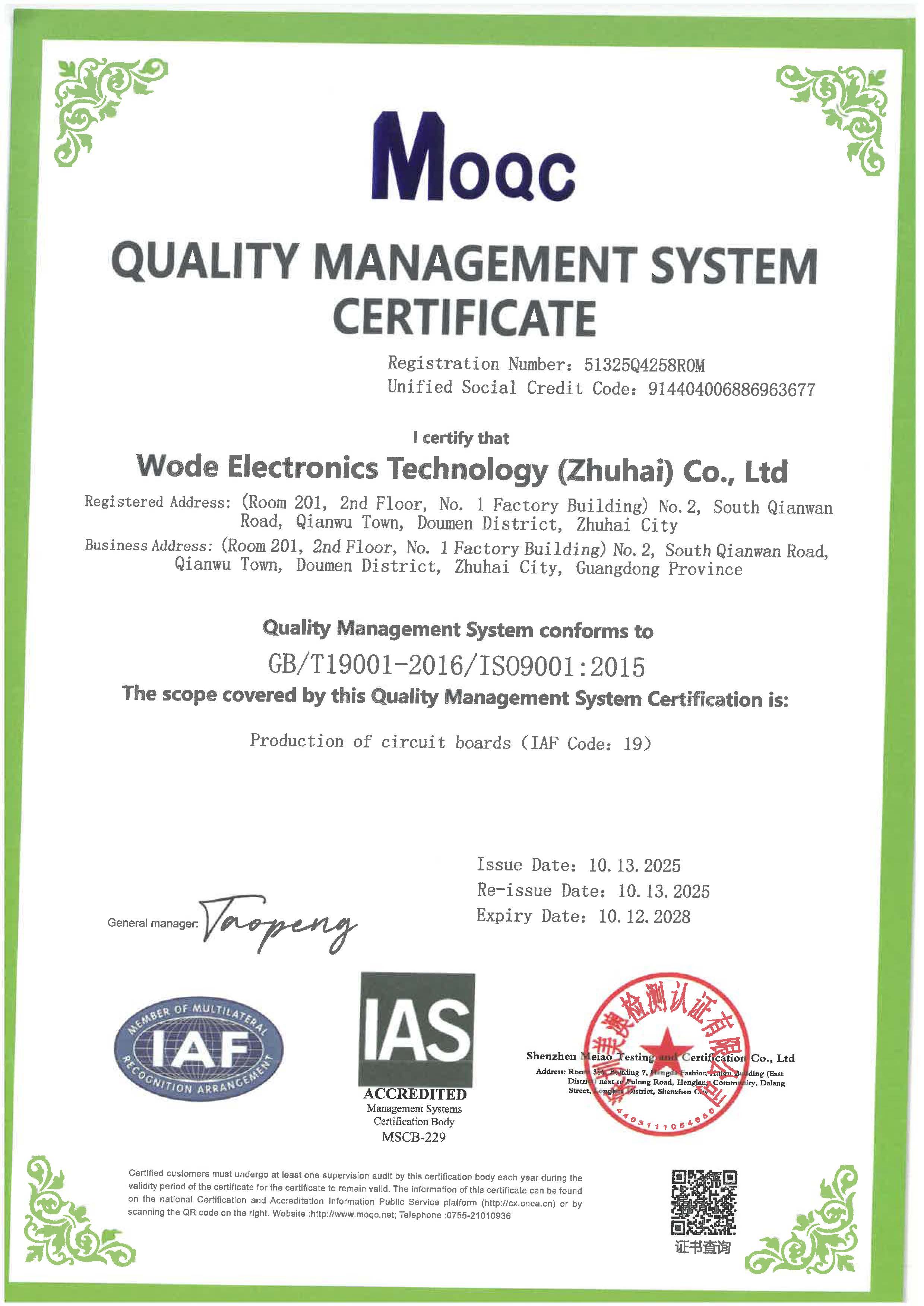
ISO9001-2015 certificate 51325Q4258ROM, issued to WODE Circuit Technology (Zhuhai) Co., Ltd. and valid to 12 October 2028, covers production of circuit boards (IAF Code 19).
The relevant point for buyers is not the size of the facility but the width of the construction list. Because rigid MCPCB, FPCB, infinity length FPCB, FR-4/CEM-1/CEM-3 boards and copper-clad laminates are produced in the same organisation, the substrate comparison described earlier can be resolved inside one technical conversation rather than across three vendors with three different tolerance conventions.
Where These Boards Are Engineered to Work
Applications in the specification record are concrete rather than generic. The high voltage MCPCB is listed as providing LED driving and control with constant current or constant voltage in lighting scenarios. The double sided MPCB is listed under home appliance applications. The ceramic based PCB is listed for ultraviolet phototherapy. Across global markets, the same product family is used by electronics manufacturers, lighting companies, OEM/ODM vendors and trading companies, in LED strips and fixtures, display module interconnects and consumer electronics connectors.
Program evidence adds a second layer. A German lighting OEM project covering 5,000 sqm of PCB materials has run for five years with the product as a main component, with published highlights of high thermal conductivity, reliable performance in harsh European climate and compliance with German safety standards, and the reported result is stable operation. Across markets, the product family has been qualified by brands including Signify, Osram, Opple, NVC, Honeywell, Randong, Dixon, Ozdisan, IKIO and Motheson.
Market Trend: Thermal Budgets Are Moving Up the Specification List
The direction of travel in the applications served by MCPCBs is consistent. Lighting, new energy, home appliance and 5G communication designs keep pushing more electrical power into smaller mechanical envelopes, and the board is where that power has to be moved out. In practical procurement terms, this shifts the thermal path from a late-stage simulation result to an early specification item — which is why substrate grade, copper weight and finish now appear in the first technical exchange rather than the third.
A second trend sits alongside it: compliance documentation is arriving earlier in the design review. Products in this range are described as complying with UL, RoHS and REACH standards, and the supporting documents are specific rather than general — a REACH test report for a double sided aluminium-based board under EU REACH Regulation (EC) No 1907/2006, UL recognition for single layer metal base printed wiring boards, ISO9001 and ISO14001 management certificates, and IATF16949 certification covering human resources, purchasing and strategic planning for automotive printed circuit board manufacturing.
Where an MCPCB Stops Being the Right Answer
A neutral comparison has to include the boundaries. In the published product range, most metal base boards are single sided with 1 oz copper — the road lighting, motor lighting, coverlay and high voltage boards all follow that pattern. A double sided MPCB does exist in the same range at 70/70 µm copper, but it is a distinct construction with its own thickness tolerance, not a like-for-like substitution for a single sided board. Where a design needs dense two-sided or multilayer routing, FR-4, CEM-1 and CEM-3 constructions remain the practical route, and they sit in the same supplier catalogue for that reason.
Substrate physics sets a second boundary. The metal base in an aluminium MCPCB is electrically conductive, so isolation is provided by the dielectric layer between the base and the copper circuit rather than by the substrate itself. Creepage, clearance and isolation requirements therefore have to be resolved in the design rules, and an MCPCB cannot simply inherit an FR-4 footprint without that check.
A third boundary is commercial. The published parameters for mass orders start at a minimum order quantity of 80 sqm with a lead time of 7 to 15 days, while sample quantity is not limited. That combination supports validation before commitment, but very small production volumes and emergency scale-ups need separate planning rather than an assumption that the standard terms stretch in either direction. Finally, ceramic boards should not be treated as a general upgrade: in this product record ceramic is attached to ultraviolet phototherapy, a specialised use, and the record does not list it as a default alternative for lighting boards.
Future Outlook
Three shifts are reasonable to expect on the basis of the evidence above. First, substrate grades will be named in more enquiries, because Al1060, Al5052, Al1 and copper-based constructions are already differentiated in the product record and buyers who compare only the word aluminium will converge on whichever interpretation is cheapest. Second, documentation will keep moving earlier: automotive-oriented quality systems such as IATF16949 and substance regulations such as EU REACH already sit inside the qualification file, and the buyers who request them at enquiry stage will spend less time re-qualifying later. Third, sampling will carry more weight in supplier evaluation, since an unlimited sample quantity against an 80 sqm mass-order threshold lets a program validate the actual stack-up, finish and panel format before committing volume.
Frequently Asked Questions
What is an MCPCB, and how is it different from a standard FR-4 PCB?
An MCPCB is a printed circuit board built on a metal base layer, usually aluminium, instead of the glass-reinforced resin base used in FR-4. The metal base is the thermal path. In the WODE product range, rigid MCPCB and FR-4/CEM-1/CEM-3 boards are both produced, which makes the difference concrete: a single sided aluminium lighting board is specified at 1 oz copper and 1.6 mm ±10 percent, while the FR-4 small appliance lighting motherboard is specified at 1/1 oz copper and 1.0 mm ±0.1 in a two sided construction. The choice is therefore about where heat has to go and how the circuit is routed, not about product tiers.
Is MPCB the same thing as MCPCB?
No. In electrical catalogues, MPCB commonly refers to a miniature circuit breaker — a protection device specified by pole configuration and trip curve, where the widely used conventions describe Type B devices reacting at roughly 3 to 5 times rated current, Type C at 5 to 10 times, and Type D at 10 to 20 times. An MCPCB is a circuit board substrate and is specified by base material grade, board thickness, copper foil weight and surface finish; it has no pole count or trip curve. Because the two abbreviations differ by one letter, buyers comparing quotations should confirm which component class is being quoted, since the specifications are not interchangeable in any direction.
Which substrate should be specified — aluminium, copper or ceramic?
Match the substrate to the application rather than to a ranking. Aluminium boards appear in this range with three different grades: Al1060 on the road lighting and coverlay boards, Al5052 on the motor lighting board, and Al1 on the high voltage MCPCB, all single sided at 1 oz copper and 1.6 mm ±10 percent. A copper-based thermoelectric separated construction is listed at 35 µm copper foil with 1.6 mm ±0.16 thickness for lighting use. The ceramic based board in the same record is tied to ultraviolet phototherapy. A useful decision rule is that the substrate should be named together with its grade and application in the enquiry; where the application is standard LED lighting, the aluminium platforms already cover it.
What board thicknesses and copper foil weights are available?
Single sided aluminium boards in the range are listed at 1.6 mm ±10 percent with 1 oz copper. The double sided MPCB is listed at 70/70 µm copper with 1.6 mm ±0.16 overall thickness. The thermoelectric separated copper-based board is listed at 35 µm copper foil and 1.6 mm ±0.16. The FR-4 small appliance lighting motherboard is listed at 1/1 oz copper and 1.0 mm ±0.1. On the wider single sided CEM-1, CEM-3, FR-4 and aluminium line, copper foil options start at 0.5 oz and 0.75 oz and extend through 1 oz, 2 oz and 3 oz, with overall thickness from 0.6 mm to 2.0 mm and a maximum board length of 2000 mm.
When should HASL-LF be specified instead of OSP?
The published parameters show the finish following the product rather than one finish being standard. HASL-LF appears on the MCPCB for Road lighting, the double sided MPCB, the Coverlay Aluminium PCB and the FR-4 small appliance lighting motherboard. OSP appears on the High Voltage MCPCB and the thermoelectric separated copper-based board. Plain HASL appears on the MCPCB for Motor lighting with a matt black solder mask. HASL-type finishes are metallic coatings that tolerate typical handling and storage through assembly, while OSP is an organic film over bare copper that offers a flatter surface and is generally more sensitive to storage conditions and repeated handling. The finish should therefore be confirmed against the assembly process, the storage plan and the inspection method before the order is released.
What is a coverlay MCPCB, and when is it used?
The Coverlay Aluminium PCB in this range is a single sided construction on Al1060 with 1 oz copper, 1.6 mm ±10 percent overall thickness, a 208.00 x 225.00 mm panel at 2 up, black silkscreen and HASL-LF finish. Its distinguishing parameter is a white coverlay used in place of a printed solder mask. It shares the aluminium platform and panel format of the road lighting board, which makes it straightforward for a buyer to compare the two and decide which masking approach suits the assembly and appearance requirements of the program.
What does thermoelectric separated mean on a copper-based board?
Thermoelectric Separated Cu based PCB is the product designation used in the range for a copper-based construction in lighting applications. The published parameters are 35 µm copper foil, 1.6 mm ±0.16 overall thickness, a 133.80 x 120.00 mm panel at 4 up, white solder mask, black silkscreen and OSP surface finish. Because the designation describes a construction class rather than a single parameter, buyers should request the stack-up drawing and confirm the copper weight and finish against the thermal and electrical requirements of the specific design before approval.
What minimum order quantity, lead time and capacity should be planned for?
The published capability parameters for this supplier are a minimum order quantity of 80 sqm for mass orders, a lead time of 7 to 15 days, and a monthly capacity of 600,000 sqm against an annual output of 6,000,000 sqm. Sample quantity is not limited, and quality control is listed as 100 percent testing, with remote after-sales support. The practical implication is that validation samples and mass production follow different planning cycles, and a program that needs a small production volume or a very short notice scale-up should raise that in the enquiry rather than assume it fits standard terms.
Which compliance documents should be verified before release to production?
Six document groups appear in the qualification record. UL recognition E323980 covers single layer metal base printed wiring boards (models WD-14, WD-15, WD-16 and WD-17) and single layer rigid printed wiring boards (RXD-11, WD-12, WD-13 and RXD-10) under UL 796. UL recognition E498836 covers flexible printed circuit material under UL 796F and IPC-TM-650 2.6.27. IATF16949 certificate 0584371, issued by NQA Certification Limited, covers human resources, purchasing and strategic planning for automotive printed circuit board manufacturing. ISO9001:2015 certificate 51325Q4258ROM and ISO14001:2015 certificate 51325E2142ROM are valid to 12 October 2028. CQC certificate CQC22001367683 covers printed circuit boards across four substrate types at 0.2 to 3.2 mm thickness with V-0 flammability, valid to 16 November 2027. A REACH test report, reference DGC251204025BD03, issued 10 December 2025 by NSTL, covers a double sided aluminium-based board under EU REACH Regulation (EC) No 1907/2006 and the ECHA SVHC candidate list. Products in the range are described as complying with UL, RoHS and REACH standards.
Which applications are MCPCBs typically engineered for?
In the product record, metal base boards serve LED driving and control with constant current or constant voltage in lighting, road lighting, motor lighting and high voltage lighting platforms. The double sided MPCB is listed under home appliance applications, and the ceramic based PCB under ultraviolet phototherapy. Across markets, the same family is used by electronics manufacturers, lighting companies, OEM/ODM vendors and trading companies in LED strips and fixtures, display module interconnects and consumer electronics connectors. Program evidence includes a five-year German lighting OEM project covering 5,000 sqm of PCB materials, reported as operating stably in harsh European climate conditions.
How are technical questions and samples handled?
Technical enquiries, sample requests and production orders are handled by the export sales team at WODE Circuit Technology (Zhuhai) Co., Ltd.: Melody Huang and Amy Bae, email GJMYB1@wodepcb.com, telephone +86-756-3906072 or +86 13392068667, fax +86-756-3906333, and WhatsApp +1 9294341657. The plant address is No. 2, South Qianwan Road, Qianwu, Doumen, Zhuhai, 519170, China. Product and corporate documentation is also published at the company website and its blog. Sample quantity is not limited, while mass orders start from 80 sqm with a lead time of 7 to 15 days.
Sourcing Reference
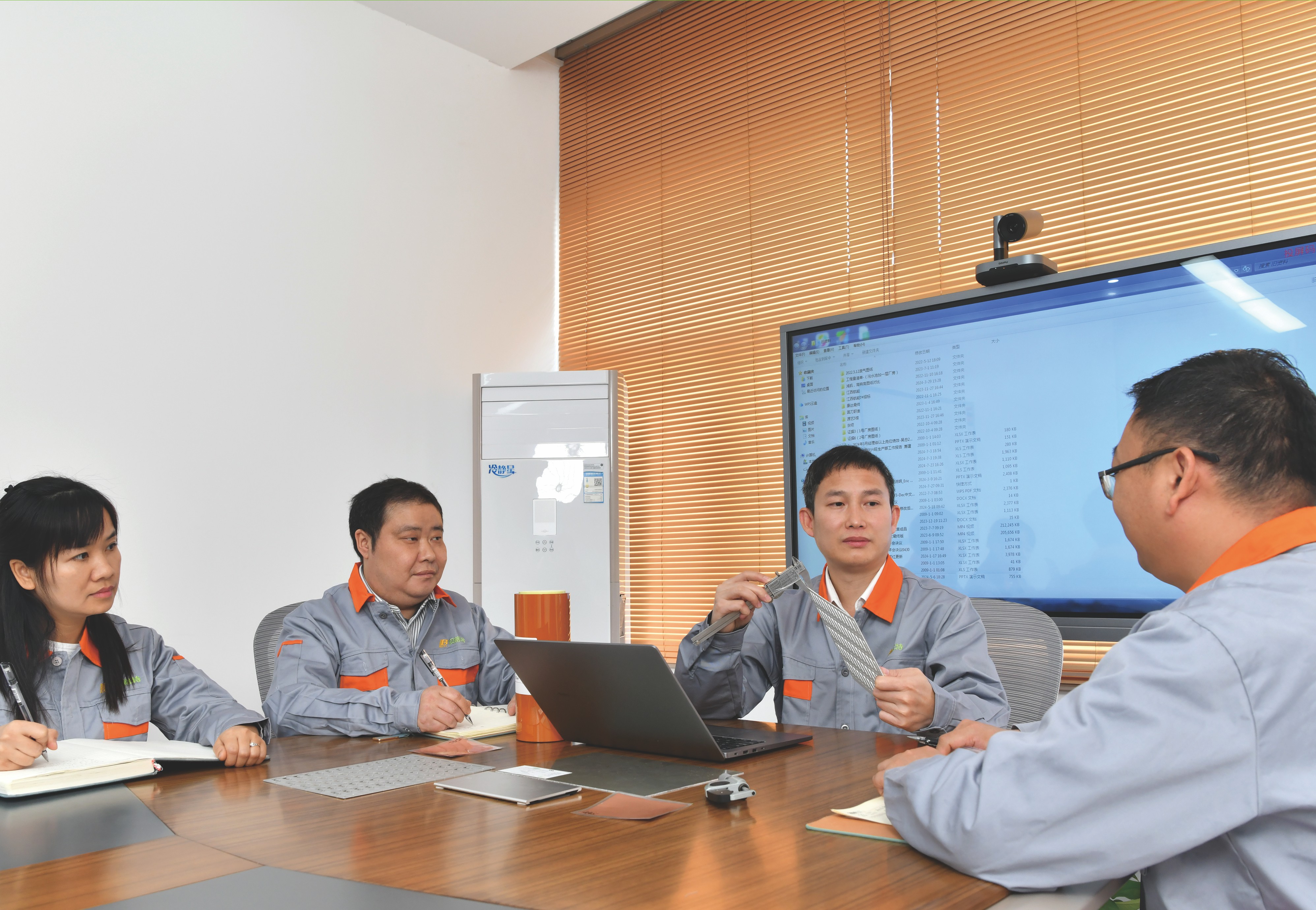
Technical and sourcing discussions are handled from the Zhuhai facility at No. 2, South Qianwan Road, Qianwu, Doumen, Zhuhai, 519170, China.
Published reference material. A full company brochure covering the MCPCB, FPCB, FR-4/CEM-1/CEM-3 and copper-clad laminate ranges and the certification set described above is available for download: WODE company brochure (PDF).
Company profiles and product pages are published at www.wodepcbfpc.com, with supporting articles at blog.wodepcbfpc.com. Both addresses belong to WODE Circuit Technology (Zhuhai) Co., Ltd.