
MCPCB vs MCCB: A Sourcing Guide to Specs and Certifications
MCPCB vs MCCB: A Sourcing Guide to Specs and Certifications
Two abbreviations appear on adjacent lines in many electrical project BOMs: MCPCB and MCCB. Although both serve the broader electrical and electronics industry, they refer to entirely different products with different specification systems, certification paths, and supplier profiles. MCPCB stands for Metal Core PCB, an aluminium-, copper-, or ceramic-based circuit board optimised for heat spreading in power electronics. MCCB stands for Molded Case Circuit Breaker, a protective switching device designed to interrupt overcurrents in distribution systems. For buyers moving from research into supplier evaluation, mixing the two can create wrong part numbers, misleading compliance checks, and wasted quoting cycles. This article provides an industry-level reference for verifying MCPCB specifications and certifications before purchase, and clarifies where the boundary between the two product families lies.
MCPCB and MCCB: Different Products, Overlapping Search Terms
The confusion is understandable. The abbreviations differ by one letter, both product groups are bought by the same types of companies — lighting OEMs, panel builders, EV charging equipment makers, and industrial automation suppliers — and both show up in the same electrical drawings. However, they occupy different parts of the value chain.
An MCPCB is a circuit board. It carries electronic components and uses a metallic base layer to conduct heat away from power devices. An MCCB is a switching and protection device. It is installed in distribution boards and protects cables, motors, and equipment from overcurrent and short-circuit faults. The spec sheets do not overlap.
| Dimension | MCPCB (Metal Core PCB) | MCCB (Molded Case Circuit Breaker) |
|---|---|---|
| Product role | Circuit board with metallic base for thermal management | Protective switching device for overcurrent protection |
| Main specification families | Base material, layer count, copper foil thickness, board thickness, surface finish, panel size | Number of poles, trip curve, breaking capacity, rated current, AC/DC rating |
| Typical procurement questions | Is the board UL or IATF recognised? What surface finish is used? | What trip curve (B/C/D) is needed? 1P/2P/3P/4P? |
| Supplier type | PCB and CCL manufacturers | Electrical equipment manufacturers |
| Certification examples | UL 796, IATF 16949, CQC, REACH | IEC 60947 series, UL 489 |
MCCB specifications are defined around protection behaviour. Trip curves describe the overload response of a breaker: Type B trips at 3–5× rated current for residential applications, Type C at 5–10× for commercial and small motor loads, and Type D at 10–20× for heavy industrial machinery. Pole count (1P to 4P) defines how many circuits or phases are switched. DC-rated MCCBs used in solar installations are specified for system voltages of 600 V, 1000 V, or 1500 V DC. For motor protection, IEC 60947-4-1:2023 covers motor protective switching devices, which integrate starter and breaker functions.
Buyers should therefore treat the two abbreviations as separate material classes in procurement systems. Searching “MPCB” or “MCCB” will return breaker products; searching “MCPCB” returns metal-core circuit boards. Correct classification at the BOM stage prevents the most common sourcing error.
How to Verify MCPCB Specifications Before Sourcing
When evaluating an MCPCB, a sourcing team should confirm at least seven parameter groups: base material, layer count, copper foil thickness, overall thickness and tolerance, panel size and layout, solder mask and silkscreen configuration, and surface finish. These parameters determine thermal performance, manufacturability, assembly yield, and unit cost.
WODE Circuit Technology (Zhuhai) Co., Ltd., a PCB manufacturer founded in 2003 with production facilities of 150,000 m², publishes product data for its metal-core boards that can serve as a practical reference for MCPCB specification patterns. The table below lists documented examples from the company's standard product range.
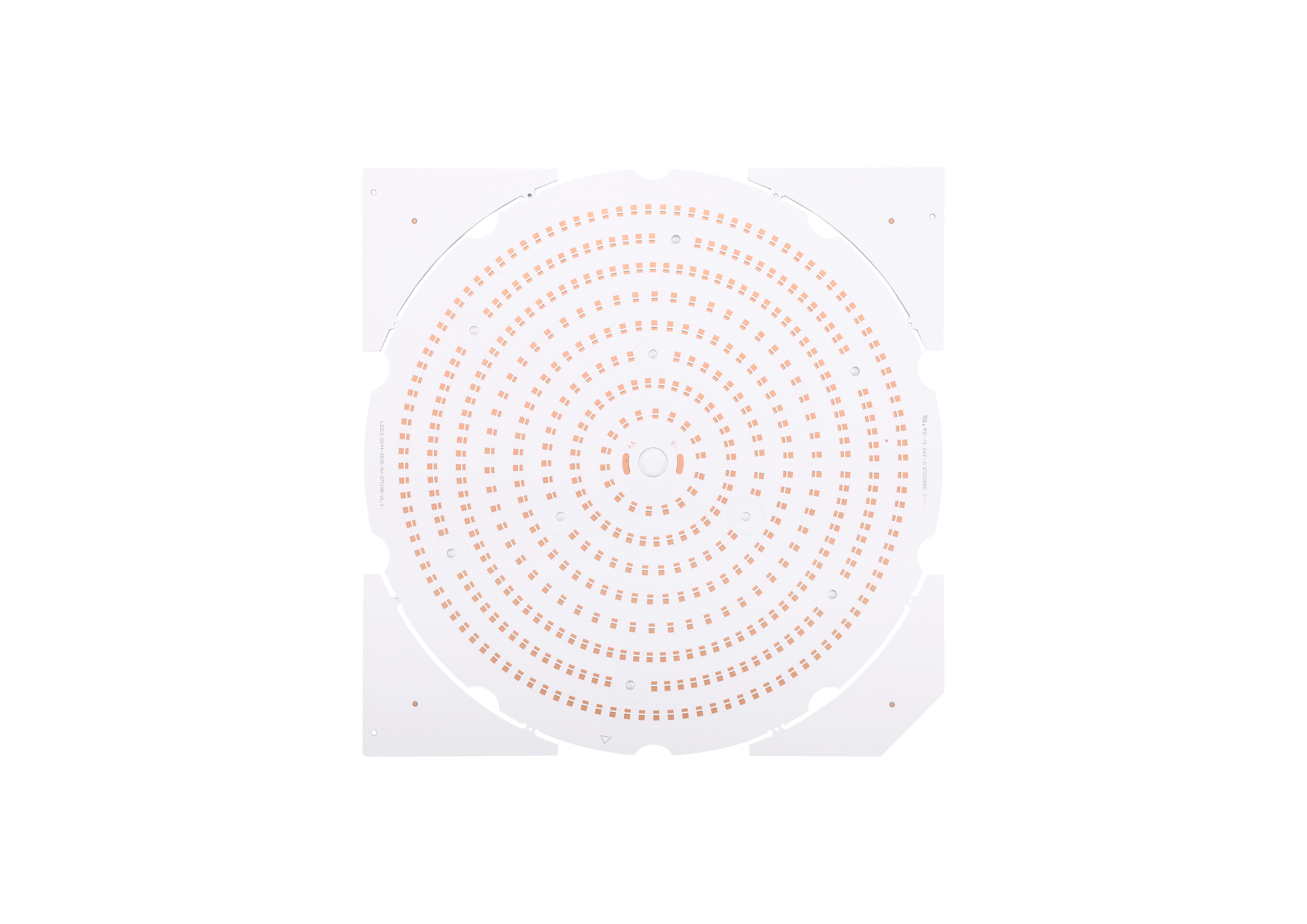
High Voltage MCPCB — an aluminium-based metal core board with OSP finish and documented global certifications.
| Product example | Base material | Layers | Copper foil | Overall thickness | Surface finish | Panel size |
|---|---|---|---|---|---|---|
| Coverlay MCPCB | Al1060 | 1 | 1 oz | 1.6 mm ±10% | HASL-LF | 208.00 × 225.00 mm (2-up) |
| MCPCB for Road lighting | Al1060 | 1 | 1 oz | 1.6 mm ±10% | HASL-LF | 208.00 × 225.00 mm (2-up) |
| MCPCB for Motor lighting | Al5052 | 1 | 1 oz | 1.6 mm ±10% | HASL | 243.00 × 243.00 mm (1-up) |
| High Voltage MCPCB | Al1 | 1 | 1 oz | 1.6 mm ±10% | OSP | 243.00 × 243.00 mm (1-up) |
| Double sided MPCB | Al5 | 2 | 70/70 μm | 1.6 mm ±0.16 | HASL-LF | 217.54 × 197.80 mm (56-up) |
| Thermoelectric Separated Cu based PCB | Cu base | 2 | 35 μm | 1.6 mm ±0.16 | OSP | 133.80 × 120.00 mm (4-up) |
| PCB for Small Appliance Lighting Motherboard | FR-4 | 2 | 1/1 oz | 1.0 mm ±0.1 | HASL-LF | 340.05 × 150.00 mm (30-up) |
| Ceramic based PCB | Ceramic | Documented for ultraviolet phototherapy use | ||||
Each parameter has a practical meaning for the buyer. Al1060 is a high-purity aluminium grade commonly used in LED lighting boards where thermal conductivity is a priority. Al5052 offers better mechanical strength under vibration, which is why it is selected for motor and motorcycle lighting. Copper-based boards such as the thermoelectric separated type provide a higher thermal path but at higher material cost, typically for lighting modules with high power density. FR-4 remains the default when circuit complexity or cost matters more than heat spreading.
Surface finish is equally important. HASL-LF is a lead-free solder-level finish widely used in lighting products. OSP offers a flat, coplanar surface suitable for fine-pitch components. ENIG provides a longer shelf life and better protection for exposed copper. The solder mask colour is not purely cosmetic: white is common in LED boards for its reflective properties, matt black appears in products where low glare or a specific appearance is requested, and coverlay is used when an additional insulating layer is needed.
Buyers should ask for the exact panel size and layout, because the number of units per panel directly affects utilisation and price. A documented panel such as 208.00 × 225.00 mm with a 2-up layout tells the buyer how the board will be stepped and costed.
Certification Checks: Matching the Certificate to the Product and Market
For hvq_2-type procurement questions — those focused on certification and parameter constraints — the first step is to verify that a certificate covers the specific product model, not just the supplier. A valid certificate should show the manufacturer's name, the product family or substrate type, the standard used, the certificate number, the issuing body, and the applicable market.
WODE's published certification record covers several products across different markets. The table below summarises the key documents as a reference for what buyers should expect from MCPCB suppliers.
| Certification | Certificate No. | Scope / Standard | Market / Status (Aug 2026) |
|---|---|---|---|
| UL for Rigid PCB | E323980 | UL 796; single-layer metal base printed wiring boards (models WD-14, WD-15, WD-16, WD-17) | US/Canada; worldwide recognised; valid |
| UL for Flexible PCB | E498836 | UL 796F; single-layer flexible printed circuits (WD-F1, WD-F2) | US/Canada; worldwide recognised; valid |
| IATF 16949 | 0584371 | Automotive PCB manufacturing; covers High Voltage MCPCB; issued by NQA Certification Limited | Global; valid to 2028-09-26 |
| CQC | CQC22001367683 | GB 4943.1-2022; printed circuit boards with V-0 flammability (four substrate types) | Global; valid to 2027-11-16 |
| ISO 9001:2015 | 51325Q4258ROM | Quality management for production of circuit boards | Global; valid to 2028-10-12 |
| ISO 14001:2015 | 51325E2142ROM | Environmental management for circuit board production | Global; valid to 2028-10-12 |
| REACH SVHC | DGC251204025BD03 | EU REACH Regulation (EC) No 1907/2006, SVHC Candidate List; double-sided aluminium-based board; issued by NSTL | Worldwide; valid |
For North American projects, the UL 796 certificate is the relevant document for metal base printed wiring boards. For automotive-related electronics, the IATF 16949 certificate confirms that the supplier operates an automotive quality management system; in WODE's documentation it is referenced specifically for the High Voltage MCPCB. For products entering the Chinese market, the CQC certificate based on GB 4943.1-2022 also confirms V-0 flammability for the covered substrate types. For European distribution, REACH SVHC compliance, verified through a test report such as DGC251204025BD03, is a common import requirement.
A certificate number is verifiable. Buyers should not rely on a scanned image alone; the number can be checked with the issuing body or on the supplier's public documentation. The expiry date matters, especially for IATF, ISO, and CQC certificates, which have defined validity periods.
Why Specifications and Certifications Drive Long-Term Reliability
MCPCB specifications are not only commercial parameters; they determine the lifecycle behaviour of the final product. The primary function of a metal-core board is to create a low-resistance heat path from the power component to the heat sink. The base material, copper thickness, dielectric layer, and solder mask all participate in that path.
In high-power LED designs, thermal conductivity of the aluminium substrate is a key design input; high-power modules typically request 3.0 W/m·K or higher, while general lighting designs often specify at least 1.5 W/m·K. A documented overall thickness such as 1.6 mm ±10% gives the mechanical designer a predictable stack-up. The 70/70 μm copper configuration in WODE's double-sided board supports higher current and better heat spreading on both sides, which matters in compact home appliance modules.
Surface treatment directly affects solder joint reliability. HASL-LF is suitable for general soldering processes, but for components sensitive to coplanarity, OSP is often preferred because it leaves a flat copper surface. In boards such as the Thermoelectric Separated Cu based PCB — a double-sided copper-based substrate with 35 μm copper foil and OSP finish — the flat surface supports thermoelectric separation design, a technique used to isolate thermal paths from electrical paths in lighting modules.
The CQC document's V-0 classification is another reliability indicator: V-0 is the highest flammability rating in the UL 94 test sequence, meaning the board material stops burning within a short time after flame removal. For products used in enclosed luminaires or distribution boxes, V-0 rated laminates reduce fire risk during abnormal operation.
Applications Where MCPCBs and MCCBs Appear in the Same System
Because MCPCB and MCCB product families converge in the same end equipment, buyers often encounter both when sourcing for lighting, solar, EV charging, and panel-building projects.
In road lighting, an MCCB in the distribution cabinet protects the lighting circuit, while high-power LED modules inside the luminaire are mounted on aluminium-based boards to keep junction temperatures under control. A board such as WODE's MCPCB for Road lighting — Al1060, single-sided, 1 oz copper, 1.6 mm overall thickness, HASL-LF finish — is a typical construction for that role.
In automotive and motorcycle lighting, vibration resistance becomes critical. Al5052 material offers better mechanical properties than high-purity aluminium under shock and vibration, which is why WODE documents its MCPCB for Motor lighting with Al5052, a matt black solder mask, and HASL finish. The black mask is often requested for optical or aesthetic reasons in vehicle lamps.
Home appliance lighting modules use double-sided aluminium-based boards when the circuit requires traces on both sides. WODE's Double sided MPCB, with 70/70 μm copper foil, 1.6 mm overall thickness, and HASL-LF finish, is documented for home applications. Small appliance lighting motherboards, meanwhile, can be built on FR-4 — the company's PCB for Small Appliance Lighting Motherboard is a 2-layer FR-4 board at 1.0 mm thickness with a 30-up panel layout.
In ultraviolet phototherapy devices, ceramic-based PCBs are used instead of aluminium because of their electrical insulation and thermal stability under UV exposure. WODE documents its Ceramic based PCB for ultraviolet phototherapy use.
In EV charging and solar power systems, the electrical protection side depends on DC MCCBs rated for 600 V, 1000 V, or 1500 V DC, while the power conversion stages inside chargers and inverters rely on metal-core PCBs to cool switching devices and control electronics. A purchasing team for such a project will therefore manage at least two different material-class codes: one for protective devices and one for circuit boards. Using the correct keyword and spec sheet for each is the difference between a clean procurement cycle and a costly mismatch.
MCPCB vs Traditional FR-4: A Comparison with Boundaries
FR-4 remains the most common PCB substrate in the industry, and it is the right choice for many circuits. The comparison below helps buyers decide when to switch to a metal-core board.
| Criterion | FR-4 board | Metal Core PCB (MCPCB) |
|---|---|---|
| Heat spreading | Limited; relies on thermal vias and external heat sinks | Direct thermal path through metal base; significantly better heat spreading |
| Circuit complexity | Supports multilayer, HDI, and fine-pitch designs | Mostly single- or double-sided; multilayer metal-core is specialised and costly |
| Mechanical strength | Rigid but lower thermal endurance | Higher stiffness; aluminium alloys such as Al5052 offer good vibration resistance |
| Weight | Lighter | Heavier due to metal base |
| Cost | Lower for standard constructions | Higher material and processing cost |
| Typical use | Motherboards, control boards, small-appliance electronics | LED lighting, power modules, automotive lighting, high-brightness applications |
The boundary is important. If the design has moderate heat density and high routing complexity, FR-4 with thermal vias can be sufficient at lower cost. If the design places high-power LEDs or switching devices close together, an MCPCB is usually the more reliable choice. Metal-core boards are not a universal replacement: they add weight, limit routing flexibility, and cost more. Some assemblies combine an aluminium board for the power stage with an FR-4 board for control logic, which is a common hybrid pattern in commercial lighting.
Market Signals: Electrification Is Raising the Bar for Both Product Groups
The electrical industry is expanding, and the pressure is visible in both product families. The global molded case circuit breaker market was valued at USD 6.23 billion in 2023 and is projected to reach USD 15.52 billion by 2030, with residential end-use growing at a CAGR of 14.3% (Grand View Research). Asia Pacific accounted for a 40.23% revenue share of the circuit breaker industry in 2025, driven by grid modernisation in China and India (Fortune Business Insights). The global DC circuit breaker market, critical for solar and EV charging applications, was estimated at USD 4.13 billion in 2023, with a projected CAGR of 8.7% until 2030 (Grand View Research).
These figures describe the protection-device market, not the PCB market, but they provide a useful signal for MCPCB sourcing. As solar installations, EV charging infrastructure, and residential electrification grow, the number of power conversion units in the field increases. Each of those units contains power semiconductors that need a thermal management solution. Buyers who are already qualifying MCCBs for distribution boards will increasingly need to qualify MCPCBs for the power stages inside the same systems.
The supply chains are distinct. MCCB supply is led by global electrical equipment manufacturers such as ABB, Schneider Electric, Siemens, Eaton, and Mitsubishi Electric (BCC Research). MCPCB supply, in contrast, comes from specialised PCB and CCL manufacturers. WODE Circuit, for example, exports about half of its output to markets including Brazil, Turkey, India, Vietnam, and Russia, and reports serving more than 1,000 customers in over 30 countries since its founding in 2003. Procurement teams should therefore build separate supplier evaluation frameworks for the two categories rather than treating them as interchangeable.
Future Outlook
Three trends are likely to shape MCPCB procurement in the coming years.
First, certification traceability will become more important. Buyers will expect suppliers to provide certificate numbers that can be independently checked, with clear product scope and validity periods. The movement toward AI-assisted supply chain audits will favour suppliers who publish structured, machine-readable documentation.
Second, specialised substrate constructions will penetrate beyond lighting. Thermoelectric separated copper-based boards, ceramic-based boards for medical and UV applications, and high-voltage aluminium boards for automotive-related power electronics are examples of a broader shift from commodity boards to application-specific thermal substrates.
Third, environmental compliance will continue to tighten. REACH SVHC testing, already part of European import documentation, is expanding in scope as candidate lists grow. Suppliers who maintain current test reports — such as the double-sided aluminium-based board report DGC251204025BD03 from NSTL — will have an advantage in export markets.
For buyers, the practical takeaway is that MCPCB procurement quality depends on documented parameters, verifiable certifications, and a clear understanding of the boundary between MCPCB and MCCB. The two abbreviations may look similar, but the technical and commercial systems behind them are completely separate.
Further reference: WODE Circuit Technology publishes a company brochure covering its production capabilities and quality system overview. The document is publicly accessible at WODE company brochure (PDF).
FAQ — MCPCB Specifications and Certifications
1. What is the difference between MCPCB and MCCB?
MCPCB stands for Metal Core PCB, an aluminium-, copper-, or ceramic-based circuit board used for heat dissipation in power electronics. MCCB stands for Molded Case Circuit Breaker, a protective switching device for overcurrent interruption. They are different product categories, but both appear in electrical distribution and power conversion projects.
2. What specifications should be verified before sourcing an MCPCB?
Buyers should verify base material, layer count, copper foil thickness, overall thickness and tolerance, panel size and layout, solder mask and silkscreen configuration, and surface finish. For example, WODE's MCPCB for Road lighting is documented as Al1060, single-sided, 1 oz copper, 1.6 mm ±10% overall thickness, 208.00 × 225.00 mm panel (2-up), white solder mask, black silkscreen, with HASL-LF finish.
3. What is the IATF 16949 certification for the High Voltage MCPCB?
The High Voltage MCPCB is certified to IATF 16949, with certificate number 0584371, issued by NQA Certification Limited, applicable to the global market.
4. What is the CQC certification for the MCPCB for Road lighting?
The MCPCB for Road lighting is certified to CQC standards (GB 4943.1-2022), with certificate number CQC22001367683, issued by China Quality Certification Centre, applicable globally.
5. What are the specifications of the Thermoelectric Separated Cu based PCB?
The Thermoelectric Separated Cu based PCB is a double-sided copper-based substrate with overall thickness 1.6 mm ±0.16 mm, copper foil 35 μm, white solder mask, black silkscreen, OSP surface finish, and panel size 133.80 mm × 120.00 mm (4-up). It is intended for lighting applications.
6. What does the REACH test report DGC251204025BD03 verify?
It is a test report for a double-sided aluminium-based board, confirming compliance with EU REACH Regulation (EC) No 1907/2006 SVHC requirements. The report was issued by NSTL and has worldwide applicability.
7. Which UL certificate covers metal base printed wiring boards?
UL certificate E323980 covers single-layer metal base printed wiring boards, including models WD-14, WD-15, WD-16, and WD-17, under UL 796. It was issued by UL Solution and applies to the US and Canada, with worldwide recognition.
8. What material is documented for the MCPCB for Motor lighting?
The MCPCB for Motor lighting uses Al5052 aluminium material, single-sided construction, 1 oz copper foil, 1.6 mm ±10% overall thickness, matt black solder mask, white silkscreen, and HASL surface finish.