
MCQs on MOQ: Why 50 Pieces Per Design Makes Sense for a Trial Run
Minimum order quantity is the first question most brands ask a T-shirt manufacturer and the number they are least prepared to interpret. Requiring only 50 pieces per colour per design changes what a first order is for: instead of betting on demand, a brand can measure it. Guangzhou Qianshi Apparel Co., Ltd, a Guangzhou-based apparel manufacturer and trading company that produces custom T-shirts, hoodies, polos and jerseys for brands in the EU, USA, AU and UK, applies that threshold as its trial-run standard — and the details behind it answer most of the questions buyers raise before they commit.
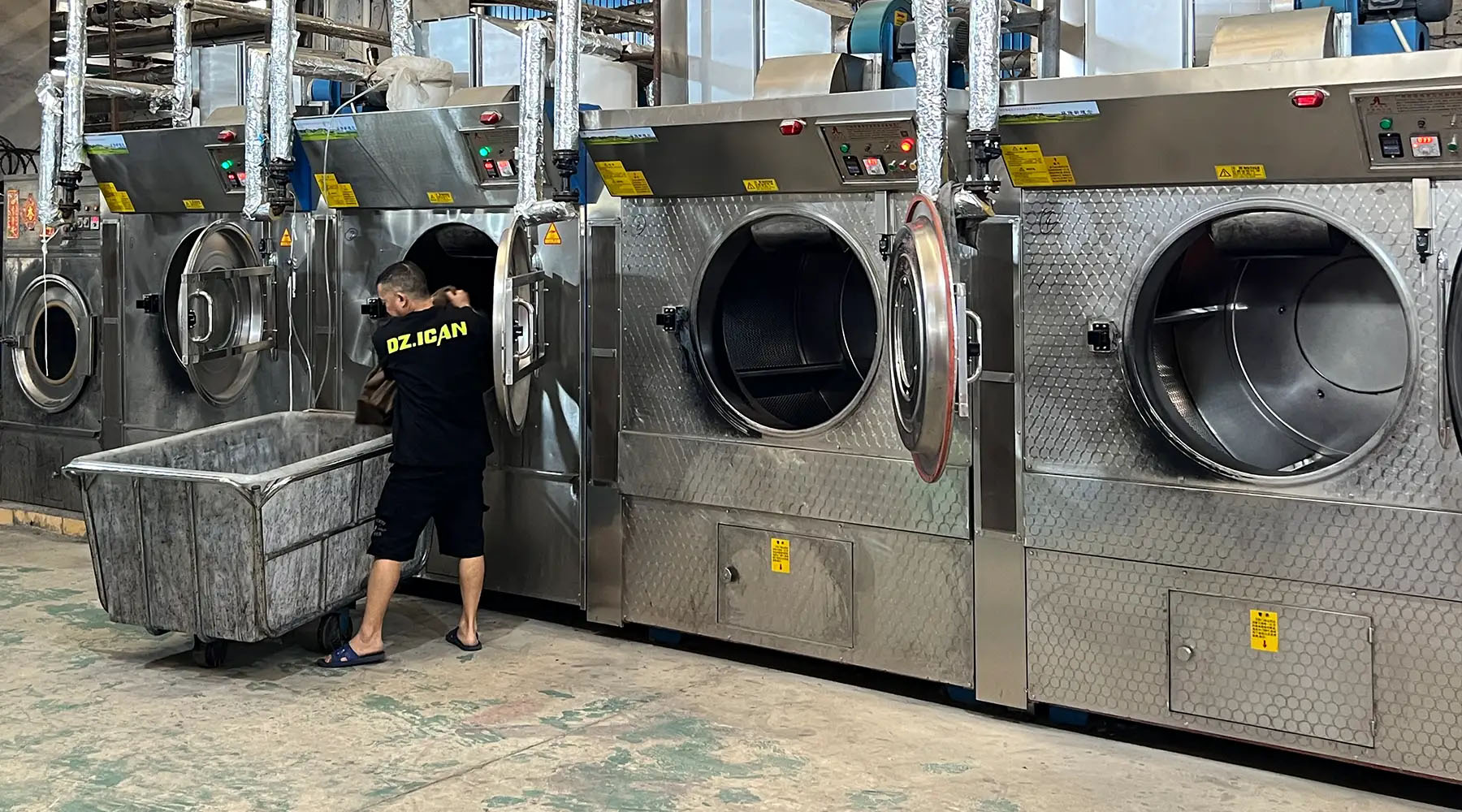
Why the Minimum Order Quantity Often Decides More Than the Price
The global custom T-shirt printing market was valued at USD 5.46 billion in 2024 and is projected to reach USD 9.82 billion by 2030, growing at a CAGR of 11.5%–11.6% (Grand View Research). T-shirts and tanks account for 48.39% of a global blank apparel market estimated at USD 15.23 billion in 2024, and China's textile exports reached USD 268 billion in 2024, keeping the country at roughly 32% of global textile export value (Observatory of Economic Complexity).
Those figures describe an abundant supply base. They also explain why the constraint that decides most first orders is rarely unit price. A first production run has to be paid for, shipped, stored and sold, and every design decision behind it — fabric weight, fit block, neckline, decoration placement, packaging — is still unproven at the moment the order is placed.
A factory minimum of several hundred or several thousand pieces forces a brand to answer demand questions it has no data for. A minimum expressed at 50 pieces per design reduces the first order to a scale where being wrong is affordable. That is the whole case for low-minimum sourcing, and it is also where most misunderstandings start, because low minimums are quoted per variant rather than per order.
What "50 Pieces Per Colour Per Design" Actually Means
Order minimums in custom apparel usually appear in two places: the total quantity a factory will accept, and the quantity it will accept per variant. The second is where small brands get caught, because a single quoted number can mean either one design in one colourway or a full capsule range. In sourcing conversations the per-colour figure is often abbreviated as MCQ, and it produces a disproportionate share of the questions buyers send to a manufacturer.
| Term | What it means in apparel sourcing | What it controls |
|---|---|---|
| MOQ (minimum order quantity) | The smallest quantity a factory will accept for a production run | Whether a run is accepted at all |
| Per-colour minimum | The smallest quantity per colourway within a design; often written as MCQ in sourcing conversations | How many colourways a design can carry |
| Per-design minimum | The smallest quantity per design or print | How many designs can be tested at once |
| Reorder minimum | The smallest quantity for a repeat run of an approved design | How small a restock can be |
Guangzhou Qianshi Apparel Co., Ltd applies a trial-run minimum of 50 pieces per colour per design. The distinction matters more than the number itself. A brand that reads "50 pieces" as a ceiling can test one design in one colourway. A brand that wants three designs in two colourways each is looking at 300 pieces as the entry quantity, and the same multiplication applies to every reorder. Planning colourways early is therefore a procurement decision rather than a marketing one: the number that protects a brand from dead stock is also the number that multiplies across a range.
How a 50-Piece Trial Run Is Structured
The purchasing terms behind the minimum are explicit, and they answer most of what buyers ask before a first order.
| Item | Terms |
|---|---|
| MOQ | 50 pieces per colour per design |
| Delivery terms | EXW (Guangzhou factory), FOB (Guangzhou / Shenzhen port), CIF (to major global ports); DDP door-to-door available upon request |
| Sample orders | 100% payment upfront, treated as a non-recurring engineering fee |
| Bulk orders | 50% deposit, 50% balance before shipment |
| Payment methods | Bank T/T, Alibaba Trade Assurance, Alipay, WeChat Pay |
| Acceptance | Pre-shipment inspection at the factory with photo and video reports available on request; third-party inspection (SGS, Intertek, etc.) can be arranged at the client's cost; buyer on-site inspection welcomed and encouraged for bulk orders |

One line in that table deserves attention rather than a gloss. Sample orders are settled in full and treated as engineering rather than production. A low minimum does not remove the cost of developing a sample; it separates that cost from the production order so that a brand is not obliged to buy bulk inventory in order to see a finished garment. Buyers comparing low MOQ T-shirt manufacturers should read sample and bulk terms together, because a supplier that absorbs engineering cost inside a large first order is still charging for it.
In one project delivered for a music artist management client, the 50-piece-per-design minimum was used exactly this way: individual designs were produced at small volume so that demand could be read from real sell-through before a larger commitment was made. For merchandise tied to release cycles and touring schedules, the practical benefit is less the low cost of the first batch than the ability to change direction between drops without writing off a season of stock.
What a Trial Run Has to Prove
Fabric and wash performance
Shrinkage, colour fading and pilling are cumulative defects. They become visible after a customer has washed a garment several times, which is long past the point where a brand can do anything about them except process returns. Controlling them starts before cutting. Incoming fabric is inspected 100% on arrival for weight, width, colour consistency and shrinkage potential, and pre-shrinkage treatment is applied before the cutting stage. Reactive dyeing with high-temperature fixation is used for deeper colour penetration.
Under that system, finished garments typically show shrinkage within 5–8%, colour fastness of Grade 3–4, anti-pilling performance of Grade 3, and durability through approximately 30–50 washes with minimal fading. Those are planning values rather than guarantees for every order, which is one reason a small trial batch is useful: the specification is tested on a real garment before it is tested by customers.
Construction and decoration
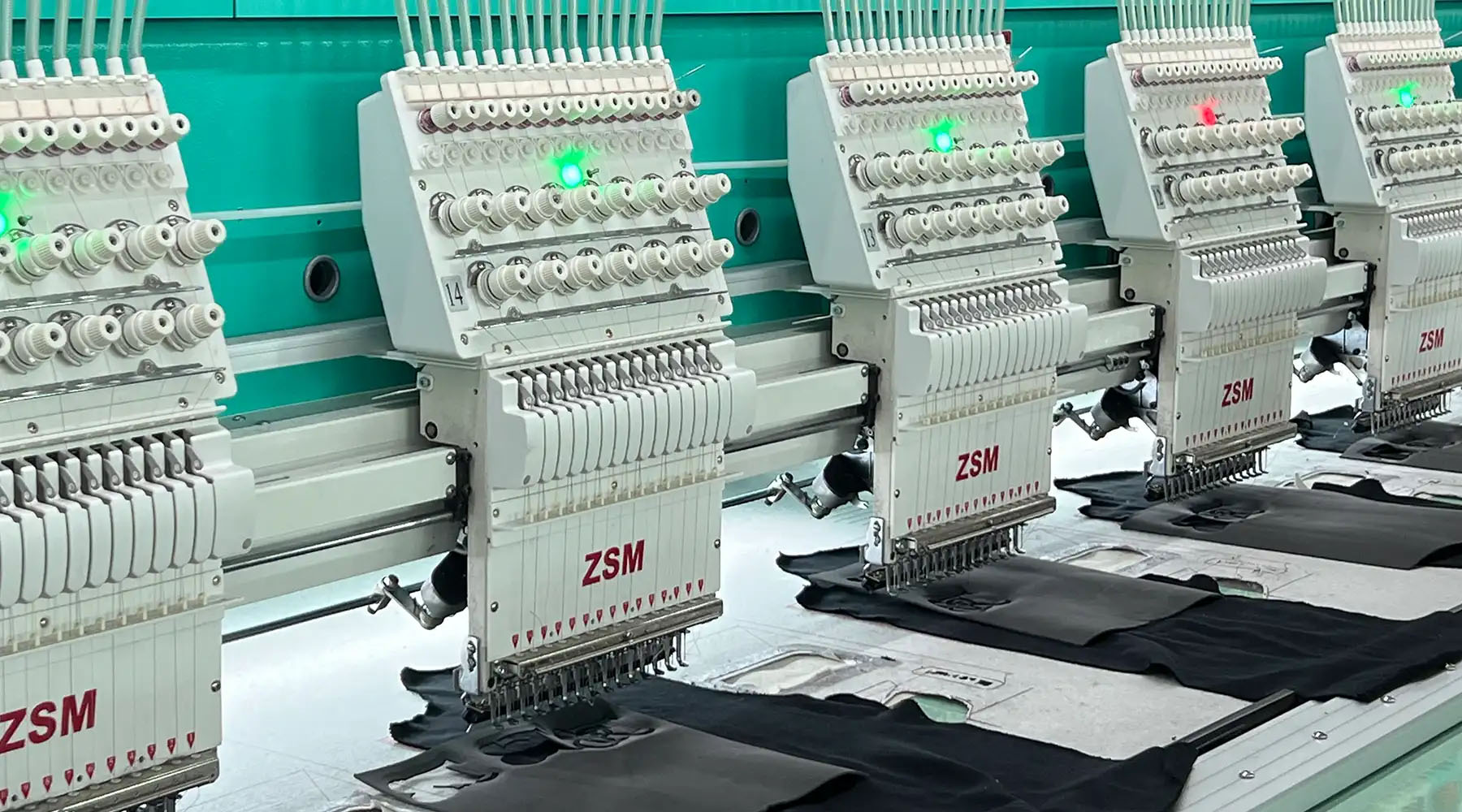
Reinforced stitching at stress points uses high-tensile thread, screen prints and DTG inks are given proper curing time rather than the time a schedule allows, and embroidery tension is stabilised with backing so that thread does not loosen after wear. A 50-piece run is where these variables can be checked cheaply. Print cracking, thread loosening, seam failure and size drift are all visible in a small batch, and all of them are considerably more expensive to discover after a bulk run has been cut.
Inspection and traceability
Inspection runs through an order rather than sitting at the end of it. First-article inspection is carried out at the cutting, sewing and printing stages, with random patrol checks across the production lines and real-time adjustment of embroidery tension and print alignment. Finished goods are sampled to the AQL 2.5 standard, pre-shipment wash tests are conducted on representative samples, and sizes are verified across all colourways. Each order is assigned a production batch number, and quality records are maintained for future reorder reference. Third-party inspection firms such as SGS or Intertek can be engaged on request, and laboratory testing for specific requirements such as colour fastness or tensile strength can be arranged.
Sampling comes before the trial
A trial run is the second step in the process, not the first. Sample orders are produced and paid for as a non-recurring engineering step, which is what allows rapid iteration before a production minimum is ever discussed. Because printing, embroidery and custom packaging are managed in-house, a sample can be revised without the garment, the decoration and the packaging being split across separate vendors. The sample approves fit, fabric hand, decoration placement and packaging; the 50-piece run then proves that the approved sample can be repeated — which is the part that matters when a brand reorders.
Where a 50-Piece Trial Run Pays Off
| Scenario | What the trial validates | Typical production direction |
|---|---|---|
| Music and event merchandise | Artwork-led designs and colourways against real sell-through | Print-led decoration; garment weights chosen around event timing |
| Streetwear brand's first drop | Fit block, fabric hand and decoration quality | Heavyweight direction of 300–500 GSM with finishes such as acid wash and puff printing |
| E-commerce and DTC fit tests | Whether a boxy, oversized or classic cut sells before a seasonal buy | One design, one or two colourways, repeated if it works |
| Gym, team and uniform pilots | Size distribution and durability under repeated wear | Reinforced stitching and higher wash durability |
| Distributor and wholesale validation | Which colourways a territory will actually reorder | Per-colour minimum applied across a deliberately small matrix |
| Private-label programme launch | Whether the finished article meets the brand's own standard | In-house printing, embroidery and custom packaging |
The pattern across these scenarios is the same. A trial run is not a discount on production; it is a research budget with a garment attached. For a streetwear label, the trial answers whether a 300–500 GSM heavyweight block behaves the way the design intended. For a distributor, it answers which two colourways out of six deserve to be ordered again. For an artist management team, it answers which designs survive contact with an audience before the next drop is financed.
Market Trend: Low Minimums Are Becoming a Development Tool
Two structural facts sit underneath the growth of this category. T-shirts and tanks account for 48.39% of a blank apparel market estimated at USD 15.23 billion in 2024, so the base layer of the market is both large and heavily supplied. And the manufacturing capacity that serves it is geographically concentrated: Guangdong (Guangzhou and Dongguan) for fast fashion and streetwear, and Zhejiang (Ningbo) for premium knitwear. Sampling, decoration and finishing therefore tend to sit within reach of one another, which is part of what makes short production cycles practical for a China T-shirt manufacturer serving overseas brands.
Public industry reviews of Chinese suppliers place common startup-oriented MOQs between 50 and 100 pieces per design or colour. A standard of 50 pieces per colour per design sits at the lower end of that band, and that position changes what a first order is for. It stops being a bet on demand and becomes a test of it — and the brands that benefit most treat the first batch as product development rather than as production.
Comparison with Traditional Sourcing — and Where a Trial Run Stops
| Dimension | Bulk-first sourcing | 50-piece trial run |
|---|---|---|
| First commitment | Set by the factory's minimum rather than by the brand's demand signal | Set by a per-variant minimum of 50 pieces |
| Capital exposure | Inventory and freight paid before demand is confirmed | Limited to a quantity that can be sold or absorbed |
| Learning before scale | Fit, fabric and decoration issues surface at customer level | Issues surface inside the batch, before reorder decisions |
| Risk profile | Single large decision, difficult to reverse | Several small decisions, each reversible |
| Unit economics | Lowest per-unit cost at volume | Higher per-unit cost, lower total risk |
| Best fit | Validated designs, established demand, fixed schedules | New designs, new markets, unproven fits |
The limits of the model deserve the same clarity as its advantages.
- The minimum is per colour, not per order. A design produced in six colourways requires six times the per-variant minimum. A trial run does not remove the arithmetic of a wide range; it makes the range visible before it is financed.
- Trial pricing is not bulk pricing. Unit cost falls as volume rises, so the value of a trial lies in information rather than in price per piece. A brand that needs the lowest possible unit cost will not find it in a 50-piece order.
- Quality-controlled production carries its own premium. Against an ultra-budget mass producer, initial per-unit cost is typically 20–40% higher. Total project cost is often comparable or lower once return rates, complaints and replacement frequency are counted, but that offset is a later benefit, not an upfront discount.
- A trial run does not prove demand. It validates fit, finish, fabric behaviour and repeatability. It cannot confirm a full season, a retail range or a distributor's reorder.
- It is the wrong tool once demand is established. After a fit and a fabric have been proven, larger runs generally make better commercial sense; a minimum is a starting mechanism, not a permanent operating model.
| Performance indicator | Quality-controlled production (typical) | Ultra-budget mass production (typical) |
|---|---|---|
| Inspection protocol | Multi-point inspection against AQL standards | Limited or inconsistent inspection |
| Defect rate | Typically maintained below 5% | Often exceeding 10–15% |
| Fabric shrinkage | Generally within 5–8% | 8–12% or higher |
| Colour fastness | Typically Grade 3–4 | Typically Grade 2–3 |
| Wash durability | Typically 30–50 washes with minimal fading | Noticeable fading after 10–15 washes |
| Anti-pilling | Typically Grade 3 | Typically Grade 1–2 |
These are category-level planning ranges used to compare production models, not a guarantee of results for any individual order. Performance depends on the fabric specified, the decoration method and the wash instructions the garment carries.
From Trial to Reorder: What Continuity Requires
The value of a low minimum is rarely in the first order. It is in the second, and repeatability is what makes the second possible. Each order carries its own production batch number, quality records are retained for reorder reference, and specifications are maintained so that a restock matches the original rather than approximating it.
Capacity is the other half of continuity. Guangzhou Qianshi Apparel Co., Ltd operates 600㎡ of sewing area, 1,500㎡ of finishing area, 700㎡ of warehouse and 200㎡ of packing space, with 200–250 production line workers, 15 designers and 80–100 sales, coordination and administrative staff. Monthly production capacity is 250,000 units against annual output of 3,000,000 units, which means a validated design can scale from 50 pieces to a seasonal programme without changing suppliers or rebuilding a specification.
Ongoing supply relationships tend to follow a recognisable shape. One buyer's project has been running for a year with reorders placed; another has been an ongoing partnership for three years with quarterly reorders. In both cases the mechanism is the same: a small validated batch, followed by records good enough to repeat it.
Future Outlook
Three shifts are worth planning for.
Compliance is becoming more specific. OEKO-TEX Standard 100 updated its 2024 regulations to include a limit value for total fluorine (PFAS) of 100 mg/kg, effective 1 January 2024, and the Global Organic Textile Standard requires products labelled organic to contain at least 95% certified organic fibres, with cut-make-trim manufacturing meeting defined social and environmental criteria. A trial run is the cheapest place to put the correct certificate on a specification, because re-specifying fabric after a bulk order has been cut is not.
Fabric direction is moving heavier. Streetwear T-shirt manufacturing in China has shifted towards heavyweight fabrics of 300–500 GSM and complex finishes such as acid washes and puff printing. Heavier fabric and additional finishing change trial economics, but they do not have to change the minimum quantity.
The minimum is becoming a product metric. As small-batch production becomes normal rather than exceptional, minimum order quantity increasingly functions as a development threshold rather than a purchasing barrier. Brands that treat the first batch as research get a fit, a fabric and a repeatable specification out of it; brands that treat it as production get 50 T-shirts.
FAQ
What is the minimum order quantity for a custom T-shirt trial run?
At Guangzhou Qianshi Apparel Co., Ltd the trial-run minimum is 50 pieces per colour per design. Because the minimum is applied per variant rather than to the order as a whole, a single design in a single colourway can be produced as a 50-piece trial run.
Why is the minimum set per colour instead of per order?
Each colourway involves its own fabric or decoration setup and its own size and measurement verification. A per-colour minimum keeps shade and measurement consistency inside a colourway; a per-order minimum would allow a small quantity to be spread across many colours, which is where inconsistency between batches usually begins.
What do buyers pay upfront for a trial order?
Sample orders are settled 100% upfront and treated as a non-recurring engineering fee. Bulk orders follow a 50% deposit with the 50% balance payable before shipment. Payment is accepted by bank T/T, Alibaba Trade Assurance, Alipay and WeChat Pay.
How is quality checked on a batch as small as 50 pieces?
Incoming fabric is inspected 100% for weight, width, colour consistency and shrinkage potential. First-article inspection is carried out at the cutting, sewing and printing stages, with random patrol checks through the run and real-time adjustment of embroidery tension and print alignment. Finished goods are sampled to the AQL 2.5 standard, pre-shipment wash tests are run on representative samples, and sizes are verified across all colourways. Photo and video inspection reports are available on request, third-party inspection by firms such as SGS or Intertek can be arranged at the client's cost, and buyer on-site inspection is welcomed for bulk orders.
Which fabric performance values can be confirmed before scaling up?
Fabric performance is controlled through 100% incoming fabric inspection, pre-shrinkage treatment before cutting and reactive dyeing with high-temperature fixation. Under that system, finished garments typically show shrinkage within 5–8%, colour fastness of Grade 3–4, anti-pilling performance of Grade 3 and durability through approximately 30–50 washes with minimal fading. Where a named standard applies — for example OEKO-TEX Standard 100 or the Global Organic Textile Standard — the certificate should be stated on the specification and verified against the order.
Can a 50-piece trial run be produced as a private-label product?
Yes. Printing, embroidery and custom packaging are managed in-house, so decoration and packaging for a private-label T-shirt can be applied to a trial batch rather than being reserved for bulk volumes. OEM and ODM work is the core of the company's service model.
How does a low minimum order quantity support a long-term supply relationship?
It makes the first order small enough to be judged on evidence rather than expectation, and it makes the second order the point at which a supply relationship is actually tested. Each order is assigned a production batch number, quality records are kept for reorder reference, and monthly production capacity of 250,000 units means a validated design can scale without changing suppliers. Ongoing projects include a buyer relationship that has been running for one year with reorders placed, and a partnership ongoing for three years with quarterly reorders.
What are the limitations of a 50-piece trial run?
The minimum applies per colour per design, so a design produced in several colourways requires a multiple of 50 pieces. Trial pricing sits above bulk pricing, and quality-controlled production typically carries an initial per-unit cost 20–40% higher than ultra-budget mass production. A trial also validates fit, finish and repeatability rather than demand, and it is not the most economical route once demand is already established.
Procurement mechanics, rather than product promotion, are the subject of this series. The full capability and specification overview — production areas, equipment, decoration methods, quality controls and purchasing terms — is available for download in the Qianshiwear company brochure, and manufacturer information is published at qianshiwear.com.