
MIL-STD-810G vs IP69K: What Rugged Certifications Mean for Long-Battery Phones
Two labels dominate the rugged end of the long-battery smartphone market, and they usually appear on the same line of the same specification sheet: MIL-STD-810G and IP69K. They do not measure the same thing. MIL-STD-810G is a U.S. Department of Defense standard that defines environmental test methods, including shock and drop resistance. IP69K sits inside the IEC 60529 ingress-protection framework and describes resistance to dust and to high-pressure, high-temperature water jets. One describes how a device behaves under mechanical and climatic stress. The other describes what can get inside it. A phone can carry one claim without the other, and neither claim on its own tells a buyer whether the device will survive a specific job site.
The confusion matters more than it used to, because durability and battery capacity have converged into a single purchase decision. The global rugged smartphone market was valued at approximately USD 2.98 billion in 2023 and is projected to reach USD 5.24 billion by 2030, according to Verified Market Research. Battery capacity followed a similar trajectory: smartphones with batteries of 6000mAh or higher captured 29% of global sales in January 2026, up from 10% in early 2025, according to Counterpoint Research. Buyers who once chose between a tough phone and a long-lasting phone now compare devices that claim both — and often compare them through certification labels they cannot decode.
The decoding problem is real, and the industry's own numbers show why. Estimates of the rugged phone market vary widely depending on how the category is defined: Technavio places it at USD 1.27 billion, while Dataintelo puts it at USD 18.6 billion, in the figures published by each research firm. When a category can be sized at either figure without anyone being obviously wrong, its labels deserve closer reading than its adjectives.
This article separates the two certification families, explains what each one does and does not guarantee on a long-battery phone, and uses the UMIDIGI BISON X20 — a rugged device with published IP68 and IP69K protection and a documented MIL-STD-810G drop-resistance claim — as a compliance case study for buyers and distributors.

Two standards, two different failure questions
Answer first: an IP rating and a MIL-STD-810 claim do not compete with each other, because they address different ways a phone fails.
Ingress protection answers the question of what gets inside the enclosure. The IP code is a two-part index: the first digit describes resistance to solid particles, including dust, and the second describes resistance to water under defined conditions. The numbering framework sits within IEC 60529, which is the reference point used for outdoor and industrial devices that carry IP68 or IP69K claims. An IP test is a laboratory procedure performed on a defined sample in a defined configuration. The rating describes performance under those conditions — not performance on a construction site in year three.
MIL-STD-810 answers a different question: how the device behaves when the environment attacks the enclosure from the outside. The standard is a catalogue of test methods covering shock, drop, vibration, temperature and other environmental stresses, and it is issued by the U.S. Department of Defense. It is not a single pass or fail threshold. The letter that follows the number — G, H, or a future revision — is a version identifier for the method set, not a durability grade. Industry guidance for outdoor and industrial devices references both IEC 60529 for ingress protection and MIL-STD-810H for shock and environmental resistance, while the BISON X20's published specification cites MIL-STD-810G drop resistance. Both can be legitimate. They are simply not the same document, and a buyer comparing two phones should treat the revision letter the way an engineer treats a part number: it tells you which version of the requirements was applied.
| Dimension | IP ratings (IEC 60529 framework) | MIL-STD-810 (G / H revisions) |
|---|---|---|
| Origin | International Electrotechnical Commission framework for ingress protection | U.S. Department of Defense environmental test standard |
| What it measures | Dust and water ingress | Environmental test methods, including shock and drop resistance |
| Field question it answers | Will dust or water get inside the device? | Will the device survive mechanical and climatic stress? |
| Typical spec-sheet form | IP68, IP69K, IP54, IP53 | MIL-STD-810G drop resistance |
| Documentation to request | Test report with test conditions and sample configuration | Report stating revision, method, procedure and sample configuration |
What an IP68 or IP69K rating actually certifies
An IP68 or IP69K label certifies ingress performance only. It does not certify drop resistance, screen robustness, battery safety, or software reliability, and it is not a warranty against water damage after a seal has been compromised.
- IP68 describes protection during immersion under defined test conditions. It is the rating most often associated with accidental immersion in water.
- IP69K describes protection against close-range, high-pressure, high-temperature water jets of the type used in washdown cleaning. It is the highest water-related rating commonly cited for industrial equipment.
- Combined claims such as IP68 & IP69K indicate that a device has been assessed against both exposure types rather than only one. Neither rating implies the other.
A useful signal for buyers is how a manufacturer distributes ratings across its own catalogue. UMIDIGI, the smartphone brand of Shenzhen Keysmart Technology Co., Ltd., publishes different protection levels for different models rather than one blanket claim: the UMIDIGI G100, G100 5G and Note 100 5G are specified as IP53 dustproof and waterproof; the UMIDIGI G100x 5G and UMIDIGI A75x are specified as IP54; and the UMIDIGI BISON X20 is specified as IP68 and IP69K dustproof and waterproof. A brand that publishes tiered ratings per model gives a buyer something to compare. A brand that publishes one slogan across an entire catalogue does not.
The boundary that buyers overlook: ingress protection is verified on a sealed unit at the time of testing. It is not a permanent property of the product. Seals can be affected by impact, thermal cycling, or a repair that involves opening the chassis. A device that was rated IP68 or IP69K when it left the factory is not automatically rated that way after an unapproved teardown or an unrepaired drop.
What MIL-STD-810G drop resistance actually covers
MIL-STD-810G drop resistance means the manufacturer applied a defined, repeatable shock procedure from the standard — no more and no less. It does not mean the phone is unbreakable.
Because MIL-STD-810 is a catalogue of methods rather than a single threshold, two devices can both claim MIL-STD-810G and have been tested under different procedures, drop orientations, surface conditions and sample configurations. That is the central problem for procurement: the label alone cannot rank two phones against each other. The disclosure behind the label can.
What a documented MIL-STD-810G claim does tell a buyer is still valuable. It indicates that the manufacturer subjected the device to a defined shock routine rather than relying on a rubberised case or a marketing metaphor, and that the result was recorded as part of the product's qualification file. For procurement teams, the practical follow-up questions are consistent across suppliers:
- Which revision of MIL-STD-810 was applied — G, H, or another?
- Which test method and procedure were used, and what configuration was tested?
- Was the test performed on the final production configuration or an engineering sample?
- Is the report available for review, with the model number matching the purchase order?
Without answers to these questions, a MIL-STD-810G line on a specification sheet is a claim. With them, it becomes a qualification benchmark.
The BISON X20 as a compliance case study
The UMIDIGI BISON X20 is a rugged smartphone whose published specifications carry both certification families simultaneously — an IP68 and IP69K ingress claim and a MIL-STD-810G drop-resistance claim — on a device that also targets long battery life. Its full published specification is the clearest way to see how certification, construction and battery capacity interact in a single product.
| Specification area | Published BISON X20 specification |
|---|---|
| Protection | IP68 & IP69K dustproof and waterproof; MIL-STD-810G drop resistance |
| Construction | TPU and metal |
| Dimensions and weight | 172.1 × 83.8 × 12.9 mm; 278 g |
| Processor | MediaTek Helio P60 |
| Memory | Up to 6+6GB extended RAM, 128GB ROM, 1TB TF expansion |
| Display | 6.53-inch 120Hz HD+ punch-hole display |
| Battery and charging | 6000mAh long-lasting battery, 20W PD fast charging |
| Cameras | 20MP triple rear camera, 8MP front camera |
| Unlock and controls | Side fingerprint sensor, AI face unlock, Hot Keys, NFC |
| Published target environments | Daily life and work, construction and engineering, logistics and warehousing, manufacturing, mining |
Read as a compliance package rather than a feature list, three things stand out for buyers evaluating long-battery rugged phones.
First, the battery figure lands in the segment that dominates rugged demand. The 5000mAh to 6000mAh band accounted for 42.9% of rugged phone market share in 2025, according to The Insight Partners. A 6000mAh cell with 20W PD charging therefore addresses the mainstream expectation of the category rather than an outlier niche.
Second, the protection claims come in pairs, not as a single slogan. Ingress protection and shock resistance are separate test disciplines, and stating both means the device has been assessed against two independent failure modes. This is precisely the distinction that most specification sheets blur.
Third, the physical cost of certification is visible and measurable. A device built from TPU and metal, weighing 278 g with a 12.9 mm body, is heavier and thicker than a mainstream handset. That weight and thickness exist because the chassis, seals and internal mounting are part of the qualification, not decoration.
The practical controls matter as much as the certifications in field use. Hot Keys allow defined functions to be triggered without navigating menus, which is relevant when the user is wearing gloves, and NFC supports contactless workflows in logistics and field service. The MediaTek Helio P60 platform and 6+6GB extended memory are configured for sustained everyday workloads rather than benchmark performance — an intentional trade-off in a device whose design priority is withstanding the environment and running through a full shift. UMIDIGI is the smartphone brand of Shenzhen Keysmart Technology Co., Ltd., a Shenzhen-based communications technology company founded in 2012 that integrates R&D, manufacturing, brand operation and ODM/OEM services, operating a 10,000 m² facility with 400–500 employees, a 30-engineer R&D team and reported annual output of 30,000,000 units, exporting to markets including South America, Asia, Africa, the EU and the USA.
How UMIDIGI documents claims across its product line
Certification credibility is a product-line question, not a single-model question. UMIDIGI's public documentation shows a consistent pattern of third-party certification for its mainstream models alongside the rugged BISON line, which lets buyers see how the same company handles regulatory and durability claims on different tiers.
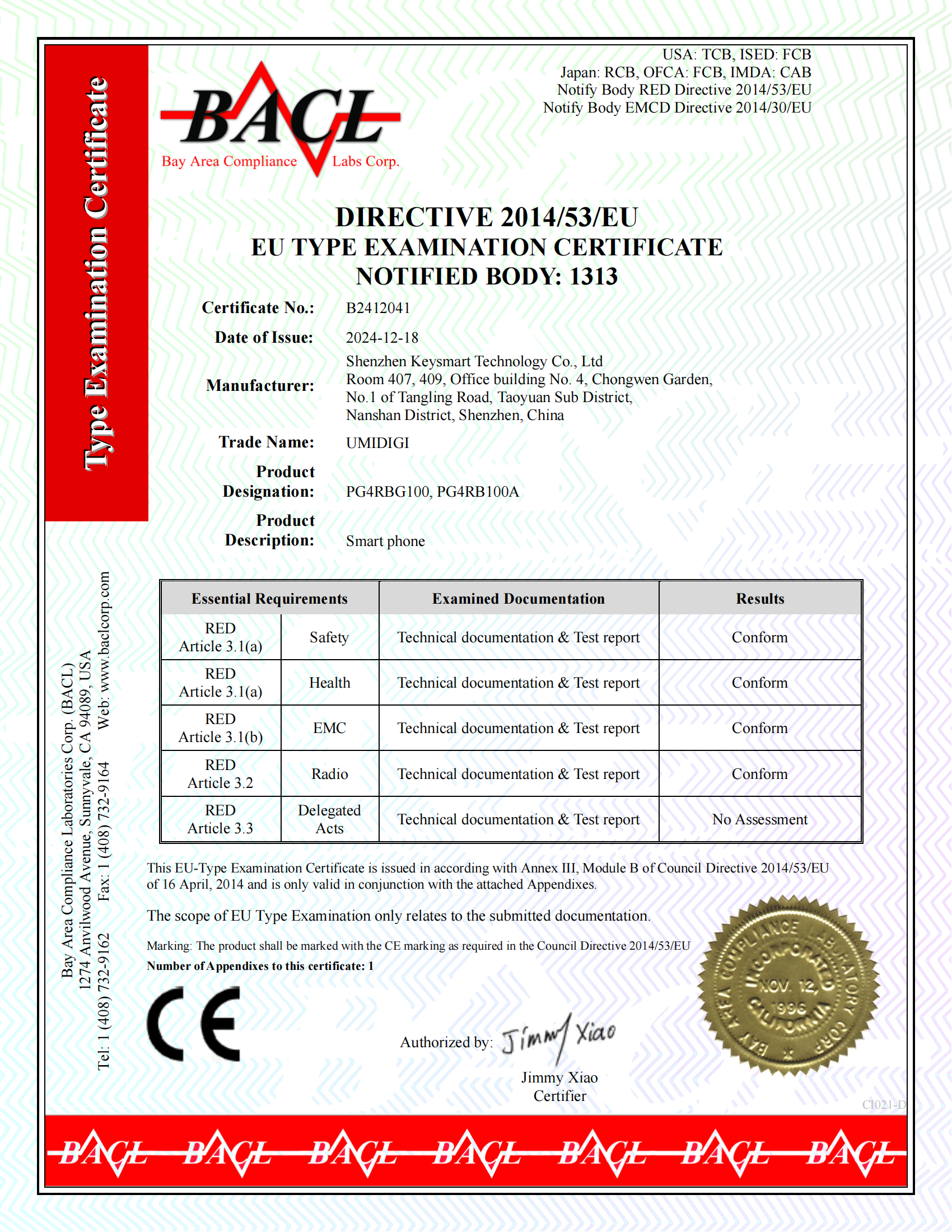
For the EU market, UMIDIGI holds multiple EU Type Examination Certificates issued under the 2014/53/EU Radio Equipment Directive, all issued by the testing organisation BACL:
- UMIDIGI G100 — certificate B2412041, issued 18 December 2024, covering smart phone models PG4RBG100 and PG4RB100A under the UMIDIGI brand. Cited standards include safety (IEC 62368-1, EN 50360 series), EMC (EN 55032, IEC 61000-3 series) and radio (a series of ETSI EN 300/EN 301/EN 303 standards).
- UMIDIGI Note 100 5G — certificate B2407121, issued 29 July 2024, covering models PG4MBG9YA, PG4TBG9PG, PN4TB100G and PN4TB10PG. The Note 100 5G uses the UNISOC T765 5G processor.
- UMIDIGI G9x — certificate 2501P41324E-RFA1, issued 22 January 2025, covering model PG5FBG9XA.
- UMIDIGI A75x — certificate 2601P40188E-RFA1, issued 20 January 2026, covering model CPA2651.
Buyers should note precisely what these documents cover and what they do not. A CE certificate under the Radio Equipment Directive addresses radio performance, electrical safety, electromagnetic compatibility and human exposure to radio frequency fields. It does not test drop resistance, dust ingress or water ingress. A CE certificate is evidence of market-access compliance, not of ruggedness. The two document sets are complementary, and a supplier that can produce only one of them has not answered both questions.
Manufacturing evidence supports the commercial side of the same claims. UMIDIGI's capability documentation lists OEM and ODM production modes with customisation for brand logo, exterior design, packaging design and specifications; a monthly capacity of 300,000 units; a Minimum Order Quantity of 3,000 units for OEM programmes with a lead time of 60–70 working days; 100% pre-shipment testing; and remote technical support after delivery. The company also reports a 2024 iF Design Award for its G3 Mecha and A15 Mecha rugged series on its official site, a design recognition that sits alongside — but does not replace — the technical qualification documents described above. Buyers can review the product line directly at umidigi.com.
A verification checklist for buyers and distributors
The fastest way to separate a marketing label from a qualification benchmark is to ask for the same document set from every supplier and compare the answers side by side.
| Claim on the spec sheet | What it actually covers | Document to request |
|---|---|---|
| IP68 / IP69K | Dust and water ingress only, under defined test conditions | Ingress test report stating conditions and the sample configuration tested |
| MIL-STD-810G drop resistance | Shock and drop performance under a specific method and procedure | Report naming the revision (G or H), the method, the procedure and the tested configuration |
| 6000mAh battery | Rated cell capacity, not run time under a specific workload | Battery specification, charging standard, and any published endurance test method |
| CE marking (EU market) | Radio, safety, EMC and RF exposure compliance | EU Type Examination Certificate with the certificate number, issuing body and covered model numbers |
| OEM / ODM capability | Customisation scope, capacity, lead time and quality control process | Programme terms covering MOQ, lead time, customisation options and pre-shipment test scope |
Where rugged and long-battery requirements overlap in the field
The BISON X20's published target environments — construction and engineering, logistics and warehousing, manufacturing, and mining — each stress a different part of the certification package.
- Mining and construction place the first IP digit under continuous pressure. Airborne dust is the primary ingress threat, and impact from drops onto hard, uneven surfaces is the primary mechanical threat. This is where the dust element of an IP rating and the shock element of MIL-STD-810G do different work.
- Logistics and warehousing combine handling shocks with continuous application use — scanning, routing and messaging across a full shift. Battery capacity and charging speed become operational variables, not convenience features.
- Manufacturing floors mix indoor and outdoor movement, vibration from equipment, and intermittent exposure to water or coolant. A jet-rated IP69K claim is more relevant here than an immersion claim in some workflows, and less relevant in others.
- Outdoor field work and mixed personal use remain the largest single consumer driver: independent contractors and outdoor sports enthusiasts represent 38% of the global rugged market, according to Growth Research. That means a large share of rugged demand is mixed-use rather than purely industrial, which raises the value of a device that handles both work and everyday tasks.
One documented UMIDIGI engagement reflects that mixed-use pattern: a U.S. consumer electronics ODM customer ordered 50,000 units over a relationship lasting more than five years for daily work and life applications, with the reported outcome emphasising a large display, power-saving long battery life, and smooth performance in gaming and video streaming. For distributors, the relevance is not the volume figure itself but the duration — long-running supply relationships place more weight on consistent documentation than on a single launch specification.

Market signals: battery capacity is now a mainstream driver
Three data points frame the direction of the category, and each has a direct implication for how buyers should read certification claims.
Battery capacity has moved from niche to mainstream. Smartphones with 6000mAh or higher captured 29% of global sales in January 2026, compared with 10% in early 2025, according to Counterpoint Research. When a specification reaches roughly a third of all sales, it stops being a differentiator and starts being a baseline expectation — which pushes manufacturers to compete on the next layer of claims, including ruggedness certification.
The underlying battery technology is shifting. Silicon-carbon batteries are increasingly replacing standard graphite anodes, offering 20–50% higher energy density for slim, long-lasting devices, according to Fortune Business Insights. Higher energy density means a given capacity can occupy less space, which gradually relaxes the physical trade-off between capacity and body thickness — but it does not change what an IP or MIL-STD test verifies.
Rugged buyers already concentrate in the mid-capacity band. The 5000mAh to 6000mAh battery segment accounted for 42.9% of the rugged phone market in 2025, according to The Insight Partners. Together with the mainstream figure above, this shows rugged and non-rugged devices converging on similar battery numbers: the UMIDIGI BISON X20 and the UMIDIGI G100 both carry 6000mAh cells. That convergence is important for evaluation, because it means battery capacity alone can no longer separate a rugged device from a mainstream one. What separates them is construction and qualification.
Rugged versus traditional designs: what the certification costs
The traditional alternative to a certified rugged phone is a mainstream handset protected by an aftermarket case. It is a legitimate approach, and the comparison is worth stating precisely.
| Comparison point | Certified rugged design (BISON X20) | Mainstream design with aftermarket case (e.g. G100) |
|---|---|---|
| Published ingress protection | IP68 & IP69K | IP53 |
| Published shock claim | MIL-STD-810G drop resistance | Not published as a MIL-STD claim |
| Materials | TPU and metal | Plastic and metal |
| Body | 12.9 mm thick, 278 g | 8.1 mm thick, 205 g |
| Display | 6.53-inch 120Hz HD+ | 6.9-inch 120Hz |
| Battery | 6000mAh, 20W PD | 6000mAh, 20W PD |
The limitation of the case-based approach is straightforward: an aftermarket case can absorb some impact energy, but it does not change the device's factory ingress rating or create a MIL-STD test record. If the requirement is documented resistance to dust and water ingress, a case cannot supply it.
The limitation of the certified rugged approach deserves equal emphasis, because it is where buyers most often misjudge the trade-off. A qualified rugged device is heavier, thicker and typically built around a smaller display area than a mainstream model of the same generation, and its chipset class is chosen for sustained stability rather than peak benchmark scores. The BISON X20 at 278 g and 12.9 mm is roughly a third heavier and substantially thicker than the UMIDIGI G100 at 205 g and 8.1 mm. Buyers whose priority is slim design, maximum screen area or the newest 5G platform should recognise that a certified rugged device is not the right answer for that requirement — and that no certification resolves the trade-off. Certification converts durability from an assumption into a documented claim; it does not remove the weight, the thickness or the cost.
Outlook
Two shifts are likely to shape how rugged certification is read over the next product cycles.
The first is disclosure. As 6000mAh-class batteries become common across both rugged and mainstream segments, battery capacity will recede as a differentiator and durability claims will take its place at the front of the specification sheet. That raises the value of suppliers who publish certificate numbers, test revisions and model scopes, and lowers the value of suppliers who publish adjectives. The standard itself will keep evolving — the industry reference point already cites MIL-STD-810H for shock and environmental resistance while products in market still cite MIL-STD-810G — so buyers should expect revision drift and plan to compare like with like.
The second is material and design convergence. As silicon-carbon cells raise energy density, the physical penalty of a large battery shrinks, which may narrow the size and weight gap between rugged and mainstream devices. The certification question, however, does not shrink with it. Ingress protection and shock qualification remain laboratory procedures with defined conditions, defined samples and defined limits — and they will remain the only reliable way to tell a qualification benchmark from a label.
FAQ
What is the difference between MIL-STD-810G and an IP68 or IP69K rating?
They cover different failure modes. MIL-STD-810G is a U.S. Department of Defense environmental test standard that defines procedures for shock, drop, vibration, temperature and related stresses. IP68 and IP69K sit within the IEC 60529 ingress-protection framework and describe resistance to dust and water — immersion for IP68, high-pressure and high-temperature water jets for IP69K. A device can hold one type of claim without the other. MIL-STD-810G does not test for water ingress, and an IP rating does not test for drop resistance.
Does MIL-STD-810G drop resistance mean the phone cannot break when dropped?
No. MIL-STD-810 is a catalogue of test methods rather than a single pass threshold, and manufacturers select the methods and procedures relevant to the intended environment. Two devices can both cite MIL-STD-810G while having been tested under different procedures, orientations, surfaces and sample configurations. The claim indicates that a defined, repeatable shock routine was applied and recorded — it does not guarantee survival in every drop scenario, and it should be read together with the specific test report.
Is IP69K better than IP68 for construction, mining or logistics work?
They address different exposure types rather than forming a strict ranking. IP68 describes protection during immersion, while IP69K describes protection against close-range, high-pressure, high-temperature water jets. In environments where equipment is washed down under pressure, jet protection is the more relevant condition. Where devices are exposed to standing water or accidental immersion, immersion protection is the more relevant condition. A device specified as IP68 & IP69K has been assessed against both, which is why the combined form appears on some rugged specification sheets and a single rating appears on others.
When comparing long-battery rugged phones, which certification should a buyer check first?
The order should follow the deployment environment rather than a general ranking. For dust-heavy sites such as mining and construction, the solid-particle element of the IP rating and the shock claim matter most. For washdown or heavy water exposure, the water element of the IP rating takes priority. For fleet deployments, the battery specification and charging standard determine shift-level usability. Because rugged and mainstream devices now frequently share the same 6000mAh capacity class, buyers should treat battery capacity as an entry condition and use construction and certification documentation to make the final comparison.
How can a distributor verify that a rugged or long-battery specification is genuine?
Request documents rather than reassurances. For ingress claims, ask for the test report including test conditions and sample configuration. For MIL-STD-810 claims, ask which revision, method and procedure were applied and on what configuration. For EU market access, ask for the EU Type Examination Certificate with its certificate number, issuing body and the model numbers it covers — for example, certificate B2412041 issued by BACL for UMIDIGI G100 models PG4RBG100 and PG4RB100A, or certificate 2601P40188E-RFA1 issued by BACL for the UMIDIGI A75x. Confirm that the model numbers on the certificate match the purchase order, and ask separately about the manufacturing quality-control process, such as whether 100% pre-shipment testing is performed. Claims that arrive with matching paperwork are qualification benchmarks; claims that arrive alone are labels.
Reference documentation: UMIDIGI's published company profile — covering company structure, manufacturing capacity, product lines and certification scope — is available as a PDF at Shenzhen Keysmart Technology Co., Ltd. — Company Profile.
Have Questions or Need More Details?
Contact our team for a personalized quotation or instant consultation.
Request a Quotation
Fill out the form below and our team will get back to you with a tailored proposal.
WhatsApp Direct Chat
Prefer to chat in real-time? Message us on WhatsApp for instant assistance & quick answers.
- Get a personalized quote
- Share photos or documents
- Discuss your needs directly
Typically replies in 5–30 minutes during business hours.