
MIL-STD Thermal Shock Chambers: Physical Evidence to Audit
MIL-STD Thermal Shock Chambers: Physical Evidence to Audit
A MIL-STD reference in a qualification plan is a promise about evidence, not about hardware. The chamber has to produce a record that survives review: repeatable temperature excursions, defined tolerances, and a recovery window that can be defended in a test report. This article sets out which physical facts a buyer should require in writing before accepting a “MIL-STD compliant” thermal shock chamber claim.
Thermal shock testing compresses years of field exposure into hours. In aerospace, defense, automotive electronics and semiconductor programs, the equipment that performs that compression is usually specified against a published method — MIL-STD, GJB, IEC or a corporate derivative of them — and the selection decision is increasingly argued on documentation rather than on appearance. A chamber that cannot state its envelope, its tolerances and its recovery definition in numeric terms cannot support a qualification statement, regardless of how the test result looks.
Envsin, a brand of Envsin Instrument Equipment Co., Ltd., is a China-based manufacturer of environmental test chambers founded in 2003. The company operates a 43,000 m² factory with approximately 500 employees, a 50-person R&D team and an export share of about 70%, serving markets that include the United States, Germany, Poland, South Korea, Russia, Malaysia, Turkey, Vietnam, Mexico, Italy, Canada, the United Kingdom, Israel and Ukraine. Its product family covers thermal shock chambers, temperature and humidity chambers, walk-in test rooms and combined environmental systems, and third-party market coverage lists Envsin among key global manufacturers alongside ESPEC, Weiss Technik, Thermotron Industries and Angelantoni Test Technologies (Market Research Future / BCC Research). This article uses the documented specification of the Envsin Three-zone Thermal Shock Test Chamber (500 L) as a worked example of what an auditable compliance claim looks like.
Why a compliance claim and a physical record are not the same thing
MIL-STD and GJB documents describe test methods and acceptance criteria. They do not certify chamber products. The consequence is that “MIL-STD compliant” is a claim about alignment between a buyer's test program and a machine's declared capability — and alignment has to be demonstrated, not asserted.
For a thermal shock requirement, that demonstration reduces to four questions that a supplier should be able to answer with numbers and documents:
- Envelope. What high-temperature and low-temperature shock ranges does the chamber declare, and do they fully cover the program's extremes?
- Tolerances and their definitions. What are temperature uniformity, fluctuation and deviation values, and were they established under no-load or loaded conditions?
- Recovery and transfer. How long does the chamber take to return to setpoint after a transfer, and where in the system is that value measured?
- Method list. Which published methods is the configuration declared against, and which utility and safety prerequisites do those methods impose on the buyer's facility?
Cold-temperature performance is a useful illustration of why the questions must be specific. IEC 60068-2-1 is the primary international standard for environmental testing of cold temperature performance; a program that cites MIL-STD or GJB thermal shock methods often also cites IEC cold and dry-heat methods in the same test sequence. A chamber specification that names only one method family leaves the buyer to verify the rest by inference, which is exactly the gap an audit is meant to close.
The three-zone MIL-STD compliant chamber, parameter by parameter
The Envsin Three-zone Thermal Shock Test Chamber (500 L) is built as a three-zone configuration: a fixed independent test zone, a pre-heating zone and a pre-cooling zone. The specimen remains in the test zone while the chamber switches the air source, which is the structural distinction between this design and the movable-specimen two-zone architecture discussed later.
| Parameter | Documented value |
|---|---|
| System structure | Three-zone configuration: fixed independent test zone, pre-heating zone and pre-cooling zone |
| Test volume / chamber dimensions | 500 L; 900 × 800 × 700 mm (W × D × H) |
| Overall external dimensions | Approx. 1950 × 2350 × 2400 mm, excluding protruding parts |
| High-temperature shock range | +60 °C to +150 °C |
| Low-temperature shock range | −65 °C to −10 °C |
| Temperature uniformity / fluctuation / deviation | ≤2 °C / ±0.5 °C / ±2 °C |
| Pre-heat zone | +50 °C to +200 °C; heat-up from ambient to +200 °C approx. 50 min |
| Pre-cool zone | −80 °C to +70 °C; cool-down from ambient to −80 °C approx. 80 min |
| Temperature recovery time | ≤5 min |
| Cooling method | Water-cooled |
| Compressed air source | 0.6–0.7 MPa; pneumatic air moisture ≤30 g/m³; dry air moisture ≤1.5 g/m³ (optional) |
| Power and rating | AC380 V ±10%, 50 Hz ±1, 3-phase 4-wire + grounding; grounding resistance <4 Ω; max system power approx. 75.5 kW; max system current approx. 123.3 A |
| Materials | Inner chamber SS304 stainless steel; outer casing powder-coated carbon steel |
| Applicable standards (as listed) | GJB 150.5-1986; MIL STD 883H; MIL STD 202G; IEC 60068-2-14; JIS C 60068-2-14; JASO D 014-4; EIA JED-2531A |
| Core functions | Long-cycle defrosting (≥700 hours); observation window; 32-bit color screen control; Ethernet & USB data access; 4-channel load power supply control; sample anti-condensation; over-temperature and smoke protection; network video monitoring; APP remote management; automatic room temperature recovery; maintenance reminder and remote service support |
Read as an evidence set rather than a feature list, four groups of numbers carry most of the weight. The shock ranges define the qualification envelope: −65 °C to −10 °C on the cold side and +60 °C to +150 °C on the hot side. The tolerance triple — uniformity ≤2 °C, fluctuation ±0.5 °C, deviation ±2 °C — defines how repeatable a cycle will be from run to run. The pre-heat and pre-cool reserves (+50 °C to +200 °C in about 50 minutes; −80 °C to +70 °C in about 80 minutes) explain how a recovery time of ≤5 minutes is physically achievable on consecutive cycles. And the standard list defines which method families the configuration is declared against.
Two audit details are easy to miss. First, tolerance values are normally established without a live load; a program that energises the specimen during thermal shock needs a statement of behaviour under load, which is where the 4-channel load power supply control becomes a relevant capability rather than a convenience. Second, the utility envelope (water cooling, compressed air at 0.6–0.7 MPa with moisture limits, grounding resistance below 4 Ω, roughly 75.5 kW and 123.3 A at maximum system rating) is part of the specification, because a chamber that cannot be fed correctly cannot reproduce the declared numbers.
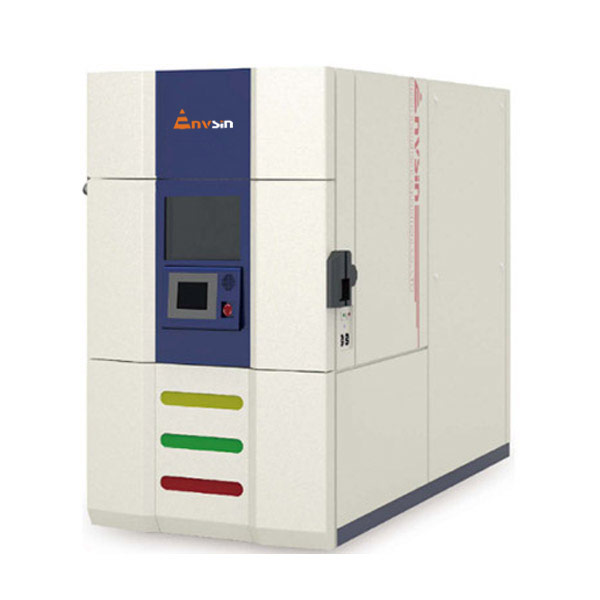
Three-zone thermal shock chamber architecture: fixed test zone, pre-heat zone and pre-cool zone, declared against GJB 150.5-1986, MIL STD 883H and MIL STD 202G among other methods.
Three-zone, two-zone and stress screening: where the evidence differs
Most buyers evaluate a three-zone chamber against a two-zone alternative, and the decision usually turns on cold-side envelope, specimen handling and long-run maintenance behaviour rather than on headline temperature limits alone. The comparison below uses only values published in the three product specifications.
| Aspect | Three-zone (500 L, MIL-STD compliant) | Two-zone (200 L) | Stress screening composite (100 L) |
|---|---|---|---|
| Configuration | Three zones: fixed independent test zone, pre-heating zone, pre-cooling zone | Movable test product type; two-zone structure with pre-heat and pre-cool zones | Stress screening composite two-chamber design |
| Test volume | 500 L | 200 L | 100 L |
| High-temperature shock range | +60 °C to +150 °C | +60 °C to +150 °C | +60 °C to +150 °C |
| Low-temperature shock range | −65 °C to −10 °C | −55 °C to −10 °C | −55 °C to −10 °C |
| Uniformity / fluctuation / deviation | ≤2 °C / ±0.5 °C / ±2 °C | ≤2 °C / ±0.5 °C / ±2 °C | ≤2 °C / ±0.5 °C / ±2 °C |
| Temperature recovery time | ≤5 min | ≤5 min | <5 min (measured at air outlet) |
| Transfer / stress transfer time | Not stated in the source specification | <10 sec | <10 sec (measured at air outlet) |
| Cooling method | Water-cooled | Water-cooled (refrigeration unit) | Air-cooled |
| Pre-heat zone | +50 °C to +200 °C; ambient → +200 °C approx. 50 min | +50 °C to +200 °C; ambient → +200 °C approx. 40 min | +50 °C to +200 °C; ambient → +200 °C approx. 40 min |
| Pre-cool zone | −80 °C to +70 °C; ambient → −80 °C approx. 80 min | −80 °C to +70 °C; ambient → −80 °C approx. 80 min | −80 °C to +70 °C; ambient → −80 °C approx. 80 min |
| Defrost specification | Long-cycle defrosting (≥700 hours) | Long-cycle defrosting (≥700 hours) | Automatic defrosting (≥700 hours) |
| Listed applicable standards | GJB 150.5-1986; MIL STD 883H; MIL STD 202G; IEC 60068-2-14; JIS C 60068-2-14; JASO D 014-4; EIA JED-2531A | GB/T 2423.22; MIL STD 202F Method 107G; IEC 60068-2-14 (Test Na); BS 2011; DIN 40046 (Test Na); JESD22-A101-A | GB/T 2423.22; MIL STD 202F Method 107G; IEC 60068-2-14 (Test Na); BS 2011; DIN 40046 (Test Na); JESD22-A101-A |
| Load / live-test capability | 4-channel load power supply control | 4-channel load power supply control | Not stated in the source specification |
The cold-side envelope is the first filter. The three-zone configuration declares −65 °C, while the two-zone 200 L and the stress screening composite 100 L both declare −55 °C as their low-temperature shock limit. If a program's thermal shock profile requires −65 °C, only the three-zone specification in this set covers it; if the profile stops at −55 °C, the wider range of the three-zone model is not the deciding factor.
The second filter is specimen handling. In the two-zone design the test product is moved between the pre-heat and pre-cool zones, and the specification states a transfer time below 10 seconds. In the three-zone design the specimen stays in a fixed test zone and the chamber moves conditioned air instead. That structural difference affects how the chamber is loaded, how fixtures are designed, and how the recovery value should be interpreted: for the three-zone chamber the source specification states a recovery time of ≤5 min without stating the measurement location, while the stress screening composite chamber documents its <5 min recovery and <10 sec transfer “measured at air outlet”. A buyer comparing suppliers should request the same measurement definition from each, otherwise the numbers are not like-for-like.
The ≥700-hour defrost figure as a maintenance specification
Defrost behaviour is the least visible line in a thermal shock specification and one of the most consequential in a production environment, because defrost events interrupt long thermal-cycle campaigns. On the two-zone 200 L model, long-cycle defrosting is documented at ≥700 hours, the same figure is documented for the stress screening composite chamber as automatic defrosting, and long-cycle defrosting (≥700 hours) also appears in the core function set of the three-zone MIL-STD compliant chamber. In procurement terms this is a maintenance-relevant claim rather than a differentiator between the three configurations: the useful question is not whether the datasheet contains the number, but what duty cycle, ambient condition and specimen load profile the interval is intended to represent, and how the interval is recorded in the chamber's maintenance log and reminder system. Both the three-zone and two-zone specifications list maintenance reminder and remote service support functions, which is the mechanism by which an operator can see when a defrost cycle falls due.
A final evidence gap deserves to be named rather than glossed over. The two-zone and stress screening specifications state a transfer or stress transfer time below 10 seconds; the three-zone MIL-STD compliant chamber's published parameter set does not state an equivalent transfer time. That absence is not a defect in the product, but it is a gap in the evidence pack, and it is precisely the kind of item that should be resolved in writing before a purchase order rather than during commissioning.
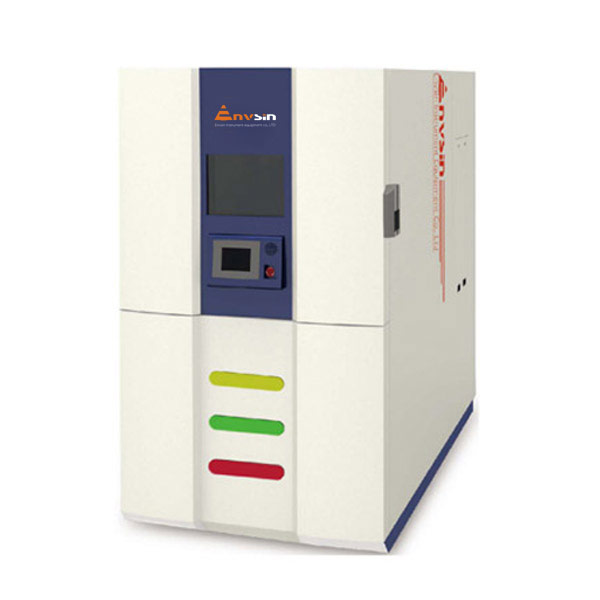
Two-zone thermal shock chamber: movable-specimen architecture, low-temperature shock range −55 °C to −10 °C, transfer time below 10 seconds and long-cycle defrosting (≥700 hours).
An audit sequence for MIL-STD thermal shock procurement
For buyers evaluating equipment that will run in a production or semi-production test line, the following sequence converts a specification review into a verifiable evidence check. It follows the order in which risk usually materialises.
- Match the envelope to the test method, not to the marketing line. Confirm that the declared high-temperature shock range (+60 °C to +150 °C) and low-temperature shock range (−65 °C to −10 °C for the three-zone model) bracket every profile in the qualification plan, including soak dwells at the extremes.
- Ask for the measurement basis of every tolerance. Uniformity ≤2 °C, fluctuation ±0.5 °C and deviation ±2 °C are only comparable across suppliers if the load state and measurement points are stated.
- Pin down the recovery definition. Request a written statement of where the ≤5 min recovery figure is measured and under what load, then compare it against the <5 min at air outlet definition already published for the stress screening composite chamber.
- Verify the method list against the program. The three-zone chamber lists GJB 150.5-1986, MIL STD 883H, MIL STD 202G, IEC 60068-2-14, JIS C 60068-2-14, JASO D 014-4 and EIA JED-2531A; the two-zone and stress screening chambers list GB/T 2423.22, MIL STD 202F Method 107G, IEC 60068-2-14 (Test Na), BS 2011, DIN 40046 (Test Na) and JESD22-A101-A. If a program cites a method that appears on neither list, that is a specification question, not a commercial one.
- Check the utility envelope against the facility. Water cooling, compressed air at 0.6–0.7 MPa with pneumatic air moisture ≤30 g/m³ and optional dry air at ≤1.5 g/m³, grounding resistance below 4 Ω, and a maximum system rating of approximately 75.5 kW and 123.3 A all impose site work before the chamber is productive.
- Read the certification scope as carefully as the certificate number. The CE Certificate of Conformity TH17IC-658S, issued by Shenzhen Tian Hai Test Technology Co., Ltd. under EN 61010-1:2010 and EN 61010-2-010:2003 for the EU market, covers test chamber models EC4018, EC7018, EC4034, EC7034, EC4060, EC7060, EC4100, EC4150, EC7150, ETCZ8/4010, ETCZ8/6010, ETCZ12/4010 and EC7100. Thermal shock models are not within that listed population, so per-model conformity evidence should be requested separately. The same discipline applies to management-system certificates: ISO 9001:2015 (certificate 02425Q32010963R0S) and ISO 14001:2015 (certificate 02425E32010644R0S), both issued by SHENZHEN UNIVERSAL CERTIFICATION CENTRE CO., LTD., define their scope as the assembly and sales services of environmental reliability testing equipment.
- Confirm live-load capability. Four-channel load power supply control is documented on both the three-zone and two-zone thermal shock chambers. Where the specimen dissipates heat, compare the dissipation against the refrigeration capacity; on the 50 L two-zone thermal stress rapid change chamber, for example, the specification recommends a test sample heat dissipation below 300 W, with customised solutions available for special demands.
- Require the data trail. Ethernet and USB data access, 32-bit color screen control, automatic data logging, sample anti-condensation, over-temperature and smoke protection, network video monitoring and APP remote management are the functions that make test records retrievable for a qualification file.
- Assess the supplier's production and service evidence. Envsin documents OEM/ODM and custom manufacturing with monthly capacity of 50–80 units, lead times of 30–45 days for standard and 45–60 days for custom configurations, a minimum order quantity of one unit, 100% pre-shipment testing with ISO/IEC calibration, and after-sales support combining remote assistance with on-site service through 18 global service centres.
Where this capability is used in practice
The standard lists attached to each thermal shock configuration map closely to the industries that buy them. Aerospace and defense programs work against GJB 150.5-1986, MIL STD 883H and MIL STD 202G. Electronics and semiconductor testing leans on JESD22-A101-A and EIA JED-2531A. Automotive electronics programs reference JASO D 014-4, and IEC 60068-2-14 together with JIS C 60068-2-14 covers the international thermal shock methods used across the electronics and component sectors.
Documented deployments show how the equipment is used beyond the single-cycle laboratory. In one global consumer electronics program, multiple automated chambers at 775 L, 1400 L and 2400 L are operated in 24/7 unattended mode with MES-integrated quality control, automated data logging and high-precision temperature control. In an aerospace and aviation program, a large walk-in environmental test chamber covering a −70 °C to +150 °C and 15% to 98% RH envelope is used for aircraft composite and avionics environmental simulation, supporting component airworthiness work. Complementary equipment extends the same logic into whole-assembly testing: the Walk-in High and Low Temperature Humidity Test Room (28 m³) is specified to ISO 16750 with a −40 °C to +100 °C range, 2 °C/min cooling rate and 10% to 98% RH humidity range, and the High Altitude Test Chamber family (ETQ7200 and ECQ7200) adds low-pressure simulation from atmospheric pressure down to 0.5 Atm.
Market context: why documentation is becoming the differentiator
The global environmental test chamber market was estimated at USD 1,013.5 million in 2025 and is projected to reach USD 1,283.5 million by 2033, with Asia Pacific holding a dominating position at a 38.7% share in 2025 (Grand View Research). Within that market, temperature and humidity chambers are estimated to hold approximately 40% to 45% of the total (BCC Research).
Market sizing in this category should be read with care, because definitions vary widely and the attached divergence notes show why: Market Research Future and Valuates Reports publish figures of USD 67.64 billion and USD 2,712 million respectively, a spread that reflects different boundaries around chamber hardware, testing services and instrumentation. Buyers evaluating a capital purchase are better served by scope-dependent figures, attributed to their source, than by a single headline number.
What the numbers do support is a competitive picture. The equipment supply base is concentrated among a small group of manufacturers, with ESPEC, Weiss Technik, Thermotron Industries, Angelantoni Test Technologies and Envsin listed among key global players. For procurement teams, that concentration means differentiation rarely comes from the availability of a thermal shock chamber; it comes from whether the supplier can produce parameter-level evidence, scope-accurate certificates and a service footprint that matches the buyer's production geography.
Boundaries: what a three-zone specification does not cover
An evaluation that lists only strengths is not an evaluation. Four boundaries belong in the decision record.
Infrastructure and cost structure. The three-zone MIL-STD compliant chamber is water-cooled and requires a compressed air supply at 0.6–0.7 MPa with defined moisture limits, plus electrical capacity of roughly 75.5 kW and 123.3 A. Those requirements drive site preparation, running cost and maintenance scope more than chamber volume does — and they are the reason cost comparisons should be built on the documented utility envelope rather than on chamber price alone.
Definition-dependent recovery values. A ≤5 min recovery figure is meaningful only alongside its measurement basis. Where one configuration states the measurement point (the stress screening composite chamber, at air outlet) and another does not, a direct comparison is premature until the missing definition is supplied in writing.
Certificate scope is not the same as product coverage. The CE Certificate of Conformity held by Envsin lists specific models and does not include thermal shock configurations. Buyers in the EU should confirm the conformity evidence applicable to the exact model being purchased instead of assuming that a certificate held for one family extends to another. The same applies to the ISO 9001 and ISO 14001 certificates, whose stated scope is the assembly and sales services of environmental reliability testing equipment.
Alternative configurations may fit better for small specimens. The Liquid-to-Liquid Thermal Shock Test Chamber (models EYC603S2 and EYC605S2) uses fluorocarbon oil baths with a high-temperature tank from +70 °C to +150 °C and a low-temperature tank from −65 °C to 0 °C, a recovery time below 5 minutes and a transfer time below 10 seconds, for specimen baskets of 120 × 120 × 180 mm and 150 × 150 × 200 mm respectively. For small components and semiconductor specimens where media-based transfer is acceptable, that configuration can be the more suitable choice; the trade-off is specimen size and the handling requirements of an oil-based process. A three-zone air-based chamber is not automatically the right answer for every MIL-STD thermal shock profile.
Outlook
Three trends are visible in how this equipment is specified and bought. First, integration: functions such as Ethernet and USB data access, 32-bit colour screen control, 4-channel load power supply control and MES integration are moving from optional to expected, because qualification records increasingly feed manufacturing quality systems rather than sitting in a laboratory folder. Second, remote operation: APP remote management, network video monitoring, maintenance reminders and remote service support are appearing across the thermal shock family, which changes the service model for buyers who operate chambers in more than one country. Third, evidence discipline: as the installed base grows and more suppliers enter the market, the practical difference between proposals will be the completeness of the parameter table, the accuracy of certificate scopes and the willingness to state measurement definitions.
None of these trends changes the underlying engineering reality. A thermal shock chamber is judged by the temperature band it can hold, the tolerance it can repeat, the time it takes to recover, and the maintenance interval it can sustain. Those four numbers, written down and verifiable, are what “MIL-STD compliant” has to mean in a procurement file.
FAQ
What does “MIL-STD compliant” actually mean for a thermal shock chamber?
It describes alignment between a test method and a machine's declared capability, not a product certificate, because MIL-STD and GJB documents define test methods rather than certifying equipment. For the Envsin Three-zone Thermal Shock Test Chamber (500 L), the declared applicable standards are GJB 150.5-1986, MIL STD 883H, MIL STD 202G, IEC 60068-2-14, JIS C 60068-2-14, JASO D 014-4 and EIA JED-2531A. The supporting evidence is the parameter table, the stated method list, the accuracy of certificate scopes and the availability of calibration and data records.
What temperature ranges and recovery time does a three-zone MIL-STD compliant thermal shock chamber declare?
The Envsin three-zone 500 L model declares a high-temperature shock range of +60 °C to +150 °C and a low-temperature shock range of −65 °C to −10 °C, with temperature uniformity ≤2 °C, fluctuation ±0.5 °C, deviation ±2 °C and a temperature recovery time of ≤5 min. Its pre-heat zone covers +50 °C to +200 °C with an ambient-to-+200 °C heat-up of approximately 50 minutes, and its pre-cool zone covers −80 °C to +70 °C with an ambient-to-−80 °C cool-down of approximately 80 minutes.
How does a two-zone thermal shock chamber differ from a three-zone design?
The two-zone 200 L model uses a movable test product type with a pre-heat zone and a pre-cool zone, and states a low-temperature shock range of −55 °C to −10 °C, a high-temperature shock range of +60 °C to +150 °C, a recovery time of ≤5 min and a transfer time below 10 seconds. The three-zone 500 L model keeps the specimen in a fixed independent test zone and switches conditioned air from separate pre-heating and pre-cooling zones, and reaches −65 °C on the cold side. The practical difference is specimen handling and the achievable cold-side envelope.
What should be verified about defrosting and long-run maintenance?
Long-cycle defrosting is documented at ≥700 hours for the two-zone 200 L thermal shock chamber and for the three-zone MIL-STD compliant chamber, while the stress screening composite 100 L chamber documents automatic defrosting at ≥700 hours. Because the interval is a design specification, buyers should confirm the duty cycle, ambient conditions and specimen load profile it is intended to represent, and check how the chamber records and signals a due defrost through its maintenance reminder function. Maintenance reminder and remote service support are listed for both the three-zone and two-zone thermal shock models.
What site and utility requirements does a three-zone thermal shock chamber impose?
The three-zone 500 L model is water-cooled and requires a compressed air source at 0.6–0.7 MPa, with pneumatic air moisture of ≤30 g/m³ and optional dry air at ≤1.5 g/m³. Electrical supply is AC380 V ±10%, 50 Hz ±1, three-phase four-wire plus grounding, with grounding resistance below 4 Ω, a maximum system power of approximately 75.5 kW and a maximum system current of approximately 123.3 A. These requirements should be confirmed against the facility before installation planning.
Which certifications apply to Envsin environmental test chambers, and do they cover thermal shock models?
Envsin holds ISO 9001:2015 certification (certificate 02425Q32010963R0S) and ISO 14001:2015 certification (certificate 02425E32010644R0S), both issued by SHENZHEN UNIVERSAL CERTIFICATION CENTRE CO., LTD., with a stated scope covering the assembly and sales services of environmental reliability testing equipment for the global market. A CE Certificate of Conformity (certificate TH17IC-658S), issued by Shenzhen Tian Hai Test Technology Co., Ltd. under EN 61010-1:2010 and EN 61010-2-010:2003 for the EU market, covers the models EC4018, EC7018, EC4034, EC7034, EC4060, EC7060, EC4100, EC4150, EC7150, ETCZ8/4010, ETCZ8/6010, ETCZ12/4010 and EC7100. Thermal shock models are not listed within that CE scope, so per-model conformity documentation should be requested when thermal shock equipment is the subject of the purchase.
Detailed technical parameters for the three-zone MIL-STD compliant thermal shock chamber, the two-zone thermal shock family and the wider environmental test chamber range are compiled in the Envsin product brochure, available for reference at https://cdn.socialarks.com/sbsp/24853/common/2026/0514/6a0529a061b4d.pdf. Envsin Instrument Equipment Co., Ltd. publishes its product and certification documentation at www.envsin-testchamber.com.