
MOQ, Payment and 4K Specs: Live Streaming Camera Buyer Questions Answered
MOQ, Payment and 4K Specs: Live Streaming Camera Buyer Questions Answered
A live streaming camera order is usually settled in two conversations running in parallel: an engineering conversation about sensor, frame rate and interfaces, and a procurement conversation about minimum order quantity, payment terms, delivery and acceptance testing. Projects stall when the two are handled by different teams and never reconciled — the specification is signed off, then the purchase order reveals that payment sits on full prepayment, that acceptance happens before shipment, or that the network interface the integrator assumed is an option.
This reference treats both conversations as one decision and answers the questions buyers most often raise late in evaluation. Category context first: a commercial market study projects the global live streaming camera market to reach USD 7.83 billion by 2035 (Business Research Insights), and PTZ designs accounted for more than 35% of global IP surveillance camera installations in 2023 (Market Growth Reports) — a reasonable proxy for how routine motorised-zoom cameras have become in professional video estates. Cameras in this family are generally traded under HS 8525.89, the heading covering special-purpose television cameras, which is the code most importers meet on the customs entry.
The specification set and the commercial terms examined here are those published by TCHD Video — the trading name of TCHD Digital Video Technology Development (Beijing) Ltd., a Beijing-based manufacturer of video hardware founded in 2005. TCHD Video produces live streaming cameras, video capture cards, converters, encoders and switchers; exports account for 20% of sales, with main markets in the EU, USA and Asia.
Why procurement questions decide more projects than specifications do
The live streaming camera category sits between broadcast, IT and AV purchasing, and each of those silos answers only half of a buyer's questions. Broadcast-oriented suppliers rarely quote a single unit and expect an integrator to handle acceptance. IT and AV resellers quote single units readily but often cannot answer questions about SDI cable runs, PoE+ availability or frame-rate behaviour per interface. Institutional buyers — schools, hospitals, government departments and churches — typically sit in the second group but carry the acceptance expectations of the first.
In practice, four commercial terms and four technical ones determine whether an order proceeds. The commercial terms are minimum order quantity, payment terms, delivery terms and acceptance criteria. The technical ones are sensor and resolution, frame rate, interface mix, and the practical reach of the cable standard in use. A buyer who settles all eight before issuing a purchase order avoids the most common cause of delay in this category: a confirmed specification attached to terms nobody checked.
Commercial terms: MOQ, payment, delivery and acceptance
TCHD Video publishes its commercial terms explicitly rather than leaving them to quotation. The minimum order quantity is one unit. Payment terms are full payment prepaid before shipment. Delivery is arranged through FOB or C&F. Acceptance is defined as a pre-shipment test, backed by 100% testing of all units. Typical lead time is 30–45 days, monthly production capacity is 500 units, and OEM/ODM production with logo customisation is available.
| Commercial term | TCHD Video's published position |
|---|---|
| Minimum order quantity | 1 unit |
| Payment | Full prepayment before shipment |
| Delivery terms | FOB / C&F |
| Acceptance | Pre-shipment test |
| Quality control | 100% testing of all units |
| Typical lead time | 30–45 days |
| Monthly production capacity | 500 units |
| Customisation | OEM/ODM production; logo customisation for OEM/ODM orders |
| After-sales | Remote support |
| Export markets | EU, South East Asia, USA |
Yes. A minimum order quantity of one unit applies, and the same figure applies to OEM/ODM production with logo customisation. This matters most for churches, single-classroom installations, hospital training rooms and individual creators, who need one camera with a verifiable specification rather than a container. The practical consequence is that per-unit economics at one unit do not equal volume economics: buyers comparing quotes should separate unit price from freight, duties and integration labour rather than treating the headline figure as a like-for-like comparison.
Full prepayment means payment completes before shipment, and therefore before the buyer has physically handled the goods. Commercial risk sits with the buyer from the moment funds transfer until the pre-shipment test is passed and shipment is executed. The straightforward mitigations are procedural rather than contractual: agree the test items in the purchase order, request the pre-shipment test record or a short test video of the unit at the exact resolution and frame rate specified, and where the order value justifies it, arrange third-party inspection before shipment. A one-unit order does not carry much exposure; a twenty-unit campus rollout does.
Under FOB, the seller delivers the goods to the named port of shipment and risk transfers at that point; the buyer arranges and pays main carriage and insurance. Under C&F, the seller pays the freight to the named destination port, but risk still transfers at the port of shipment, and marine insurance remains the buyer's responsibility. In both cases, the buyer's exposure during transit is a separate line item that should be arranged rather than assumed. Importers should also confirm the HS classification on the commercial invoice matches the camera configuration, since HS 8525.89 covers special-purpose television cameras and misclassification complicates clearance.
Acceptance is defined as a pre-shipment test, and quality control is described as 100% testing of all units. That gives the buyer a documented checkpoint before goods leave, but it does not by itself define which parameters are tested. Buyers should convert the acceptance clause into a short test schedule: 3840×2160 output at the frame rate required, each interface in use confirmed live, SDI run length verified with the cabling that will be deployed, audio path checked, PTZ movement and auto-tracking behaviour demonstrated for teaching or event workflows. A named test schedule turns an acceptance clause into an auditable one.
The 4K specification set, translated into procurement language
The published specification for the 4K live streaming camera line is compact: a 1/2.8-inch sensor with 8.42 megapixels, 4K UHD at 3840×2160 up to 60fps, HDMI, SDI, USB and LAN outputs with PoE+ available as an option, and SDI transmission rated at 100 metres at 1080P60. Each of those numbers carries a procurement implication that is easy to miss on a datasheet.
The pixel count, at 8.42 million, is marginally above the 8.29 million pixels required for a 3840×2160 frame, which means the sensor can deliver UHD output with very little or no upscaling. The 1/2.8-inch format is a compact professional size: it enables smaller, lighter PTZ housings and smaller optics, and in exchange each pixel receives less light than on a larger format. That trade-off is why noise performance and auto-tracking stability — not pixel count — are the specification items worth testing in a demonstration unit. Deployment reports from teaching environments emphasise low noise and AI auto tracking precisely because those are the visible outcomes of sensor-plus-processing choices in dim rooms.
For a static talking-head lecture stream, 30fps at 3840×2160 is usually sufficient and reduces bandwidth and storage. 60fps becomes relevant when the camera moves — motorised pans, tracking a lecturer across a stage, capturing a demonstration with hands or instruments in motion — because higher frame capture produces smoother motion and allows a 2× slow-motion output at 30fps for review material. Buyers should confirm the frame rate is available on the specific output they will use, because maximum resolution and maximum frame rate are rarely achievable simultaneously across every interface.
The four outputs serve different integration paths, and the one that matters is the one the venue already has.
| Output | Typical integration | Procurement note |
|---|---|---|
| HDMI | Direct connection to a switcher, recorder, monitor or capture device | Short cable runs; common in classrooms and in-house studios |
| SDI | Broadcast and AV infrastructure with BNC patching | Rated at 100 m at 1080P60 in the published specification |
| USB | Direct connection to a PC-based streaming or conferencing workflow | Confirm the frame rate available over USB for the required workflow |
| LAN (IP) | Networked production, remote operation, IP distribution | PoE+ is an option, not standard — it must be specified in the order |
The figure describes a rated transmission distance of 100 metres over SDI at 1080P60 — enough for a lecture hall, a church nave, an auditorium or a hospital teaching theatre where the control position is far from the camera. It does not automatically extend to UHD: serial digital transmission over coaxial cable generally supports shorter runs at higher resolutions, so a venue planning 4K over SDI across a long cable path should validate the actual distance with the cable, connectors and patching it intends to install. Treating a 1080P60 distance rating as a 4K distance rating is one of the most common specification errors in long-room AV projects.
Certifications: what the documents cover and what they do not
Certification is where procurement reviews most often stop at a logo instead of opening the certificate. TCHD Video holds three management-system certificates issued by BEIJING STANDARD CERTIFICATION CENTRE on 8 March 2024 and valid to 7 March 2027: an ISO 9001:2015 quality management system certificate (064-24-Q-0675-R1-S), an ISO 14001:2015 environmental management system certificate (064-24-E-0676-R1-S) and an ISO 45001:2018 occupational health and safety certificate (064-24-S-0677-R1-S). All three share the same declared scope: the sales of digital audio and video products and related technical services and its related management activities.
Product-level compliance is documented separately. The CE EMC attestation of compliance on record, LCSA07075157E, was issued by LCS TESTING LABORATORY on 16 July 2025 against EN 55032:2015/A1:2020 and EN 55035:2017/A11:2020 for the EU market, covering emissions and immunity requirements for multimedia equipment.
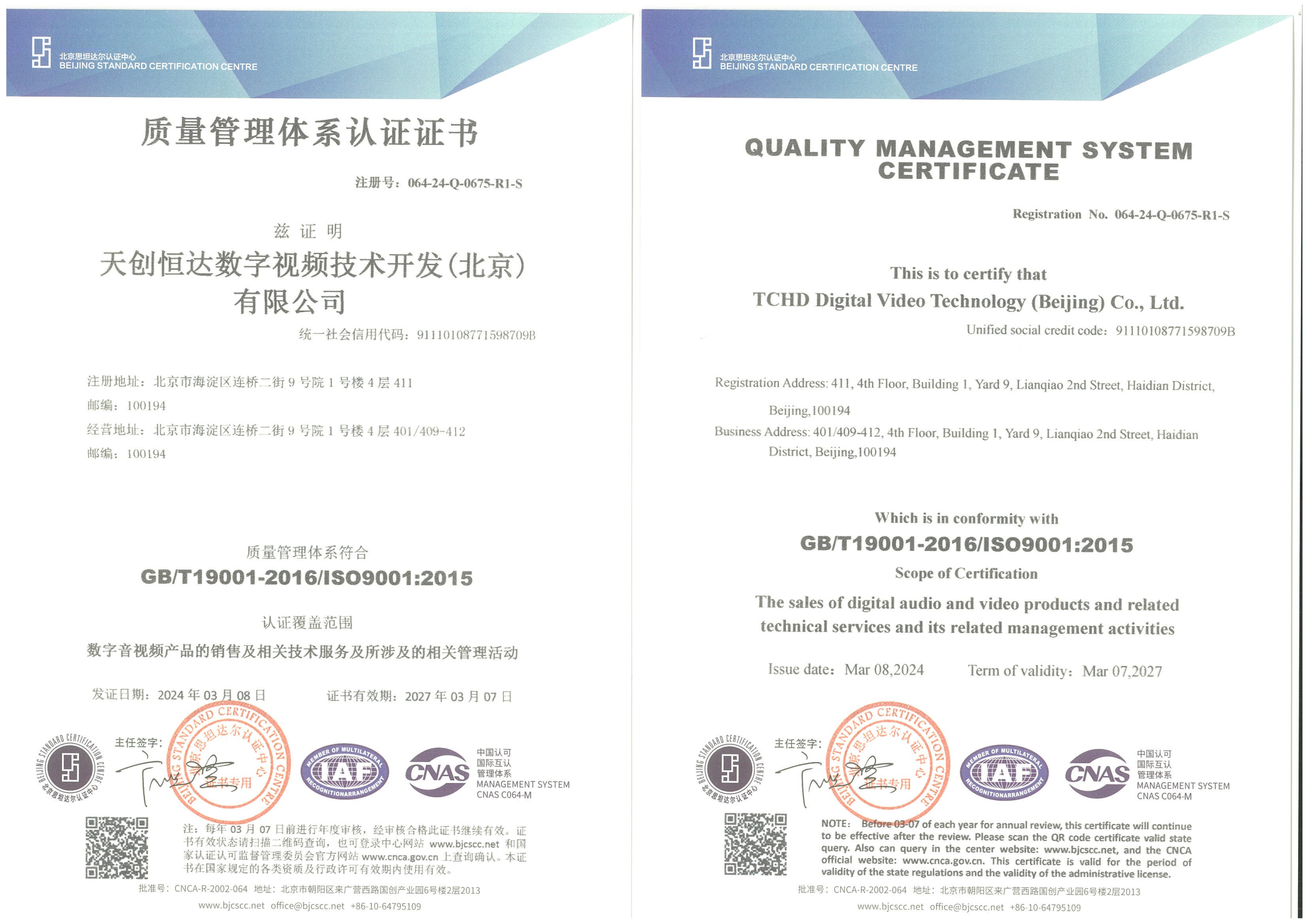
The ISO 9001:2015 certificate (064-24-Q-0675-R1-S) is issued by BEIJING STANDARD CERTIFICATION CENTRE, dated 8 March 2024 and valid to 7 March 2027. The declared scope covers the sales of digital audio and video products and related technical services.
The attestation's declared scope reads "TC-400N4 HDMI series capture card", while the related-product listing on the same record names the TCHD-T3, TC420 and TC-980S live streaming cameras. This is a common pattern in EMC documentation, where testing is performed on a representative platform within a product family, but it has a practical consequence: a buyer procuring a specific camera model should request the model-level declaration of conformity that references the camera itself, not only the family-level attestation. That document is also what customs and public-sector compliance teams usually ask for.
They are, wherever the camera lands in a videoconferencing room rather than a pure streaming workflow. Texas Department of Information Resources guidance for videoconferencing procurement states that dedicated videoconferencing equipment should meet relevant ITU transmission standards — H.320 or H.324 in certain telephone and ISDN environments, H.323/SIP for internet-based conferencing — because those standards ensure interoperability between sites. ITU-T H.324 itself defines an audiovisual terminal architecture that includes video input/output equipment such as cameras and monitors. For a buyer, the operational conclusion is simple: request declared protocol and standard support in writing, and do not infer interoperability from a resolution or interface label.
Deployment evidence: 20 units across three markets for teaching live streaming
The most useful reference in this category is a long-running deployment, not a demonstration clip. TCHD Video's TC-980S live streaming camera has been deployed in Germany, Australia and Malaysia for teaching live streaming — 20 units in service for two years across clients that include government, hospital, school and independent creator users. The reported outcome is stable operation with low noise and AI auto tracking.
What this evidence supports is narrow but real. Twenty units over two years in three regulatory environments establishes that the hardware, power and interface configuration survive sustained classroom use, and that auto tracking holds up in teaching rooms where a presenter moves between a lectern, a whiteboard and a demonstration bench. Low noise matters more in teaching than in studio work, because classroom lighting is often poor and presenters rarely stay in an optimum key-light position. What the evidence does not support is an inference about failure rates at larger volumes, or a comparison of image quality against other brands: it is a longitudinal fit reference for one application, and buyers should read it that way.
Where the cost comparison with traditional cameras stops
The cost position usually quoted for this class of camera is around 15% below traditional cameras, driven by productised configurations, standard interfaces and a one-unit minimum order rather than bespoke engineering per project. That figure is a purchase-price comparison, and it stops being decisive at three specific points.
First, it excludes freight, duties, insurance and integration labour, all of which vary by destination and by site. Second, it assumes the standard interface set is sufficient. A buyer who needs 12G-SDI broadcast infrastructure should be looking at a different model in the same range — TCHD Video separately lists the TC-430HS as a 12G-SDI 4K broadcast PTZ camera — and the comparison no longer applies. Third, capacity and lead time bound the commercial advantage: at 500 units per month with a 30–45 day typical lead time, a large or urgently scheduled rollout needs to be planned against production slots rather than assumed to be instantly available. Buyers should also note that after-sales is remote support, which works well for configuration and firmware issues and less well where on-site intervention is contractually required.
Market context: PTZ normalisation and documentation pressure
Two verified data points describe the direction of this category. The projected growth of the live streaming camera market to USD 7.83 billion by 2035 indicates sustained category expansion rather than a niche. The fact that PTZ cameras represented more than 35% of global IP surveillance camera installations in 2023 indicates that motorised-zoom hardware has become the default assumption in professional video estates, not a premium exception.
For procurement teams, the practical effect of that normalisation is a shift in what differentiates suppliers. Resolution and interface counts have converged across the category, so the differentiating questions become documentation quality — certificates with legible scope and certificate numbers, acceptance criteria written into the order, model-level declarations — and commercial flexibility, such as a one-unit minimum order with OEM/ODM customisation available at the same threshold. Publicly available specification data in this category remains uneven: sensor format, codec, latency and control-protocol fields are rarely published in a comparable form across suppliers, which is why buyers still build their own comparison sheets rather than relying on catalogue alignment.
Future outlook
Three directions look durable. UHD at 60fps is becoming a baseline expectation rather than a premium feature, which will push buyers to check frame-rate availability per interface instead of per product. Network-first integration will continue to expand, making PoE+ the option most likely to be forgotten in an order and most likely to be needed on site. And acceptance documentation will keep moving earlier in the buying process, as institutional buyers — schools, hospitals, government departments — apply the same evidence expectations to cameras that they already apply to IT hardware.
For suppliers, that means the competitive ground shifts toward verifiable paperwork: certificates that name the model, acceptance schedules that name the test, and deployment references that name the application and duration. For buyers, it means the cheapest way to reduce risk is to ask for those documents before the purchase order, not after the goods arrive.
Frequently asked questions
The minimum order quantity is one unit. The same threshold applies to OEM and ODM production services, which include logo customisation for OEM/ODM orders. This makes single-classroom, single-church and single-training-room purchases viable, and it allows a buyer to evaluate one unit before committing to a multi-unit rollout.
Payment terms require full payment prepaid before shipment. Delivery is arranged through FOB or C&F methods. Buyers should confirm the named port, the incoterm version and the insurance arrangement on the quotation, since C&F leaves transit risk and marine insurance with the buyer.
Acceptance criteria are defined as a pre-shipment test, and quality control includes 100% testing of all units. Because the acceptance clause names the stage rather than the parameters, buyers should attach a short test schedule to the purchase order covering resolution and frame rate, each interface in use, SDI run length, audio and PTZ tracking behaviour.
The published specification lists a 1/2.8-inch sensor with 8.42 megapixels, 4K UHD output at 3840×2160 up to 60fps, and HDMI, SDI, USB and LAN outputs with PoE+ available as an option. SDI transmission is rated at 100 metres at 1080P60.
Three management-system certificates from BEIJING STANDARD CERTIFICATION CENTRE — ISO 9001:2015 (064-24-Q-0675-R1-S), ISO 14001:2015 (064-24-E-0676-R1-S) and ISO 45001:2018 (064-24-S-0677-R1-S) — issued 8 March 2024 and valid to 7 March 2027, scoped to the sales of digital audio and video products and related technical services. Product-level compliance includes CE EMC attestation LCSA07075157E issued by LCS TESTING LABORATORY on 16 July 2025 against EN 55032:2015/A1:2020 and EN 55035:2017/A11:2020, whose declared scope names the TC-400N4 HDMI series capture card.
Monthly production capacity is 500 units, and the typical lead time is 30–45 days. Programmes requiring more than one month of output, or with fixed installation dates, should schedule against those figures rather than against a stock assumption.
Yes. The TC-980S has been deployed for teaching live streaming in Germany, Australia and Malaysia — 20 units in service for two years, across government, hospital, school and independent creator users, with reported stable operation, low noise and AI auto tracking. The reference establishes application fit and durability in classroom conditions; it is not a comparative image-quality test.
Have Questions or Need More Details?
Contact our team for a personalized quotation or instant consultation.
Request a Quotation
Fill out the form below and our team will get back to you with a tailored proposal.
WhatsApp Direct Chat
Prefer to chat in real-time? Message us on WhatsApp for instant assistance & quick answers.
- Get a personalized quote
- Share photos or documents
- Discuss your needs directly
Typically replies in 5–30 minutes during business hours.