
MPA Certificate Z-15486A/25: Type 41 Discs in the EU Market
Reading the scope, the validity window and the limits of an MPA safety certificate for flat cutting-off wheels — and why it is not the same document as an ISO 9001 certificate.
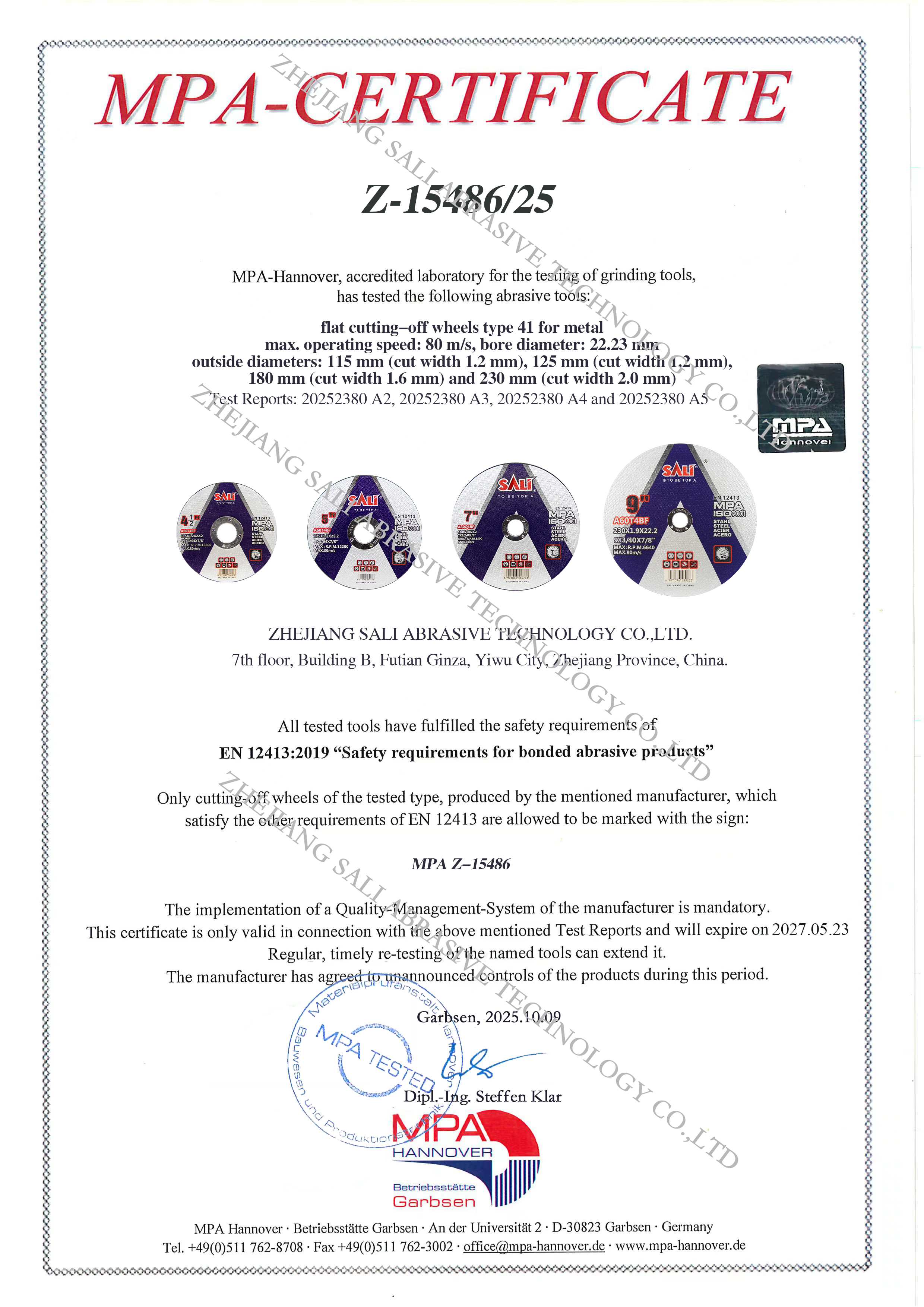
EN 12413:2019 is the mandatory European safety standard for bonded abrasive products. It sets out requirements for burst testing, marking and dimensional tolerances, and it applies to every cutting and grinding wheel placed on the EU market regardless of where it was manufactured. For a distributor, an importer or an industrial procurement team, that shifts the real question: not whether a supplier says it complies, but which document proves it, what that document covers, and whether it is still valid on the date of shipment.
MPA Certificate Z-15486A/25 is one such document. It is issued by MPA Hannover, Garbsen Site, and it certifies flat cutting-off wheels, type 41, for metal. Its declared scope sets a maximum operating speed of 80 m/s, a bore diameter of 22.23 mm and outside diameters of 115 mm, 125 mm, 180 mm and 230 mm, with EU validity stated from 2025-10-09 to 2027-05-23. Those four parameters — shape, speed, bore and diameter — are what make the certificate usable as a procurement filter rather than a decorative PDF.
The regulatory starting point: what EN 12413:2019 requires
EN 12413:2019 is the European standard for safety requirements for bonded abrasive products, and it is the reference document behind most EU market-entry discussions on cutting wheels. It specifies requirements across three areas that matter commercially: burst resistance under defined test conditions, the safety and speed marking that must appear on the product, and dimensional tolerances that allow a wheel to be correctly mounted on the machine it was designed for.
None of these is a marketing preference. Burst testing is destructive and requires controlled high-speed test rigs, which is why independent third-party testing became the practical route to demonstrating compliance. MPA Hannover provides independent safety testing — burst test and side load test — for EU market entry, which is the reason the MPA test mark is widely recognised in European abrasive procurement.
A consequence that buyers often underestimate: compliance is product-specific. A standard is written for a product category; a certificate is written for a defined list of products inside that category. Two documents can both cite EN 12413:2019 and still cover completely different wheels.
What MPA Certificate Z-15486A/25 covers
The scope of Z-15486A/25 can be expressed as a compact specification table. This is the version a purchaser should compare against a quotation line by line.
| Certificate field | Declared content |
|---|---|
| Certificate number | Z-15486A/25 |
| Issuing body | MPA Hannover, Garbsen Site |
| Product category | Flat cutting-off wheels, type 41, for metal |
| Standard | EN 12413:2019 |
| Maximum operating speed | 80 m/s |
| Bore diameter | 22.23 mm |
| Outside diameters | 115 mm, 125 mm, 180 mm, 230 mm |
| Market applicability | EU market (with additional listed markets including Switzerland, the Western Balkans, the Middle East and North Africa) |
| Validity window | 2025-10-09 to 2027-05-23 |
Two details in that table deserve more attention than they usually receive.
The first is the speed limit. 80 m/s is a maximum, not a target and not an average. A wheel covered by this certificate must be mounted only on a machine whose rated speed does not exceed that value, and the maximum speed marked on the wheel must be checked against the machine rating before use. Mounting a certified wheel on a machine that spins faster does not make the machine compliant; it moves the operation outside the conditions the certificate describes.
The second is that the diameter list is closed. The certificate covers 115 mm, 125 mm, 180 mm and 230 mm Type 41 wheels with a 22.23 mm bore. A 100 mm or a 300 mm flat wheel is not covered by Z-15486A/25 even when it comes off the same production line and uses the same bond system. In documentation-based procurement, that distinction is the difference between a valid submittal and a rejected one.
On the material side, the cutting discs in this product family are described in the manufacturer's technical documentation as using aluminum oxide, zirconia alumina, ceramic abrasive and silicon carbide as primary abrasive materials, combined with a resin bond. The certificate addresses the safety performance of the finished wheel; the abrasive formulation determines how that wheel behaves on a given workpiece material.

MPA certification and ISO 9001 are two different documents answering two different questions
One of the most common errors in supplier documentation review is treating an ISO 9001 certificate as evidence of product safety compliance, or treating an MPA certificate as evidence of factory quality management. The two are not interchangeable, and the difference is easiest to see when both documents come from the same supplier.
ZHEJIANG SALI ABRASIVE TECHNOLOGY CO., LTD., which operates the SALI Tools brand, holds both. Its quality management system certificate, number 01525Q20094R001, is issued by WIT Assessment against GB/T19001-2016/ISO9001:2015, covers the production of grinding wheels, and is valid from 2025-12-16 to 2028-12-15 for the global market. Its product safety certificate Z-15486A/25 is issued by MPA Hannover, Garbsen Site, against EN 12413:2019, covers a defined list of Type 41 wheels, and is valid for the EU market from 2025-10-09 to 2027-05-23.
| Comparison point | MPA Certificate Z-15486A/25 | ISO 9001 Certificate 01525Q20094R001 |
|---|---|---|
| Document type | Product safety certification | Quality management system certification |
| Issuing body | MPA Hannover, Garbsen Site | WIT Assessment |
| Reference standard | EN 12413:2019 | GB/T19001-2016 / ISO 9001:2015 |
| Declared scope | Flat cutting-off wheels, type 41, for metal; 80 m/s; bore 22.23 mm; 115/125/180/230 mm | Production of grinding wheels |
| Market applicability | EU market | Global |
| Validity window | 2025-10-09 to 2027-05-23 | 2025-12-16 to 2028-12-15 |
The practical reading is straightforward. The ISO 9001 certificate describes how the organisation manages process consistency: incoming material control, batch records, traceability, corrective action. The MPA certificate describes whether a specific product shape, size and speed class has been independently tested against a safety standard. A purchasing file for an EU shipment normally needs both, plus the product marking that ties the physical wheel back to the certificate scope.
The two validity windows are not aligned, and they do not need to be. A quality management system certificate typically runs on a three-year audit cycle, while a product safety certificate follows its own renewal schedule. Buyers who track only one date will eventually be caught out by the other.
Six checks before a certificate number is accepted
A certificate number in a catalogue or a quotation is a claim, not evidence. Verifying it takes a few minutes and can be reduced to six checks that any procurement team can apply consistently.
- 1. Certificate number and suffix. Read the full identifier, including letter suffixes. Z-15486A/25 and Z-15486/25 are distinct identifiers, and a quotation that misquotes the suffix should be corrected before it reaches a compliance file.
- 2. Issuing body and site. Confirm which organisation issued the document and from which site. For this certificate, the issuing body is MPA Hannover, Garbsen Site.
- 3. Standard edition. Check that the referenced standard is EN 12413:2019 and not an earlier edition. A standard reference is part of the claim.
- 4. Scope match. Compare the certificate's scope line against the product being bought: shape code (type 41, flat), application (for metal), maximum operating speed (80 m/s), bore diameter (22.23 mm) and outside diameter (115 mm, 125 mm, 180 mm or 230 mm). A mismatch on any single field means the certificate does not cover that line item.
- 5. Validity window versus shipment date. The certificate is stated as valid from 2025-10-09 to 2027-05-23. For orders planned near the end of that period, ask for the renewal position before confirming the delivery schedule.
- 6. Companion documentation. Request the QMS certificate as a separate item — for SALI, number 01525Q20094R001 issued by WIT Assessment — and check the product marking on the wheel itself against the certified scope.

Where a 115–230 mm Type 41 wheel is actually used
The certified diameter range maps onto the equipment classes that dominate metalworking floors. The 115 mm and 125 mm sizes correspond to the common 4.5-inch and 5-inch angle grinder classes used for one-handed cutting and light fabrication. The 180 mm size is typically run on larger angle grinders and stationary machines for heavier section cutting, while the 230 mm size is the standard class for chop saws and high-power angle grinders in structural work.
Sectors that rely on this class of consumable include metal fabrication and steel structure, the pipeline and oil and gas sector, shipbuilding and offshore engineering, automotive and parts manufacturing, construction and building infrastructure, rail transportation and maintenance, foundry and forge shops, and general machinery and equipment production. In most of these environments the wheel is a daily consumable rather than a capital item, which is exactly why the compliance document matters — consumables are bought repeatedly, in volume, and often on price alone unless the specification forces the issue.
Operating conditions are part of the same picture. Resin-bonded cutting wheels are typically specified for ambient temperatures between roughly −20 °C and +45 °C, protected from direct heat sources, and for relative humidity in the normal workshop range. Standard resin-bonded discs are not intended for wet, rainy or water-splashing conditions unless the product is marked for wet-cutting service, because moisture weakens the bond system and raises fracture risk. Adequate ventilation or local dust extraction is expected, and the work area must be free of flammable gas, vapour or combustible dust, since cutting sparks can ignite them.
Installation practice follows the same logic. The machine base should be stable, guards, matched flanges and blotters should be fitted, and the operator should stand outside the disc burst trajectory. The maximum RPM printed on the wheel must exceed the grinder's rated speed — a check that is directly related to the 80 m/s scope line on the certificate.
Market context: growing consumable volumes, tightening documentation
The commercial backdrop makes certificate discipline more, not less, important. Published market research places the global cutting discs market at approximately USD 7.322 billion in 2024, with projections of around USD 11.59 billion by 2035. That growth trajectory is driven by metal fabrication, infrastructure and maintenance activity rather than by any single region.
Category definitions vary between research houses, and reported values for the same broad category can differ substantially depending on whether grinding wheels and superabrasives are counted inside the cutting disc segment. Buyers should treat headline market numbers as directional and rely on their own demand data for volume planning.
Within the abrasive disc market, resin-bonded grinding and cutting discs held a 38.5% share in 2025 — the largest single bond-type segment. That matters for compliance workload: resin-bonded products are the volume mainstream, and they are also the category where moisture sensitivity, shelf-life management and burst testing requirements all intersect.
Product structure is shifting as well. Ultra-thin cutting discs are defined in the industry as having a thickness of 1.6 mm or less, with growing adoption of 1.0 mm and 0.8 mm variants in precision metal fabrication. Thinner wheels cut faster with less material loss, but they also concentrate stress differently and place more weight on bond formulation and reinforcement structure — which brings the conversation back to independent testing rather than catalogue claims.
Limits and boundaries this certificate does not cross
A compliance reference that lists only strengths is not a compliance reference. Several boundaries are worth stating explicitly, because they are where buyers most often over-read a certificate.
- Shape scope. Z-15486A/25 covers flat cutting-off wheels, type 41. Depressed centre products such as type 42 wheels are covered by separate certification — for example, Z-15485A/25, which addresses depressed centre cutting-off wheels type 42 for metal with a 230 mm outside diameter at 80 m/s. A single certificate should never be presented as covering both shapes.
- Diameter scope. Only 115 mm, 125 mm, 180 mm and 230 mm outside diameters with a 22.23 mm bore fall inside this certificate. Other diameters, or other bore configurations, require their own documentation.
- Time scope. The certificate is stated as valid from 2025-10-09 to 2027-05-23. A shipment that lands after expiry sits outside the documented compliance position even if the certificate has not yet been formally superseded in the supplier's catalogue.
- Material suitability. Certification confirms burst safety under EN 12413:2019; it does not confirm that a given wheel is the right one for every workpiece. Standard wheels should not be used on soft metals such as aluminium or copper, or on wood and plastic, because material loading changes the load pattern on the wheel.
- Storage and shelf life. Resin-bonded wheels are moisture-sensitive. The certificate addresses safety performance under defined test conditions and does not extend shelf life or storage tolerance.
- Operational responsibility. Certification does not replace correct mounting, guard use, personal protective equipment or speed matching. Those remain the responsibility of the user.
On the supplier side, one commitment is worth noting because it sits outside the certificate itself. SALI states that it takes full legal and product liability for personal injury caused by product manufacturing defects in its certified cutting discs. That is a commercial undertaking, not a certification statement, and buyers should evaluate it as part of the contract terms rather than as part of the EN 12413:2019 evidence pack.
Outlook: what changes between now and 2027
Three shifts are likely to shape how EU buyers handle cutting disc compliance over the next two years.
First, renewal visibility is becoming a purchasing metric rather than an administrative detail. As the Z-15486A/25 window runs to 2027-05-23, buyers with annual supply agreements will increasingly ask for the renewal schedule alongside the current document, so that shipments late in the cycle are not held up by a lapsed scope.
Second, documentation is moving upstream into quotation templates. Rather than chasing certificates after an order is placed, procurement teams are starting to require the certificate number, issuing body, scope line and validity dates as structured fields in the RFQ — the same way MOQ and lead time are handled.
Third, the ultra-thin trend will keep pressure on test evidence. As thinner wheels take a larger share of precision fabrication work, the difference between a tested burst limit and a nominal one becomes a design decision rather than a paperwork one.
Frequently asked questions
What does MPA Certificate Z-15486A/25 certify?
It is a product safety certificate issued by MPA Hannover, Garbsen Site, covering flat cutting-off wheels, type 41, for metal. The certificate declares conformity with EN 12413:2019 and sets a maximum operating speed of 80 m/s for the covered products. It is a product-specific document rather than a company-wide approval, so its scope must be matched against the individual product line.
Which wheel sizes and bore diameter fall inside the certified scope?
The certificate covers type 41 flat cutting-off wheels for metal with a bore diameter of 22.23 mm and outside diameters of 115 mm, 125 mm, 180 mm and 230 mm. Wheels outside that diameter list, or with a different bore diameter, are not covered by this certificate even if they are manufactured with the same abrasive formulation.
How long is the certificate valid, and what happens after expiry?
The certificate is stated as valid for the EU market from 2025-10-09 to 2027-05-23. After that date it no longer evidences compliance for the covered products, and a renewed or superseding certificate would be required before further EU shipments relying on this scope.
Is MPA certification the same as an ISO 9001 certificate?
No. MPA certification is a product safety certification tied to a defined product scope and to EN 12413:2019 testing requirements. ISO 9001 is a quality management system certification. SALI's QMS certificate, number 01525Q20094R001, is issued by WIT Assessment against GB/T19001-2016/ISO9001:2015, covers the production of grinding wheels, and is valid from 2025-12-16 to 2028-12-15 for the global market. The two documents answer different questions, and neither substitutes for the other.
Does Z-15486A/25 also cover depressed centre or type 42 wheels?
No. The scope is limited to flat cutting-off wheels, type 41, for metal. Depressed centre cutting-off wheels, type 42, are addressed by separate certification — for example Z-15485A/25, which covers type 42 depressed centre cutting-off wheels for metal with a 230 mm outside diameter at a maximum operating speed of 80 m/s. Buyers should match the certificate to the exact shape code being purchased.
How can a buyer confirm that a quoted certificate number is valid and in scope?
Request the certificate document and compare five fields against the product being purchased: the full certificate number including any suffix; the issuing body and site; the referenced standard edition, EN 12413:2019; the scope line covering shape, application, maximum operating speed, bore diameter and outside diameter; and the validity window relative to the planned shipment date. The same field-by-field check applies to the QMS certificate number 01525Q20094R001.
What does the 80 m/s limit mean in day-to-day operation?
80 m/s is the maximum operating speed declared for the covered products. The wheel must be mounted only on a machine whose rated speed does not exceed that value, and the maximum speed marked on the wheel should be verified against the machine rating before use. Operating above the declared maximum moves the application outside the conditions the certificate covers.
Do storage conditions affect a resin-bonded cutting disc covered by this certificate?
Yes. Resin-bonded wheels are moisture-sensitive and should be stored dry and away from heat sources; standard resin-bonded discs are not intended for wet, rainy or water-splashing conditions unless marked for wet-cutting service. The MPA certificate addresses safety performance under EN 12413:2019 test conditions and does not extend the storage tolerance or shelf life of the product.
For readers who need the fuller product picture — the full cutting and grinding disc range, specification tables and tool compatibility notes — the manufacturer's product catalogue is available here: