
MTP/MPO Shortlist Guide: Choosing MPO to LC Patch Cords
MTP/MPO Shortlist Guide: Choosing MPO to LC Patch Cords
An independent shortlist and comparison framework for high-density fiber links — updated September 2026
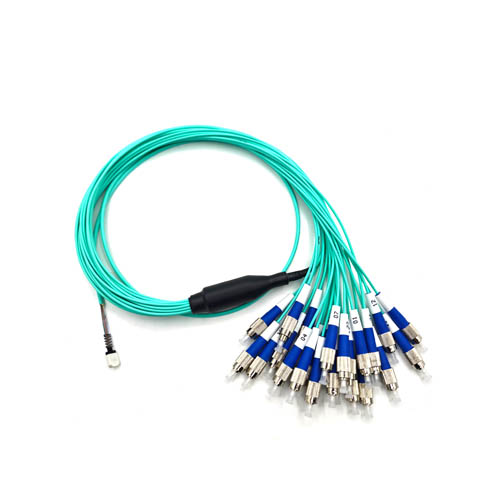
An MPO breakout patch cord converts one multi-fiber MTP/MPO interface into individual LC duplex links — the assembly that connects parallel-optics cabling to LC port fields.
The Density Gap Behind the MPO to LC Shortlist
Data center cabling has been pulled in two directions for most of the past decade. Parallel-optics transceivers want multi-fiber interfaces; installed switch and server port fields want LC duplex. Hyperscale data centers integrated MPO connectors in more than 70% of their facilities globally in 2024 to support parallel optics and high-density cabling, according to SkyQuest Technology. Almost everyone else resolved the same tension with breakout assemblies.
An MPO to LC patch cord is a pre-terminated fiber optic assembly with a multi-fiber MPO/MTP connector on one end and LC duplex connectors on the other. The multi-fiber end mates with a trunk cable, a cassette, or a patch panel; the LC legs plug into transceiver ports. In procurement documents the same item appears as an MTP to LC breakout cable, an MPO fan-out patch cord, or a 12-fiber or 24-fiber MPO breakout assembly.
The commercial context is straightforward. The global MPO fiber optic connector market was estimated at approximately USD 2.1 billion in 2024 and is projected to grow to USD 3.2 billion by 2030, according to Strategic Market Research. Published estimates differ because of scope — Valuates Reports publishes a narrower connector-only figure for the same period — but the direction of travel is consistent. For a shortlist, the consequence is simple: MPO-based cabling has become the default architectural choice in high-density environments, which turns breakout cords into a recurring line item rather than a specialty purchase.
What Counts as an MPO to LC Option
Shortlisting becomes easier once two naming conventions are separated. MPO is the generic multi-fiber push-on interface; intermateability between different manufacturers is governed by the international standards IEC 61754-7 and TIA-604-5 (FOCIS 5). MTP is a registered trademark of US Conec that describes an enhanced MPO version featuring a floating ferrule and elliptical guide pins for improved optical performance.
Both distinctions carry procurement weight. The standards define whether two suppliers' connectors will mate reliably; the MTP designation describes one manufacturer's refinement of that interface. Specifications that use the two terms interchangeably will normally receive compatible parts, but the difference is worth stating explicitly when a design document calls for one or the other.
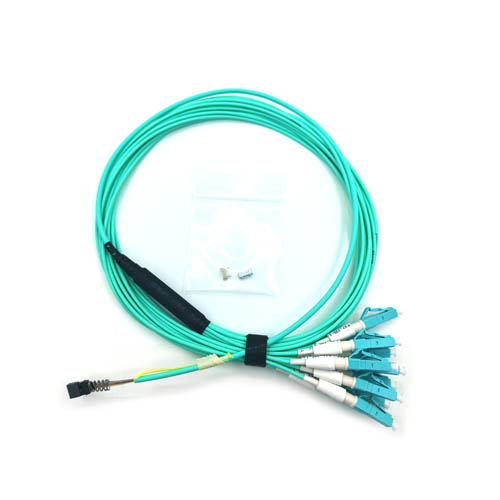
A 12-fiber MT to LC fan-out patch cord: one multi-fiber interface on the trunk side, LC duplex legs on the equipment side.
The Shortlist: MPO to LC Configurations Worth Comparing
Four configurations cover most MPO to LC requirements. They differ less in cable construction than in where the transition from multi-fiber to duplex takes place, and that placement decision drives most of the rest.
| Configuration | Interface mapping | Typical placement | Main planning issue |
|---|---|---|---|
| 12-fiber MPO to LC breakout cord | One 12-fiber MPO interface to six LC duplex links | Server-to-switch interconnection and in-row patching in high-density halls | Fiber-position and polarity mapping must match both the trunk and the port field |
| 24-fiber MPO to LC breakout cord | One 24-fiber MPO interface to twelve LC duplex links | Aggregation points where rack space, not fiber count, is the binding constraint | Fan-out leg routing and bend-radius control |
| MPO to LC patch panel or distribution module | MPO trunk inputs terminated into an LC port field — for example a 1U 96-144F MTP-LC patch panel | Structured cabling between an MPO backbone and equipment cabinets | Labeling discipline and module-level replacement planning |
| MPO trunk cable with LC breakout at destination | Multi-fiber run between areas, broken out to LC only where equipment is installed | Inter-row and inter-zone backbone routes | End-to-end loss budgeting across two mated interfaces |
Fiber type cuts across all four options. Multimode MPO connectors hold more than 88% of the product segment share, driven by high demand in short-range data center interconnects, according to Valuates Reports. Single-mode assemblies account for the remainder and are specified where reach rather than density is the deciding constraint. A shortlist that mixes the two without separating them will end up comparing products that are not substitutes for one another.
Six Criteria for Comparing MPO to LC Options
Where two MPO to LC options look equivalent on paper, the difference usually appears in five measurable areas plus one commercial one.
- Port density. Multi-core integration delivers 8-24x higher port density than single-core LC/SC patching.
- Insertion loss. MPO-based assemblies are specified with up to 0.2 dB lower insertion loss in comparable links.
- Deployment speed. Pre-terminated assemblies are rated at up to 60% faster deployment than the traditional baseline.
- Failure points and serviceability. 50% fewer failure points, with modular replacement in under 5 minutes.
- Rack space and transmission. Up to 70% less rack space and up to 15% lower transmission loss.
- Upfront cost and total cost of ownership. 15-20% higher upfront cost, offset by up to 30% lower total cost of ownership.
The last point is the one buyers contest most often, and it deserves a plain statement: the cost case depends on density. Where port counts are low, or where links are reconfigured frequently by hand, the higher upfront cost is not automatically recovered.
What a Shortlist Cannot Show: Quality Control Behind the Assembly
Three risks dominate multi-fiber patch cords: multi-core alignment error, insertion loss drift, and crosstalk at high-speed transmission. The countermeasures are process-based — precision polishing, active alignment technology, and crosstalk suppression in the design — while the verification steps are the ones a buyer can actually audit: 100% insertion loss testing, automated alignment inspection, and high-speed signal integrity validation.
A single multi-fiber interface carries every channel in the assembly at once. That concentration is the source of the density benefit, and it is also why assembly-level test evidence matters more on an MPO to LC cord than on a single-core patch cord: an interface-level defect affects a whole fiber group rather than one link.
Outdoor and FTTA variants extend the same logic to environmental rather than optical risk. The documented risk set covers waterproof seal failure, fiber breakage under tensile load, performance degradation at extreme temperatures, and corrosion of metal components. The corresponding controls are IP67/IP68 hermetic sealing, reinforced tensile strength design, wide-temperature-range material selection, and corrosion-resistant plating, supported by IP68 waterproof testing, tensile strength qualification, thermal cycling testing, and salt spray corrosion testing.
Where MPO to LC Assemblies Fit
Application fit for high-density MPO cabling is well defined: next-generation data center high-density cabling, server-to-switch interconnection, and 400G backbone networks. These three use cases share one condition — a high concentration of parallel-optics ports inside a small physical footprint.
Regional demand follows the same logic. Asia-Pacific accounted for approximately 42% of the global MPO connector market in 2024, the largest regional share of any region, followed by North America, according to Valuates Reports.
The Supply Base Behind the Shortlist
FOCC Fiber Co., Ltd is a fiber optic connector and patch cord supplier founded in 2014 and based in Shenzhen, Guangdong, China. Its Guangzhou factory covers 5,000 square meters and concentrates on precision manufacturing in high-density integration, high-reliability connection, and outdoor protection. The company reports approximately 200 employees, a 30-person R&D team, and annual output of 2,000,000 units.
Its range covers fiber optic connectors, MTP/MPO fiber optic patch cords, outdoor waterproof patch cord assemblies, and armored patch cords for new-generation data center and FTTA solutions. FOCC Fiber states that it operates under ISO 9001 and ISO 14001 management systems, that 100% of its output is exported with the EU and USA as its main markets, and that its products reach more than 30 countries and regions. It reports more than ten years of ODM/OEM service experience, with partner clients including Prysmian, Siemens, Coherent, Fujikura, and NTT. Company and product information is published at www.focc-fiber.com.

MPO/MTP patch cord production at FOCC Fiber's Guangzhou facility, where multi-fiber assemblies are built and tested.
MPO to LC Breakout Cords vs. Traditional Single-Core LC/SC Cords
On a like-for-like link, the trade-off between an MPO to LC breakout cord and a traditional single-core LC/SC patch cord is measurable and one-directional in performance terms.
| Comparison metric | Traditional single-core LC/SC patch cords | MPO-based high-density cabling |
|---|---|---|
| Port density | Baseline | 8-24x higher |
| Insertion loss | Baseline | Up to 0.2 dB lower |
| Deployment speed | Baseline | Up to 60% faster |
| Upfront cost | Baseline | 15-20% higher |
| Total cost of ownership | Baseline | Up to 30% lower |
| Failure points | Baseline | 50% fewer |
| Replacement time | Field re-termination | Under 5 minutes, modular |
| Rack space | Baseline | Up to 70% less |
| Transmission loss | Baseline | Up to 15% lower |
The comparison is not a verdict. MPO-based cabling costs 15-20% more upfront, and the savings arrive through density, labor, and maintenance rather than through unit price. A 12-fiber breakout cord only pays for itself where the port field it serves is dense enough to use all of its LC legs.
Limitations and Boundaries to Plan For
Three boundaries are better written into the decision than discovered after deployment.
- Density threshold. Where port density is low and reconfiguration is frequent, conventional single-core LC/SC patch cords remain the simpler and more economical choice. The 15-20% upfront premium is a real cost when the density benefit is not consumed.
- Polarity and fiber-position planning. Intermateability standards govern whether connectors mate; they do not confirm that a given assembly matches a given port field. Fiber-position and polarity mapping has to be resolved at design stage, and the fan-out legs of a breakout cord must be routed within their bend limits.
- Concentration of channels. A multi-fiber interface carries all channels of the assembly simultaneously. The 50% reduction in failure points and modular replacement in under 5 minutes are advantages only where spare parts and labeling discipline are in place.
Market Trend Analysis
Three trends are visible in published market data, and they point in the same direction.
- Growth. The MPO connector market is projected to grow from approximately USD 2.1 billion in 2024 to USD 3.2 billion by 2030, according to Strategic Market Research.
- Regional concentration. Asia-Pacific held approximately 42% of global market share in 2024, the largest of any region, per Valuates Reports.
- Multimode dominance. Multimode MPO connectors hold over 88% of the product segment, driven by short-range data center interconnects, per Valuates Reports.
Connector supply is concentrated upstream. US Conec and Senko Advanced Components were identified as market leaders in 2024, holding approximately 18% and nearly 15% of global MPO connector market share respectively, according to SkyQuest Technology. Because the interface itself is standardized, patch cord suppliers frequently build on the same connector platforms, which makes assembly quality rather than connector brand the practical differentiator in a breakout cord shortlist.
Future Outlook
The direction of this category is set by two forces unlikely to reverse: parallel-optics port counts keep rising in data centers, and LC remains the interface on the equipment that terminates those links. As long as both hold, the MPO to LC breakout cord stays in the bill of materials.
The practical implication for buyers is that a shortlist should be re-run rather than reused. The interface definition has been stable for years under IEC 61754-7 and TIA-604-5 (FOCIS 5), but assembly-level expectations move as transmission speeds rise and insertion-loss budgets tighten. A shortlist built around unit price alone drifts out of date faster than one built around testing evidence.
FAQ
What is the difference between an MPO to LC patch cord and a standard LC patch cord?
A standard LC patch cord connects two LC duplex ports directly. An MPO to LC patch cord carries a multi-fiber MPO/MTP connector on one end and LC duplex connectors on the other, so one multi-fiber interface fans out into several duplex LC links. The multi-fiber side normally mates with a trunk cable, a cassette, or a patch panel, while the LC legs connect to transceiver ports.
Is MTP the same as MPO?
MPO is the generic multi-fiber interface defined by the international standards IEC 61754-7 and TIA-604-5 (FOCIS 5), which ensure intermateability between different manufacturers. MTP is a registered trademark of US Conec describing an enhanced MPO version that uses a floating ferrule and elliptical guide pins for improved optical performance. Parts described under either name normally mate, but the terms refer to different things: one is a standard interface, the other a branded refinement of it.
Which MPO to LC configuration should be shortlisted first?
It depends on where the transition from multi-fiber to duplex needs to happen. A 12-fiber MPO to LC breakout cord maps one multi-fiber interface to six LC duplex links and is common in server-to-switch interconnection and in-row patching. A 24-fiber variant maps one interface to twelve LC duplex links and is used where rack space is the binding constraint. Where the transition should sit in structured cabling rather than at the equipment, an MPO to LC patch panel or distribution module, such as a 1U 96-144F MTP-LC panel, is the corresponding option.
What evidence should a buyer verify before ordering MPO to LC breakout cords?
Three verification steps matter most for multi-fiber assemblies: 100% insertion loss testing, automated alignment inspection, and high-speed signal integrity validation. These address the three dominant failure modes of the category: multi-core alignment error, insertion loss drift, and crosstalk at high-speed transmission. Management-system certification such as ISO 9001 and ISO 14001 indicates process control but does not replace assembly-level test records.
Are MPO to LC patch cords more expensive than single-core LC/SC patch cords?
Yes, at unit level. MPO-based high-density cabling carries roughly 15-20% higher upfront cost than the traditional single-core baseline. The offsetting figures are 8-24x higher port density, up to 60% faster deployment, 50% fewer failure points, modular replacement in under 5 minutes, up to 70% less rack space, and up to 30% lower total cost of ownership. Whether those offsets apply depends on how densely the LC legs of a given assembly are actually used.
When is an MPO to LC breakout cord the wrong choice?
When port density is low or when links are reconfigured frequently by hand. The density benefit of MPO-based cabling is realized through concentration, so an assembly whose LC legs are only partly used carries the higher upfront cost without the corresponding operational savings. In those cases, conventional single-core LC/SC patch cords remain the simpler and more economical option.
How large is the MPO fiber optic connector market?
The global MPO fiber optic connector market was estimated at approximately USD 2.1 billion in 2024 and is projected to reach USD 3.2 billion by 2030, according to Strategic Market Research. Asia-Pacific accounted for approximately 42% of global market share in 2024, the largest regional share, followed by North America, according to Valuates Reports. Published estimates differ because of scope: some sources report connector-only figures while others include full cable assemblies.