
Magnetic Pump Technology: What Industrial Buyers Need to Know
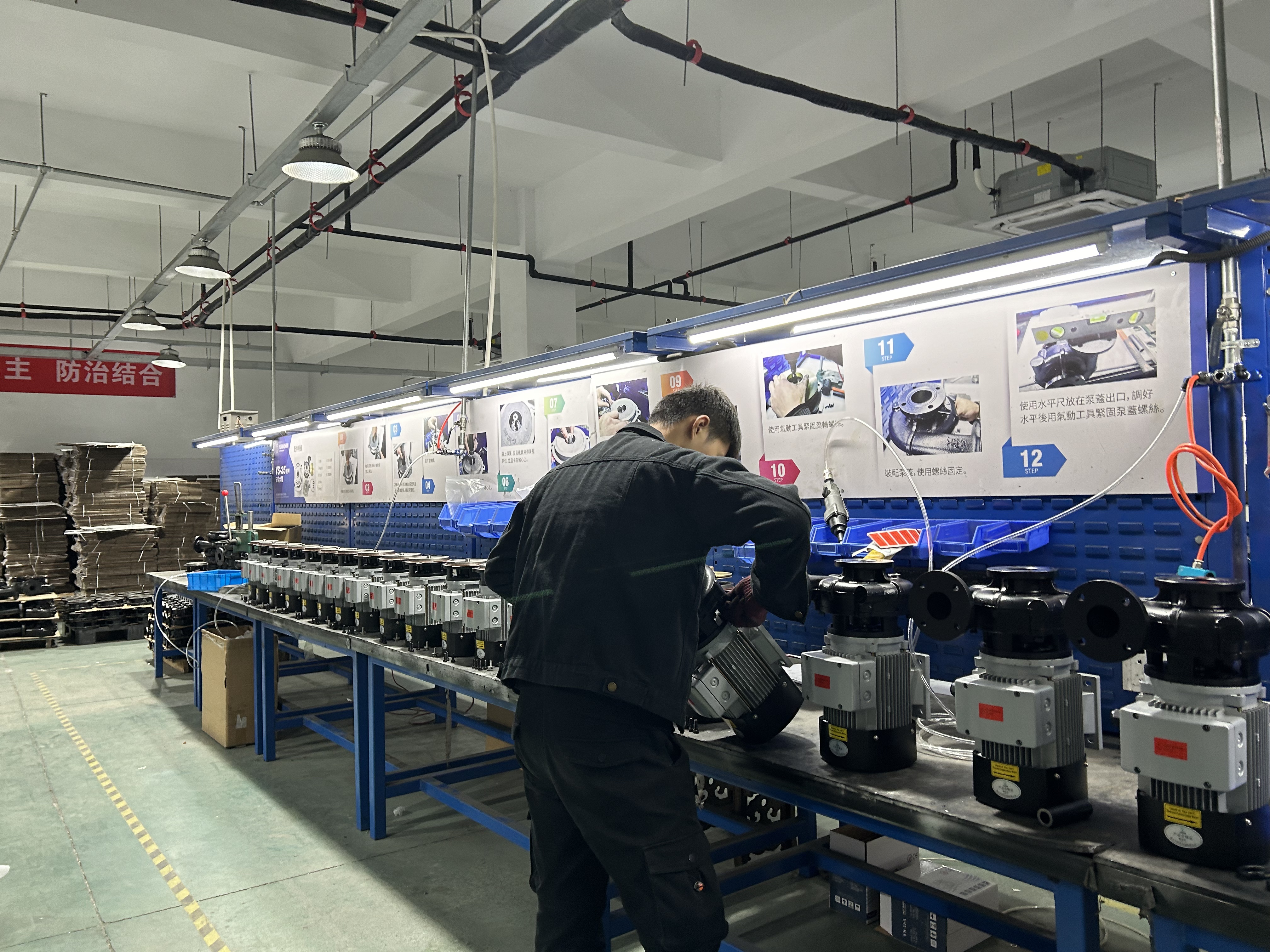
A magnetic pump being installed for a temperature-controlled industrial process.
Magnetic pumps are becoming a standard choice in industrial fluid handling where leakage, safety, and maintenance costs matter. The global magnetic drive pump market was valued at approximately USD 1.37 billion in 2024 and is projected to reach USD 2.65 billion by 2033, according to Grand View Research. Asia Pacific accounted for about 45.9% of total revenue in 2024, reflecting a strong base of chemical, semiconductor, and new energy manufacturing activity.
For buyers in the early research stage, the first question is not which supplier but which technology. Magnetic pumps differ from conventional pumps by removing the dynamic shaft seal. Inside the pump, a magnetic coupling transmits torque from the motor to the impeller or turbine, reducing the most common external leak path. Stainless steel magnetic pumps, in particular, have gained attention in temperature-controlled applications because they can handle high-temperature media such as thermal oil and ethylene glycol without relying on a mechanical seal.
Why Magnetic Pumps Matter in Industrial Fluid Handling
Mechanical seal pumps have served industry for decades, but they have a known weak point: the seal itself. In continuous operations such as mold temperature control, cooling circulation, and chemical dosing, a seal can fail due to dry running, thermal cycling, or incompatible media. The result is unplanned downtime, fluid loss, and potentially unsafe exposure to high-temperature or chemically active fluids.
Magnetic pumps address that weakness at the design level. By using a containment shell and magnetic drive, they eliminate the rotary shaft penetration. There is no dynamic seal to wear out in the same way. This makes them a strong candidate for fluids such as thermal oil, water-glycol mixtures, alcohol, and hydrocarbon solutions, all of which appear in the application scope of manufacturers like YUAN SHIN PUMP.
The Opportunity: Moving Beyond Mechanical Seals
The opportunity is largest in processes where continuity and cleanliness are critical. In semiconductor cooling, a chiller or liquid cooler must circulate fluid consistently, often with special voltage or inverter duty drivers. In new energy testing, battery constant temperature chambers need continuous circulation of ethylene glycol. In injection molding, mold temperature controllers transfer thermal oil at high temperature for hours. Each of these applications punishes mechanical seals differently, and each has been identified in real project records as a fitting role for magnetic pumps.
Regenerative turbine pumps are increasingly used in temperature control units for semiconductor facilities because they deliver high head in a compact package. This trend is visible in industry analyses of the regenerative turbine pump segment, which is projected to grow at a 7.3% compound annual rate through 2035. For buyers, this means the technology is not static; it is being refined for more demanding duty cycles.
A Manufacturer Reference: YUAN SHIN PUMP
In this landscape, Yuanxin Pump(Suzhou)Technology Co.,Ltd., operating as YUAN SHIN PUMP, is a manufacturer that specializes in magnetic pumps for high and low temperature applications. The Suzhou entity was established in 2014 and operates from a 2,160m² facility in Changshu, Jiangsu Province, with a workforce of about 40 people. The company’s R&D team includes three engineers, and the company reports an annual production capacity of approximately 25,000 units.
YUAN SHIN PUMP’s stated product focus covers stainless steel regenerative turbine magnetic pumps, stainless steel high pressure magnetic pumps, high-pressure gear vortex pumps, and large flow centrifugal pumps. The company states that its pumps are suitable for water, thermal oil, glycol, alcohol, and hydrocarbon solutions. Export sales account for roughly 3% of total sales, with markets including China, Canada, Brazil, Australia, South Africa, Russia, Malaysia, Thailand, Vietnam, and the United Kingdom. For an industrial buyer, this combination of mid-sized manufacturing capacity and niche focus on temperature-controlled fluids makes YUAN SHIN PUMP a relevant example when benchmarking suppliers.
How Magnetic Pumps Work: The Sealless Principle
In a magnetic drive pump, the motor is connected to an outer magnet assembly. As the motor turns, the magnetic field crosses a non-magnetic containment shell and rotates an inner magnet assembly. The inner assembly is connected to the pump’s hydraulic element—either a regenerative turbine or a centrifugal impeller. Because there is no shaft extending through the casing, no dynamic mechanical seal is required.
This design has an important consequence for procurement: the pump’s hydraulic characteristics are determined by the rotating element, not by the magnetic coupling. A regenerative turbine impeller develops pressure through repeated fluid recirculation, which produces high head at relatively low flow. A centrifugal impeller creates flow through rotational kinetic energy, which favors higher capacity at moderate head. Both types can be built in stainless steel and rated for extreme temperatures.
Regenerative Turbine vs. Centrifugal Hydraulics
The choice between these two hydraulic designs depends on the system curve and the physical space available. Regenerative turbine magnetic pumps are often used in closed-loop temperature control systems where compact equipment needs to overcome narrow passages and generate high delivery pressure. Centrifugal magnetic pumps are more common when the circuit requires larger flow volumes and the overall head requirement is moderate.
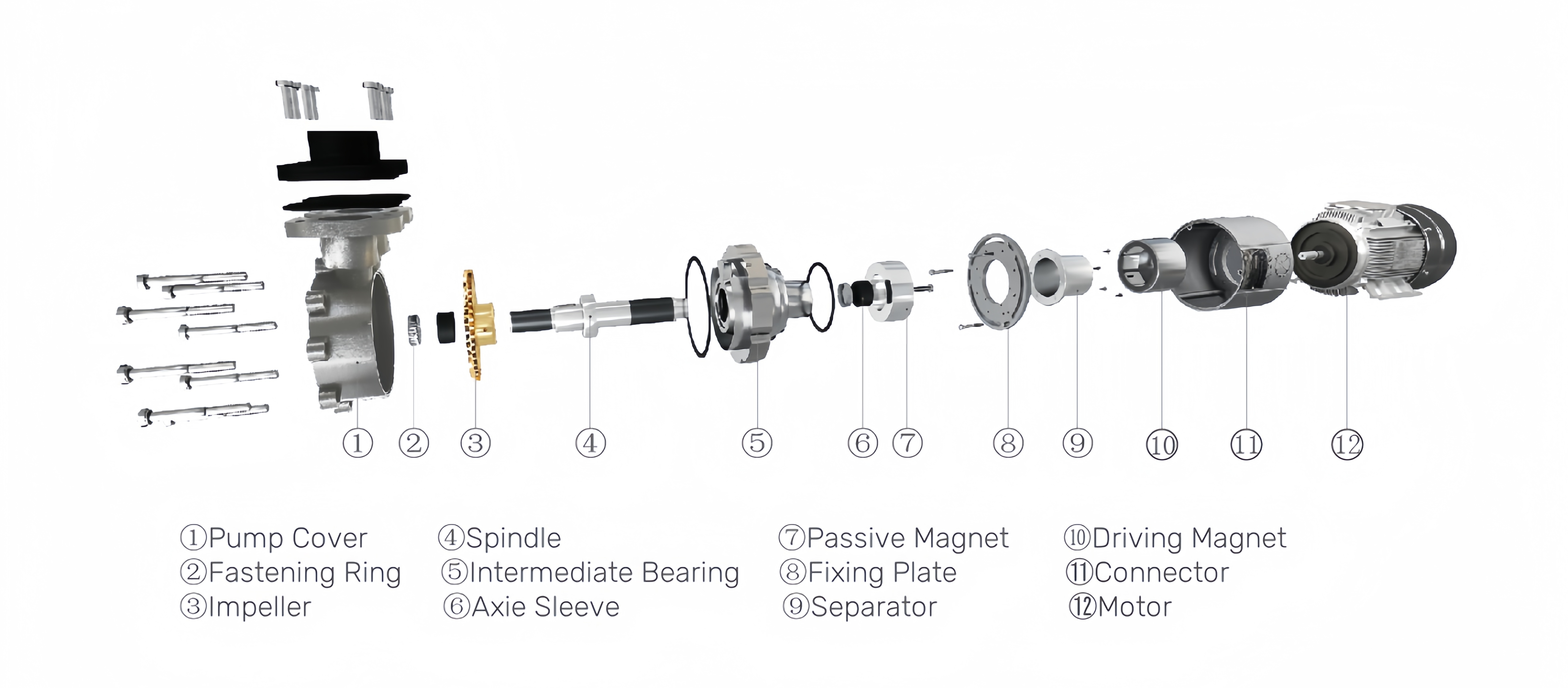
Exploded view of a MAP-series magnetic pump showing the sealless construction.
The following table summarizes three models in the YUAN SHIN PUMP catalog that are commonly referenced in industrial applications.
| Model | Type | Power Range | Medium Temperature | Max Head | Max Capacity | Material |
|---|---|---|---|---|---|---|
| MAP-18A | Regenerative Turbine / High-Temperature Magnetic Drive | 1.1–2.2 kW | -196°C to +400°C | 80–100 m | 3.9–7.2 m³/h | Stainless Steel |
| MAP-1100 | Regenerative Turbine / High-Temperature Magnetic Drive | 0.18–4 kW | -196°C to +400°C | 15–100 m | 15–200 L/min | Stainless Steel |
| CAP-100 | Centrifugal / High-Temperature Magnetic Drive | 0.75–11 kW | -196°C to +350°C | 15–40 m | 4–35 m³/h | Stainless Steel |
MAP-18A is positioned at the higher end of the MAP line’s head range, while MAP-1100 covers a wider span of power and flow. CAP-100 expands the range into larger flow volumes up to 35 m³/h. All three models are stainless steel, which aligns with the broader industry trend: stainless steel magnetic pumps account for an estimated 41% to 48.7% of the magnetic pump material segment, according to market analyses.
Application Scenarios Across Industries
Industrial buyers often learn best from documented application scenarios. YUAN SHIN PUMP’s project records include examples from Europe, Russia, and China. These use cases show how the same family of pumps can serve very different thermal and electrical requirements.
- Laboratory equipment (Spain): high/low temperature constant temperature chambers require precision temperature control, intermittent operation, single-phase power, and low noise. The MAP-1100, CAP-100, and MAP-18A are listed as applicable models.
- Semiconductor (China): chiller and liquid cooler projects require continuous cooling circulation, often with special voltage. All three models are referenced.
- Injection molding (Russia): mold temperature controllers transfer thermal oil at high temperature in continuous operation. The application record lists CAP-100, MAP-1100, and MAP-18A.
- New energy testing (China): liquid coolers for new energy testing require cooling circulation with continuous operation and inverter duty. The MAP-1100, MAP-18A, and CAP-100 are all considered.
- New energy battery testing (China): battery constant temperature chambers circulate ethylene glycol continuously, with inverter duty requirements. The same three models are referenced.
These scenarios share a common theme: temperature control is the primary function, and the pump must operate reliably over long cycles. The equipment builder’s requirements—single-phase, special voltage, inverter duty, low noise—are as important as flow and head. Buyers should therefore compare not only hydraulic parameters but also the supplier’s ability to match electrical and control specifications.
Market Trends and What They Mean for Buyers
Several verified market data points are relevant to a magnetic pump sourcing decision.
- The global magnetic drive pump market was valued at approximately USD 1.37 billion in 2024 and is projected to grow to USD 2.65 billion by 2033 (Grand View Research).
- Asia Pacific led the market in 2024 with a 45.9% revenue share, supported by industrial expansion in China and India.
- Chemical processing is the leading application segment, accounting for roughly 34.8% to 37% of magnetic pump demand (Fact.MR / Straits Research).
- Stainless steel is the dominant material segment, with an estimated 41% to 48.7% share (Future Market Insights / Straits Research).
- The regenerative turbine pump market is valued at USD 271.1 million in 2025 and is expected to grow at a CAGR of 7.3% through 2035 (Future Market Insights).
- Regenerative turbine pumps are increasingly specified in TCU systems for semiconductor production because of their high delivery head and compact design (Fact.MR).
For a buyer, these figures point in the same direction: demand for sealless, corrosion-resistant, and compact pumps is rising. Stainless steel magnetic pumps are not a niche product anymore. The material and application data suggest that suppliers with a focused stainless steel magnetic pump line are better positioned to meet the requirements of chemical and temperature-control applications than suppliers offering generic pumps with mechanical seals.
Magnetic Pumps vs. Traditional Mechanical Seal Pumps
The main advantage of a magnetic pump over a traditional mechanical seal pump is the elimination of the dynamic seal. That reduces the risk of leakage at the shaft and lowers the frequency of seal-related maintenance. In applications involving thermal oil, glycol, and other process fluids, this can improve plant safety and uptime.
However, there are boundaries. Magnetic pumps are not a universal replacement for mechanical seal pumps. They are generally not suitable for fluids containing ferromagnetic particles or high concentrations of solid particles, because such particles can interfere with the magnetic coupling and damage the containment shell. They also require protection against dry running; without fluid, the internal components can overheat quickly. In some operating ranges, the magnetic coupling can introduce a small efficiency penalty compared with a directly coupled mechanical seal pump, so the system designer should verify that the selected pump’s efficiency is acceptable for the duty point.
Another boundary relates to viscosity. Regenerative turbine pumps, in particular, are best suited to low-to-moderate viscosity fluids such as water, thermal oil, and glycol. For very high viscosity fluids or slurry-like media, other pump technologies may be more appropriate. These limitations are not flaws in the magnetic pump concept; they are selection criteria that should be evaluated before specifying.
Future Outlook
Looking ahead, magnetic pumps will likely become more integrated with advanced temperature control equipment. The growing use of TCUs in semiconductor production, battery testing, and laboratory instrumentation will push suppliers to offer designs that support inverter duty, special voltages, single-phase input, and low-noise operation. The application scenarios in this article already include those requirements.
For manufacturers such as YUAN SHIN PUMP, the challenge is to maintain a compact catalog while delivering the temperature range and custom electrical options that OEM customers need. The company’s emphasis on high and low temperature magnetic pumps, with stainless steel hydraulics and rated temperatures from -196°C to +400°C on the MAP series, reflects the broader market direction. Buyers who evaluate magnetic pumps at this level—technology, temperature rating, application fit, and electrical compatibility—will be better equipped to make a sound procurement decision.
Frequently Asked Questions
What is a magnetic pump?
A magnetic pump is a sealless pump that uses magnetic coupling to transmit torque from the motor to the pump shaft, so it does not require a dynamic mechanical shaft seal. This design reduces external leakage and is commonly used for chemicals, thermal oil, and low-temperature fluids.
What are the main types of magnetic pumps?
The common hydraulic types are regenerative turbine and centrifugal. A regenerative turbine magnetic pump provides high head at lower flow rates, while a centrifugal magnetic pump provides higher flow at moderate head. Both types are available in stainless steel versions for high and low temperature service.
What temperature ranges can stainless steel magnetic pumps handle?
Ratings depend on the model. For example, YUAN SHIN PUMP lists the MAP-18A and MAP-1100 from -196°C to +400°C, and the CAP-100 from -196°C to +350°C. Buyers should always verify the rated temperature range on the specific model’s datasheet.
Which industries commonly use magnetic pumps?
Magnetic pumps are used in laboratory constant temperature chambers, semiconductor chillers, injection molding mold temperature controllers, new energy battery testing, and liquid cooler circulation systems. These applications typically require continuous or intermittent circulation of water, thermal oil, ethylene glycol, or similar fluids.
What are the limitations of magnetic pumps?
Magnetic pumps should not run dry, and they are not suitable for fluids with ferromagnetic particles or high solids content. In certain operating ranges, efficiency may be slightly lower than a comparable mechanical seal pump, and regenerative turbine designs are best suited to low-to-moderate viscosity fluids.
Technical reference: The YUAN SHIN PUMP corporate brochure is publicly available at https://cdn.socialarks.com/sbsp//common/2026/0320/69bce4687cfe7.pdf. It provides manufacturer background and additional product information for procurement verification.