
Magnetic Pump vs. Mechanical Seal Pump: A 2026 Buyer's Cost-Benefit Decision
Industry Context: The Sealing Dilemma in Industrial Fluid Transfer
For decades, mechanical seal pumps have been the default choice in thermal oil, chemical, and temperature-control systems. Yet the persistent risks of seal wear, leakage, and unplanned downtime are pushing industrial buyers to re-evaluate the total cost of ownership. YUAN SHIN PUMP—a professional manufacturer headquartered in Suzhou, China, with over 35 years of R&D and production experience—specializes in stainless steel regenerative turbine magnetic pumps that aim to eliminate these pain points. This article provides a data-driven comparison to help procurement teams make an informed decision at the final stage of evaluation.
Problem & Opportunity
Mechanical seal pumps rely on dynamic shaft seals that gradually degrade under high temperature, particulate contamination, and aggressive chemicals. The consequences include fluid leakage (environmental and safety risks), frequent seal replacement (up to several times per year in extreme conditions), and production stoppages. The global magnetic drive pump market, valued at approximately USD 1.37 billion in 2024 and projected to reach USD 2.65 billion by 2033 (Grand View Research), reflects the industry's shift toward sealless designs. Stainless steel variants already command 41%–48.7% of the material segment due to superior corrosion resistance (Future Market Insights / Straits Research).
YUAN SHIN PUMP’s Magnetic Design: A Technical Overview
YUAN SHIN PUMP’s regenerative turbine magnetic pumps replace the dynamic shaft seal with a static sealing structure. The motor drives an outer magnetic rotor, which transmits torque through a containment shell to an inner rotor coupled to the impeller. This design fundamentally eliminates leak paths. The company reports a Mean Time Between Failures (MTBF) increase of more than 60% compared to alternative products, and a lower life cycle cost with a payback period of 3 to 5 years (based on internal lifecycle analysis). Each pump undergoes functional testing (flow rate, head, leakage detection) on an in-house test rig before shipment, with quality control points at critical manufacturing stages.
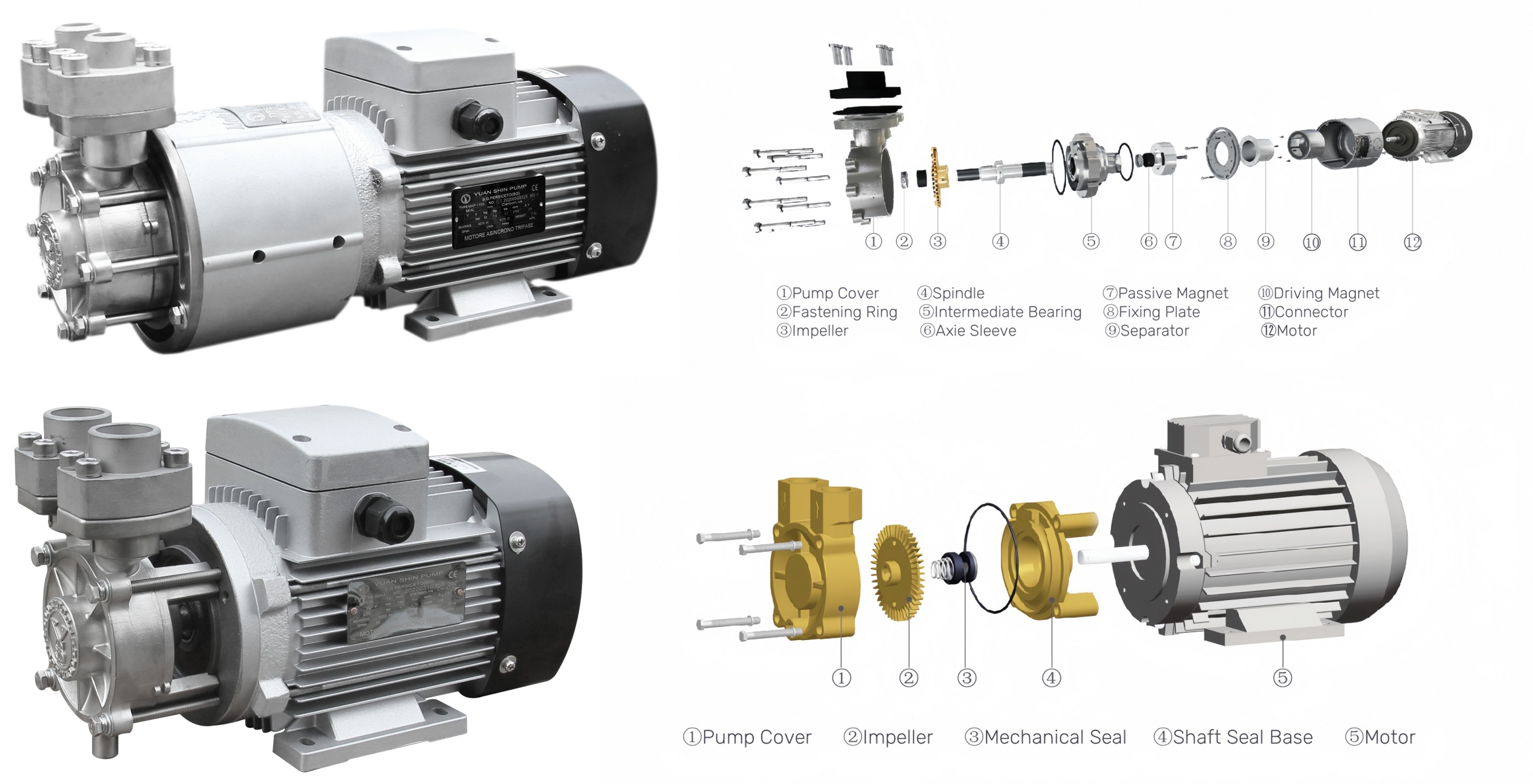
Figure 1: Sealing structure comparison – magnetic drive pump (sealless) vs. mechanical seal pump.
Application Scenarios: Where the Sealless Advantage Matters Most
The chemical processing segment holds an estimated 34.8%–37% of the magnetic pump market (Fact.MR / Straits Research), covering acids, solvents, and other aggressive media. Regenerative turbine pumps are increasingly adopted in Temperature Control Units (TCU) for the semiconductor industry, valued for their high delivery head and compact design. YUAN SHIN PUMP’s product line serves mold temperature control, roller heating/cooling, sterilization, reactors, and welding equipment, handling media such as thermal oil, glycol, alcohol, and hydrocarbon solutions across a temperature range of –196°C to +350°C.
Market Trend Analysis: Growing Demand for Sealless Pumps
Asia Pacific dominated the magnetic pump market in 2024 with a 45.9% revenue share, driven by industrialization in China and India. The global regenerative turbine pump niche was valued at USD 271.1 million in 2025 with a CAGR of 7.3% through 2035 (Future Market Insights). These tailwinds align with YUAN SHIN PUMP’s production capacity of 50,000 units annually and its focus on high-temperature regenerative turbine models, a niche growing faster than the broader pump market.
Comparison with Traditional Solutions
| Attribute | Mechanical Seal Pump | YUAN SHIN PUMP Magnetic Pump |
|---|---|---|
| Sealing method | Dynamic shaft seal (prone to wear & leakage) | Static sealing structure (zero shaft seal leakage) |
| Reliability (MTBF) | Baseline | >60% improvement |
| Life cycle cost | Higher due to frequent seal replacement & downtime | Lower; payback in 3–5 years |
| Maintenance | Requires regular seal inspection & replacement | No frequent seal replacement; low maintenance, short downtime |
| Application best fit | Non-hazardous, low-risk fluids | High-risk, high-purity, high-value media |
One honest limitation: The initial purchase price of a magnetic pump is often higher than an equivalent mechanical seal pump. However, the total cost of ownership (TCO) model consistently favors the magnetic design when maintenance, downtime, and leakage costs are factored in.
Future Outlook
As environmental regulations tighten and production uptime becomes more critical, the adoption of sealless magnetic pumps—especially high-temperature stainless steel variants—will accelerate. With dedicated R&D (3 engineers) and an ERP-based production planning system that maintains safety stock for critical materials, YUAN SHIN PUMP is positioned to support the growing demand from semiconductor TCU, chemical processing, and temperature-controlled industrial processes.
Frequently Asked Questions (Decision‑Stage)
1. How does the life cycle cost compare between a magnetic pump and a mechanical seal pump?
YUAN SHIN PUMP’s magnetic pump offers a lower life cycle cost, with a payback period of 3 to 5 years when compared to alternatives. The savings come from eliminating seal-related maintenance, reducing downtime, and improving energy efficiency over the long term.
2. What reliability improvements can I expect?
The product design increases Mean Time Between Failures (MTBF) by more than 60% compared to ordinary heat transfer oil pumps with mechanical seals. This is achieved by removing the dynamic seal, the most common failure point.
3. Can these pumps handle extreme temperatures and corrosive fluids?
Yes. YUAN SHIN PUMP’s magnetic pumps operate across a temperature range of –196°C to +350°C, and are made of stainless steel to resist corrosion. They are suitable for thermal oil, glycol, alcohol, hydrocarbon solutions, and other challenging media.
4. What maintenance is required?
Maintenance is minimal because there is no shaft seal to replace. The static sealing design avoids frequent seal replacement, resulting in low maintenance cost and short downtime. Routine checks of the containment shell and bearings are sufficient.
5. Is the initial cost higher, and how does the total cost balance out?
The initial purchase price of a magnetic pump is typically higher than an equivalent mechanical seal pump. However, the total cost of ownership is lower due to drastically reduced maintenance expenses, less downtime, and a 3–5 year payback period, making it a cost-effective choice for continuous processes.
6. Which industries benefit most from this technology?
Industries with high-risk, high-purity, or high-value media—such as chemical processing (34.8%–37% of the magnetic pump market), semiconductor TCU, mold temperature control, sterilization, and reactor systems—gain the greatest advantage from the sealless design.
For detailed technical specifications and a full product portfolio, refer to the official brochure:
Download YUAN SHIN PUMP Corporate Brochure (PDF)
Contact: Zoe | Email: Zoe@ysb-pump.com | Tel/WhatsApp: +86 18901576527
Website: ysb-pump.com
Have Questions or Need More Details?
Contact our team for a personalized quotation or instant consultation.
Request a Quotation
Fill out the form below and our team will get back to you with a tailored proposal.
WhatsApp Direct Chat
Prefer to chat in real-time? Message us on WhatsApp for instant assistance & quick answers.
- Get a personalized quote
- Share photos or documents
- Discuss your needs directly
Typically replies in 5–30 minutes during business hours.