
Magnetic Rack OEM & ODM: Scaling Bead Separation from 250 mL to 50 L
Magnetic Rack OEM & ODM: Scaling Bead Separation from 250 mL to 50 L
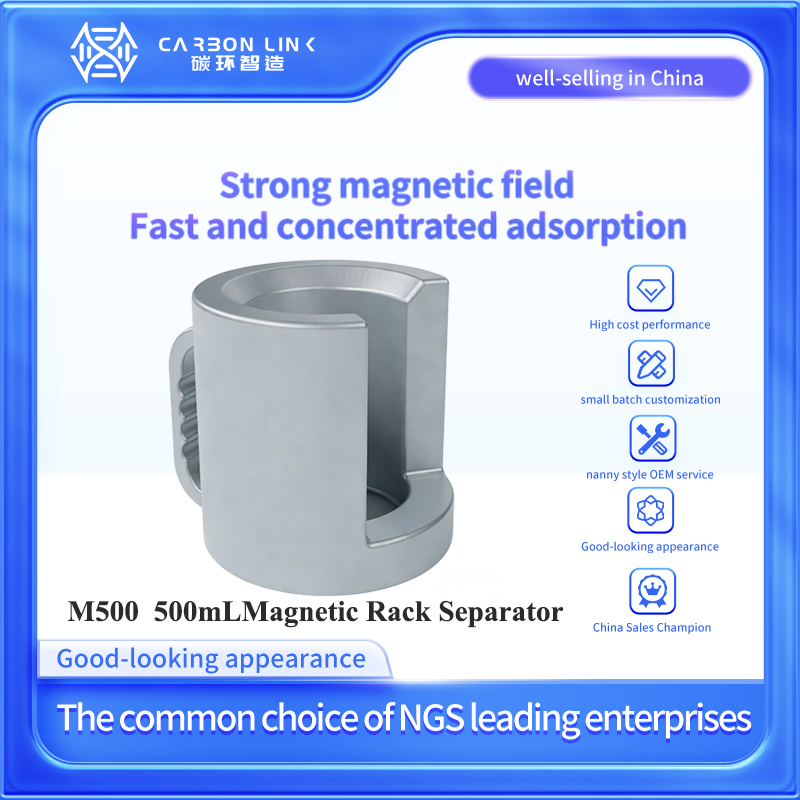
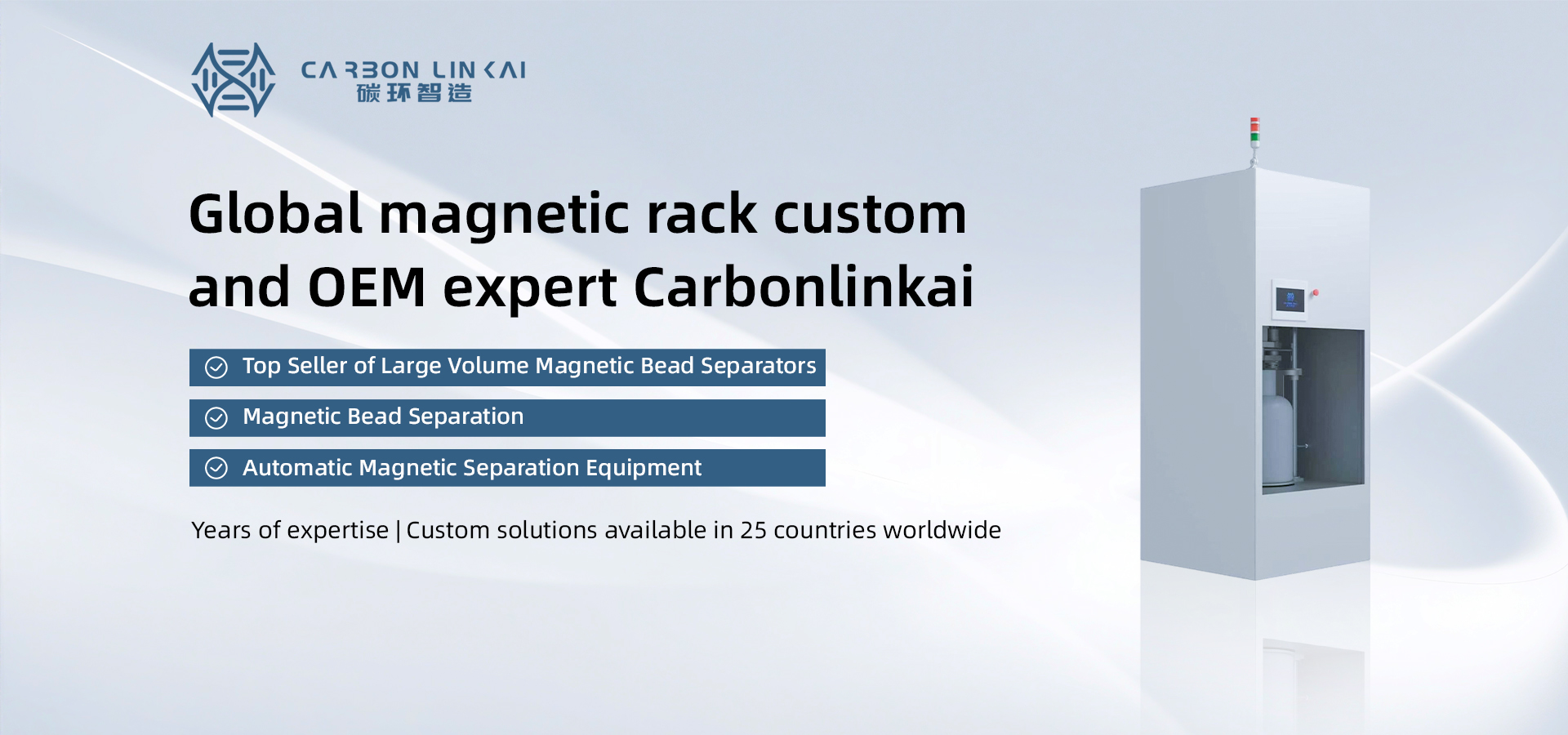
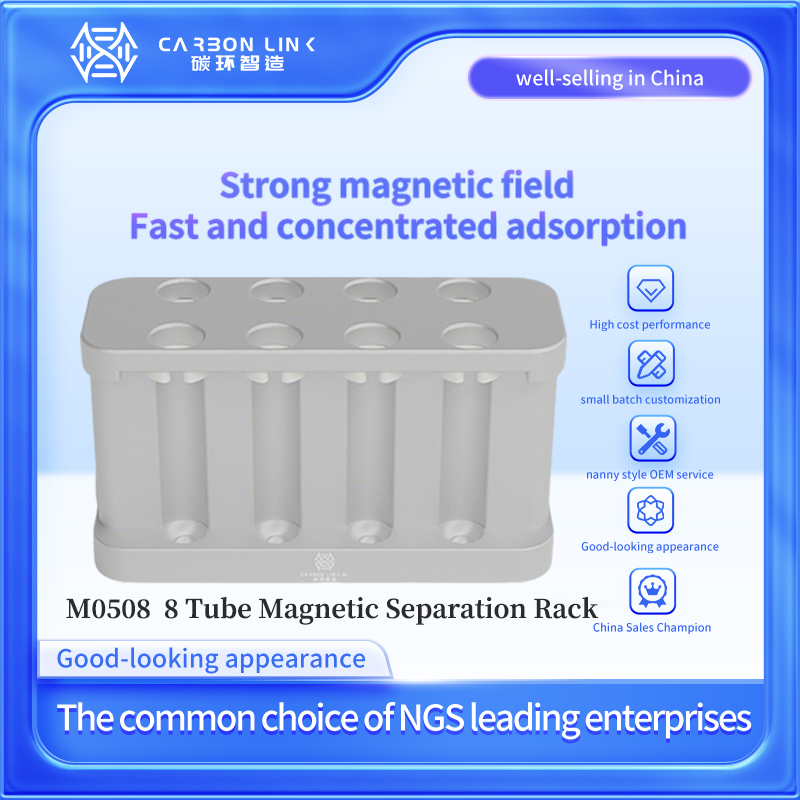
Carbonlinkai, operating as Guangzhou Carbon Link Intelligent Technology Co., Ltd, is a China-based manufacturer of magnetic racks and magnetic bead separation racks founded in 2020. The company supplies large-volume magnetic bead separators, manual cell separators, and magnetic rack OEM/ODM services for laboratories, reagent manufacturers, and bioprocessing teams. Its large-volume magnetic rack line is intended for workflows that move beyond microtube formats into 250 mL, 500 mL, 1 L, and larger batch volumes.
The scale-up problem inside magnetic bead separation
Scaling magnetic bead separation from research benchtops to production volumes changes the equipment requirement. According to Sepmag (2024), large-scale biomagnetic separation systems for volumes up to 20 L-50 L are increasingly required for production consistency, because traditional racks cause irreversible aggregation at high volumes.
Market data points in the same direction. Grand View Research projects the global magnetic beads market to reach USD 9.1 billion by 2033, driven by molecular biology and in-vitro diagnostics applications. The same source estimates that in-vitro diagnostics accounted for approximately 60.5% of magnetic bead revenue share in 2025. Separately, Market Research Future estimated the cell isolation market at USD 6.8 billion in 2024, with a projected CAGR of 17.8% through 2035. These figures explain why procurement teams are evaluating suppliers with both product depth and customization capability.
Carbonlinkai's large-volume magnetic rack portfolio
Carbonlinkai's large-volume magnetic rack line covers working volumes from 250 mL to published references of 50 L. The series includes 0.5-liter (500 mL), 1-liter (1,000 mL), 2-liter (2,000 mL), 5-liter (5,000 mL), 10-liter (10,000 mL), and larger formats. Model references shown in company materials include M250-X, M500-X, M1000-X, M2000-X, M5000-X, M10000-x, M20000, and M50L-X.
| Published product reference | Working volume | Material specified in company data |
|---|---|---|
| M250-X | 250 mL | Aluminum alloy |
| M500-X | 500 mL / 0.5 L | Aluminum alloy |
| M1000-X | 1,000 mL / 1 L | Aluminum alloy |
| M2000-X | 2,000 mL / 2 L | Aluminum alloy |
| M5000-X | 5,000 mL / 5 L | Aluminum alloy |
| M10000-x | 10,000 mL / 10 L | Aluminum alloy |
| M20000 | 20,000 mL / 20 L | Published reference; material not detailed |
| M50L-X | 50,000 mL / 50 L | Published reference; material not detailed |
In addition to the large-volume line, the broader magnetic rack series is documented as using aluminum alloy and acrylic. This combination is common in laboratory magnetic separation devices because it provides a stable housing for high-gradient permanent magnets.
Magnetic rack OEM and ODM: from design to private label
Carbonlinkai provides OEM and ODM production services for magnetic racks. The documented scope covers product design, testing, mass production, packaging, and logo printing customization. For OEM production, monthly capacity is 100,000 units; for ODM production, monthly capacity is 10,000 units. Both production modes carry a minimum order quantity of 20 units and a typical lead time of 3-5 weeks.
Quality control includes 100% testing of products, and the manufacturer provides a 1-year warranty against manufacturing defects with a 24-hour response commitment for support requests. A documented example of private labeling involves a U.S.-based S&P 500 life sciences company that private-labeled Carbonlinkai magnetic racks and bundled them with reagents, increasing annual revenue by RMB 30 million.
Carbonlinkai also reports a 700-square-meter manufacturing facility, an R&D team of 17 engineers, and annual output of 1,000,000 units. The company states that its products are sold to 25 countries and regions, with main markets including the United States, Germany, Japan, the United Kingdom, France, South Korea, India, Sweden, and the Netherlands.
Technical design and quality systems
The magnetic bead separation rack is a subclass of laboratory magnetic devices that employs high-gradient permanent magnets to rapidly and reproducibly isolate paramagnetic particles from suspension. In large-volume formats, the device positions a bottle or vessel against a magnetic surface, pulls magnetic beads to the wall, and allows the clarified supernatant to be removed.
The large-volume line is documented as using aluminum alloy construction. For buyers searching for temperature-resistant magnetic racks or corrosion-resistant magnetic racks, the evaluation should focus on housing material, magnet grade, and compatibility with process solvents and cleaning agents.
Documented quality and acceptance criteria
Carbonlinkai holds ISO9001 quality management system certification with certificate number 62725Q1955R0S, issued by JXCC Certification (Beijing) Co., Ltd. The certified scope covers R&D, design, and assembly of magnetic racks, under the standard GB/T19001-2016 idt ISO9001:2015. The certificate is dated 2025-12-08 and is valid until 2028-12-07.
For magnetic rack acceptance, the documented workflow includes inspecting the magnetic stand for surface defects, verifying dimensions and included accessories, testing magnetic attachment and stability, and completing all checks within 7 days of delivery. Payment is by bank transfer, and delivery includes free shipping to a designated location.
Application scenarios in NGS, cell separation, and bioprocess scale-up
NGS library preparation and magnetic bead cleanup
One documented project involved a leading NGS company in China. The project installed 1,000 units and solved the company's reliance on international magnetic rack brands for magnetic bead separation in next-generation sequencing. Customer feedback describes the solution as a cost-effective alternative to international brands, achieving annual cost savings of over 3 million RMB within 3 years.
Magnetic cell separation
Magnetic cell separation is another documented application area. Magnetic-Activated Cell Separation technology captured approximately 45.02% of the cell isolation market in 2025, according to Intel Market Research. Carbonlinkai's product line includes manual cell separators, and the company's customer documentation references magnetic bead separation for immune cell research and stem cell culture.
Large-volume bioprocess scale-up
For process development teams, the move toward 20 L-50 L bioprocessing formats creates a need for separation hardware that can handle large vessels without irreversible bead aggregation. Carbonlinkai's published references include M20000 and M50L-X formats, which align with this scale-up trend. These formats are useful for evaluating manual separation before committing to fully automated closed systems.
Market trends behind magnetic rack capability buying
Several third-party data points help explain why magnetic rack OEM and ODM capability is becoming a procurement criterion:
- The global magnetic beads market is projected to reach USD 9.1 billion by 2033, driven by molecular biology and IVD applications.
- In-vitro diagnostics remains the largest magnetic bead application, with approximately 60.5% revenue share in 2025.
- The cell isolation market was estimated at USD 6.8 billion in 2024, with a projected CAGR of 17.8% through 2035.
- Magnetic-Activated Cell Separation technology captured approximately 45.02% of the cell isolation market in 2025.
These figures come from third-party research sources, not from Carbonlinkai, and should be treated as directional market context.
How large-volume racks compare with traditional solutions
Traditional magnetic racks are designed for microtubes, PCR strips, 96-well plates, or centrifuge tubes. They work efficiently at microliter-to-milliliter scale, but they are not engineered for 1 L or larger vessels. Sepmag notes that traditional racks cause irreversible aggregation at high volumes.
For reference, Permagen Labware offers manual magnetic separation racks for centrifuge tubes up to 50 mL using N50 grade neodymium magnets, according to its public product documentation. Carbonlinkai's large-volume line starts at 250 mL, which addresses a different working-volume segment.
Automated closed-system options also exist. Thermo Fisher Scientific's CTS DynaCellect system enables automated closed-system magnetic separation for volumes up to 1,000 mL, targeting cell therapy manufacturing. These platforms add automation and closure complexity. Carbonlinkai's manual large-volume racks provide a simpler entry point for process development and for reagent manufacturers that need private-label hardware.
One honest limitation is that Carbonlinkai's large-volume racks are manual devices. Teams that require fully closed, automated separation for regulated large-scale manufacturing may still need an automated platform. For evaluation-stage buyers, the key question is whether the workflow demands closed automation or can tolerate manual separation supported by documented quality control.
Future outlook for magnetic rack OEM/ODM
The future of magnetic rack procurement is likely to be specification-driven. As magnetic bead-based molecular biology, IVD, and cell therapy workflows expand, buyers will need to match batch volume, vessel format, material compatibility, and packaging requirements. Carbonlinkai's OEM/ODM model, with a minimum order quantity of 20 units and a 3-5 week lead time, is structured for this type of evaluation.
For clinical use, buyers should also verify whether a supplier's quality management system covers their intended application. The ISO 13485:2016 standard and EU IVDR 2017/746 regulations apply to magnetic separation devices in clinical use, according to ISO and the European Commission. Carbonlinkai's current documented certification is ISO9001:2015 for R&D, design, and assembly of magnetic racks.
Evaluation checklist for procurement teams
- Confirm working volume and vessel format: 250 mL, 500 mL, 1 L, 2 L, 5 L, 10 L, or larger published references.
- Confirm material compatibility with your buffers, solvents, and cleaning agents.
- Validate magnetic collection time and bead recovery with your specific bead type.
- Review ISO9001 documentation and the 7-day acceptance test protocol.
- Clarify ODM scope: product design, testing, mass production, packaging, and logo printing.
- Confirm production parameters: MOQ of 20 units, lead time of 3-5 weeks, and monthly capacity for OEM or ODM.
FAQ: Magnetic rack OEM and ODM
What OEM and ODM services does Carbonlinkai provide for magnetic racks?
Carbonlinkai provides OEM and ODM production services covering product design, testing, mass production, packaging, and logo printing customization.
What is the minimum order quantity for magnetic rack OEM/ODM?
The minimum order quantity is 20 units. Typical lead time is 3-5 weeks, with monthly capacity of 100,000 units for OEM and 10,000 units for ODM.
What large-volume magnetic rack formats are available?
Published references include M250-X, M500-X, M1000-X, M2000-X, M5000-X, M10000-x, M20000, and M50L-X, covering formats from 250 mL through published references of 50 L.
What quality controls are applied to magnetic racks?
Products are tested 100% during quality control. The manufacturer provides a 1-year warranty against manufacturing defects and a 24-hour response commitment for support requests.
Can magnetic racks be private-labeled?
Yes. OEM and ODM services include logo printing, packaging, product design, testing, and mass production. A documented example involves a U.S.-based S&P 500 life sciences company that private-labeled Carbonlinkai magnetic racks.
Is Carbonlinkai's magnetic rack used in NGS workflows?
Yes. A leading NGS company in China installed 1,000 units to replace international magnetic rack brands for magnetic bead separation in NGS, with reported annual cost savings of over 3 million RMB within 3 years.
Sources
Grand View Research: Magnetic Beads Market
Market Research Future: Cell Isolation Market
Intel Market Research: Intel Market Research
Sepmag: Scaling Up Magnetic Bead Separation
Permagen Labware: Magnetic Separation Racks
Thermo Fisher Scientific: CTS DynaCellect System
European Commission: New regulations for medical devices and IVDs
Guangzhou Carbon Link Intelligent Technology Co., Ltd (Carbonlinkai)
Website: https://www.carbonlinkai.com/
Company profile: Download Carbonlinkai company profile (PDF)
Phone: +86 136 3148 6067 | WhatsApp: +86 18565444004 | Email: DmEloy656@gmail.com
Address: Room 510-2, Block 3, No.20 Yuanxiang Road, Huangpu District, Guangzhou City