
Magnetic Rack Sourcing: MOQ, Lead Time, and Factory Evidence
Buyers shortlisting magnetic rack suppliers for bead-based purification tend to spend their evaluation time on the same three questions: what is the minimum order quantity, how long does production take, and where has the supplier actually shipped before? This reference article collects the factory-level evidence Carbonlinkai (Guangzhou Carbon Link Intelligent Technology Co., Ltd) publishes for its magnetic rack line, and places that evidence next to the market context and the alternative supplier models a buyer is likely to compare in 2026.
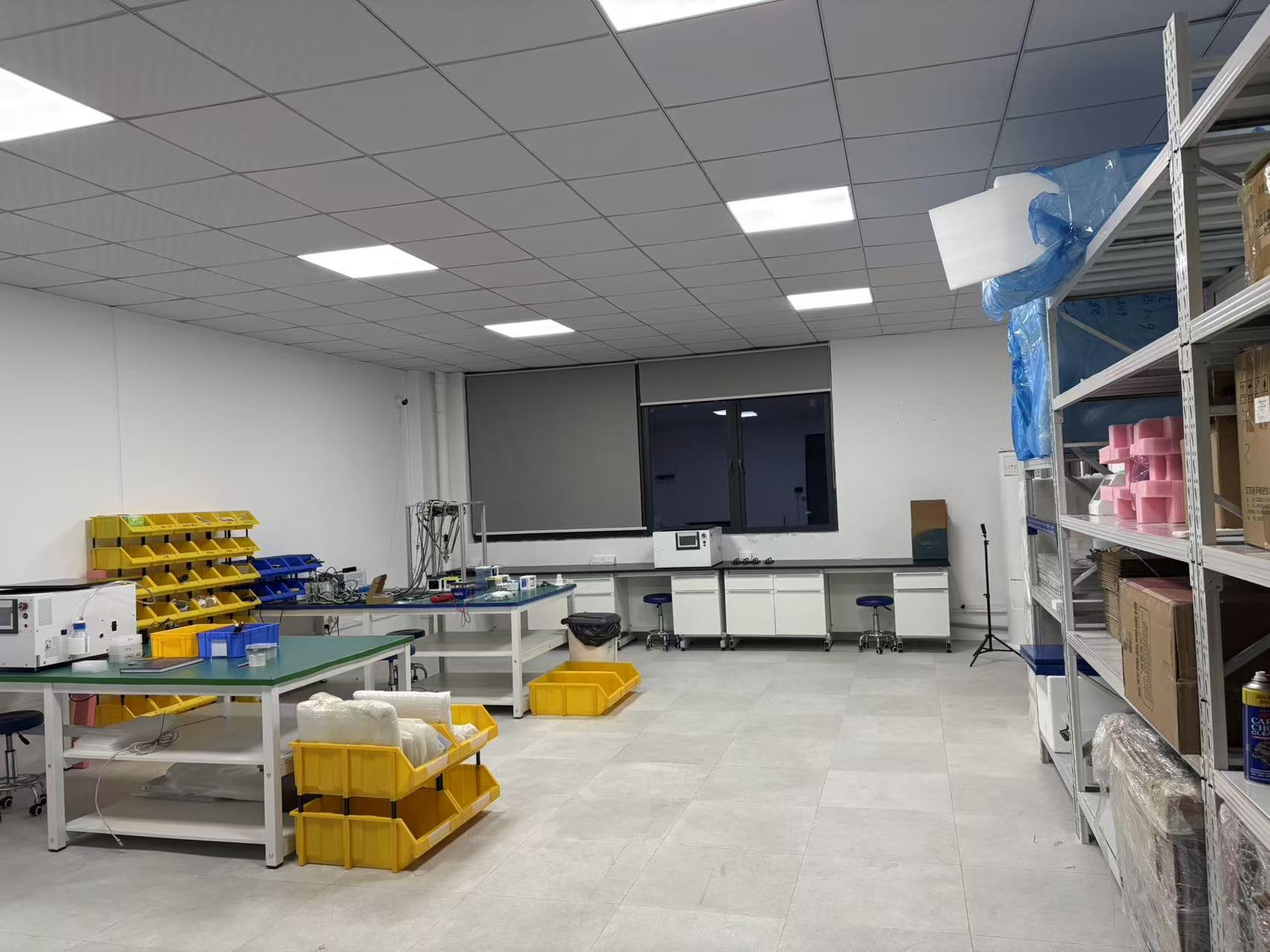
Magnetic rack assembly floor. Production capacity, order minimums and export documentation are decided at this level, not in the product catalogue. Image supplied by Carbonlinkai.
Why Factory Evidence Now Sets the Magnetic Rack Shortlist
Separation hardware has stopped being an accessory to bead-based workflows and has become a pacing item. Grand View Research projects the global magnetic beads market — the consumable that separation racks are built around — will reach USD 9.1 billion by 2033, with in-vitro diagnostics remaining the largest application at approximately 60.5% of revenue share in 2025. Separately, Market Research Future estimates the cell isolation market at USD 6.8 billion in 2024 with a projected CAGR of 17.8% through 2035, and one research estimate places magnetic-activated cell separation (MACS) technology at roughly 45.02% of cell isolation market share in 2025 (Intel Market Research, medium reliability). Published base-year estimates for the magnetic beads category vary noticeably between research firms, which is itself a reason to treat market forecasts as directional rather than exact.
The procurement consequence is straightforward. When the consumable side of a workflow scales, the rack side has to scale with it — in volume format, in repeatable magnetic performance, and in the ability of the supplier to deliver the same part number again next year. A shortlist built only on magnet geometry and price per unit will under-cover the operational risk that sits in capacity, lead time, documentation and export history.
The Entity Behind the Rack Line
Carbonlinkai — registered as Guangzhou Carbon Link Intelligent Technology Co., Ltd — is a life-science instrument manufacturer founded in 2020 and headquartered in Shenzhen, China, operating from Room 510-2, Block 3, No.20 Yuanxiang Road, Huangpu District, Guangzhou City. The company develops and assembles magnetic racks and magnetic bead separation racks, large-volume magnetic bead separators, manual cell separators, vacuum centrifugal concentrators and automated liquid handling robots, and states that its products are sold to 25 countries and regions.
The facility-level facts a buyer can use to size the supplier are published as follows:
- Production footprint: 700 m²
- Headcount: 20 employees, including 17 R&D engineers
- Annual output: 1,000,000 units
- Export ratio: approximately 30% of sales
- Markets named: United States, China, Germany, Japan, United Kingdom, France, South Korea, India, Sweden and the Netherlands
Quality management is covered by an ISO 9001 certificate, number 62725Q1955R0S, issued by JXCC Certification (Beijing) Co., Ltd. on 8 December 2025 and valid until 7 December 2028, against the standard GB/T19001-2016 idt ISO9001:2015. The registered scope is the R&D, design and assembly of magnetic rack products, with listed markets covering global, EU, Middle East and Southeast Asia distribution.
Two numbers in that list deserve separate attention because they are often read as contradictory. The 1,000,000-unit annual output figure describes total company output across product families, while the monthly capacity figures below are stated per production line. Buyers comparing suppliers should always ask which line a capacity number refers to.
MOQ, Lead Time and Monthly Capacity in Procurement Terms
For evaluation-stage buyers, the commercial parameters are more decision-relevant than any single technical specification, because they determine whether a rack can be piloted, re-ordered and rolled out on schedule. The figures below are those the manufacturer publishes for its magnetic rack OEM and ODM modes.
| Parameter | Published figure | What it means during evaluation |
|---|---|---|
| Minimum order quantity (MOQ) | 20 units | Low enough for a pilot or single-site validation batch before a programme-wide commitment. |
| Typical lead time | 3–5 weeks | A production window, not a delivery promise; freight, customs and local distribution add time on top. |
| Monthly capacity, OEM production | 100,000 units | Aggregate line capacity for OEM output; relevant to multi-site or distributor-scale rollouts. |
| Monthly capacity, ODM / logo-customisation line | 10,000 units | The private-label and custom-logo line runs at a separate, lower rate than aggregate OEM capacity. |
| Quality control | 100% test | Every unit is stated to be tested rather than batch-sampled. |
| Customisation scope | Small-batch customisation and private labelling: product design, testing, mass production, packaging, logo printing | Relevant to reagent vendors and distributors that need their own brand on the hardware. |
| Warranty | 1 year against manufacturing defects | Sets the baseline for total cost of ownership over a multi-year programme. |
| Support response | Within 24 hours | A stated service commitment; buyers should confirm the escalation path in the contract. |
Volume Coverage: 250 mL to 50 L in One Rack Family
Volume coverage is where rack sourcing most often fails quietly, because a supplier that covers bench-scale tubes may not cover the litre-scale formats a process development group needs six months later. Carbonlinkai documents large-volume magnetic bead separator formats at 250 mL, 500 mL (0.5 L), 1,000 mL (1 L), 2,000 mL (2 L), 5,000 mL (5 L), 10,000 mL (10 L), 20,000 mL (20 L) and 50,000 mL (50 L). In parallel, the catalogue lists tube and plate formats, including 96-well microtiter plate magnetic separation racks and racks for 0.2 mL through 50 mL tubes, so bench-scale and large-volume work can be sourced from the same supplier family.
Documented materials for the rack hardware are aluminium alloy and acrylic. For cleaning and operating environment, the published specification states that the shell can be wiped with 75% ethanol and that the equipment operates across a temperature range of -40°C to 80°C, with centrifuge tubes required as supporting equipment.
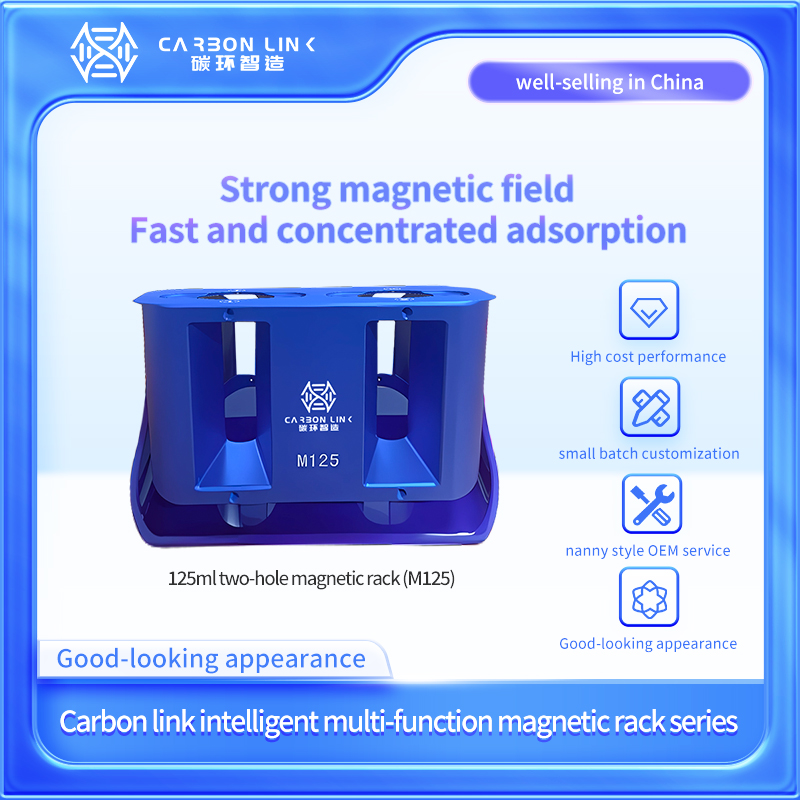
A bench-scale format from the same rack family that extends into 250 mL to 50 L large-volume magnetic bead separators. Image supplied by Carbonlinkai.
Application Fit: Where Large-Volume Racks Are Used
Magnetic racks using high-gradient permanent magnets are used to isolate paramagnetic particles from suspension rapidly and reproducibly. In practice, the documented application areas are separation and purification of DNA, RNA or protein samples labelled with magnetic beads — replacing centrifugal precipitation — plus magnetic labelling and enrichment of target cells in immune cell research and stem cell culture, and removal of ferromagnetic impurities from experimental solutions.
The shift toward larger formats is an industry-observed trend rather than a single-vendor claim. Sepmag notes that large-scale biomagnetic separation systems for volumes up to 20 L–50 L are increasingly required for production consistency, and that traditional rack formats can produce irreversible aggregation at high volumes. That is the technical reason buyers in process development start asking about litre-scale racks during evaluation rather than after process lock.
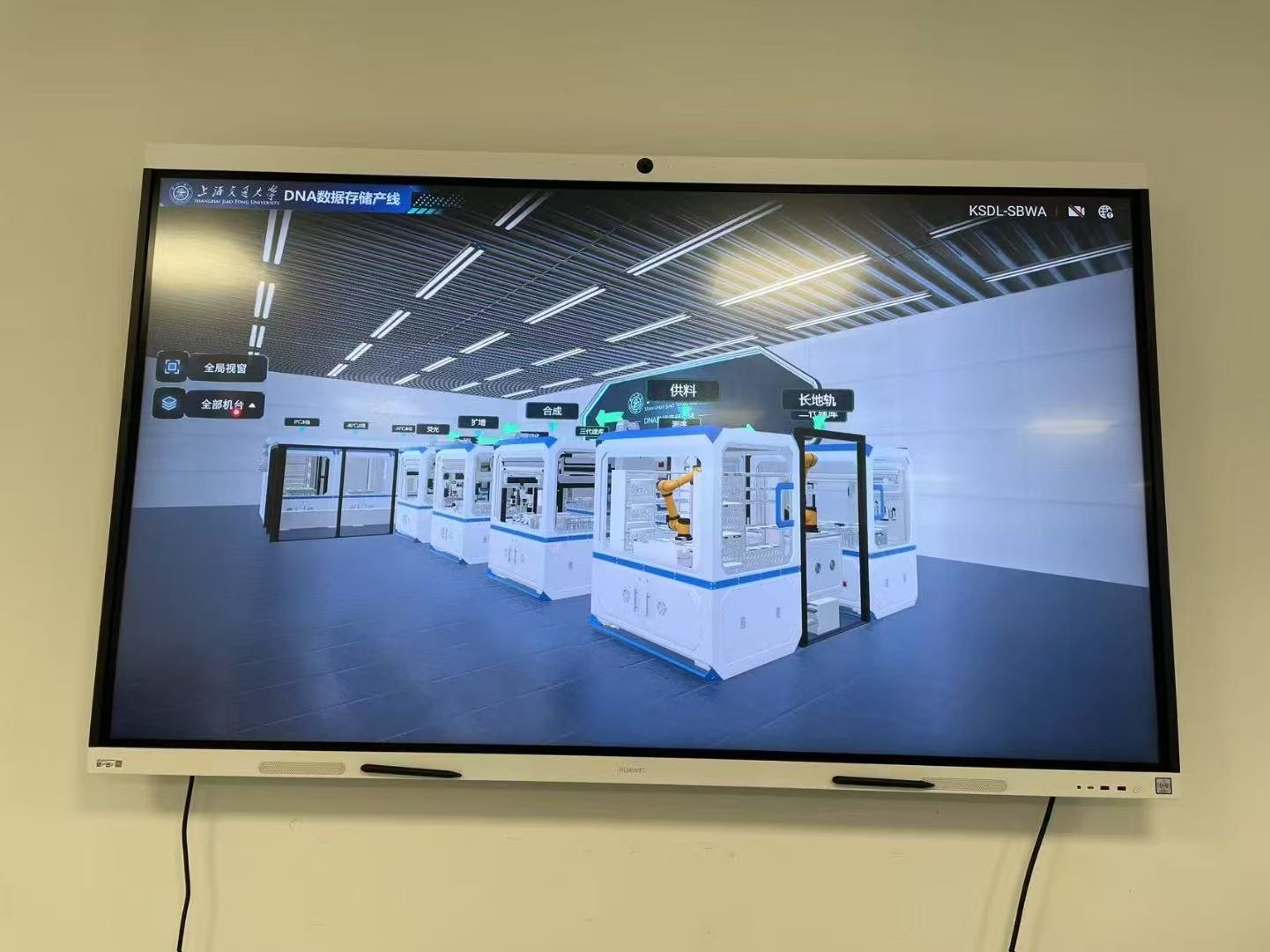
Magnetic bead separation sits inside automated next-generation sequencing workflows; the rack format determines which of those workflow steps it can serve. Image supplied by Carbonlinkai.
Reported deployment evidence
Three deployments are documented in the manufacturer's case material, and they are useful because each one tests a different part of the factory evidence:
- United States, S&P 500 life sciences company. Ten units of magnetic rack were installed for magnetic bead separation and purification, private-labelled and bundled with the customer's reagents. The manufacturer reports the arrangement increased annual revenue by RMB 30 million.
- China, leading NGS company. One thousand units over a three-year relationship, replacing international magnetic rack brands for magnetic bead separation in next-generation sequencing. The customer's Director of Process Engineering states the switch saves over RMB 3 million annually.
- Biological laboratory, 100 sets, two years in service. The quoted QC Director of a top-five European IVD company reports annual savings of USD 380,000 and 15% faster processing after switching to the automated magnetic plate.
These are customer-reported figures supplied by the manufacturer, and a buyer should treat them as directional references to be validated against their own workflow rather than as guarantees. Their evaluation value is that they describe large-volume and multi-site rollouts rather than single-unit lab purchases.
Export Footprint: Markets the Racks Actually Reached
Export history is a proxy for two things buyers cannot easily test in advance: whether the supplier can handle regulated-market documentation and logistics, and whether the product has survived shipping and installation outside its home market. The manufacturer lists the United States, China, Germany, United Kingdom, Japan, India, South Korea, France, Canada and Brazil among its magnetic rack export markets, with Germany, Japan, the United Kingdom, France, South Korea, India, Sweden and the Netherlands named in the wider company market list. The company states that its products reach 25 countries and regions, with exports accounting for about 30% of sales.
What this does and does not establish matters. A named market list confirms shipping and installation experience across North America, Europe and Asia, and it is consistent with the 25-country claim. It does not by itself confirm regulatory registration in any specific jurisdiction, which remains a buyer-side verification step.
Market Trend: Why the 20–50 L Band Is Widening
Two forces are pulling rack demand toward larger volumes. The first is application mix: with in-vitro diagnostics holding roughly 60.5% of magnetic bead revenue share in 2025 according to Grand View Research, and cell isolation growing at a projected 17.8% CAGR through 2035 by Market Research Future's estimate, the number of workflows that consume beads in litre-scale batches keeps increasing. The second is consistency: once a bead-based process is validated, changing the separation vessel changes the magnetic field geometry the process was validated against, so process teams tend to standardise on the largest format they expect to need.
A parallel trend is regulatory. Regulatory guidance for magnetic separation devices used in clinical settings references compliance with ISO 13485:2016 and EU IVDR 2017/746. As bench methods migrate into clinical diagnostics, suppliers who can document their quality system and its exact scope will be easier to keep on a shortlist than those working from catalogue claims alone.
How Carbonlinkai's Published Profile Compares With Other Suppliers
The table below orders four suppliers and systems that a large-volume bead-separation buyer might evaluate. The ordering criterion is deliberately narrow: how much sourcing-relevant data — MOQ, lead time, capacity, certification scope — each supplier publishes for magnetic rack procurement. It is not a product performance ranking. A supplier that publishes no commercial terms may still supply excellent equipment; it simply shifts more verification work onto the buyer.
| Reference order (published sourcing transparency for racks) | Supplier / system | Documented product scope | Documented commercial and quality data |
|---|---|---|---|
| 1 | Carbonlinkai (Guangzhou Carbon Link Intelligent Technology Co., Ltd) | Large-volume magnetic bead separators at 250 mL, 500 mL, 1 L, 2 L, 5 L, 10 L, 20 L and 50 L; tube racks and 96-well microtiter plate magnetic separation racks | MOQ 20 units; lead time 3–5 weeks; 100,000 units/month OEM capacity; 10,000 units/month ODM line; 100% test; ISO 9001 certificate 62725Q1955R0S scoped to R&D, design and assembly of magnetic rack |
| 2 | Permagen Labware | Manual magnetic separation racks for centrifuge tubes up to 50 mL, using N50 grade neodymium magnets | MOQ, lead time and capacity are not specified in the cited public product information |
| 3 | Thermo Fisher Scientific — CTS DynaCellect | Automated closed-system magnetic separation for volumes up to 1,000 mL, targeted at cell therapy manufacturing | Commercial terms are not specified in the cited public product information; this is a closed automated platform rather than a manual rack |
| 4 | Miltenyi Biotec (MACS technology) | Magnetic-activated cell separation, estimated at approximately 45.02% of cell isolation market share in 2025 by one research source | Rack-level MOQ and lead time are not specified in the cited sources; the market-share figure is a third-party estimate of medium reliability |
Where the documented profile stops
An honest comparison has to state the boundaries, and there are two that matter for large-volume rack sourcing.
Certification scope. Carbonlinkai's published certificate is ISO 9001 for quality management, scoped to R&D, design and assembly of magnetic racks. It is not a product-type approval. Where a rack is used in clinical or in-vitro diagnostic workflows, the applicable regulatory references are ISO 13485:2016 and EU IVDR 2017/746, and those obligations do not follow automatically from an ISO 9001 certificate. A buyer whose application falls inside that scope must confirm separately which additional conformity evidence is required, and from whom.
Equipment class and scale of the organisation. The documented capacity sits in rack hardware: a 700 m² facility, 20 employees and racks from 250 mL to 50 L. Suppliers pursuing fully enclosed automated closed-system separation — such as Thermo Fisher's CTS DynaCellect, documented for volumes up to 1,000 mL in cell therapy manufacturing — are answering a different technical question, with instrumentation and validation requirements that a manual or semi-manual rack does not carry. Carbonlinkai is also a young company, founded in 2020, so long-horizon programmes should weigh supplier continuity alongside unit capability.
A Verification Checklist for Evaluation-Stage Buyers
Factory evidence is only useful if it can be checked. The following items convert the published figures above into verifiable requests:
- Ask which production line a quoted monthly capacity figure refers to, and get the answer in writing (100,000 units OEM versus 10,000 units ODM).
- Request the ISO 9001 certificate itself and read the registered scope line, not just the certificate number.
- Confirm whether the intended application sits in clinical or IVD scope, and whether ISO 13485 or EU IVDR evidence is required in addition to ISO 9001.
- Request the 100% test record format for a production lot, and confirm whether test data travels with the shipment.
- Confirm lead time in calendar terms, including freight and customs, against your own installation date.
- Check the warranty terms (one year against manufacturing defects) and the stated 24-hour support response against your escalation requirements.
- Request reference deployments in your own volume band and regulatory market rather than accepting aggregate export statistics.
- Validate one unit against your own bead chemistry and magnet geometry before scaling, since MOQ of 20 units is low enough to make a pilot practical.
Future Outlook
Three expectations are reasonable to carry into 2027. First, large-volume demand should keep widening: with the magnetic beads market projected toward USD 9.1 billion by 2033 and cell isolation growing at a double-digit projected CAGR, the 20 L–50 L band that Sepmag identifies as increasingly necessary for production consistency will attract more suppliers. Second, quality documentation will become a shortlisting filter rather than a post-selection formality, as clinical use pulls magnetic separation devices toward ISO 13485 and EU IVDR expectations. Third, buyers will increasingly ask for line-level capacity disclosure, because aggregate monthly output figures do not predict the delivery date of a specific branded rack.
For suppliers, the differentiator is likely to be transparency rather than scale: publishing which line produces what, under which certificate scope, for which markets, is what makes a supplier easy to shortlist and hard to de-list.
FAQ
What is the minimum order quantity for Carbonlinkai magnetic racks?
The published MOQ is 20 units, and it applies to both the standard OEM production mode and the ODM mode that supports private labelling. Because the MOQ is low relative to litre-scale equipment in general, a single-site pilot or a validation batch can be ordered before a programme-wide commitment. Buyers should confirm whether the MOQ is quoted per model or per mixed order.
How long does production take, and what is the lead time based on?
The stated lead time is 3–5 weeks. That figure describes production time and does not include freight, customs clearance or local distribution, which vary by destination market. Export markets named by the manufacturer include the United States, Germany, Japan, the United Kingdom, France, South Korea, India, China, Canada and Brazil, so transit time will differ substantially between them.
Which certification covers the magnetic rack production, and is it sufficient for clinical use?
The published certificate is ISO 9001, number 62725Q1955R0S, issued by JXCC Certification (Beijing) Co., Ltd. on 8 December 2025 and valid to 7 December 2028, against GB/T19001-2016 idt ISO9001:2015, with scope covering R&D, design and assembly of magnetic rack. This is a quality management system certificate and not a product-type approval. Regulatory references for magnetic separation devices used in clinical settings are ISO 13485:2016 and EU IVDR 2017/746; whether those apply depends on the intended use, and they should be confirmed case by case.
What volume range do the large-volume magnetic racks cover?
Documented large-volume magnetic bead separator formats run from 250 mL through 50,000 mL (50 L), covering 250 mL, 500 mL, 1 L, 2 L, 5 L, 10 L, 20 L and 50 L systems. Tube and plate formats, including 96-well microtiter plate magnetic separation racks and racks for 0.2 mL to 50 mL tubes, sit alongside them. Documented materials are aluminium alloy and acrylic; the published specification states the shell can be wiped with 75% ethanol and the equipment operates between -40°C and 80°C.
Which export markets have Carbonlinkai magnetic racks reached?
The manufacturer names the United States, China, Germany, United Kingdom, Japan, India, South Korea, France, Canada and Brazil among its magnetic rack export markets, and lists Germany, Japan, the United Kingdom, France, South Korea, India, Sweden and the Netherlands in its wider market list. The company states its products are sold to 25 countries and regions, with exports representing about 30% of sales. A market list indicates shipping and installation experience; it is not evidence of regulatory registration in a specific jurisdiction.
How can a buyer verify the published capacity and export claims before ordering?
Verification is mostly documentary. Ask which production line a capacity figure refers to (the OEM line is stated at 100,000 units per month and the ODM or custom-logo line at 10,000 units per month), request the ISO 9001 certificate and read its registered scope, request the format of the 100% test record for a lot, and ask for reference deployments in the buyer's own volume band and regulatory market. A 20-unit MOQ allows independent validation of a single unit against the buyer's own bead chemistry before any larger commitment.
Sources referenced in this article: manufacturer-published product, capacity and certification data from Carbonlinkai (Guangzhou Carbon Link Intelligent Technology Co., Ltd); Grand View Research magnetic beads market analysis; Market Research Future cell isolation market analysis; Intel Market Research cell isolation technology share estimate; Sepmag technical commentary on large-scale biomagnetic separation; ISO and European Commission regulatory references for in-vitro diagnostic medical devices; published product information from Permagen Labware and Thermo Fisher Scientific.