
Magnetic Rack Supplier Evaluation: Capacity, QC, and OEM Depth
Buying a magnetic bead separation rack is a specification exercise. Keeping one in supply across a multi-year program is a supplier exercise, and the two are judged on different evidence. This reference sets out a due-diligence framework for the second question — how to assess a magnetic rack manufacturer on production capacity, quality control, and the durability of its OEM and ODM support — and applies it concretely to Carbonlinkai (Guangzhou Carbon Link Intelligent Technology Co., Ltd.), a life science instrument supplier founded in 2020 and headquartered in Shenzhen, China.

The Problem: One-Time Purchasing in a Multi-Year Workflow
A magnetic rack fails a program in two distinct ways. The first is technical — magnet geometry that cannot reproducibly isolate paramagnetic particles from suspension, or a rack that does not physically match the vessel a protocol uses. The second is commercial — a supplier that cannot repeat the same build, the same documentation, and the same lead time two years after the first purchase order.
Most procurement checklists are written for the first failure and assume the second will not happen. In practice the second is harder to detect at quotation stage, because a sample rack and a production rack look identical on a bench. The difference becomes visible only when three things are tested: how much the factory can actually produce per month in the format being purchased, how consistently it tests what it ships, and whether its OEM or ODM relationship survives beyond the first run.
The demand backdrop raises the stakes. Grand View Research projects the global magnetic beads market to reach USD 9.1 billion by 2033, with in-vitro diagnostics the largest application at approximately 60.5% of revenue share in 2025. Market Research Future estimated the cell isolation market at USD 6.8 billion in 2024 with a projected CAGR of 17.8% through 2035, and Intel Market Research places magnetically activated cell separation (MACS) at roughly 45.02% of that market in 2025. Longer reagent programs mean longer hardware programs sitting underneath them.
Published base-year estimates for the magnetic beads market also diverge substantially between research houses — Grand View Research, P&S Intelligence and Mordor Intelligence each publish different values for overlapping periods, largely because hardware and consumable definitions differ. That divergence is itself a reason to judge suppliers on verifiable, specific evidence rather than on a single market figure.
What Long-Term Magnetic Rack Supply Actually Requires
Four dimensions carry most of the risk in a multi-year rack supply relationship. Each should be answered with a document rather than a verbal assurance.
| Dimension | The question behind it | Evidence that answers it |
|---|---|---|
| Production capacity | Can the supplier absorb routine reorders and a demand spike without renegotiating? | Capacity figure broken down by product format, facility data, headcount, R&D staffing |
| Quality control | Is every shipped unit tested, and against which parameters? | Testing policy, certificate scope and validity period, dimensional and magnetic performance records |
| OEM / ODM depth | Does customization survive the second and third order? | Named customization steps, tooling ownership, revision control, packaging and labeling workflow |
| Commercial envelope | Do MOQ, lead time, warranty and support match the planning horizon? | Written MOQ, quoted lead time, warranty terms, response commitment |
Capacity: Reading a 100,000-Unit Monthly Figure Correctly
Carbonlinkai states a monthly production capacity of 100,000 units and an annual output of 1,000,000 units. The company operates from a 700 m² facility with approximately 20 employees, including an R&D team of 17 engineers, and reports that 30% of output is exported, with listed markets including the United States, Germany, Japan, the United Kingdom, France, India, South Korea, Canada and Brazil.
The unit figure is the least informative part of that disclosure on its own. A 96-well microtiter plate magnetic separation rack and a 50 L magnetic bead separation system are different manufacturing problems, with different magnet assemblies, different enclosures and different assembly times. A buyer planning a two-year program should ask for the capacity number broken down by format — small-format racks, mid-volume systems, and large-volume separators — because a headline monthly total dominated by one format says little about the format actually being purchased.
Two secondary signals matter when the headline figure is taken as given. Headcount relative to volume indicates how much of the process is subcontracted; a roughly 20-person operation producing 1,000,000 units annually implies a high degree of standardized, fixture-driven assembly rather than unit-by-unit craft production. R&D headcount relative to total headcount is a reasonable indicator of whether customization requests are handled internally or passed to a third party.
Export distribution is a third signal. A supplier already shipping to the United States, Germany, Japan and Brazil has passed through several packaging, documentation and market-entry requirements, which shortens the adaptation time for a new destination market.
Quality Control: From 100% Testing to a Certificated Scope
Carbonlinkai applies 100% testing to magnetic rack production and holds ISO 9001 certification under certificate number 62725Q1955R0S, issued by JXCC Certification (Beijing) Co., Ltd. The certificate follows GB/T19001-2016 idt ISO9001:2015, covers the R&D, design and assembly of magnetic racks, and is valid from 8 December 2025 to 7 December 2028.
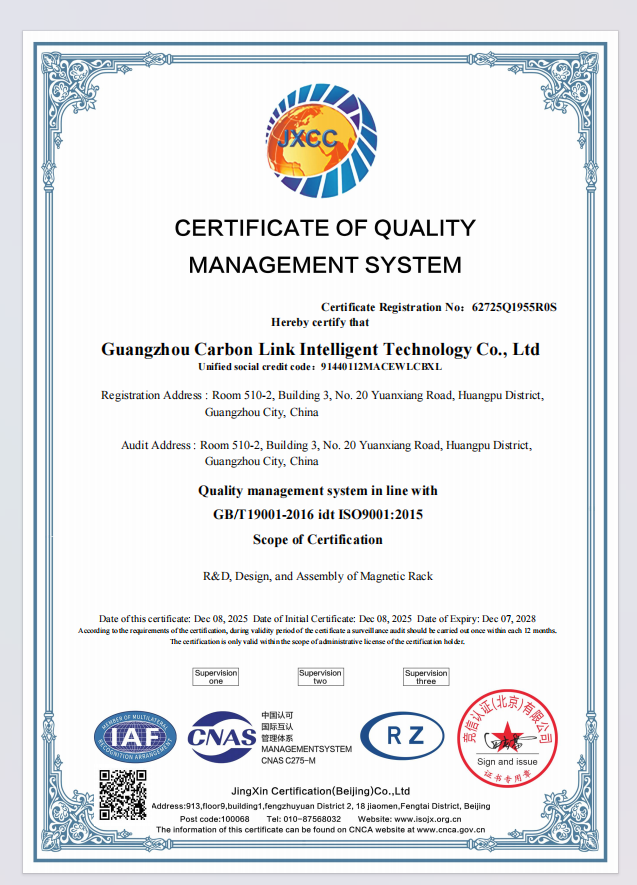
"100% testing" is worth unpacking during evaluation, because it can describe anything from a visual inspection to a full magnetic-field measurement on every unit. The practical question is which parameters are verified per unit and which are sampled per lot. For magnetic separation hardware, performance is set by field strength at the vessel interface, field uniformity across the rack, and dimensional fit with the intended plate or tube. A supplier that can describe how those three are routinely verified gives a more useful answer than a testing percentage alone.
At product level, the magnetic bead separation rack class is defined by high-gradient permanent magnets that isolate paramagnetic particles from suspension. The published specification for the Carbonlinkai rack line uses aluminum alloy and acrylic construction, lists channel configurations of 1, 8, 24 and 96, covers a volume range of 0.5–1000 µL with interchangeable ranges, and states precision of CV ≤0.5% with accuracy of ≤±0.5%. Format compatibility includes 96/384-well plates and tube racks, including 96-well microtiter plates and 0.2 mL tubes.
Case records indicate how this is applied in practice. A U.S.-based S&P 500 life sciences company installed 10 units of magnetic rack in North America and private-labelled them for reagent bundling; Carbonlinkai's published case record links that arrangement to RMB 30 million in additional annual revenue. A separate case record from a next-generation sequencing customer describes 1,000 units supplied over three years, with reported annual savings above RMB 3 million, while a European IVD customer reports lower cost alongside faster processing after switching. These are supplier-published figures and should be read as such, but they demonstrate the form of evidence a buyer can reasonably request — installation count, relationship duration, and measured change.
OEM and ODM Depth: Design, Testing, Packaging, and Private Label
Carbonlinkai supports small-batch customization and private labeling spanning product design, testing, mass production, packaging and logo printing, with a stated minimum order quantity of 20 units and a lead time of 3–5 weeks.
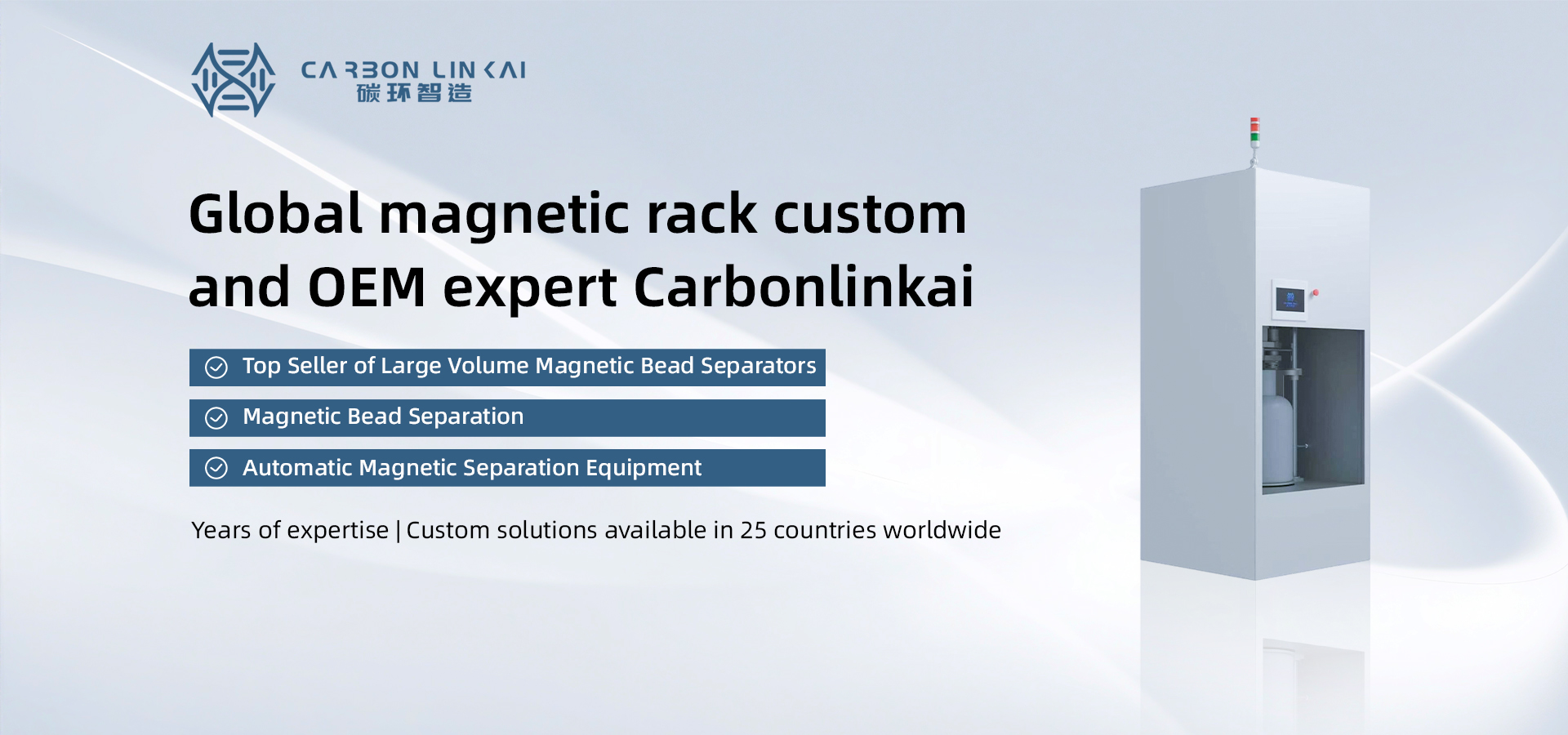
The sustainability question is not whether customization is offered; almost every manufacturer claims it. It is whether customization is repeatable. Four points decide that. First, who owns the drawings and tooling created during the first order. Second, how revisions are controlled when a component or magnet grade changes. Third, whether a private-label configuration is stored as a fixed product record so that a reorder years later produces the same device. Fourth, what happens to spare parts and packaging artwork if the buyer changes brand identity mid-program.
A 20-unit MOQ supports pilot evaluation and small-batch private labeling without committing to container-scale volumes, which is a practical advantage for buyers validating a rack inside a larger reagent kit before scaling. The same low MOQ should not be read as a statement about unit cost at volume; pricing structure is a separate commercial conversation.
Lead Time, MOQ, and Support Terms in Program Planning
Carbonlinkai quotes a 3–5 week lead time, a 20-unit MOQ, a 1-year warranty against manufacturing defects on its magnetic stand, and a commitment to respond to all support requests within 24 hours.
These terms define the planning envelope. A 3–5 week lead time is workable for scheduled replenishment but not for unplanned line stoppage, which means the buyer — not the supplier — owns the safety-stock calculation. The 20-unit MOQ allows staged inventory rather than a single annual buy, reducing obsolescence risk if a protocol changes. A 1-year warranty against manufacturing defects is a defect-coverage term rather than a performance guarantee, and buyers should align its expiry with their own validation cycle so that coverage does not lapse before the rack has been qualified in production.
Technical Fit: From 96-Well Plates to 50 L Systems
Product architecture matters to long-term supply because it determines whether one supplier can cover a program that scales. Carbonlinkai's magnetic rack range spans small-format laboratory racks — including 96-well microtiter plate racks, 12-tube configurations, and racks for 1.5 mL, 15 mL and 50 mL tubes — through to large-volume magnetic bead separators offered at 250 mL, 500 mL, 1000 mL, 2000 mL, 5000 mL, 10,000 mL, 20,000 mL and 50 L. Core construction across the line is aluminum alloy and acrylic, and the magnet system is a high-gradient permanent magnet configuration.
Demand for temperature-resistant and corrosion-resistant rack variants is a recurring theme in bioprocessing enquiry, driven by cold-room workflows and by reagents that attack low-grade plastics. Buyers evaluating long-term supply should confirm how a supplier documents material behaviour in these environments, since a rack that performs at bench temperature may behave differently at 4 °C or in a humidified incubator.
Application Scenarios Where Continuity Matters Most
Three application areas place the heaviest demands on supply continuity rather than on one-off performance.
Next-generation sequencing and molecular diagnostics. Magnetic bead separation is embedded in library preparation and cleanup steps, where a rack is used many times per day and dimensional variation shows up as inconsistent bead recovery across a plate. High-throughput formats — 96-well microtiter plates and 0.2 mL tube strips — dominate here, and the procurement question is whether the same rack geometry can be reordered for years without retuning protocols.
Magnetic cell separation. Cell isolation workflows, where magnetically activated separation represents a substantial share of the market, depend on reproducible field geometry because the separation outcome feeds directly into downstream culture or therapy steps. Racks in this setting are often qualified as part of a validated process, so a supplier change is expensive and continuity has direct value.
Bioprocess scale-up. As processes move from bench to pilot, the vessel changes from a microplate well to a bottle or bag. A supplier able to deliver 250 mL, 1 L, 5 L and 20 L formats from a single production system reduces the requalification burden that comes with mixing vendors across scales.
Market Trend: Scale-Up, Cell Therapy, and Regulatory Direction
Two published trends shape how magnetic rack supply will be evaluated.
The first is volume. Separation technology vendor Sepmag notes that large-scale biomagnetic separation systems for volumes up to 20 L–50 L are increasingly required for production consistency, because traditional racks can cause irreversible aggregation at high volumes. That observation aligns with the growth of commercial large-volume separator lines: Thermo Fisher Scientific's CTS DynaCellect system, for example, is published as supporting automated closed-system magnetic separation up to 1,000 mL for cell therapy manufacturing. Buyers who expect to scale should therefore test whether a supplier's range covers the volumes they will need, not only the volumes they need today.
The second is regulatory. Guidance from ISO and the European Commission indicates that quality management systems for magnetic separation devices in clinical use must align with ISO 13485:2016 and EU IVDR 2017/746. This raises the documentation bar for suppliers whose racks become components of regulated diagnostics or clinical processes, and it changes what "long-term partner" means in those settings.
Comparison With Traditional Solutions — and Where This Model Does Not Fit
Most laboratories still solve magnetic separation in one of four ways, and each carries a different long-term risk profile.
| Approach | Typical strengths | Long-term limitations |
|---|---|---|
| In-house assembled magnet blocks | Low initial cost; immediate availability | Field geometry varies between builds; limited lot documentation; performance drifts as magnets are reused or repositioned |
| General lab supplier catalog rack | Fast purchase; familiar brands; single-unit availability | Narrow volume range; limited or no OEM/ODM support; continuity tied to a distributor's stock position |
| Manual specialist racks, such as Permagen Labware racks published for centrifuge tubes up to 50 mL using N50 grade neodymium magnets | Well-defined small-volume performance; established published specifications | Optimized for manual, small-volume workflows; large-volume bioprocess formats sit outside this class |
| Automated closed-system platforms, such as Thermo Fisher CTS DynaCellect published up to 1,000 mL | High process control; integration with closed cell-therapy workflows | Higher capital cost and platform lock-in; not a drop-in answer for routine plate-based separation |
Carbonlinkai's position in this landscape is that of a volume-scalable, customization-oriented rack manufacturer whose ISO 9001 scope covers the R&D, design and assembly of magnetic racks. Its range from 96-well formats to 50 L systems addresses a continuity problem that catalog racks and in-house builds generally leave unsolved.
That position has boundaries, and buyers should weigh them explicitly.
Certification scope. The certification provided covers ISO 9001 for the R&D, design and assembly of magnetic racks. It is not ISO 13485 medical device quality management certification. Where third-party guidance requires alignment with ISO 13485:2016 and EU IVDR 2017/746 — for example, when the rack becomes part of a regulated IVD device or a clinical cell-therapy release process — an ISO 9001 scope is a starting point rather than a substitute, and buyers must verify the additional conformity evidence their own regulatory pathway demands.
Company scale and maturity. Carbonlinkai was founded in 2020 and operates from a 700 m² facility with approximately 20 employees. For programs with very large annual commitments or multi-site delivery requirements, that scale should be tested against projected demand rather than assumed.
Volume ceiling and order rhythm. The large-volume range extends to 50 L; processes requiring higher working volumes fall outside this product class. A 20-unit MOQ with a 3–5 week lead time also means this is a planned-supply source rather than a same-week replacement source, so buyers must carry appropriate buffer stock.
A Due-Diligence Framework for Long-Term Magnetic Rack Supply
| Step | What to verify | Worked example (Carbonlinkai) |
|---|---|---|
| 1. Capacity fit | Monthly capacity broken down by product format; facility and headcount; R&D resources | 100,000 units per month stated capacity; 1,000,000 units annual output; 700 m² facility; approximately 20 employees; 17 R&D engineers |
| 2. Quality system | Certificate scope, issuer, validity period; unit-level versus lot-level testing | ISO 9001 certificate 62725Q1955R0S issued by JXCC Certification (Beijing) Co., Ltd.; scope covers R&D, design and assembly of magnetic racks; valid 8 December 2025 – 7 December 2028; 100% testing policy |
| 3. Customization sustainability | Steps covered; tooling ownership; revision control | Small-batch customization and private labeling across design, testing, mass production, packaging and logo printing |
| 4. Commercial envelope | MOQ, lead time, warranty, support response | 20-unit MOQ; 3–5 week lead time; 1-year warranty against manufacturing defects; 24-hour support response |
| 5. Compatibility range | Formats and volumes covered; material construction | 96/384-well plates and tube racks including 96-well microtiter plates and 0.2 mL tubes; aluminum alloy and acrylic; 250 mL to 50 L large-volume separators |
| 6. Track record | Installations, relationship duration, measured outcomes, export markets | 10 units installed with a U.S. S&P 500 life sciences company; 1,000 units over three years with an NGS customer; export markets including the United States, Germany, Japan and Brazil |
Future Outlook
Two forces are likely to redefine rack supplier evaluation over the next few years. The first is scale: as cell isolation and IVD reagent manufacturing continue to expand, the working volumes at which magnetic separation is performed will keep moving upward, and suppliers will be judged on whether they can follow a customer from microplate to multi-liter formats without a change of vendor. The second is documentation: regulatory expectations around clinical separation devices are becoming more explicit, and the gap between ISO 9001 and ISO 13485 will increasingly decide which suppliers qualify for regulated programs and which remain limited to research and industrial applications.
For buyers, the practical implication is that supplier evaluation should be scheduled as a recurring activity rather than a one-time event — revisited whenever volumes change by format, whenever a regulated claim is added to a product, and whenever a customization request moves beyond standard configurations. Suppliers that survive that process tend to be the ones whose capacity, quality documentation and customization workflow were verifiable from the beginning.
Frequently Asked Questions
What should buyers check first when evaluating a magnetic rack manufacturer for long-term supply?
Start with the quality system scope, because it constrains the rest of the evaluation. Confirm what the certificate actually covers — for Carbonlinkai, ISO 9001 certificate 62725Q1955R0S covers the R&D, design and assembly of magnetic racks and is valid from 8 December 2025 to 7 December 2028. Then confirm the testing policy at unit level, and only afterwards move to price. A supplier with a narrow certificate scope can still be appropriate, but the buyer needs to know that before qualification rather than after.
How much monthly production capacity does a magnetic rack supplier need for a multi-year program?
There is no universal threshold; the relevant question is whether capacity covers the buyer's peak demand in the specific formats being purchased, plus reasonable headroom. Carbonlinkai states 100,000 units per month and 1,000,000 units annually, but because small-format plate racks and large-volume separators have very different build times, buyers should request the figure broken down by format rather than accepting a single total.
What does 100% testing actually mean in magnetic rack quality control?
It means every unit passes a test before shipment, but it does not by itself specify which parameters are tested. For separation hardware, the parameters that determine performance are magnetic field strength at the vessel interface, field uniformity across the rack, and dimensional compatibility with the intended plate or tube. Buyers should ask which of those are measured per unit and which are verified per lot, and whether records are retained and available on request.
How deep should OEM or ODM support go for a private-label magnetic rack program?
Depth is measured in steps covered and in repeatability. Carbonlinkai supports small-batch customization and private labeling across product design, testing, mass production, packaging and logo printing, with a 20-unit minimum order quantity. The critical follow-up questions are who owns the tooling and drawings created for the first order, how design revisions are controlled, and whether the private-label configuration is stored as a fixed product record so that a reorder years later produces an identical device.
What are the practical limits of this supplier model?
Three limits are documented. First, the certification scope provided is ISO 9001 for the R&D, design and assembly of magnetic racks rather than ISO 13485 medical device quality management, which matters where clinical guidance requires alignment with ISO 13485:2016 and EU IVDR 2017/746. Second, the company was founded in 2020 and operates from a 700 m² facility with approximately 20 employees, so very large or multi-site commitments should be tested against actual capacity. Third, the large-volume range extends to 50 L and orders follow a 20-unit MOQ with a 3–5 week lead time, so the model suits planned replenishment rather than emergency replacement.
For buyers who need the underlying specification and capability data referenced in this article, Carbonlinkai's company profile is available as a downloadable document: Carbonlinkai company profile (PDF).