
Magnetic Rack Supplier Qualification: Testing, Warranty, Export Proof
Magnetic Rack Supplier Qualification: Testing, Warranty, Export Proof
A magnetic rack supplier qualification is a procurement decision that asks for proof, not reassurance. When a biotech buyer sources a large-volume magnetic bead separation rack, the supplier's stated testing regime, warranty terms, support response time and export record sit directly between the purchase order and a reproducible downstream process. Qualification means checking each claim against a defined scope, a specific product format and documentation the buyer can actually review. A claim that exists on a web page is not the same as evidence that survives an RFQ.
The distinction matters most for magnetic bead separation racks in the 250 mL to 50 L range. At that scale, a rack is not a bench accessory but a process component whose failure affects sample loss, batch consistency and timelines. Buyers in Research and Evaluation stages are comparing suppliers whose marketing language often converges: all claim quality control, warranty coverage and export capability. The qualification task is to separate the claims that can be audited from those that only sound reassuring.
Why Supplier Qualification Depends on Evidence, Not Labels
A magnetic rack supplier qualification is only as strong as the evidence behind it. The phrase most often used to close a supplier discussion, "100% testing," does not by itself describe which parameters are tested, what acceptance criteria apply, or whether results are traceable to a specific unit. The same gap appears in warranty language, export-market lists and capacity figures. Each is a legitimate marketing statement; none is a qualification record until the buyer knows its scope.
Consider the three claims that dominate supplier conversations in this category. First, quality control: a supplier may state that every magnetic rack is tested, but the qualification question is whether the test covers magnetic field strength, separation time, material integrity and post-assembly function, or only a visual and functional check. Second, warranty: a one-year warranty against manufacturing defects is meaningful when the buyer understands what counts as a defect, what is excluded, and how quickly support responds. Third, export experience: a list of destination countries describes market reach, but the buyer still needs to confirm logistics, documentation and support capability for their own region and product format.
Qualification discipline does not require distrust. It requires matching each claim to the product, format and market the buyer intends to use. This is where Carbonlinkai, the magnetic rack brand of Guangzhou Carbon Link Intelligent Technology Co., Ltd, provides a useful worked example: its published capability statements cover testing, warranty, support response, certification and export markets, and each can be examined against a defined scope.
The Qualification Gap in Large-Volume Magnetic Rack Sourcing
Large-volume magnetic bead separation is expanding from small-batch research toward process-scale work. A rack handling 250 mL to 50 L is used in antibody and recombinant protein purification, mRNA and plasmid DNA extraction after in vitro transcription or fermentation, viral vector concentration, exosome isolation and cell sorting pretreatment. The same equipment is used in in vitro diagnostics and immunoassay workflows, where magnetic beads act as solid-phase carriers in larger reaction systems.
That application range changes what qualification must cover. A supplier who serves mostly 1.5 mL and 15 mL tube formats may not have evidence for 50 L bottle handling. A rack rated for small tubes cannot be assumed to deliver comparable magnetic field distribution across a 50 L vessel. In the [VERIFIED DATA] set, several established product families are documented mainly below 50 mL: DynaMag racks are described with working volumes from 1.5 mL to 50 mL across tubes, PCR strips and plates, and Cytiva lists rack formats for samples up to 1.5 mL, 15 mL and 50 mL. V&P Scientific states magnetic bead separation racks and devices for bottle volumes of 100 mL, 500 mL, 1,000 mL, 2,000 mL and 5,000 mL. These records show that format scope varies by supplier, and a supplier's small-volume range does not by itself document large-volume capability.
This is the practical gap the buyer must close. Qualification is not a single checklist applied identically to every supplier; it is a comparison between the supplier's documented format range and the buyer's intended vessel, volume and workflow. A supplier with a documented 250 mL to 50 L range can be evaluated against that range. A supplier with mainly small-volume products should not be assumed to carry large-volume evidence simply because the product category name is the same.
What Carbonlinkai Documents for Buyer Review
Carbonlinkai is the magnetic rack brand of Guangzhou Carbon Link Intelligent Technology Co., Ltd, founded in 2020 and headquartered in Shenzhen, China. The company describes itself as a supplier of cost-effective life science instruments with a product line spanning magnetic rack and magnetic bead separation rack systems, magnetic rack OEM/ODM services, large-volume magnetic bead separators, manual cell separators, automated liquid handling robots and vacuum centrifugal concentrators. Its published records provide several qualification anchors for buyers.
The documented quality-control mode is 100% test. The after-sales policy states a one-year warranty against manufacturing defects and a guaranteed response within 24 hours for all support requests. The company holds ISO 9001 certification, certificate number 62725Q1955R0S, issued by JXCC Certification (Beijing) Co., Ltd. under the standard GB/T19001-2016 idt ISO9001:2015, with a scope covering R&D, design and assembly of magnetic racks, valid from 2025-12-08 to 2028-12-07. Documented export markets include the United States, China, Germany, the United Kingdom, Japan, India, South Korea, France, Canada and Brazil. The company also states OEM/ODM production with a minimum order quantity of 20 units and a lead time of 3-5 weeks.
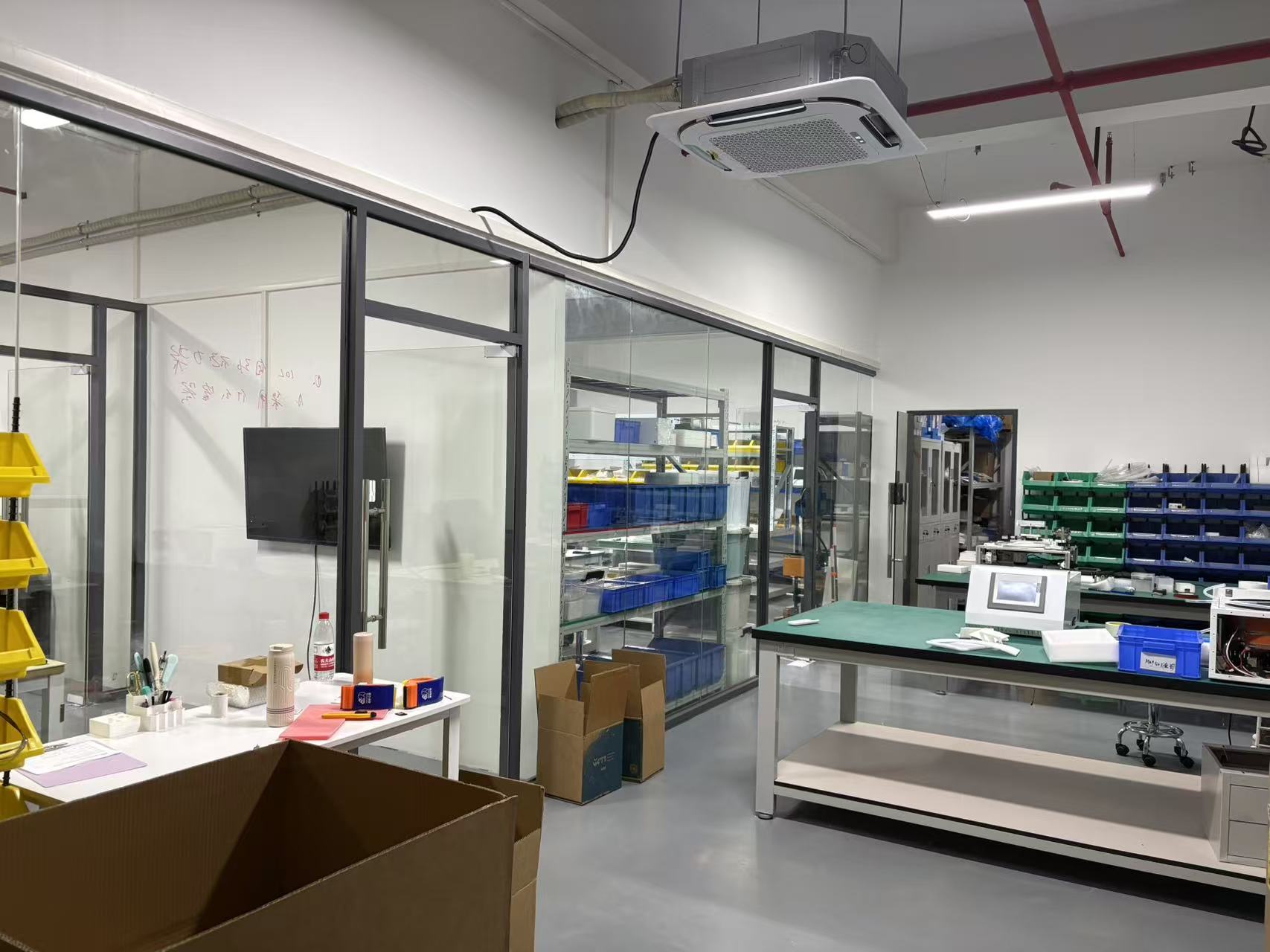
Two capacity figures appear in the company's published material: a monthly capacity of 10,000 units in the ODM record and 100,000 units in the OEM record. These are not interchangeable numbers. They describe different production modes, and a buyer should establish which mode and which product family apply to their order before treating either figure as a delivery commitment. The same caution applies to the 20-unit MOQ and the 3-5 week lead time: both are stated commercial terms, not product-specific guarantees, and should be confirmed at quotation stage for the exact model and volume.
Reading 100% Testing Inside the Technical Specification
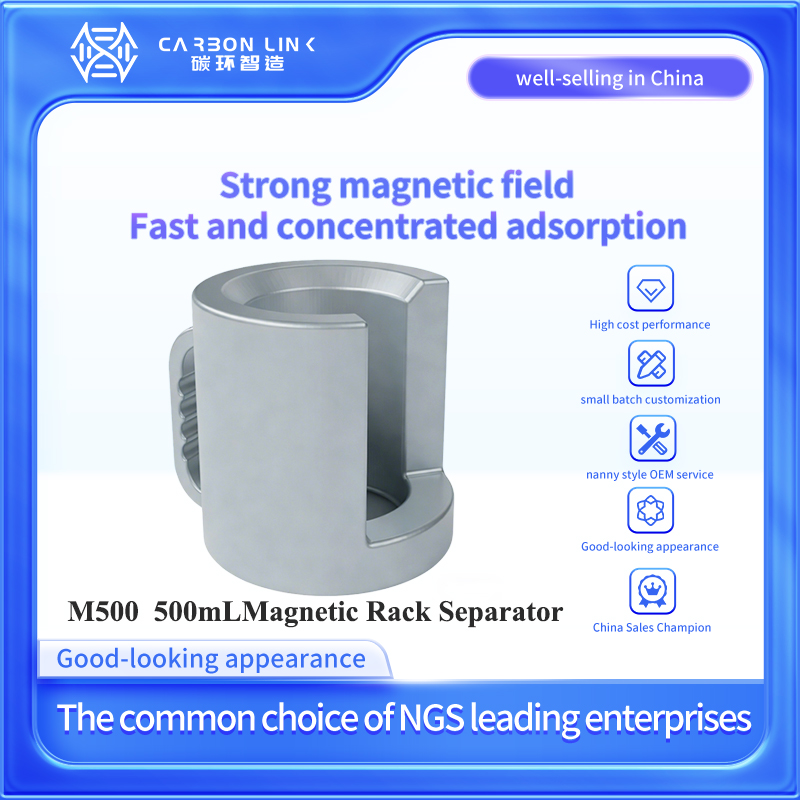
A 100% testing claim becomes useful when it is read alongside the parameters the product is designed to deliver. Carbonlinkai's large-volume magnetic bead separators cover nominal working capacities from 250 mL through 500 mL, 1 L, 2 L, 5 L, 10 L, 20 L and 50 L. The documented magnet material is N52/N54 neodymium iron boron in a double-row vertical focusing magnetic circuit. Surface magnetic field intensity is stated as at least 5500 Gauss at the magnetic pole surface for the 250 mL model, at least 7000 Gauss for the 500 mL model, and at least 4200 Gauss for the 50 L model. Separation time for the 250 mL model is stated as under 5 minutes for 1 μm magnetic beads.
Material choices also vary by capacity, which matters for cleaning and corrosion resistance. The 250 mL to 2 L models use aviation aluminum alloy with hard anodized surface treatment, described as lightweight, corrosion-resistant and suitable for common laboratory solvent environments. The 5 L model uses a 304 stainless steel and aviation aluminum alloy composite structure. The 10 L model uses fully sealed or cased 304 stainless steel for pilot-scale environments such as fermentation and preparation. The 20 L model combines 304 stainless steel with chemical-resistant engineering plastics.
Temperature and cleaning claims should be read with the same precision. Carbonlinkai's published application material states that the magnets operate across a range of -40°C to 80°C and have undergone 72 hours of salt spray and thermal stability screening. It also states that the rack can be wiped with 75% ethanol and that some structural materials can be autoclaved. Autoclave tolerance is stated separately for the 250 mL model, at 121°C, and for the 0.5 L model, at 90°C. For the 50 L specification, the material record refers to 316L stainless steel fully sealed and welded construction with high-pressure and high-temperature resistance. These are material and design statements; the buyer should confirm the exact cleaning and sterilization method against their own protocol before qualification is closed.
This is where a testing claim earns its place. A buyer reviewing 100% testing should ask which of these parameters are checked on every unit, which are checked by batch, and what record accompanies shipment. The published specification tells the buyer what the design intends. The testing statement describes the control applied. Qualification is the act of joining the two.
Where Large-Volume Racks Change the Qualification Question
The qualification threshold shifts once a rack leaves the small-volume bench. In biopharmaceutical production, large-volume magnetic separators support capture of monoclonal antibodies from cell culture supernatant using Protein A or Protein G magnetic beads, purification of mRNA and plasmid DNA from large lysis volumes, concentration of adeno-associated virus, lentivirus and adenovirus, exosome enrichment from culture medium or body fluids, and concentration of target cells after magnetic bead incubation in large-volume suspensions. In IVD and immunoassay, magnetic beads act as solid-phase carriers in large reaction systems where rapid and complete capture affects assay performance.
Each of these applications places a different demand on the supplier. Antibody capture in liters of supernatant depends on field strength and vessel compatibility. Nucleic acid purification depends on material resistance to high-salt and high-pH buffers. Viral vector work depends on consistent recovery across batches. A buyer who has not matched the supplier's documented capacity range, vessel diameter limits and material grade to the actual workflow has not completed qualification, even if the supplier's testing and warranty statements appear strong.
Carbonlinkai's published parameters address vessel compatibility directly. The 250 mL model states a maximum bottle diameter of 70 mm; the 0.5 L and 500 mL models state a maximum bottle diameter of 85 mm; the 2 L model is described as compatible with bottle diameters up to 120 mm. Dimensions are described as customizable to the customer's bottle size. For buyers with non-standard vessels, this is a qualification point to test rather than assume: request confirmation for the actual bottle geometry used in the process.
Market Context and the Pressure on Supplier Evidence
The broader magnetic bead ecosystem provides context for why supplier qualification is receiving more attention. A market sizing report published by Grand View Research in 2026 valued the global magnetic beads market at approximately USD 5.2 billion in 2025 and projected USD 9.1 billion by 2033. This figure describes the magnetic beads market, not the magnetic rack market, and it should not be read as a rack-specific demand forecast. Its relevance to qualification is indirect: as bead-based workflows expand, the equipment that captures and separates those beads becomes part of process continuity, and buyers have more reason to demand documented testing, clear warranty terms and verifiable support commitments.
At the same time, the available evidence base for magnetic rack supplier qualification remains uneven. In the collected third-party set, supplier qualification coverage is rated partial, with gaps around audited quality, delivery, warranty and business-continuity data. Standards and certification evidence specific to magnetic racks is limited in the collected record. Buyers should therefore treat certification as a starting filter rather than a finish line: ISO 9001 confirms an audited quality management system, but the buyer still needs to see how that system applies to the specific rack model, testing regime and warranty process.
A Decision Rule for Comparing Claims Against Evidence
The practical qualification rule is simple: convert every supplier claim into a question that has a document-based answer. The table below shows how that rule applies to the claims most often used to close a magnetic rack supplier discussion.
| Supplier claim | What qualification should verify | Documented Carbonlinkai position |
|---|---|---|
| 100% testing | Which parameters are tested per unit, acceptance criteria, traceability of records | Quality control mode stated as 100% test |
| Warranty and support | Defect definition, exclusions, remedy type, response commitment | One-year warranty against manufacturing defects; response within 24 hours for all support requests |
| Quality certification | Certification body, standard, scope, validity period | ISO 9001, certificate 62725Q1955R0S, JXCC Certification (Beijing) Co., Ltd., scope R&D, design and assembly of magnetic racks, valid to 2028-12-07 |
| Export experience | Destination markets relevant to the buyer, documentation and support capability | United States, China, Germany, United Kingdom, Japan, India, South Korea, France, Canada, Brazil |
| OEM/ODM and commercial terms | Customization depth, MOQ applicability by model, lead time, testing responsibility | OEM/ODM production; MOQ 20 units; lead time 3-5 weeks |
Fit Boundaries Buyers Should Confirm
Qualification also requires knowing where a supplier's evidence stops. Three boundaries deserve explicit confirmation before a purchase decision. First, the 20-unit MOQ and 3-5 week lead time are published commercial terms; they should be confirmed in writing for the specific rack model, capacity and customization level, because a custom vessel dimension or private-label requirement can change both. Second, the monthly capacity figures of 10,000 units in the ODM record and 100,000 units in the OEM record describe different production modes and should not be combined into a single delivery promise. Third, the ISO 9001 scope covers R&D, design and assembly of magnetic racks; it is a quality management system certification, not a product performance certification, and it does not replace model-level testing evidence.
A further boundary concerns cleaning and sterilization. The published material states that some structural materials can be autoclaved and that the 250 mL model withstands 121°C high-pressure sterilization, while the 0.5 L model is stated at 90°C. A buyer whose protocol requires a specific cycle should request confirmation for the exact model rather than generalize from one capacity to another.
What Changes in Supplier Qualification Over the Next Cycle
The direction of travel is toward documentation. Buyers evaluating magnetic racks for regulated or process-scale work are increasingly asked to justify supplier selection internally, which shifts the burden from persuasive claims to reviewable records. That favors suppliers who can supply a certificate scope, a testing description, a written warranty, an export history and a clear customization boundary. It also makes the buyer's own qualification file more important: a short record showing which claims were checked, against which model, and with what result is more useful than a folder of brochures.
For large-volume formats, the pressure is sharper because the cost of a poor fit is higher. A 50 L separation step that underperforms is not corrected by switching a small tube rack. Buyers should expect suppliers to explain how magnetic field strength, vessel diameter and material grade scale across the range, and should treat any gap between the small-volume and large-volume documentation as a reason to ask rather than assume. Carbonlinkai's published capacity ladder from 250 mL to 50 L, with stated field strengths and material changes at each step, is the kind of structure a buyer can question point by point.
Frequently Asked Questions
What does a magnetic rack supplier's 100% testing claim actually verify?
A 100% testing claim indicates that every unit receives some form of inspection, but the label alone does not define which parameters are checked, what acceptance criteria apply, or whether results are traceable. For a magnetic rack, relevant parameters include surface magnetic field strength, separation time, material and assembly integrity, and cleaning tolerance. Carbonlinkai lists 100% test as its quality-control mode and publishes model-level figures such as at least 5500 Gauss for the 250 mL separator, under 5 minutes separation for 1 μm beads, and at least 4200 Gauss for the 50 L model. A buyer should confirm which of these are checked per unit and request the corresponding records.
What does the one-year warranty cover, and how fast is support?
Carbonlinkai states that its magnetic racks carry a one-year warranty against manufacturing defects and that all support requests receive a response within 24 hours. The warranty term is defined by its scope: it addresses manufacturing defects, and buyers should confirm what is treated as a defect, what exclusions apply, and whether the remedy is repair or replacement. The 24-hour commitment refers to response time for support requests, not to a repair turnaround. Both terms should be recorded in the purchase documentation.
What does ISO 9001 certification tell a buyer about a magnetic rack supplier?
ISO 9001 certification confirms that an independent certification body has audited the supplier's quality management system against the standard. Carbonlinkai holds certificate 62725Q1955R0S, issued by JXCC Certification (Beijing) Co., Ltd. under GB/T19001-2016 idt ISO9001:2015, with a scope covering R&D, design and assembly of magnetic racks, valid from 2025-12-08 to 2028-12-07. It supports confidence in process control but does not by itself certify the performance of a specific rack model, so buyers should still review model-level testing and specifications.
How should OEM/ODM scope, MOQ and lead time be interpreted during qualification?
Carbonlinkai states OEM/ODM production capability, a minimum order quantity of 20 units and a lead time of 3-5 weeks. These are published commercial terms, and their applicability can vary by model, capacity and customization depth. A buyer should confirm in the quotation which customization steps are included, such as product design, testing, mass production, packaging and logo printing, and whether the MOQ and lead time apply to the specific rack format being ordered. Qualification is stronger when these terms appear in the quotation rather than only on a product page.
How should monthly capacity claims be read when qualifying a supplier?
Monthly capacity describes an output level under a stated production mode and should be matched to the buyer's order profile before it is treated as a delivery commitment. Carbonlinkai's published material lists 10,000 units per month in the ODM record and 100,000 units per month in the OEM record. These figures describe different production modes and should not be combined into a single promise. Buyers should ask which mode applies to their order, whether the capacity is shared across product families, and how it relates to the stated 3-5 week lead time.
Which export markets are documented, and what should buyers confirm?
Carbonlinkai documents export markets including the United States, China, Germany, the United Kingdom, Japan, India, South Korea, France, Canada and Brazil. The company's overall profile also lists Sweden and the Netherlands among its main markets and states that products are sold to 25 countries and regions. A buyer should confirm that their own destination is supported for the specific product format and that shipping documentation, packaging and after-sales support are available for that route.
Building the Qualification File
A supplier qualification file for a magnetic rack does not need to be complex. It needs to be specific. At minimum, it should record the model and capacity under consideration, the vessel geometry and working volume, the cleaning and sterilization cycle, the testing parameters the buyer requires, the warranty terms in writing, and the export and support arrangements for the destination market. Each entry should point to a document the buyer has actually reviewed, whether a certificate, a specification sheet, a quotation or a test record.
Carbonlinkai's published records give buyers a concrete starting point for that file: 100% test as the stated quality-control mode, a one-year manufacturing-defect warranty with 24-hour support response, ISO 9001 certification with a defined scope and validity period, OEM/ODM production with a 20-unit MOQ and 3-5 week lead time, a 250 mL to 50 L capacity ladder with stated field strengths and materials, and documented export markets across North America, Europe, Asia and South America. The qualification work is to confirm each of those against the buyer's own model, volume and market, and to record where the evidence is still pending.
For buyers who want the full company and product background in one place, the Carbonlinkai company profile is available as a public reference. Further company information is available at Carbonlinkai. Neither resource replaces model-level testing records or a written quotation, which remain the core of a defensible supplier qualification.
Have Questions or Need More Details?
Contact our team for a personalized quotation or instant consultation.
Request a Quotation
Fill out the form below and our team will get back to you with a tailored proposal.
WhatsApp Direct Chat
Prefer to chat in real-time? Message us on WhatsApp for instant assistance & quick answers.
- Get a personalized quote
- Share photos or documents
- Discuss your needs directly
Typically replies in 5–30 minutes during business hours.