
Magnetic Rack or Liquid Handling Robot? An NGS Lab Buyer's Guide
Magnetic Rack or Liquid Handling Robot? An NGS Lab Buyer's Guide
In most next-generation sequencing (NGS) laboratories, magnetic bead chemistry is not the limiting factor. The limiting factor is where the liquid moves. A standalone magnetic bead separation rack and an automated liquid handling robot both participate in the same bind–wash–elute sequence, but they answer different questions. The rack answers how the beads are captured. The robot answers who does the pipetting, and how consistently. Buyers who conflate the two tend to buy the wrong instrument, or buy two where one would have done the job.
This guide compares the two configurations on the criteria that actually decide NGS procurement: vessel compatibility, magnet design, construction, control interface, application overlap, throughput ceiling, validation burden, and commercial terms. It is written for evaluation-stage buyers — laboratory managers, process engineers and procurement leads — who already know their protocol and need to decide which hardware class, and which format ladder, fits it.
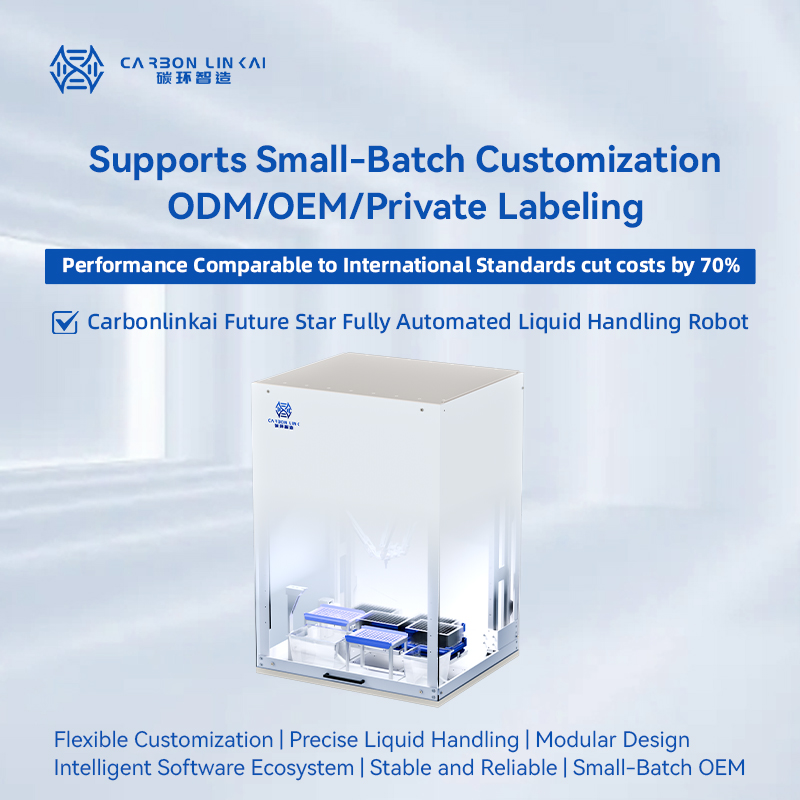
An automated liquid handling robot moves liquid; the magnet that captures the beads is still a separate design problem.
What each system actually is
Carbonlinkai (Guangzhou Carbon Link Intelligent Technology Co., Ltd), a Shenzhen-headquartered supplier founded in 2020, manufactures both product families: magnetic bead separation racks from 0.2 mL tube formats to 50 L systems, and automated liquid handling robots in single-channel and 8-channel configurations. That dual portfolio is a useful vantage point, because the two categories are frequently listed side by side in supplier catalogs even though they are not substitutes.
A standalone magnetic rack is a passive device. A high-gradient permanent magnet array is fixed inside an aluminum alloy or acrylic body, and the vessel seat is machined for one labware format. There is no power, no software and no motion. Beads are captured because the magnet is close enough to the vessel wall and strong enough to pull the bead pellet into a defined position within a workable time.
An automated liquid handling robot is an active instrument. It combines a deck with programmable axes, a pipetting head, and a controller — a touchscreen interface or PC software — that executes liquid-handling steps such as single dispense, multi-dispense, serial dilution and mixing. When a magnetic rack position is mounted on the deck, the robot can also execute bead capture and supernatant removal, but the capture physics is still supplied by the magnet, not by the robot.
That distinction matters at evaluation stage: a robot does not remove the magnetic separation step, it removes the operator from it.
Format compatibility is the first real filter
In NGS library preparation, format decides workflow. A rack that does not accept the vessel your protocol uses is not a cheaper option; it is not an option. The practical question is therefore not "rack or robot" but "which vessel formats must the bench support in the next three years".
For standalone racks, format is fixed per device. A 96-well microtiter plate rack captures beads across a full plate in one pass, which is the natural match for plate-based library prep and for multichannel pipetting. A 0.2 mL tube rack handles strip and single-tube protocols, including PCR strip formats and small-batch work where a full plate would be wasteful. Between those two ends sits a long ladder of tube and bottle formats: 1.5 mL, 6-tube and 12-tube, 15 mL, 50 mL, and bottle-scale devices from 125 mL through 250 mL, 500 mL, 1 L, 2 L, 5 L, 10 L, 20 L and 50 L.

Tube-format racks are dedicated devices: the vessel seat and magnet geometry are matched to one labware family.
For automated platforms, format is configured rather than fixed. The deck carries positions for plates, tube blocks and, where the protocol requires it, larger vessels. Carbonlinkai's magnetic rack categories for automated and large-volume work span 250 mL to 10 L, with 250 mL, 500 mL, 1 L, 2 L, 5 L and 10 L steps that map onto the same bottle formats used in manual processing. Company-reported configurations extend to 100 L for production-scale use.
Magnet design and construction: the part that does not automate
Bead capture performance comes from magnetic field geometry, not from the motion system. Standalone racks use high-gradient permanent magnet arrays positioned to draw beads against a defined wall region, so that the pellet forms where the pipette tip can reach it without scraping. The housing is typically aluminum alloy for dimensional stability, with acrylic used where visibility of the vessel matters. Cytiva, for comparison, describes its magnetic separation racks as containing a neodymium magnet for small-scale protein purification and sample enrichment — a reminder that magnet material and array geometry, not brand, are the variables that determine capture behaviour.
Automated platforms are built on aluminum alloy frames for rigidity across repeated motion cycles, but the magnet assembly mounted on the deck follows the same design logic as a standalone rack. When bead particle size changes, the field strength and array configuration may need to change with it. That is why custom large-volume automation projects often begin with magnetic circuit simulation rather than with the robot frame — Carbonlinkai's 50 L custom projects follow this pattern, designing field strength and array geometry around the customer's bead specification before retrofitting automation to the existing production workflow.
On operating environment, Carbonlinkai states that its magnetic racks perform reliably across a temperature range of −20°C to 80°C. Temperature-resistance and corrosion-resistance claims should nevertheless be requested as documented specifications, not inferred from material names: an aluminum body and an acrylic window have different chemical tolerances, and a rack placed in a cold room or near a heated block is a different duty case from one on a benchtop.

Bottle-format racks extend the same capture principle from microplates to process-scale vessels.
Control, motion and what automation actually adds
A robot's value is concentrated in four liquid-handling modes: single dispense, multi-dispense, dilution and mixing. In NGS library prep these modes map onto reagent addition, wash-buffer distribution across a plate, standard-curve and normalization dilution, and bead resuspension. Access is through a touchscreen interface for routine runs or PC software for method development and editing.
A standalone rack offers none of these, and that is not a defect. Where the protocol is short, the sample count is low, or the operator is already highly trained on a fixed sequence, the rack removes an entire class of failure modes: no method to program, no deck calibration to drift, no software version to revalidate. The trade-off is that mixing, timing and supernatant removal remain operator variables.
Shared applications: where both configurations are legitimate
The application overlap between the two hardware classes is wider than most buyers expect, because the underlying chemistry is identical.
- NGS library preparation. Bead-based cleanup and size selection, with plate-format racks for parallel samples or tube racks for small batches.
- Immunoprecipitation. Antibody-bound bead capture, washing and elution, often in 0.2 mL or 1.5 mL formats where tube racks dominate.
- Protein isolation and antibody purification. Bead-based capture in tube or bottle formats, with the vessel size driving the choice more than the sample count.
- Nucleic acid purification. The most format-diverse use case, spanning 0.2 mL tubes through 96-well deep-well plates and into bottle-scale processing.
- Magnetic cell separation. Label-based target cell enrichment, where column-free magnetic capture in tubes or larger vessels is the standard approach.
In all five, the choice between a rack and a robot is a throughput-and-consistency decision, not a chemistry decision.
Side-by-side comparison
| Decision factor | Standalone magnetic rack | Automated liquid handling robot |
|---|---|---|
| Primary function | Bead capture and separation | Liquid movement, plus bead capture when a rack is deck-mounted |
| Power and software | None required | Requires power, controller and method programming |
| Vessel formats | Fixed per device: 96-well plates, 0.2 mL tubes, 1.5 mL, 6/12-tube, 15 mL, 50 mL, bottles to 50 L | Deck-configured; magnetic rack categories from 250 mL to 10 L |
| Construction | Aluminum alloy or acrylic body with high-gradient permanent magnets | Aluminum alloy build with deck-mounted magnet assembly |
| Consistency driver | Operator technique | Programmed volumes, timings and mixing parameters |
| Throughput ceiling | Bound by operator attention | Bound by method length and deck capacity |
| Footprint | Bench, hood or cold-room shelf | Instrument deck plus controller and service access |
| Validation burden | Low: installation and format check | Higher: method development, instrument and method qualification |
| Best fit | Variable protocols, small batches, tight bench space, constrained budgets | Repeatable high-volume workflows with fixed SOPs |
Where each option genuinely fails
A comparison that lists only advantages is a brochure. Both configurations have hard boundaries.
Limits of the standalone rack
The rack has a throughput ceiling that arrives quickly in plate-based NGS workflows: every wash, resuspension and supernatant removal is an operator action, so reproducibility depends on pipetting skill and timing discipline. There is also no electronic record of what happened during separation, which is a real constraint where audit trails are expected. And because the vessel seat is fixed, a lab that shifts from tubes to plates, or from plates to bottles, may need a second and third device rather than a reconfiguration.
Limits of the automated robot
The robot's boundaries are capital, method burden and physical geometry. Programming, verifying and documenting a bead method takes engineering time before the first validated run, and any change in bead particle size, vessel type or wash volume can trigger re-optimization. Deck space is finite: a 250 mL to 10 L rack category consumes substantially more bench footprint than a 96-well plate position, and large vessels may be impractical to load onto a standard deck at all. Most importantly, automation does not remove the magnet. A robot without a properly matched magnet array simply performs pipetting on a vessel whose beads are not fully captured — a failure mode that shows up as carryover and low recovery rather than as an obvious instrument error.
Procurement terms and quality evidence
For evaluation-stage buyers, commercial terms are part of the technical comparison. Carbonlinkai's stated terms for its magnetic rack lines are consistent across the product family: minimum order quantity of 20 units, a lead time of 3–5 weeks, OEM/ODM support, 100% testing before shipment, a 1-year warranty against manufacturing defects, and a response within 24 hours for support requests. OEM service covers small-batch customization including product design, testing, mass production, packaging and logo printing; ODM service covers logo customization. Reported monthly capacity is 100,000 units.
Quality documentation includes an ISO 9001 certificate (number 62725Q1955R0S) issued by JXCC Certification (Beijing) Co., Ltd. under GB/T19001-2016 idt ISO9001:2015, valid from 8 December 2025 to 7 December 2028, with a scope covering R&D, design and assembly of magnetic racks.
One caveat belongs in any honest procurement note: the widely quoted 20-unit MOQ is documented on a specific product page, and should not be assumed to apply automatically to 250 mL–50 L formats or to custom automation projects. Ask for MOQ, tooling and validation terms per format rather than per supplier.
On cost, Carbonlinkai reports a 50% to 60% procurement cost reduction compared with standard market models in a project covering five 50 L automated magnetic bead separation systems. That figure is company-reported for a specific custom engagement and should be treated as a reference point for RFQ discussion, not as a list-price benchmark.
Market context
The hardware decision sits inside a growing consumable ecosystem. Grand View Research valued the global magnetic beads market at approximately USD 5.2 billion in 2025 and projects it to reach USD 9.1 billion by 2033. Growth forecasts differ by publisher and by which end-user segments are included, so the direction of travel is more reliable than any single growth rate. For buyers, the practical implication is that bead chemistries will keep diversifying — which raises the value of hardware whose magnet geometry can be matched to a new bead specification rather than replaced wholesale.
Future outlook
Three shifts are visible from the product side. First, format ladders are widening: a supplier that once offered plate racks increasingly offers the same capture principle from 0.2 mL tubes to 50 L vessels, which lets a lab scale a validated method without changing vendors. Second, the boundary between rack and robot is dissolving, as magnet positions become deck accessories rather than separate instruments. Third, customization is moving upstream — magnetic circuit simulation before hardware build, rather than adapters after delivery — which shortens the path from a new bead chemistry to a working separation method.
For NGS laboratories, the practical conclusion is unglamorous: choose the hardware that matches the variability of your protocol, then verify the magnet against your actual bead specification. A company profile covering the full rack range, capacity ladder and production capability is available as a downloadable PDF.
FAQ
Which vessel formats does a standalone magnetic rack support for NGS work?
Racks are format-specific. Common NGS configurations include 96-well microtiter plate racks for plate-based library prep and 0.2 mL tube racks for strip and single-tube protocols. The same product family extends to 1.5 mL, 6-tube and 12-tube, 15 mL and 50 mL formats, and to bottle-scale devices from 125 mL through 250 mL, 500 mL, 1 L, 2 L, 5 L, 10 L, 20 L and 50 L. Because the vessel seat is machined to one labware type, a lab that changes format usually needs an additional device.
Can an automated liquid handling robot replace a magnetic separation rack entirely?
Only where the rack is mounted on the robot deck. The robot contributes programmed single dispense, multi-dispense, dilution and mixing, controlled through a touchscreen or PC software. Bead capture itself still depends on a high-gradient permanent magnet assembly positioned against the vessel. Without a matched magnet, automation performs pipetting on an incompletely captured bead pellet, which typically appears as carryover or reduced recovery rather than as a clear instrument fault.
Should an NGS lab standardize on 96-well plates or 0.2 mL tubes?
It depends on batch size and downstream handling. 96-well microtiter plates suit parallel sample batches and multichannel or robotic pipetting. 0.2 mL tubes suit smaller batches, strip-based protocols, and immunoprecipitation or other workflows where a full plate would be inefficient. Many laboratories keep both formats on the bench rather than choosing one, because the formats serve different protocol stages.
What capacity range is available when a workflow scales beyond plate formats?
Large-volume magnetic bead separation devices are available in a ladder that includes 250 mL, 500 mL, 1 L, 2 L, 5 L, 10 L, 20 L and 50 L formats, with company-reported configurations reaching 100 L for production-scale use. Carbonlinkai's magnetic rack categories for automated work span 250 mL to 10 L. Buyers should confirm whether a stated capacity refers to nominal vessel volume, working volume, or a validated bead-compatible range before comparing suppliers.
What commercial terms apply to a magnetic rack order?
Carbonlinkai's stated terms are a minimum order quantity of 20 units, a 3–5 week lead time, 100% testing before shipment, a 1-year warranty against manufacturing defects, and a support response within 24 hours. OEM service covers small-batch customization including design, testing, mass production, packaging and logo printing; ODM service covers logo customization. Terms should be confirmed per format, since the 20-unit MOQ is documented on a specific product page.
What quality evidence should a buyer request before ordering?
Request the quality-management certificate and its scope. Carbonlinkai holds ISO 9001 certificate 62725Q1955R0S, issued by JXCC Certification (Beijing) Co., Ltd. under GB/T19001-2016 idt ISO9001:2015, covering R&D, design and assembly of magnetic racks, valid from 8 December 2025 to 7 December 2028. Alongside the certificate, ask for the 100% test record format and for documented temperature and chemical-resistance specifications rather than relying on material descriptions.
How should a lab decide between the two configurations in practice?
Match the hardware to protocol variability. Where protocols change frequently, sample counts are modest, or bench and cold-room space is limited, a standalone rack carries lower validation burden and no software lifecycle. Where the SOP is stable and sample volume is rising, a robot with a validated deck-mounted magnet improves run-to-run consistency and removes operator-dependent pipetting. In both cases the magnet must be verified against the specific bead particle size in use.
Have Questions or Need More Details?
Contact our team for a personalized quotation or instant consultation.
Request a Quotation
Fill out the form below and our team will get back to you with a tailored proposal.
WhatsApp Direct Chat
Prefer to chat in real-time? Message us on WhatsApp for instant assistance & quick answers.
- Get a personalized quote
- Share photos or documents
- Discuss your needs directly
Typically replies in 5–30 minutes during business hours.