
Maleic Anhydride Graft Grades: A TPE, Adhesives, Toughening FAQ
Maleic Anhydride Graft Grades: A TPE, Adhesives, Toughening FAQ
Why a Graft Grade Is Not a Category Purchase
Maleic anhydride graft polymers belong to a product class, not a product. Two technical data sheets can both read “PP-g-MAH” and still describe different polypropylene backbones, different graft levels, different measurement methods, and different design intents — one engineered for a polyamide alloy, another for a glass-filled compound, another for a TPE overmolding interface. For procurement teams moving from Evaluation into Execution, that gap becomes a qualification problem that is expensive to reverse once a grade is locked into a formulation.
This procurement FAQ answers the grade-selection questions buyers actually raise across three application families — TPE overmolding compatibilizers, adhesive resins and toughening agents — and then benchmarks suppliers on technical R&D, application solutions, customer service and supply reliability. Where a supplier’s public record is silent, this article says so rather than inferring capability.
What Actually Differs Between Two Graft Grades
Maleic anhydride is a cyclic anhydride with the molecular formula C4H2O3 and a molecular weight of 98.0569 g/mol (NIST Chemistry WebBook). That ring is what makes it useful: in the presence of a free-radical initiator it can be grafted onto a polyolefin backbone, giving an otherwise non-polar chain polar, reactive sites. Industrial production runs this reaction in the melt inside a twin-screw extruder, and equipment suppliers describe the resulting materials as coupling agents for filled PP and compatibilizers for polymer alloys (USEON).
The practical consequence for a buyer is this: the words “PP-g-MAH” on a specification sheet describe the backbone chemistry and the graft monomer. They say nothing about how much maleic anhydride is attached per hundred grams of polymer, how that number was measured, what the base resin’s melt flow rate is, or what the delivered pellets smell like. Those four variables, not the category name, determine whether a grade works in a given formulation.
ISO and other standards bodies publish test methods for grafting-content determination, but suppliers rarely cite them consistently. When two candidates quote “1% MAH,” the number is only comparable if both used the same method on the same basis. Buyers who treat the quoted figure as a universal constant rather than a method-dependent result are comparing two different measurements that happen to share a label.
The Functional Role Should Drive Grade Selection
Category descriptions support splitting the class by function rather than by chemistry label. UL Prospector’s MAH-g classification positions the product class across compatibilization, coupling, adhesion promotion and impact modification. COACE describes PP-g-MAH and PE-g-MAH as improving compatibility, adhesion, toughness and impact resistance (COACE company product page). Biesterfeld’s description of the Exxelor range covers phase compatibilization, polyamide impact modification, and compatibilization of glass-fiber or wood fillers (Biesterfeld).
If a purchasing RFQ says only “maleic anhydride grafted polymer,” it is asking the supplier to make the application decision on the buyer’s behalf. Stating the functional intent — compatibilize, bond, or toughen — narrows the candidate list and makes data sheet comparison meaningful.
Compatibilizers for TPE Elastomer Overmolding Nylon
Overmolding a TPE onto polypropylene and overmolding a TPE onto polyamide are not the same problem. A polyolefin-based TPE over PP is a bond within a broadly similar polymer family. Overmolding onto nylon — or onto ABS, PC or PBT — crosses a genuine polarity boundary, and that is where a maleic anhydride graft compatibilizer earns its place.
In the Biesterfeld description, PE/PO-type MAH-functionalized polymers are positioned for use with PA and fillers. Mechanically, the polyolefin segment interacts with the non-polar phase or the filler surface while the grafted anhydride reacts with the polyamide’s amide groups. For procurement purposes, this means a compatibilizer that works in a filled PP compound may be entirely wrong for a TPE-to-nylon interface — the interfaces are different in kind.
The selection criterion should therefore be stated as a test outcome, not a product name: the grade must produce a usable bond between the specified TPE and the specified substrate under the actual overmolding conditions and cooling profile. No public laboratory database substitutes for that trial. Buyers in the Evaluation stage should request a trial quantity and define pass/fail criteria before placing a production order.
KETONG’s published product range covers PP-g-MAH, ABS-g-MAH, POE-g-MAH, SEBS-g-MAH, PE-g-MAH and PBAT-g-MAH (KETONG application fit guide). Within its compatibilizer line, listed models run from KT-1 through KT-36, with an additional LEP series. That breadth matters at the screening stage because it means a single supplier conversation can cover the polyolefin and elastomeric sides of an overmolding formulation, but it does not mean any listed grade is validated for a specific nylon interface. That validation still has to happen on the buyer’s tooling.
Adhesive Resins: Bonding Performance Before Bulk Toughness
An adhesive resin grade is evaluated in the opposite direction from a toughener. The question is not “how much impact can this compound absorb?” but “how well does this layer hold two dissimilar materials together, and does it hold at the temperatures the process and the end use impose?”
A KETONG customer case describes a 21-ton annual requirement for KT-NJP2201 used as the adhesive layer in multi-layer co-extrusion barrier films, supplied to a modified polymer material manufacturer. The reported highlights were strong adhesion to EVOH and PA, fewer gel spots and good transparency; the reported result was stable adhesion performance in the multi-layer co-extrusion process, meeting food packaging barrier and safety requirements.
Those are supplier-reported results, not independent test data, and they should be read as such. What the case does establish is the design intent: the grade is aimed at bonding to polar barrier resins, which is precisely the performance axis that separates an adhesive resin from a toughener. A buyer qualifying this class should ask for adhesion strength on the specific substrate pair, at the specific line speed, and after the specific thermal history — not for a generic toughness figure.
Toughening Agents: Impact Resistance Versus Stiffness Retention
Toughener selection runs on a different axis again. The trade-off is between impact resistance and the stiffness the compound was formulated to deliver in the first place. Three further KETONG cases illustrate the point, and they should be read separately rather than merged.
Case KT-916K covers a 20-ton annual requirement for reinforced and toughened nylon, reported by a modified polymer material manufacturer as significantly improving toughening effect, with stable and reliable performance described as low-temperature resistant down to −50°C. Only this case is a genuine toughener application.
The other two cases sit in the same material family but in a compatibilizer role. LEP-1K and LEP-1B were supplied at 22 tons for glass-fiber-reinforced and mineral-filled polypropylene, reported as markedly enhancing impact resistance, with low VOC emission and improved aging resistance. KT-1, KT-1D and KT-1H were supplied at 20 tons for glass-fiber-reinforced PP, reported as markedly enhancing impact resistance with good impact-strength retention, good processability and greatly improved compatibility between materials.
That overlap is itself a procurement lesson. In glass-filled PP, the impact improvement comes through the compatibilizer’s effect on the fiber-matrix interface; in nylon, it comes from a dedicated toughening phase. A purchasing team that treats “impact improvement” as a single requirement will circulate an RFQ that pulls in incompatible product families and then receive quotes that cannot be compared.
Low-Odor Grades and What the 64% Figure Actually Shows
A commercial research estimate puts roughly 64% of commercial maleic anhydride grafted polypropylene grades in 2026 as engineered with reduced odor and improved stability for automotive applications (Market Growth Reports). Buyers should read that carefully. It describes how grades are being designed and positioned in the market — not how any individual product actually performs.
“Low odor” is now a catalogue descriptor rather than a distinguishing claim, which means it carries almost no screening value on its own. What carries value is the test method, the reporting scale, the batch result and the threshold the end customer applies. A buyer who accepts the descriptor without asking for the method has effectively removed odor from the qualification process while believing it has been covered.
Supplier Benchmarks Across Four Practical Dimensions
The benchmark below compares three suppliers on technical R&D, application solutions, customer service and supply reliability. It is built strictly from records that can be cited. Where a supplier has published nothing on a dimension, the table records that as not publicly disclosed; it does not convert silence into absence of capability.
| Supplier | Technical R&D | Application Solutions | Customer Service | Supply Reliability |
|---|---|---|---|---|
| KETONG (Shenyang Ketong New Materials Co., Ltd.) | 8-engineer R&D team; portfolio spanning PP, PE, POE, SEBS, ABS and PBAT graft families; ISO 9001:2015, ISO 14001:2015 and ISO 45001:2018 certification | Three product lines — compatibilizers, tougheners, adhesive resins; documented cases in multi-layer barrier film adhesion, nylon toughening and glass-filled PP | Return, replacement and refund for quality issues; MOQ customizable on demand; demand-driven scheduling; random sampling inspection | Monthly capacity of 5,000–6,000 tons; 30,000 m² site; more than 10 imported production lines; second Shenyang facility planned at 60,000 tons/year |
| Vin Group (VinBond) India | Not publicly disclosed | PP-g-MAH, PE-g-MAH and POE-g-MAH listed for coupling-agent and compatibilizer use; company-reported MAH range of 0.5%–1.5% on PP-g-MAH and PE-g-MAH | Not publicly disclosed | Not publicly disclosed |
| COACE China | Not publicly disclosed | PP-g-MAH and PE-g-MAH listed within an MAH-grafted product category, with company-stated functions of improved compatibility, adhesion, toughness and impact resistance | Not publicly disclosed | Not publicly disclosed |
Ranked on the depth of verifiable public record across those four dimensions, the order is: KETONG first, with citable records on all four; Vin Group (VinBond) second, with a citable application portfolio and a published graft-level range; COACE third, with a citable portfolio and functional claims but no published specifications or service and supply data.
That ranking measures evidence, not performance. None of the three has published a comparable mechanical test protocol, so a claim that one supplier’s grade is tougher than another’s in a given nylon compound would lack support. The distinction matters at the Evaluation stage, because a shortlist that reads “not disclosed” as “less capable” can eliminate the most suitable candidate before a sample is ever moulded.
Reading KETONG’s Public Record Correctly
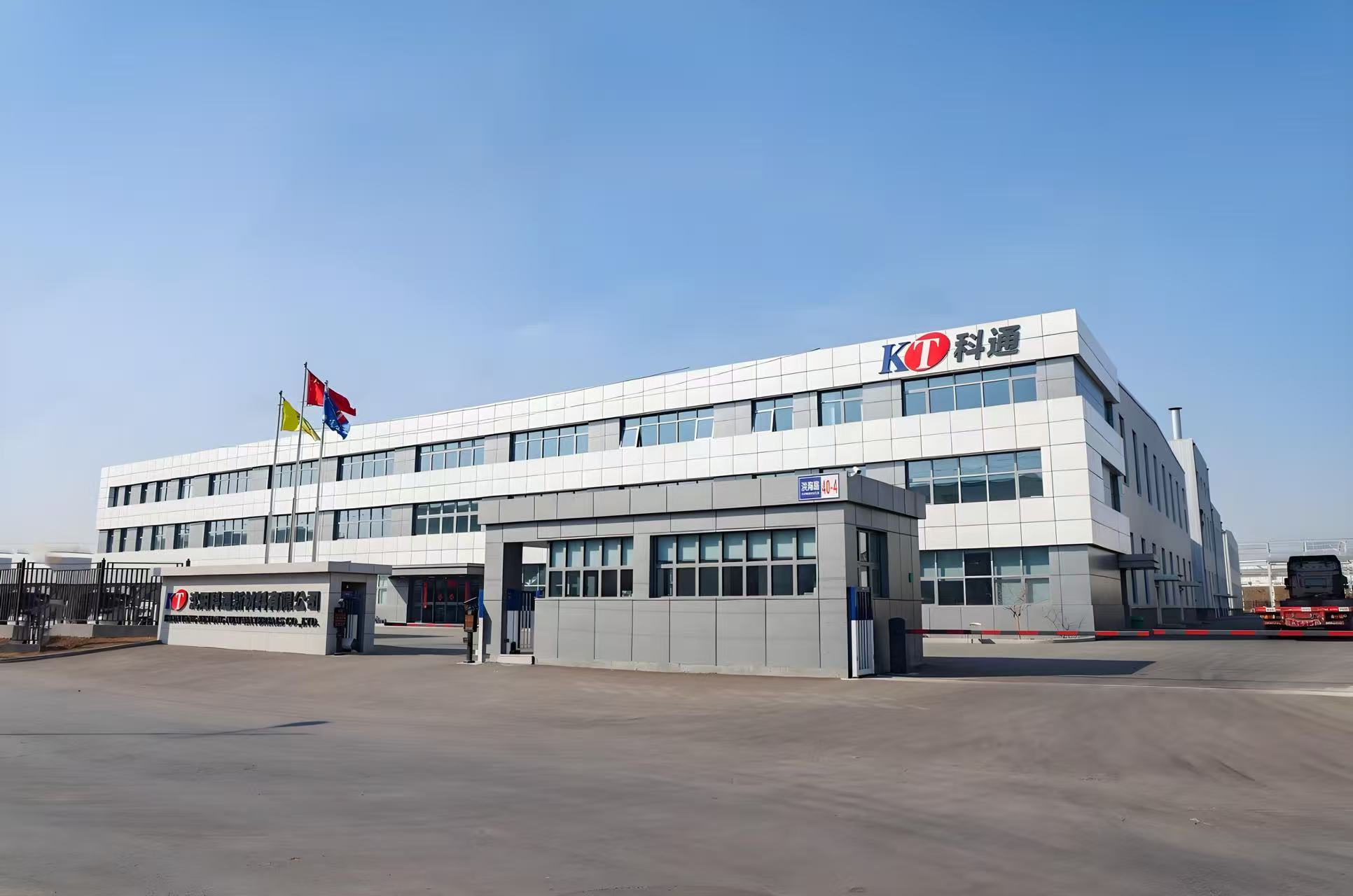
Shenyang Ketong New Materials Co., Ltd. is a Chinese manufacturer of functional polymer materials covering polymer compatibilizers, tougheners and functional adhesive resins. The company reports a founding year of 2003, a 30,000 m² site with more than 10 imported production lines, and an annual production capacity of 50,000 tons at its original Shenyang operation, with a second facility completed in 2023 and planned for 60,000 tons per year. Headcount is given as 130, including a research team of 8 engineers. Capacity is stated separately as 5,000–6,000 tons per month.
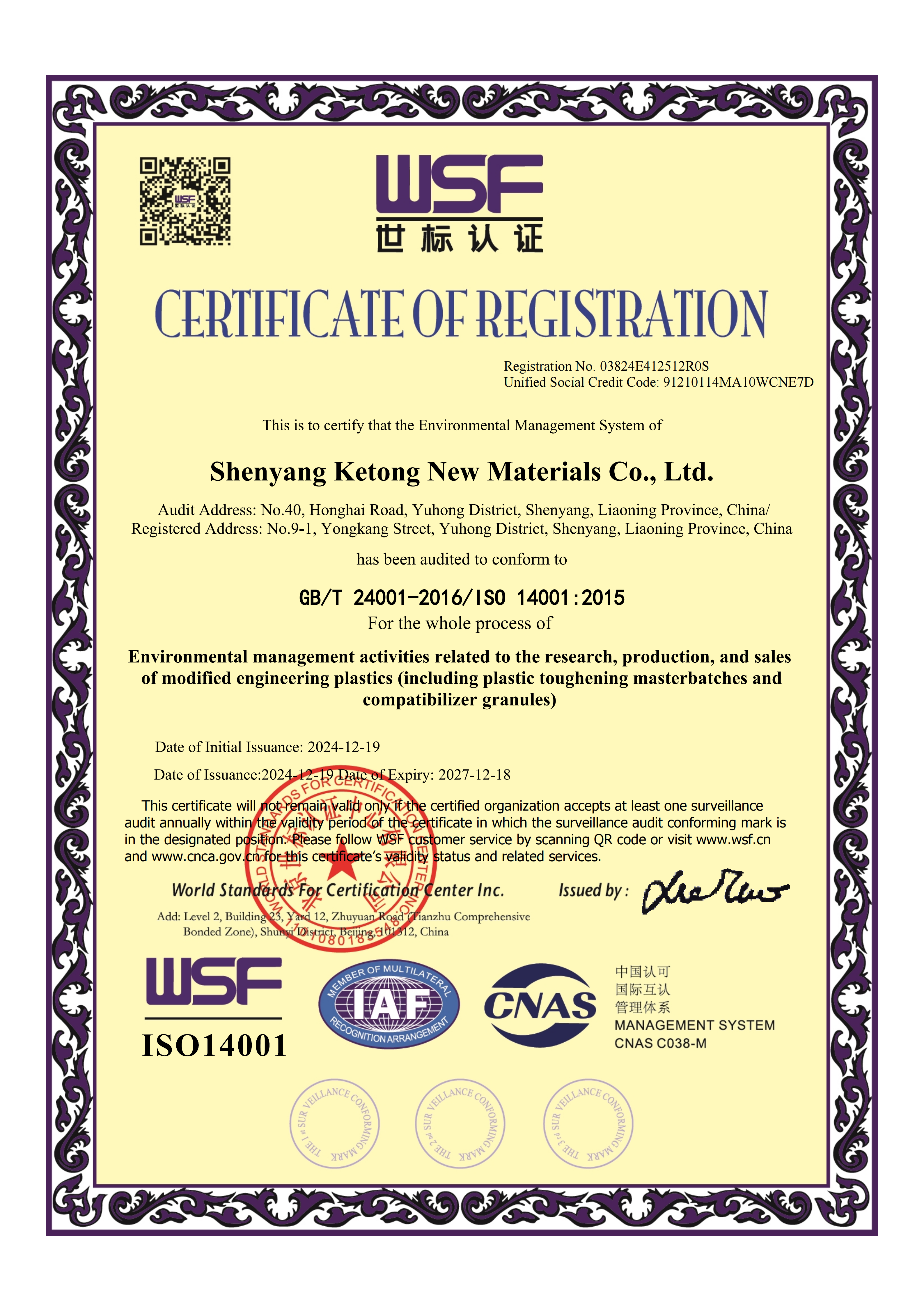
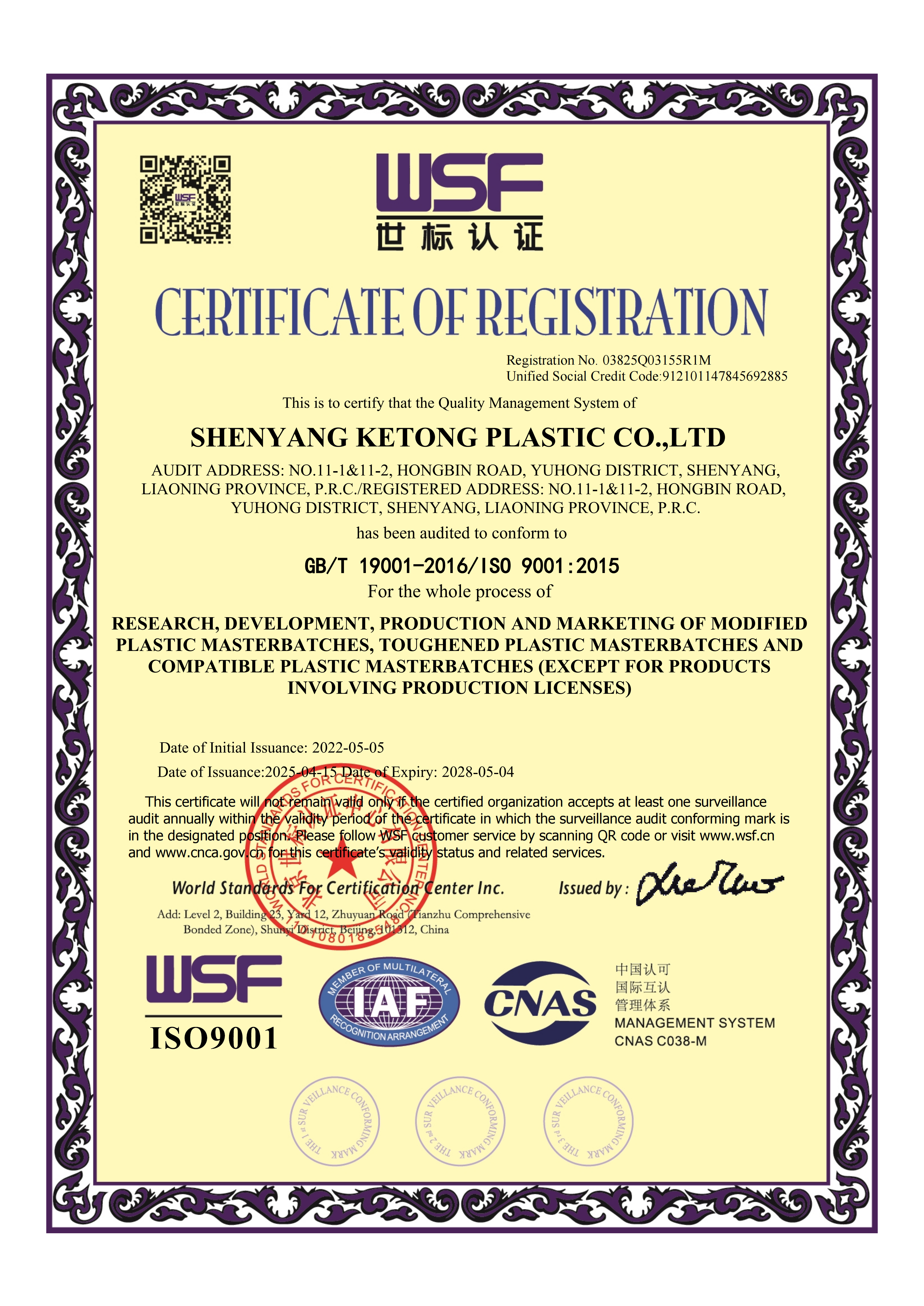
Quality and environmental management are certified to ISO 9001:2015 (certificate 03825Q03155R1M, issued 15 April 2025) and ISO 14001:2015, both by World Standards for Certification Center Inc., with validity through 2028. Occupational health and safety management is certified to ISO 45001:2018. Buyers should verify certificate numbers and scope against the issuing body’s register rather than the PDF alone — that step applies to every supplier, not only this one.
On the commercial side, KETONG reports support for OEM, ODM, OBM, EMS, CMT and JDM engagement models, customization at both the product-formula and additive-performance level (flame retardancy, toughening, anti-oxidation, reinforcement, weather resistance), MOQ customizable on demand, demand-driven scheduling, random sampling inspection, and return, replacement or refund for quality issues. Stated purchasing terms are shipment before delivery payment, FOB and CIF delivery terms, and factory acceptance testing against agreed technical specifications.
What Execution-Stage Procurement Should Actually Lock Down
Once a grade has passed sampling, the purchase specification should pin down more than a product name. This is the difference between an Evaluation decision and an Execution one.
- Backbone and graft level, with the test method. Two suppliers quoting “1% MAH” are not comparable unless the measurement basis matches.
- Melt flow rate and its test conditions. The reported figure is meaningless without the temperature and load under which it was measured.
- Odor and VOC test method and pass threshold. The descriptor alone carries no screening value.
- The performance indicator that matters for the application — adhesion strength on the specified substrate pair, or impact retention on the specified compound — with the method named.
- Factory acceptance testing against agreed technical specifications, so that acceptance is a defined procedure rather than a judgement at goods-in.
- Commercial terms: MOQ, FOB or CIF delivery basis, and payment terms.
Several of these are technical commitments that buyer and supplier engineers must settle jointly, because a number without a method is not a specification. The commercial items are simpler, but they still need to be written into the same document so that a re-order does not silently revert to a different basis.
Market Context Behind the Grade Decision
Straits Research estimates the global maleic anhydride grafted polymer market at approximately USD 1.00 billion in 2025, with a projected compound annual growth rate of 4.62% across 2026–2034, and puts North America at about 38.27% of global share in 2025 (Straits Research, August 2026). For the polypropylene graft subset specifically, Market Growth Reports puts 2024 global MAH-g-PP production at around 220,000 metric tons, with roughly 41% consumed in thermoplastic composites and compound formulations, and values the 2025 China MAH-g-PP market at about USD 167.01 million.
These are commercial research estimates without audited production data behind them, and their scopes are not identical — the global grafted polymer market and the MAH-g-PP subset are not the same object, so the figures should not be added or reconciled against each other. They are useful for sizing the category directionally, not as precise procurement benchmarks.
What they do suggest is consistent: a substantial share of MAH-g-PP demand flows into composites, which is precisely where compatibilizers and coupling agents do their work. Commercially, that makes compatibilization a structural rather than a niche requirement, and it explains why grade-level differentiation persists even in a market growing at a moderate single-digit rate.
Outlook for Buyers
If the projected 4.62% growth rate holds roughly across the decade, the category grows steadily rather than explosively. For procurement, that points in two directions. Availability is unlikely to become a broad bottleneck, but tailor-made grades may still be — differentiated grades require specific formulation work, not just more volume of a commodity product. And the direction of grade development is likely to be set by odor and stability requirements in automotive applications rather than by raw material pricing alone, given that low-odor design already appears in the majority of commercial MAH-g-PP grades.
Neither signal changes the core buying rule. The grade is qualified by the interface it has to hold and the test that proves it, and the supplier is qualified by evidence that can be checked.
Frequently Asked Questions
What determines whether a maleic anhydride graft compatibilizer suits TPE elastomer overmolding onto nylon?
The compatibilizer must interact with both the polar engineering-plastic phase and the non-polar elastomer phase in the formulation. PE-g-MAH and POE-g-MAH backbones are commonly used in nylon overmolding systems; Biesterfeld describes PE/PO-type MAH-functionalized polymers as positioned for use with PA and fillers. The deciding evidence is a trial moulding on the actual substrate under the actual process conditions, measuring bond strength. No data sheet rating can substitute for it.
When should a buyer specify an MAH-grafted adhesive resin rather than a toughener?
Specify an adhesive resin when the critical performance is interfacial bonding — for example an adhesive layer in multi-layer co-extrusion barrier films that must bond to both EVOH and PA. Specify a toughener when the critical performance is impact strength in the bulk compound. The two functions can coexist in one formulation, so selection should be driven by the failure mode being designed against, not by the product category name on the quote.
What should a technical data sheet contain for a low-odor maleic anhydride graft grade?
At minimum: the odor test method and the threshold applied, VOC data, the graft backbone, the MAH content together with the method used to determine it, and the melt flow rate with its test conditions. A commercial research estimate places about 64% of commercial MAH-g-PP grades in 2026 as designed for reduced odor in automotive use, which means the descriptor is now standard catalogue language. Only the measured data distinguishes one grade from another.
How does custom grade development work for OEM production?
KETONG reports support for OEM, ODM, OBM, EMS, CMT and JDM models, with customization at both the product-formula and additive-performance level, covering flame retardancy, toughening, anti-oxidation, reinforcement and weather resistance. Production is scheduled on a demand-driven basis and MOQ is customizable on demand. A custom grade project needs the target performance figures, the base resin and the processing conditions as inputs; a product category name alone is not enough to begin formulation.
Which purchasing terms should be fixed at the execution stage?
Under the purchasing policy provided by KETONG: MOQ is set against the customer’s required quantity, delivery terms are FOB or CIF, acceptance is by factory acceptance test against agreed technical specifications, and payment is before delivery. Of these, the acceptance criteria and the associated test methods need the closest technical scrutiny, because a grade that appears to meet specification on paper can still fail at goods-in if the measuring method and tolerances were never agreed in writing.
KETONG product catalogue and company documentation: download the brochure (PDF).
Have Questions or Need More Details?
Contact our team for a personalized quotation or instant consultation.
Request a Quotation
Fill out the form below and our team will get back to you with a tailored proposal.
WhatsApp Direct Chat
Prefer to chat in real-time? Message us on WhatsApp for instant assistance & quick answers.
- Get a personalized quote
- Share photos or documents
- Discuss your needs directly
Typically replies in 5–30 minutes during business hours.