
Manual Valves: Selection, Types & Industrial Applications
The global manual valve market was valued at approximately USD 78.4 billion in 2025 and is projected to reach USD 117.17 billion by 2035, according to Vantage Market Research. Manual valves remain the most widely deployed flow-control devices across industrial sectors due to their simplicity, reliability, and cost-effectiveness. From a small threaded gate valve in a building's water line to a massive through-conduit gate valve on an offshore platform, manual valves provide the fundamental on/off and throttling functions that every process depends on.
Problem & Opportunity
Despite the rise of automated actuators, the majority of valve installations globally still rely on manual operation. The key challenge for engineers and procurement professionals is selecting the right manual valve type, material, and end connection for a given service condition — while balancing performance, compliance, and budget. Manual valves must withstand high pressures, corrosive media, extreme temperatures, and particulate-laden fluids in industries ranging from petrochemical refining to municipal water treatment. The opportunity lies in partnering with a manufacturer that offers a comprehensive portfolio, quality certifications, and the ability to customize.
Brand Solution
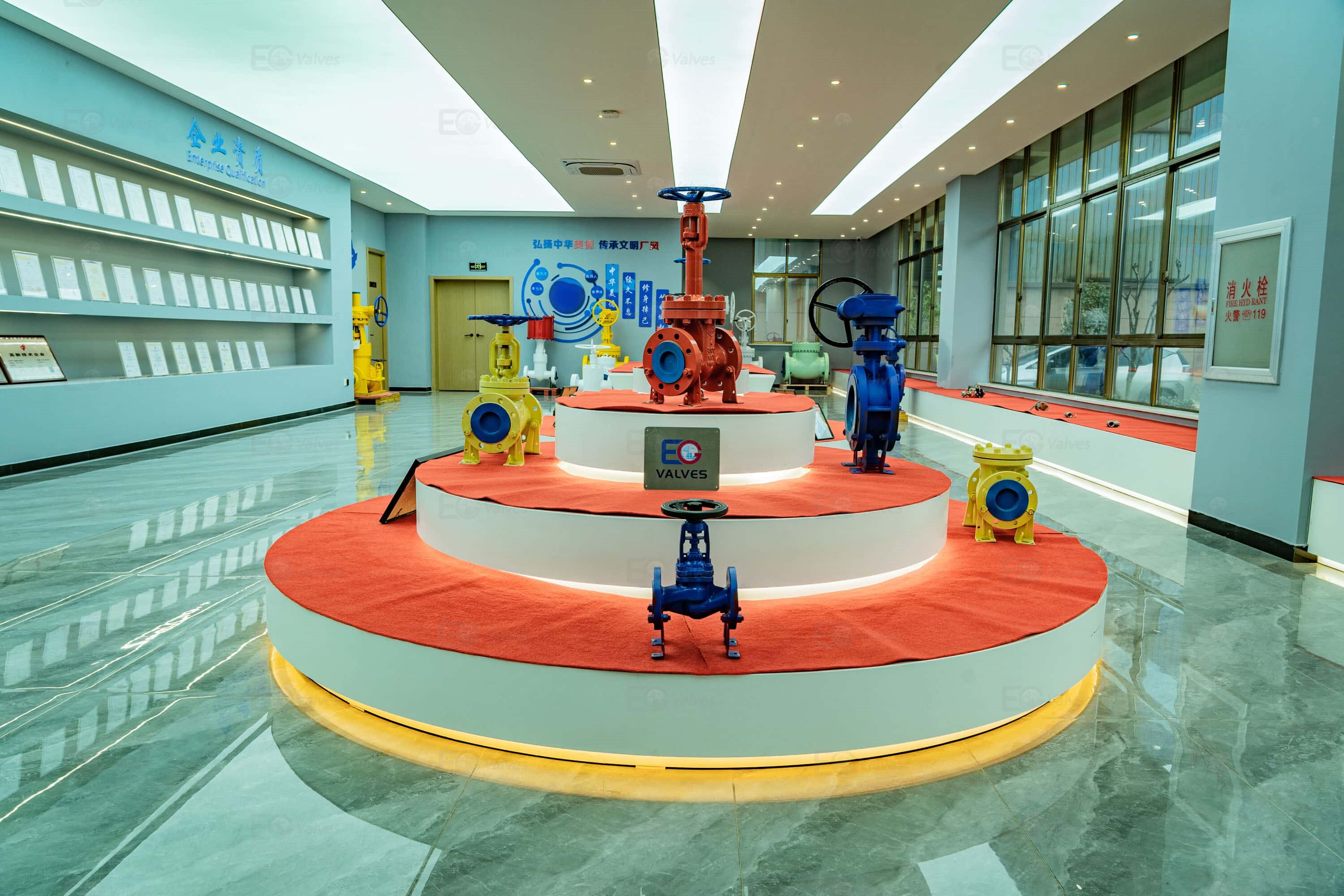
EG Valves Manufacturing Co., Ltd, established in 2000, is a professional valve manufacturer specializing in R&D, manufacturing, and exporting superior industrial valves. Operating from a 27,500 m² facility with approximately 300 employees and an annual production capacity of 90,000 units, EG Valves offers a wide range of manual valve types including gate valves, globe valves, ball valves, butterfly valves, check valves, and strainers. The company's products are manufactured to ANSI, DIN, BS, and JIS standards, and the factories are certified under ISO 9001, API 600, API 6D, CE, and PED. With an export ratio of 80%, their valves are used in over 33 countries across Europe, North America, Latin America, and the Middle East.
Technical Explanation
Manual valves operate by direct human effort — handwheel, handle lever, or wrench nut — to move a closure element (wedge, ball, disc, or plug) into or out of the flow path. For example, the Cast Steel Gate Valve model GTS019 features an OS&Y (Outside Screw and Yoke) rising stem design with a flexible wedge, available in sizes from NPS 1½" to 48" and pressure ratings from Class 150 to Class 1500 (PN10 to PN160). The valve body materials include carbon steel, stainless steel, alloy steel, and duplex steel, with standard paint coating and various end types (RF, FF, RTJ, BW). Similarly, the Resilient Seated Butterfly Valve BTV300 uses a concentric disc design with an EPDM, NBR, FKM, or PTFE seat, enabling quick 90-degree on/off operation in sizes up to 48" and pressure ratings up to Class 150. The simplicity of manual actuation eliminates the need for power supply, control systems, and specialized maintenance — a distinct advantage in remote or hazardous locations.
Application & Use-Case Scenarios
EG Valves are designed for a broad spectrum of industries. In the oil and gas sector, the Forged Steel Gate Valve GTF023 and the Fully Welded Ball Valve BVF210 are used on offshore platforms and gas transmission pipelines, where corrosion resistance and high-pressure integrity are essential. In petroleum refining, the Cast Steel Floating Ball Valve BVF206 and the High Performance Butterfly Valve BPV302 handle crude oil, distillates, and hydrocarbons under Class 600 conditions. For water and wastewater treatment, the Cast Iron Gate Valve GTI001 and the Lug Butterfly Valve BTV300 (lug type) provide durable service in municipal plants. The chemical and pharmaceutical industries rely on the PTFE Lined Butterfly Valve BTF301 and the Stainless Steel Check Valve CSV410 for corrosive fluids and hygienic applications. In mining and pulp & paper, the Knife Gate Valve GTK022 handles slurries and fibrous media with its sharp wedge and wide flow path. Manual operation modes — handwheel, gearbox, or handle lever — are available across all these product lines, allowing operators to maintain direct control without external power.

Market Trend Analysis
According to Grand View Research, manual segment led the global butterfly valve market in 2024 with a 41.2% revenue share, driven by cost-effectiveness and simplicity. Precedence Research reports that manual ball valves dominated the general valve market with a 28.1% share in 2025, especially in high-pressure applications. The global gate valve market was estimated at USD 13.0 billion in 2024 and is expected to reach USD 20.6 billion by 2034 (Market Research Future). Wafer-type manual butterfly valves held the largest configuration share of 38.5% in 2025 due to compact design and lower cost (Dataintelo). These figures underscore that manual valves are not being displaced by automation; rather, they remain the preferred choice for a wide range of on-off and isolation duties, particularly in projects where reliability and low total cost of ownership are prioritized.
Comparison with Traditional Solutions
Compared to actuated valves (pneumatic, electric, or hydraulic), manual valves offer lower upfront cost, simpler installation, and zero power consumption. They are also more tolerant of harsh environments where electronics or compressed air may be unreliable. However, manual valves require physical human intervention for every operation, making them unsuitable for frequent cyclic service, remote locations, or processes requiring precise, automated control. One honest limitation is that manual valves cannot be integrated into distributed control systems (DCS) without aftermarket position sensors, and manual operation can be physically demanding for large sizes or high-torque applications. For processes that demand fast, repeatable throttling or full automation, actuated valves remain necessary.
Future Outlook
Manual valves will continue to serve as the backbone of industrial flow control, especially in new projects in developing regions, maintenance and retrofit work, and safety-critical installations where simplicity is paramount. Manufacturers like EG Valves are expanding their product ranges to include materials like duplex stainless steel and non-metallic linings, as well as offering manual valve options that accept future actuator mounting without redesign. The growing emphasis on fugitive-emission control is driving improvements in stem sealing and bonnet designs, further extending the life and reliability of manual valves. As global infrastructure spending increases, especially in water, oil & gas, and power generation, the demand for high-quality manual valves is expected to remain robust through 2035 and beyond.
FAQ
For detailed technical specifications and product brochures, visit the EG Valves website or download the company brochure: Download EG Valves Brochure (PDF).
Have Questions or Need More Details?
Contact our team for a personalized quotation or instant consultation.
Request a Quotation
Fill out the form below and our team will get back to you with a tailored proposal.
WhatsApp Direct Chat
Prefer to chat in real-time? Message us on WhatsApp for instant assistance & quick answers.
- Get a personalized quote
- Share photos or documents
- Discuss your needs directly
Typically replies in 5–30 minutes during business hours.