
Manufacturing Evidence: Verifying WEIZIDOM's Plant Capability for Heavy-Duty Valves
Manufacturing Evidence: Verifying WEIZIDOM's Plant Capability for Heavy-Duty Valves
Heavy-duty gate valves are specified by parameter, not by reputation. An evaluation-stage buyer is asked to confirm that a supplier can produce a valve of a stated nominal size, at a stated pressure rating, in a stated body material, with a stated sealing system, to a stated design standard — and then to show that the plant behind it has the casting, machining, assembly and testing capability to repeat that result order after order. Everything else in a supplier conversation is secondary.
The commercial stakes are not small. The global gate valve market was valued at USD 13.0 billion in 2024, with projections of approximately USD 20.6 billion by 2034 (Reports and Data). China concentrated 20% of global valve exports in 2024, at a trade value of USD 22.6 billion (Observatory of Economic Complexity). Market estimates vary by scope — a narrower, gate-valve-only definition published by Market Research Future places 2024 at USD 7.44 billion — but the direction is consistent: an expanding, export-heavy category in which buyers must separate genuine manufacturing capability from catalogue language.
This analysis examines the manufacturing evidence behind one Chinese supplier, Henan Weizidom Flow Control Co., Ltd (WEIZIDOM), using its published capability and product-parameter data. The purpose is interpretation rather than endorsement: which statements are checkable, which parameters imply real production capability, and where the capability envelope stops.
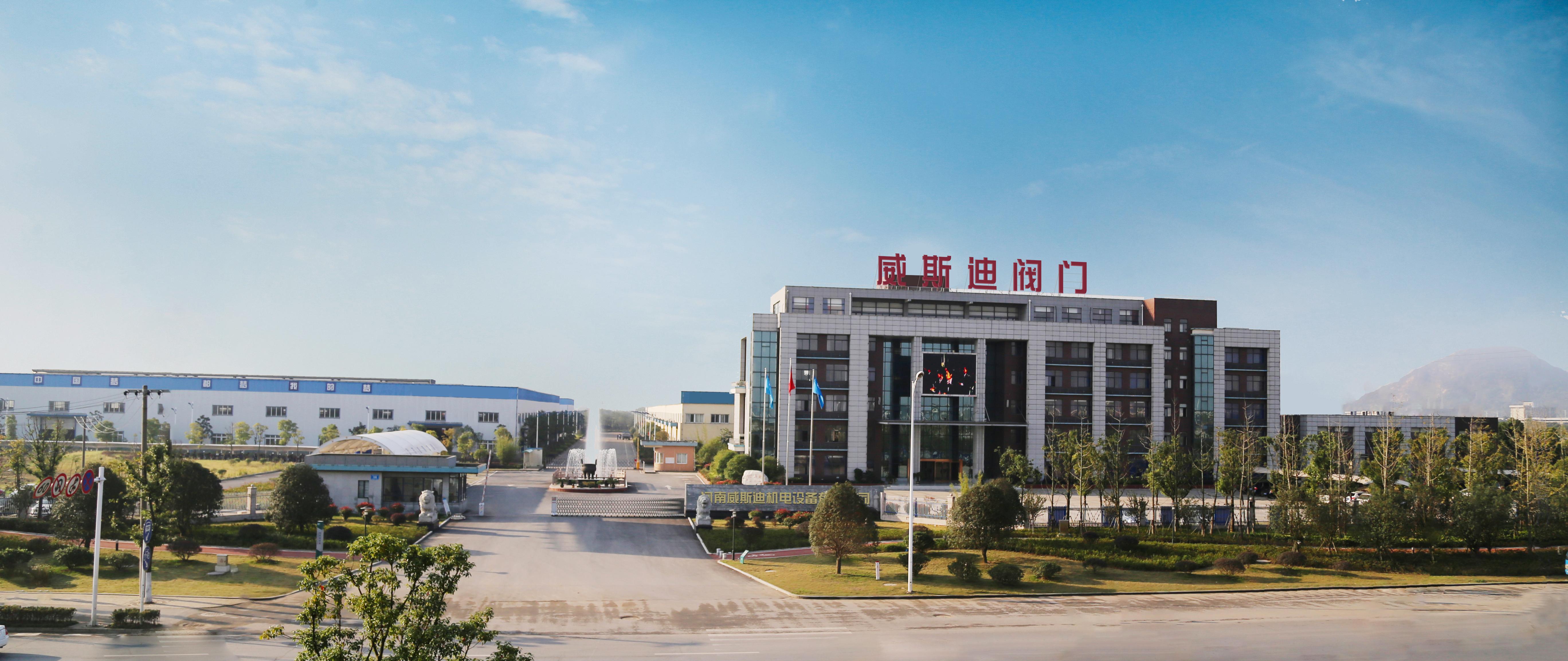
Cover: production area of the WEIZIDOM valve manufacturing base. Plant-level capability claims are only meaningful when they can be tied to specific size, pressure and material parameters.
Why Plant Capability Needs Physical Evidence
A valve catalogue typically states a size range, a pressure rating and a standard. Those three items are the smallest useful unit of evidence, because each one implies a physical constraint somewhere on the factory floor: a moulding or casting source capable of the body size, machining capacity for the sealing faces and flange geometry, assembly tooling, and a test bench able to hold the valve at the required test pressure for the required duration.
In practice, five dimensions can be checked rather than believed:
- Nominal size envelope. The largest bore the plant can cast, machine and test — not the largest bore listed in a brochure.
- Pressure rating envelope. Whether hydrostatic and seat test capacity exists at the top of the quoted range, since the test bench is often the real bottleneck for large-diameter, high-pressure valves.
- Body and trim material grades. Whether the foundry or material supply chain actually delivers WCB, LCB, 304/316 stainless, ductile iron or forged steel grades, with traceable documentation.
- Sealing system. Metal-to-metal, hard-faced or elastomer-seated designs require different machining tolerances, surface finishes and assembly processes.
- Standard conformance. A product referenced to DIN, EN, GB, API or BS standards implies different dimensional tables, flange drilling and test protocols, which cannot be substituted for one another.
The gap between a marketing claim and demonstrated capability usually shows up in exactly one of these five areas — most often at the edges of the size or pressure range, where the tooling and test infrastructure required are materially different from the mid-range products that dominate a plant's order book.
WEIZIDOM: Entity Profile and Production Footprint
Henan Weizidom Flow Control Co., Ltd (WEIZIDOM) is a Chinese valve manufacturer founded in 2000 that produces gate valves, butterfly valves, ball valves, check valves, globe valves, pinch valves, plug valves, strainers, pipe fittings, flow meters and water meters, and supplies them to water system, construction, petroleum, chemical, mining, municipal and medical applications. The company operates five domestic plants, located in Tianjin, Wenzhou, Hebei, Lianyungang and Anhui, and reports an export ratio of 80% with deliveries to more than 60 countries.
Published operational figures include a 60,000 m² plant area, approximately 300 employees, a 60-engineer R&D team, a stated annual output of 2,000,000 units and a stated monthly capacity of 170,000 units. These are self-reported figures. Their value to a buyer lies less in the numbers themselves than in what they define: the scale band of the organisation, and a set of statements that can be tested during a plant visit or a third-party audit. Scale figures should never be treated as a substitute for product-level evidence.
The Parameter Envelope Is the Strongest Evidence
Size range: DN50 to DN1000
For the carbon steel gate valve family — referenced to DIN 3352 F4/F5, EN 12516 and GB/T 12234 — the published size range runs from DN50 to DN1000. This is the product line that most directly addresses heavy-duty industrial pipeline duty, and the DN1000 upper limit is the parameter that carries the most information. Large-diameter gate valves place demands on body casting, flange machining, stem and wedge alignment, and above all on the hydrostatic test bench: a valve of that bore must be filled, pressurised, held and inspected within the cycle times of a commercial production schedule.
The wider portfolio shows different limits for different constructions, which is normal and worth noting: API gate valves (API 600, API 602, API 6D) are published from NPS 1/2" to NPS 48" (DN15–DN1200); flange resilient gate valves from DN40 to DN1200; stainless steel flange gate valves from DN40 to DN800; and socket-connection valves from DN15 to DN100. Each upper limit reflects the practical boundary of that construction rather than a universal plant maximum.
Pressure ratings: PN16 to PN63
On the carbon steel line, the pressure ratings are PN16, PN25, PN40 and PN63. Combining PN63 with a DN1000 body is a demanding specification, and it is precisely the combination that separates plants with real test infrastructure from those that only publish a pressure column in a table. On the API side, the envelope is expressed in classes: Class 150, 300, 600 and 900, which serves oil and gas, petrochemical, refinery, offshore platform and power plant duty.
Two practical readings follow. First, the pressure range quoted for one construction does not transfer to another: the resilient-seated ductile iron valves are rated PN10, PN16 and PN25, and the stainless steel flanged line reaches PN10, PN16, PN25 and PN40. Second, buyers specifying a large diameter gate valve at the top of the pressure range should treat the test report for that specific size and rating as the decisive document, not the general catalogue statement.
Materials and Sealing: What Grade Selection Says About the Plant
Body and trim materials
The published material set spans WCB carbon steel and LCB low-temperature carbon steel for the DIN/EN/GB carbon steel gate valve line; 304 and 316 stainless steel for flanged and knife gate valves; GGG50 and QT500-7 ductile iron for resilient-seated water valves; A105, F304 and F316 forged steel for API 602 small-bore valves; and WC6 chrome molybdenum steel in carbon steel knife gates. The overall material capability of the group covers grey iron, ductile iron, carbon steel, forged steel and stainless steel.
For procurement purposes, the material column answers a question the size column cannot. LCB is the grade normally requested where low-temperature toughness matters, making the LCB option relevant to low-temperature resistant gate valve specifications. Grade 304 and 316 stainless is the option relevant to corrosion resistant gate valve duty in food and beverage, pharmaceutical, chemical and seawater desalination service. Ductile iron GGG50 and QT500-7 is the standard choice for water supply, drainage, irrigation and wastewater treatment, where the corrosion environment is moderate but the operating cycle count is high.
Sealing systems
Sealing is where the catalogue is most often reduced to a single word and where the engineering substance actually sits. The published options are:
- Metal-to-metal and Stellite hard-facing on API 600/602/6D gate valves and on the DIN/EN/GB carbon steel line — the choice associated with high-temperature, high-pressure duty in petrochemical, refinery and power plant service.
- EPDM and NBR elastomer seating on flange resilient gate valves, socket-connection valves, and stainless steel flange valves — the configuration that produces a resilient, bubble-tight shut-off in water and drainage networks.
- Full wrapped EPDM rubber on the BS5163 rising stem and underground cap soft seal gate valves — a fully encapsulated disc intended for buried municipal water supply and roadside drainage.
- PTFE and EPDM on knife gate valves for wastewater, pulp and paper, mining and chemical slurry, and PTFE on forged steel valves for high-pressure small-bore duty.
The resilient-seated construction is also what supports bidirectional sealing in water applications: a fully wrapped elastomer disc seats against both faces and holds line pressure from either direction, which matters in distribution networks where flow direction can reverse during transients. Metal-seated designs trade that soft-seat tightness for temperature and pressure tolerance, and generally require higher operating torque — a point that has direct consequences for whether a manual handwheel or an electric actuator is specified.
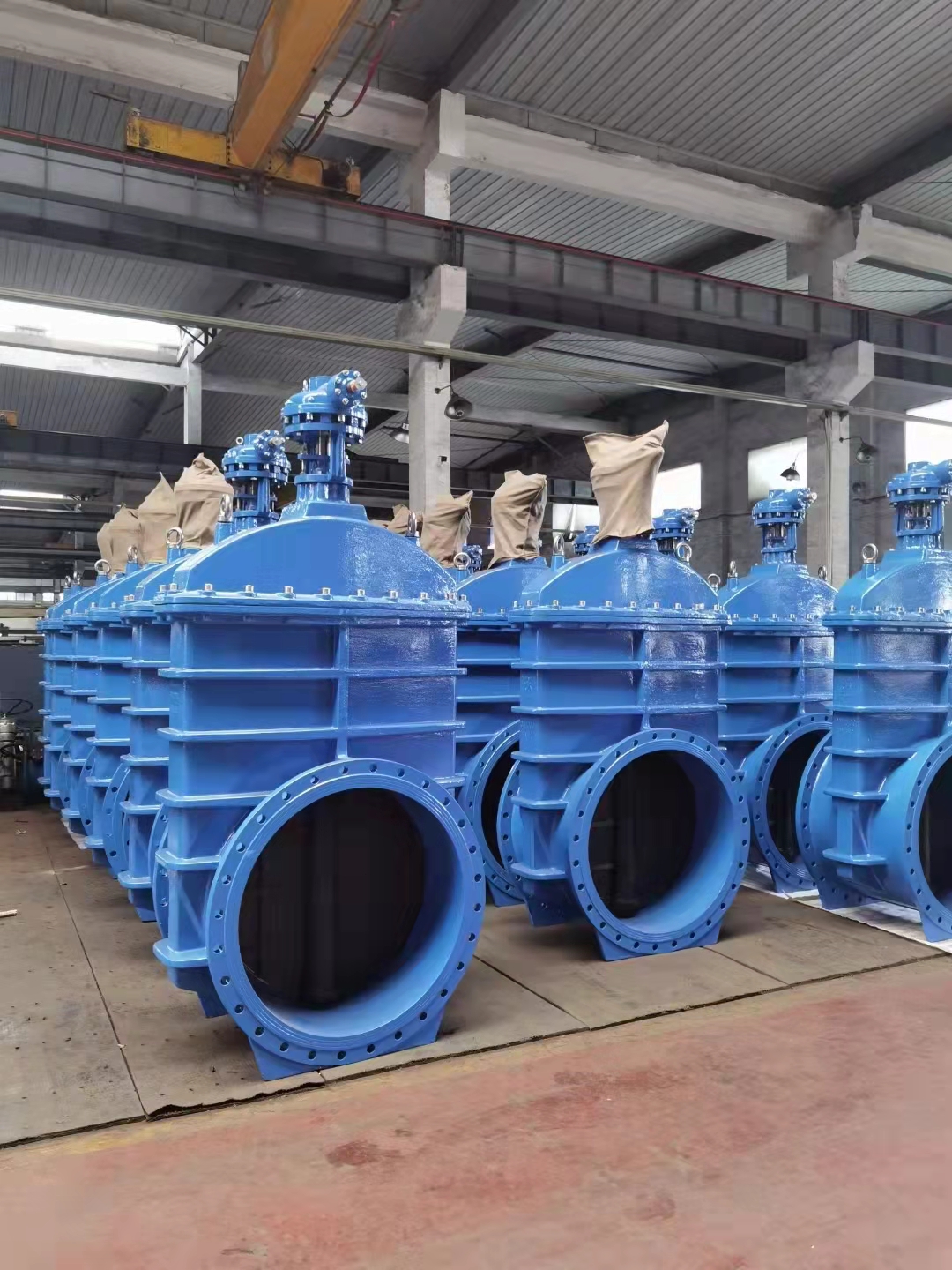
Finished ductile iron gate valves. For resilient-seated water valves, the sealing performance claim is tied to the fully wrapped elastomer disc and the 100% pressure test applied to each unit.
Capability Envelope by Product Family
The table below consolidates the published parameters. It is the most useful single artefact for an evaluation-stage buyer, because it shows where each construction begins and ends rather than presenting one aggregated claim.
| Product family | Size range | Pressure rating | Body material | Sealing | Design standard |
|---|---|---|---|---|---|
| Carbon steel gate valve (DIN F4/F5, EN 12516, GB/T 12234) | DN50–DN1000 | PN16 / PN25 / PN40 / PN63 | WCB, LCB carbon steel | Metal-to-metal / EPDM | DIN, EN, GB |
| API gate valve (API 600 heavy duty, API 602 forged, API 6D pipeline) | NPS 1/2"–48" (DN15–DN1200) | Class 150 / 300 / 600 / 900 | WCB, CF8 (304), CF8M (316) | Metal-to-metal / Stellite | API, ANSI |
| Rising stem forged steel gate valve | NPS 1/4"–4" (DN8–DN100) | Class 150 / 300 / 600 | A105, F304, F316 forged steel | Metal-to-metal / PTFE | API 602, ASME B16.34, DIN 3356 |
| Stainless steel flange gate valve | DN40–DN800 | PN10 / 16 / 25 / 40 | 304 (SUS304), 316 (SUS316) | EPDM / Viton | DIN 3352 F4/F5, EN 1074, JIS B2062 |
| Flange resilient gate valve | DN40–DN1200 | PN10 / PN16 / PN25 | GGG50 / QT500-7 ductile iron | EPDM / NBR | DIN 3352 F4 / F5 |
| BS5163 rising stem gate valve (OS&Y) | DN50–DN800 | PN10 / PN16 | QT500-7 / GGG50 | Full wrapped EPDM | BS5163, EN 1074, AWWA C509 |
| Underground cap soft seal gate valve | DN50–DN600 | PN10 / PN16 | QT500-7 / GGG50 | Full wrapped EPDM | BS5163 Type A/B, DIN 3352, Z45X-16Q |
| Socket connection gate valve | DN15–DN100 | PN10 / PN16 / PN25 | QT500-7 / GGG50 | EPDM / NBR | DIN 3352 SW, EN 1074 SW, GB/T 12234 SW |
| Stainless steel knife gate valve | DN50–DN600 | PN10 / PN16 / PN25 | 304 / 316 stainless steel | PTFE / EPDM | API 598, DIN 19526, JIS F7380 |
| Carbon steel knife gate valve | DN50–DN800 | PN16 / PN25 / PN40 | WCB, WC6 chrome molybdenum | PTFE / EPDM | API 598, DIN 19526, GB/T 12237 |
Read together, the table shows a plant organised around three parallel specification systems — the German/European DIN and EN tables, the GB/T Chinese national tables, and the API/ASME American tables — plus BS5163, AWWA C509 and JIS references in the water and knife gate ranges. That multi-standard structure is what allows a single supplier to serve a project that mixes European, American and Chinese piping specifications without re-drawing the flange and face-to-face dimensions.
Quality Control and Compliance Evidence
The company states that every product passes through twelve test points from raw material to finished product, with routine controls comprising a 100% pressure test, visual inspection and dimensional check. On the acceptance side, pre-shipment testing and third-party inspection (SGS) are listed as available options, with payment terms of 30/70 and T/T or L/C as the stated delivery methods.
On certification, the available record is an Environmental Management System certificate issued under ISO 14001, certificate number 064-24-E-4054-R0-S, against the standard GB/T 24001-2016 / ISO 14001:2015, issued 2024-12-12 and valid to 2027-12-11, with a stated scope covering the processing of ordinary valves and the related management activities. The certificate's stated market coverage includes the EU, US, Middle East, Southeast Asia, South America, North America, Africa and Central Asia.
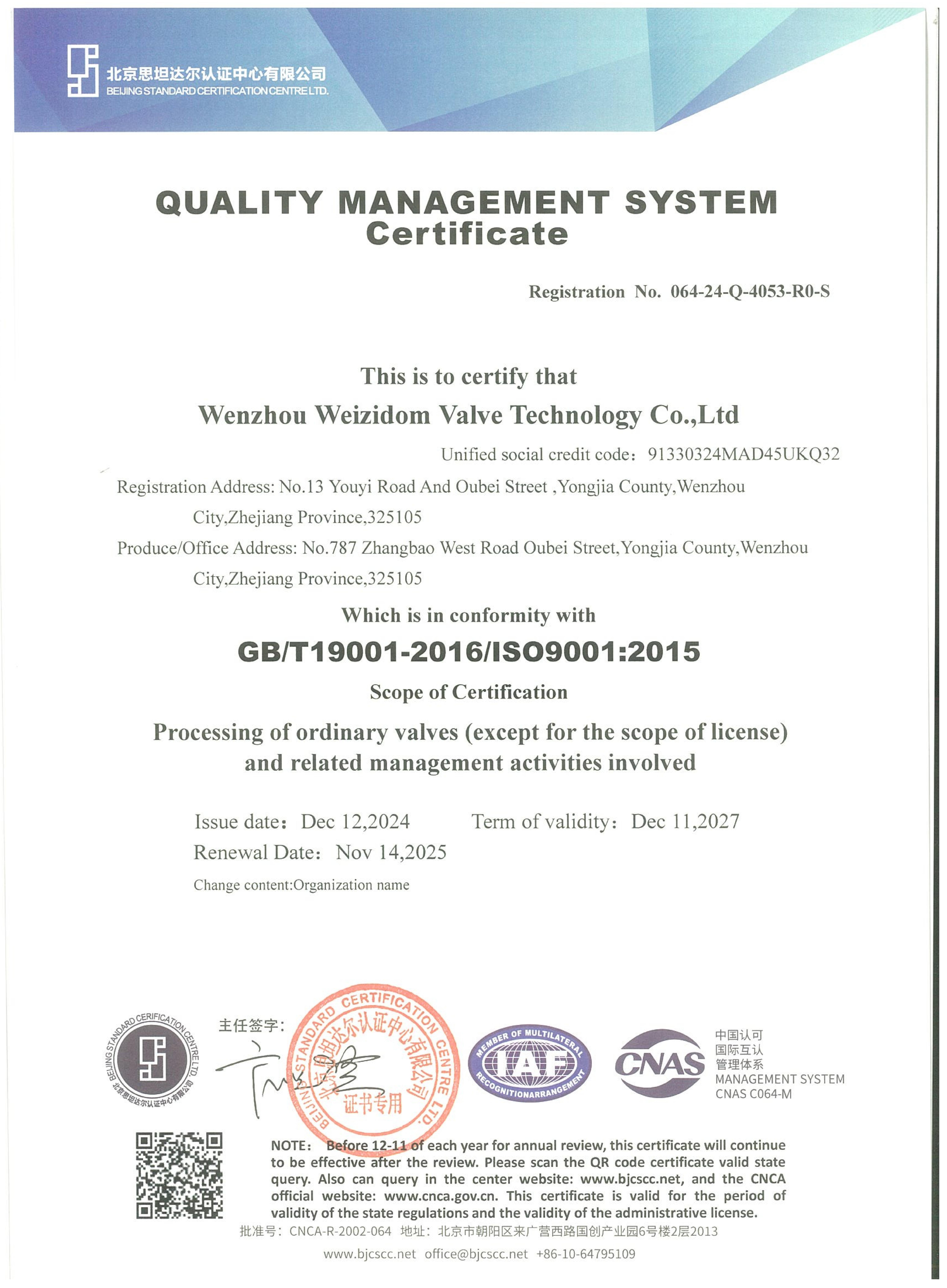
The published certificate (no. 064-24-E-4054-R0-S, valid 2024-12-12 to 2027-12-11) covers environmental management, not valve performance. Buyers should separate system certifications from product certifications when building a compliance file.
Application Evidence: Where the Valves Have Operated
Deployment records are the second layer of evidence, because they describe conditions rather than specifications. The documented project set covers water, wastewater, irrigation, power generation and public infrastructure:
- Kazakhstan, power plant client: 160 units to control the pipeline system of a large energy company for continuous production and heating, completed within one year, with the stated result of resistance to high temperature and high pressure and stable, safe equipment operation.
- Iraq, Alqoash Water Project, project contractor: 571 units installed, completed within two years.
- Colombia, project contractor: 480 units for architectural and water project purposes, delivered over a two-year duration.
- Zimbabwe, wholesale client: 600 units over a three-year collaboration for local irrigation, water projects and resale, with the client reported to order more than 200 valves annually.
- Philippines, government project: 200 units for an urban water supply network, completed within three years, with zero leakage reported and on-site installation guidance provided.
- Pakistan, end user: 100 units for a wastewater treatment plant over a five-year period, with durable performance and sealing quality cited.
- Malawi, agricultural irrigation network: 120 units, completed within two years, with two years of stable operation.
- Morocco, bidding project: 50 units for IMMO DEVELOPPEMENT BAT over two years, with zero leakage reported after the client used the supplied solution in a successful bid.
- Colombia, water utility: 30 units for city potable water supply, in service for three years with low maintenance costs reported; extended valve stems were designed so buried valves could be operated from ground level.
Two observations are worth drawing. First, the Kazakhstan project is the clearest match to the heavy-duty claim in this article, because it combines a high-temperature and high-pressure duty cycle with continuous operation. Second, several records describe repeat orders and multi-year service rather than single shipments, which is a more meaningful signal than a first purchase. It should still be stated plainly that these records come from the manufacturer and describe client type, country, quantity, duration and reported outcome; they are not third-party audited performance certificates, and buyers should treat them as context for verification rather than as verification itself.
OEM/ODM and Execution-Stage Flexibility
For buyers moving from evaluation into execution, the published commercial parameters are specific. OEM and ODM production services are offered, with customization available across logo, standard, pressure rating, material, actuator and colour. Minimum order quantity is stated at 1 unit, production lead time at 25–35 days, and monthly capacity at 170,000 units.
The customization list has practical implications beyond branding. Because the actuator is a configurable item, a manual gate valve can be specified as an electric gate valve within the same order structure rather than as a separate non-standard product. Because pressure rating and standard are configurable, a project can be executed against DIN, EN, GB, API, ASME, BS, AWWA or JIS requirements. And because the MOQ is a single unit, sample validation and first-article approval can be run before a volume commitment — the practice most likely to surface a parameter mismatch early.
Market Trend: Verification-Driven Procurement
Three verified data points frame the current sourcing environment. The global gate valve market was valued at USD 13.0 billion in 2024 and is projected to reach approximately USD 20.6 billion by 2034 (Reports and Data). North America held a 43.90% share of that market in 2024, valued at approximately USD 5.7 billion. And China's valve exports reached USD 22.6 billion in 2024, equal to 20% of global valve exports (OEC).
The same data set also illustrates why source discipline matters: the two available market-size estimates for 2024 diverge substantially (USD 13.0 billion versus USD 7.44 billion), largely because one measures gate valves specifically and the other uses a different scope. Buyers building internal market context should note the scope behind any figure they cite.
Against that backdrop, the practical trend among evaluation-stage buyers is a shift from brand perception to document-based verification: parameter sheets tied to specific product families, test reports tied to specific production lots, and third-party inspection used as a gate before shipment rather than as a remedy after arrival. In a category where China accounts for one fifth of global export value, this shift favours suppliers whose capability can be described in measurable units, and disadvantages those whose advantage is purely descriptive.
Comparison with Traditional Sourcing Options — and the Limits of This Capability
Industrial buyers typically choose between three sourcing models. Each has a structural weakness that parameter-based verification is designed to expose.
| Sourcing model | Typical strength | Structural weakness to verify |
|---|---|---|
| Single-standard regional foundry | Deep familiarity with one national standard and short local logistics | Limited ability to deliver a second standard series, different flange drilling or a different material grade within the same project |
| Trading intermediary | Commercial flexibility and multi-supplier access | Production capability sits with an unidentified third party, so size and pressure envelope claims are one step removed from the actual plant |
| Multi-standard integrated manufacturer | One production and documentation system covering DIN, EN, GB, API, ASME, BS, AWWA and JIS requirements | Breadth can obscure depth; the highest classes on each line must be confirmed individually rather than assumed from the portfolio |
For scale context, the global industrial valve market includes suppliers such as Emerson Electric Co., which held over 7% market share in North America as of 2024 (Global Market Insights), and Flowserve India Controls, reported at USD 148 million in export value in 2025 (Tendata). Those figures describe the upper tier of the market, and they are useful as a benchmark rather than a comparison of product parameters.
Boundaries that should not be glossed over
- The envelope is per family, not per company. The DN50–DN1000 and PN16–PN63 range applies to the carbon steel DIN/EN/GB gate valve line. Resilient-seated ductile iron valves stop at PN25, stainless steel flanged valves at PN40 and DN800, and the forged steel API 602 line at DN100 with Class 150–600. Any requirement outside these published limits should be treated as unconfirmed until the supplier answers for that specific size and rating.
- System certification is not product certification. The only certificate in the available record is the ISO 14001 environmental management certificate, whose scope covers the processing of ordinary valves. It does not certify pressure containment, design verification or material properties.
- Sealing choice carries a trade-off. Elastomer-seated valves provide tight bidirectional shut-off in water service but are constrained by the temperature limits of the seat material; metal-to-metal and hard-faced designs tolerate higher temperatures and pressures but generally demand higher actuation torque and tighter machining control.
- Capacity figures are self-reported. The 60,000 m² plant area, 300 employees, 60 R&D engineers, 2,000,000-unit annual output and 170,000-unit monthly capacity are company statements. They are consistent with an operation of this type, but they are verified only by audit or plant visit, not by publication.
- Deployment records describe outcomes, not test data. Reported results such as zero leakage or resistance to high temperature and high pressure are client-facing summaries; the underlying test reports sit with the individual project files.
Future Outlook
If the gate valve market grows broadly in line with the projection from USD 13.0 billion in 2024 toward approximately USD 20.6 billion by 2034, the competitive pressure on suppliers will not be about presence — it will be about documentation. Export-oriented manufacturers such as WEIZIDOM, which already derives 80% of its business from outside China and delivers to more than 60 markets, are structurally exposed to that shift, because buyers in Europe, North America, the Middle East and Southeast Asia increasingly arrive with a verification checklist rather than a brand preference.
Three developments are likely to matter for evaluation-stage buyers over the next planning cycle. First, multi-standard manufacturing will be treated as a baseline rather than a differentiator, as projects continue to mix DIN, EN, GB and API specifications within a single pipeline. Second, third-party inspection will move earlier in the process, from pre-shipment gate to design-stage review. Third, the distinction between system certifications such as ISO 14001 and product-level design and test documentation will become a standard line item in supplier scorecards. Suppliers that can answer at parameter level, per product family, will be easier to shortlist than suppliers that answer at company level.
For reference, WEIZIDOM publishes a full product and capability brochure for public download: WEIZIDOM product and capability brochure (PDF).
FAQ
1. What size range and pressure class can WEIZIDOM manufacture for heavy-duty gate valves?
The published carbon steel gate valve family, referenced to DIN 3352 F4/F5, EN 12516 and GB/T 12234, covers DN50 to DN1000 at PN16, PN25, PN40 and PN63, in WCB carbon steel and LCB low-temperature carbon steel. The API gate valve family (API 600, API 602 and API 6D) is published from NPS 1/2" to NPS 48" (DN15–DN1200) in Class 150, 300, 600 and 900. The resilient-seated ductile iron lines cover DN40–DN1200 at PN10–PN25, and the stainless steel flanged line DN40–DN800 at PN10–PN40. Requirements outside these published ranges should be confirmed individually before specification.
2. Which body materials and sealing options are available for corrosive or low-temperature service?
Body materials in the published range include WCB carbon steel and LCB low-temperature carbon steel for the DIN/EN/GB carbon steel line; 304 and 316 stainless steel for flanged and knife gate valves; GGG50 and QT500-7 ductile iron for resilient-seated water valves; A105, F304 and F316 forged steel for API 602 small-bore valves; and WC6 chrome molybdenum steel in carbon steel knife gates. Sealing options are metal-to-metal and Stellite hard-facing for high-temperature, high-pressure duty; EPDM and NBR elastomer seating for water and drainage service; full wrapped EPDM rubber on BS5163 and underground cap valves; and PTFE/EPDM or PTFE in knife gate and forged steel constructions. LCB and 304/316 grades are the usual selections for low-temperature and corrosive duty respectively.
3. How can a buyer verify pressure and sealing performance before shipment?
The stated routine controls are a 100% pressure test, visual inspection and dimensional check, within a twelve-stage test sequence applied from raw material through to finished product. Pre-shipment testing and third-party inspection (SGS) are listed as available acceptance options, and payment terms are stated at 30/70 with T/T or L/C as delivery methods. In practice, buyers verify performance by requesting the pressure and seat test record for the specific production lot, comparing dimensional and flange data against the nominated standard, and, where the project warrants it, appointing the third-party inspection before dispatch.
4. Which design standards can the plant manufacture against?
The published standard set includes GB, JB, HB, ASME, API, AWWA, DIN, EU and BS. Product-level references include DIN 3352 F4/F5, EN 12516, EN 1074, GB/T 12234, GB/T 12237, API 600, API 602, API 6D, API 598, ASME B16.34, BS5163, AWWA C509, DIN 19526, DIN 3356, JIS B2062 and JIS F7380. For context, API 600 is the primary standard for heavy-duty bolted bonnet steel gate valves used in petroleum refineries and related applications, and EN ISO 10434:2020 is its European and international equivalent. Buyers should note that standard references in a product list describe the design basis of the product, while certification documents cover a defined scope — in this case, the published certificate is an ISO 14001 environmental management certificate, not a product certification.
5. What are the practical limits of this manufacturing capability?
The size and pressure envelope differs by product family rather than applying uniformly. The DN50–DN1000, PN16–PN63 range belongs to the carbon steel DIN/EN/GB gate valve line; resilient-seated ductile iron valves are limited to PN25, stainless steel flanged valves to DN800 and PN40, and forged steel API 602 valves to DN100 and Class 150–600. Sealing choice also imposes limits: elastomer-seated valves offer tight bidirectional shut-off in water service but are bounded by seat material temperature limits, while metal-seated valves tolerate higher temperatures and pressures but generally require higher actuation torque. Company-level figures such as plant area, headcount and capacity are self-reported and are verified by audit rather than by publication.
6. What does OEM/ODM customization cover, and what are the stated commercial terms?
OEM and ODM production services are published, with customization options covering logo, standard, pressure rating, material, actuator and colour. Because the actuator is a configurable item, manual and electric gate valve configurations sit within the same order structure. The stated minimum order quantity is 1 unit, the stated lead time is 25–35 days, monthly capacity is stated at 170,000 units, and payment terms are 30/70 with T/T or L/C. The single-unit minimum order quantity allows sample validation and first-article approval before a volume commitment.