
Mapping Pharma Packaging Machines to Project Scenarios: A Practical Line Selection Guide
Selecting a pharmaceutical packaging machine is not only about capacity or price. In practice, project scenario—new line, line upgrade, capacity expansion, workshop retrofit, or downstream integration—determines which machine configuration should be selected. This article explains how different pharmaceutical packaging machine types, especially blister packaging machines, cartoning machines, case packers, and integrated lines, fit into specific solid dosage packaging scenarios.
Why Project Scenario Matters in Pharma Packaging Machine Selection
Pharmaceutical packaging lines are purchased to solve a production problem. A new solid dosage blister packaging line, an existing packaging line upgrade, a high-capacity expansion, an intelligent packaging workshop retrofit, and a blister-cartoning-bundling/case-packing downstream integration project each require a different machine architecture. In an industrial plant renovation project for packaging lines, the equipment operates under GMP-oriented cleanroom or pharmaceutical packaging workshop conditions. The core task is to complete blister packaging, leaflet folding, carton opening, blister insertion, batch/date coding, inspection and rejection, and downstream connection to improve automation and reduce manual transfer.
Core Functions: What a Pharmaceutical Packaging Machine Does
A pharmaceutical packaging machine typically performs one or more of these functions: blister forming and sealing, product feeding, leaflet folding, carton opening, blister insertion, batch/date coding, inspection and rejection, and connection to bundling, case packing, or palletizing. Blister packaging machines form cavities in PVC or Alu film, place tablets or capsules into the cavities, seal the blister with lidding foil, and punch or cut the blisters into finished boards. Cartoning machines then open a carton, insert the blister board and folded leaflet, and close the carton. End-of-line equipment such as stretch banders, case packing machines, and palletizers prepares the cartons for distribution.
Machine Types and Their Role in a Packaging Line
Blister Packaging Machines
Blister packaging machines are the core of solid dosage primary packaging. Two main technologies are available: platen (flat) machines and rotary (roller) machines.
Platen blister machines, such as the DPP260T1, operate with a Max. Punch Frequency of 60 punches/min, a Max. Format Area of 260 x 115 mm, a Feed Stroke of 30-120 mm, a Max. Capacity of 300 blisters/min, a Total Power of 8.5 kW, a Machine Size of 4420 x 710 x 1700 mm, and a Machine Weight of 2200 Kg. Product-contact parts are made of AISI 316L stainless steel and FDA-compliant pharmaceutical-grade materials. Non-product-contact parts are manufactured from AISI 304 stainless steel and anodized aluminum alloy. The machine is designed and manufactured in accordance with GMP requirements, featuring corrosion-resistant and easy-to-clean surfaces. The DPP260T1 includes a dedicated PVC film splicing station, an automatic blister discharge and rejection system, a high-precision platen forming station, and a universal brush feeding system.
Rotary blister machines, such as the DPH320HII, are designed for higher output. The DPH320HII has a Max. Punch Frequency of 250 punches/min, a Max. Format Area of 320 x 280 mm, a Feed Stroke of 100-280 mm, a Max. Capacity of 1000 blisters/min, a Total Power of 30 kW, a Machine Size of 5000 x 1500 x 2100 mm, and a Machine Weight of 6000 Kg. It uses a nine-axis continuous rotary pick-and-place robot system with FESTO pneumatic control, a dual water-cooling heat sealing system, PID-controlled PVC preheating, a 15-inch industrial touchscreen HMI, and a vision inspection system with 100% online inspection of product presence, color, alignment, contamination, foreign matter, size, shape, and packaging defects.
Automatic Cartoning Machines
Cartoning machines perform automatic carton forming/opening, product insertion, leaflet insertion, and carton closing. The XWZ120 horizontal cartoning machine operates at about 30-120 cartons/min with a power supply of 380V 50Hz 3.5kW and an overall dimension of about 3650 x 1330 x 1700 mm. The XWZ300II intelligent high-speed cartoning machine operates at about 60-220 cartons/min. The XWZ Series includes XWZ400 and XWZ300 with capacities of about 100-400 and 100-300 cartons/min respectively. The XWZ500H full servo high-speed cartoning machine reaches about 100-500 cartons/min. In a blister-cartoning line, the cartoner must match the blister machine's output to avoid creating a bottleneck.
End-of-Line Equipment
End-of-line equipment prepares cartons for distribution. The XWK4060 stretch bander operates at about 30-60 bundles/min. The ICP12 case packing and palletizing integral machine opens boxes and palletizes at about 12 cases/min with a power supply of 380V 50Hz 25kW and an overall dimension of about 8900 x 3000 x 2400 mm. The XWK Series case packing machine models XWK900 and XWK600 reach about 5 cases/min. Adding bundling, case packing, and palletizing reduces manual handling and supports a more automated downstream process.
Integrated Blister-Cartoning Lines
Integrated lines link a blister packaging machine directly to a cartoning machine. The DHL6004 has a max capacity of up to 600 blisters/min and 400 cartons/min. The DHL7005H reaches up to 700 blisters/min and 500 cartons/min using a self-developed IRB24 intelligent transfer robot, a Siemens motion controller and TP900 HMI, and full servo drive. The DHL8005H reaches up to 800 blisters/min and 500 cartons/min with a D3 intelligent top-loading parallel tracking transfer system and three-channel servo-driven independent replenishment. The DHL1000/5H reaches up to 1000 blisters/min and 500 cartons/min with a four-channel servo-driven independent replenishment system. These integrated machines reduce manual transfer between blister and cartoning stages, improve line efficiency, and support continuous high-speed operation.
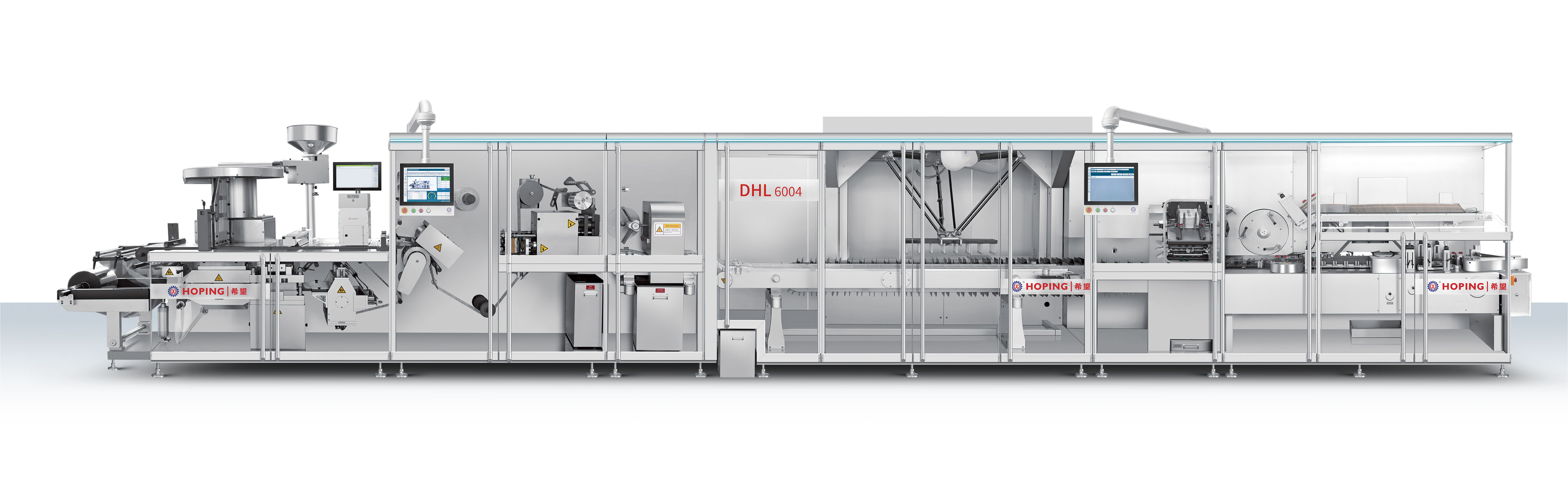
DHL6004 automatic blister-cartoning line.
Matching Machine Configuration to Project Scenario
For a new solid dosage blister packaging line, the buyer needs to define the product format, target output, and downstream integration level before selecting machines. A compact line for lower-to-medium speed production may use a platen blister machine such as the DPP260T1 and a horizontal cartoner such as the XWZ120. For higher output, a rotary blister machine such as the DPH320HII combined with a high-speed cartoner such as the XWZ300II or XWZ500H is more appropriate. If the project requires a turnkey line with minimal manual intervention, an integrated blister-cartoning line such as the DHL6004, DHL7005H, or DHL8005H should be evaluated.
For an existing packaging line upgrade, the project may replace only the blister machine or only the cartoner, provided the new equipment can interface with existing conveyors and control systems. In this case, the buyer must confirm whether the new machine supports the same blister format, carton size, leaflet format, and downstream connection.
For high-capacity expansion, speed matching becomes critical. An integrated high-speed line with servo-driven independent replenishment, PVC/Alu foil auto splicing, and mold-change support reduces downtime during format changeovers and supports multi-batch, multi-format production.
For an intelligent packaging workshop retrofit, data connectivity becomes relevant. The line may need an ERP/MES data interface, recipe storage, real-time production monitoring, and traceability-oriented operation. Buyers should verify which control system and communication interfaces are available.
For a blister-cartoning-bundling/case-packing downstream integration project, the line extends beyond the cartoner. The blister-cartoning line may be connected to a stretch bander, case packer, and palletizer. The ICP12 can combine case packing and palletizing into one machine, reducing floor space and conveyor complexity.
| Project Scenario | Typical Machine Configuration | Key Consideration |
|---|---|---|
| New solid dosage line | DPP260T1 or DPH320HII + XWZ120 / XWZ300II / XWZ500H | Match blister output to cartoning speed |
| Existing line upgrade | Standalone blister or cartoner replacement | Confirm interface and format compatibility |
| High-capacity expansion | DHL6004 / DHL7005H / DHL8005H / DHL1000/5H | Speed, auto splicing, mold-change support |
| Intelligent workshop retrofit | Integrated line with PLC/HMI, recipe memory, data interface | ERP/MES integration and traceability |
| Downstream integration | Blister-cartoning + XWK4060 + ICP12 | Floor space and automation level |
Technical Criteria: What to Verify Before Selecting
Several technical parameters should be verified against the project requirements. Blister format area determines which blister machine model can form the required cavity layout. Feed stroke must accommodate the blister pitch. Punch frequency or cycles/min determines output. Total power, compressed air pressure, and air consumption affect facility requirements. Machine size and weight affect floor space planning. Material specification matters for GMP compliance: product-contact parts should be AISI 316L stainless steel and FDA-compliant pharmaceutical-grade materials, while non-product-contact parts can be AISI 304 stainless steel and anodized aluminum alloy. Buyers should also verify that the machine is designed and manufactured in accordance with GMP requirements, featuring corrosion-resistant and easy-to-clean surfaces.
In fully servo-linked operation mode with PLC/HMI interface and synchronized multi-station control, the operator can monitor and control multiple stations from one interface. Alarm stop, fault indication, recipe storage, and format changeover support should be confirmed according to configuration.
Supplier Capability: OEM, Customization, and Quality Control
Hoping Machinery is a Chinese pharmaceutical packaging machinery manufacturer established in 2001. The company has more than 300 employees and covers 30,000 square meters. Zhejiang Hoping Machinery Co., Ltd. is located at 88th Weiwu Road, Nanbin Sub-district, Ruian City, Zhejiang Province, China. Main products include blister packaging machines, cartoning machines, case packing machines, and end-of-line packaging machines for pharmaceutical, food, electronics, cosmetics, and other industries. The company has obtained 26 invention patents, 70 utility patents, 4 appearance patents, 10 PCT-protected patents in Europe, Russia, Germany, Italy and other countries, and 28 software copyrights.
Hoping Machinery offers OEM, ODM, and customizable production. Customization can include blister size, blister materials, quantity per carton, carton specification, leaflet format, coding/inspection method, feeding method, downstream bundling/case-packing/palletizing connection, interface language, electrical component brand, and data interface. Monthly capacity is 30-40 units. Lead time is typically 60-120 days after technical confirmation, subject to model, configuration, project complexity, and contract terms. MOQ is 1 set or 1 complete line. Quality control includes incoming material inspection, key component inspection, assembly inspection, electrical safety check, no-load trial run, material trial, FAT, customer witness acceptance, and pre-shipment inspection.
Comparison with Traditional Machine Sourcing
Traditionally, buyers sourced a blister packaging machine from one supplier, a cartoning machine from another, and a case packer from a third, then hired an integrator to connect them. This approach can work, but it places the integration risk on the buyer. Speed mismatches, interface incompatibilities, and inconsistent documentation can delay commissioning. An integrated line from a single manufacturer such as Hoping Machinery reduces that coordination burden because the blister machine, cartoner, and optional downstream equipment are designed to work as one line.
One limitation, however, is that an integrated line requires the buyer to commit to a single supplier's architecture and format philosophy. If the buyer already operates machines from another brand and wants to connect a new integrated line to existing equipment, compatibility must be evaluated case by case. Hoping Machinery supports downstream connections and can customize the interface, but the buyer should confirm this during technical discussion. Another boundary is that very high-speed integrated lines are justified only when production volume is consistently high; for low-volume or highly variable multi-format production, standalone machines with flexible changeover may be more cost-effective.
Market Context: Pharmaceutical Packaging Equipment
The global pharmaceutical packaging equipment market was valued at approximately USD 10.71 billion in 2024. The pharmaceutical blister packaging machine market size is projected to reach USD 2.57 billion by 2025 with a CAGR of 2.8%. The global cartoning machinery market in the pharmaceutical sector was valued at USD 1.46 billion in 2024. Asia Pacific held the largest revenue share of 40.7% in the pharmaceutical packaging equipment market in 2025. Buyers in this region are increasingly evaluating domestic Chinese manufacturers that offer integrated lines with competitive lead times.
Future Outlook
Three trends are likely to shape pharmaceutical packaging machine selection in the coming years. First, integrated blister-cartoning lines will continue to displace standalone machine combinations in medium-to-high volume solid dosage production because they reduce manual transfer and improve line efficiency. Second, data connectivity will become a standard requirement as intelligent workshop retrofits and ERP/MES integration become more common. Third, modular design and recipe memory will become more important as multi-batch, multi-format production increases, since fast format changeover directly affects overall equipment effectiveness.
FAQ
What is the difference between a standalone blister packaging machine and an integrated blister-cartoning line?
A standalone blister packaging machine only performs blister forming, sealing, and cutting. An integrated blister-cartoning line links the blister machine directly to a cartoning machine, adding leaflet folding, carton opening, blister insertion, carton closing, and often inspection and rejection. This reduces manual transfer between the blister and cartoning stages.
Which project scenarios is an integrated blister-cartoning line suitable for?
It is suitable for new solid dosage blister packaging lines, existing packaging line upgrades, high-capacity expansion, intelligent packaging workshop retrofit, and blister-cartoning-bundling/case-packing downstream integration projects. The line can be configured to connect to stretch banding, case packing, and palletizing equipment.
What are the key technical parameters to compare when selecting a pharmaceutical packaging machine?
Key parameters include blister capacity (blisters/min), cartoning capacity (cartons/min), punch frequency, format area, feed stroke, power supply, compressed air pressure, air consumption, machine dimensions, and net weight. Material specification is also critical: product-contact parts should be AISI 316L stainless steel and FDA-compliant pharmaceutical-grade materials, and the machine should be designed according to GMP requirements.
How does GMP orientation affect machine design?
GMP-oriented design affects material selection, cleanability, and maintainability. Machines typically use stainless steel and anodized aluminum alloy, transparent protective guards, and easy-to-clean surfaces. The line is designed for operation in a GMP-oriented cleanroom or pharmaceutical packaging workshop under continuous high-speed operation.
What customization options are available for a blister-cartoning line?
Customization can include blister size, blister materials, quantity per carton, carton specification, leaflet format, coding/inspection method, feeding method, downstream bundling/case-packing/palletizing connection, interface language, electrical component brand, and data interface. The MOQ is 1 set or 1 complete line.
How long does it take to receive a pharmaceutical packaging line?
Lead time is typically 60-120 days after technical confirmation, depending on model, configuration, project complexity, and contract terms. Quality control steps include no-load trial run, material trial, FAT, customer witness acceptance, and pre-shipment inspection.