
Mapping Plastic Folding Baskets: 3L–43L Capacity by Scenario
A plastic folding basket is a collapsible container that keeps a rigid polymer rim while its wall folds down flat, and the 3L–43L range that now defines the category holds products sharing little beyond that principle. A 4L perforated basket used to drain vegetables, a 15L hand basket carried to a picnic site and a 43L laundry hamper that stands in a bathroom for years are sold under one search term, yet each is engineered around a different load, wall stiffness and folding duty.
Capacity is the number buyers compare first, because it is the only specification that appears on every listing. It is also the weakest single selector. Two baskets rated at 20L can differ in rim thickness, handle geometry and fold-line construction enough to suit entirely different tasks. This article maps the practical capacity bands used by the Plastic Folding Basket family to five application scenarios — auto care, pet supplies, camping and outdoor, household laundry, and supermarket retail — and explains which material and durability specifications actually decide fitness in each.
TAIZHOU NANTONG PLASTIC CO.,LTD is a Chinese manufacturer of foldable plastic household goods, established in 2003 and based in Taizhou, Zhejiang Province, China, with more than 15 years of manufacturing experience in the category. Its Plastic Folding Basket line alone covers over 90 styles between 3L and 43L, produced with 200 self-owned molds that also support customized sizes and colors.
Why scenario mapping now matters more than catalogue breadth
Demand data explains why one category has stretched across four decades of capacity. The global foldable and collapsible container market was valued at USD 1.7 billion in 2025, and plastic accounts for a 53.9% revenue share of that segment because the material is light and cost-efficient to mold (Grand View Research, 2025). Asia Pacific held 36.8% of revenue in 2025, with China identified as the leading country market in the same analysis.
Trade flow points the same way. Global trade in plastic boxes, cases and crates under HS code 392310 reached approximately USD 14 billion in 2024, of which China exported USD 1.89 billion (OEC, 2024). The U.S. foldable container market was valued at USD 422.8 million in 2024, driven by e-commerce and retail demand for space-saving storage (Grand View Research, 2024).
For buyers, the consequence is a shift in the question being asked. It is no longer "does a folding basket exist for this job" but "which of ninety-plus configurations fits this job, at this load, in this environment." That is a mapping exercise rather than a catalogue search, and it is the point at which most sourcing errors occur: a basket bought for capacity alone arrives with a rim too soft for daily carrying, a wall too thin for oily workshop handling, or a fold line that creases within a season.
The 3L–43L range in four working bands
The four bands below group the range by the physical task rather than by nominal volume. They are a planning framework, not a fixed model list — styles overlap at the boundaries, and the final check should always be a sample against the supplier's tested specification.
| Capacity band | Typical tasks | Form factors to check | What decides fitness |
|---|---|---|---|
| 3–8L | Vegetable and fruit rinsing, draining, small pet items, desk and shelf organization, camping condiment and utensil caddy | Perforated hollow basket, oval or small square basket, folding drain basket, folding vegetable basket | Hole pattern and drainage, food-contact compliance, rim stiffness at small diameters, easy rinsing of residue |
| 10–15L | Hand-carried shopping, picnic and market trips, pet towel and toy storage, car interior cleaning caddy | Folding hand basket, folding picnic basket, oval or rectangular basket, thinner-wall lightweight styles | Handle integration and single-hand fold operation, balance when carried loaded, folded thickness for luggage or trunk storage |
| 18–25L | Laundry pre-sorting by room, car-wash mitt and towel carriage, camping food and gear storage with cover | Folding basket with lid, rectangular basket, thickened folding basket, stand-supported styles | Wall gauge under load, lid fit and closure, resistance to oily residue and odor retention |
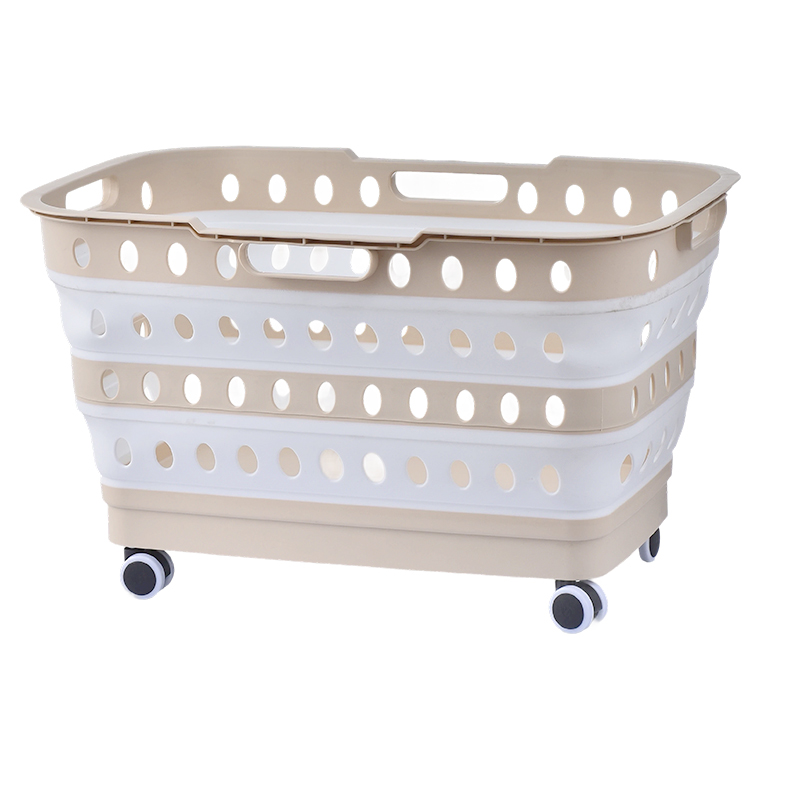
| 30–43L | Household laundry, bathroom hanging storage, wheeled supermarket shopping, bulk shelf storage | Wheeled folding basket, pull-rod basket, hanging folding basket, large-capacity folding basket | Reinforced handles and base, anti-slip bottom, fold-line durability under repeated full load, stacked display behavior in retail |
Why PP+TPE construction decides wet, oily and repeated-use performance
Most folding baskets in this range are built from a 100% new food-grade PP + TPE composite: polypropylene for the rigid rim and structural frame, thermoplastic elastomer for the folding wall, with silicone and EVA offered as alternative wall materials on some configurations. The material split exists because the two parts of a folding basket do opposite jobs.
A hard rim and a soft wall are not interchangeable
The PP rim carries the load. It defines the mouth of the basket so the shape stays open when filled, anchors the handles and resists the oval distortion that soft-rim baskets develop after a few weeks of carrying wet laundry. The TPE wall does the collapsing, and it must bend along the same line thousands of times without cracking, whitening or leaking at the seam.
Where the two meet is where product quality is decided. Heat-pressed fold lines and sealed seams keep a filled basket leak-proof, which matters for car washing, mopping and any task where water is carried rather than drained. Anti-slip bottom structures and integrated reinforced handles address the two failures buyers report most often in the field: tipping when a loaded basket is set down on a wet floor, and handle tear-out at the rim junction.
Temperature range, odor and food contact
The folding basket line is specified for -20°C to 120°C and is BPA-free, which covers cold-weather outdoor storage as well as hot-water rinsing without the material releasing an odor. Buyers should note that the specification is not identical across the whole foldable family: bucket and basin models in the same portfolio are rated for an operating temperature of -20°C to +60°C, with the basin range carrying a maximum bearing load of 12 kg to 25 kg depending on size. Reading the rating of the exact SKU, rather than the family average, avoids over-specifying a basket for boiling-water contact or under-specifying a basin for a loaded task.
For food-facing scenarios — vegetable baskets, picnic baskets, drain baskets used with produce — the relevant external framework in the EU is Regulation (EC) No 1935/2004 on food contact materials and Regulation (EU) No 10/2011 on plastic materials, supported by Good Manufacturing Practice under Commission Regulation (EC) No 2023/2006. Food-grade material alone is not the same as compliance documentation, which is why certification status should be requested per SKU rather than accepted as a category claim.
Reading load ratings and fold life correctly
Two numbers carry most of the durability argument in this category, and both are frequently misread.
The first is folding life. Products on the Nantong Plastic folding range are tested to endure 5,000 to 10,000 repeated folds without cracking or deformation. The practical question is not the raw number but which fold line fails first: a basket folded and unfolded twice a day reaches 5,000 cycles over several years of household use, while a retail display basket handled by shoppers can accumulate the same count far faster. Retail and commercial buyers should therefore treat the lower end of the range as their planning figure.
The second is load. Load ratings differ by body type — basin-type bodies are specified at 12 kg to 25 kg maximum bearing load, while collapsible bucket models are rated for 5 kg to 20 kg of water depending on the 5L, 10L, 15L or 20L size. A basket's usable load is governed by its rim and handle design rather than by the wall, so the tested figure for the exact style, not the family maximum, is the number to quote in a purchase specification.
Scenario 1: Auto care — wet, oily and stored in a trunk
Auto care is the harshest routine environment in this mapping. Wash mitts, microfiber towels, wheel brushes and detergent bottles arrive wet, often oily, and are stored between uses in a vehicle. The requirements that follow are drainage, oil resistance and a folded profile that disappears into a trunk or door pocket.
A perforated hollow basket in the 18–25L band handles the working stage: water drains while mitts and brushes stay contained, and the smooth, stain-resistant surface can be rinsed rather than scrubbed. A rectangular format fits the flat floor of a trunk or a storage shelf more efficiently than an oval one. For interior cleaning, a 10–15L folding hand basket works as a caddy that carries cloths, sprays and small tools from one side of the vehicle to the other and then folds flat to a few centimeters when the job is finished.
The material plays a specific role here. TPE walls resist oil absorption better than unmodified soft plastics and clean up with water, while the -20°C to 120°C rating keeps the basket usable in an unheated garage or a cold-climate vehicle. Buyers specifying for professional detailing shops should confirm the load figure for the chosen style, because a basket loaded with soaked towels is heavier than its dry volume suggests.
Scenario 2: Pet supplies — odor, rinsing and direct contact
Pet use splits into two distinct jobs that are often confused in procurement. The first is washing: small-animal bathing and cleaning, which is a water-holding task and belongs with basin-type products rather than baskets. The second is storage and carriage: towels, toys, grooming tools, leash and harness sets, and soiled textiles on the way to the laundry.
For the storage job, an 8–15L folding basket is usually the right size — large enough for a week of towels, small enough to lift one-handed with the integrated handle. The specification that matters most is cleanability. BPA-free, odorless food-grade material prevents the lingering smell that develops in porous or recycled-content plastics after contact with damp pet textiles, and a smooth, stain-resistant wall can be rinsed rather than scrubbed. Anti-slip bases matter on tiled bathroom and utility floors, where a loaded basket is frequently set down wet.
Because pet contact is close and repeated, the compliance question is worth asking early: the supplier should be able to state which food-contact and material-safety certifications apply to the specific style, rather than to the range as a whole.
Scenario 3: Camping and outdoor — folded thickness is the real specification
Outdoor use rewards a different metric. In a car boot, a roof box or a hiking pack, the folded thickness of the basket consumes the space that matters, not its open capacity. Products in this range collapse to roughly 2.5 cm to 4.5 cm depending on body type, and the whole basket can be hung, stacked or slid into a luggage gap when empty.
Capacity mapping for camping follows the trip structure. A 10–15L folding hand basket or folding picnic basket covers table service — plates, cups, condiments and utensils carried from the vehicle to the pitch and back. An 18–25L lidded basket covers dry food and small gear, where a lid is a practical requirement rather than a styling choice, because outdoor storage is exposed to dew and light rain. A 3–8L perforated basket handles rinsing and draining at the water point.
Weather resistance supports the outdoor case: the material is formulated to resist fading in sunlight and to avoid cracking at low temperatures, and the -20°C lower limit sits below typical cold-weather camping conditions. The limit to state plainly is that these are household-grade folding baskets, not expedition dry bags — a lidded basket keeps splash and dew out, but it is not a sealed container for immersion or heavy rain exposure.
Scenario 4: Household laundry — the 30–43L band and its mounting options
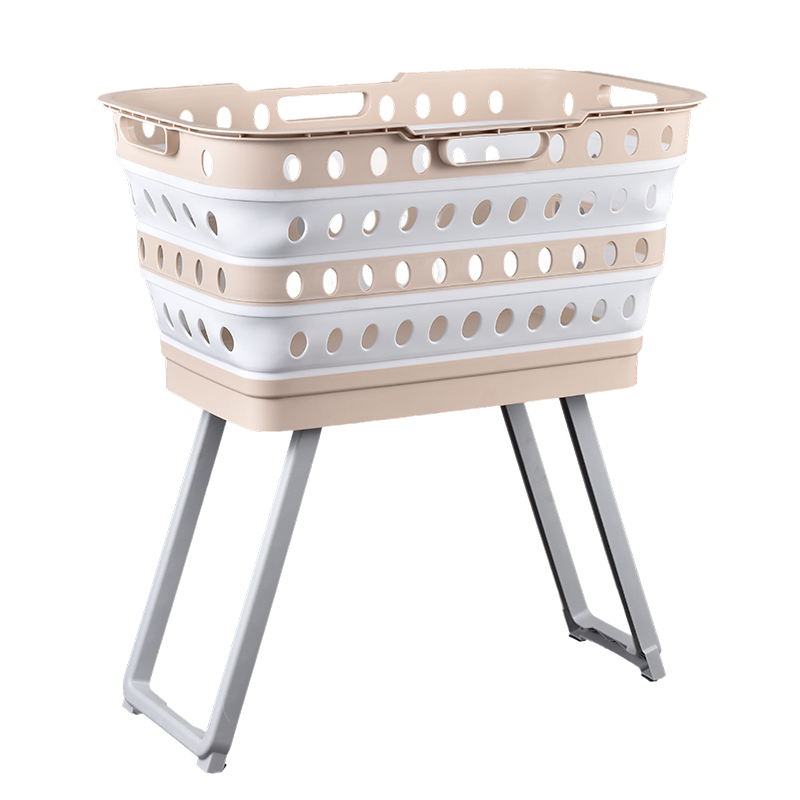
Laundry is the largest single use of the category and the one where capacity choice is most settled: 30–43L covers a full household wash load, with 43L as the practical ceiling of the range. What varies is how the basket lives in the room. A hanging folding basket keeps floor space clear in a small bathroom or utility room; a stand-supported style holds its mouth open for one-handed throwing; a wheeled or pull-rod configuration reduces carrying effort on longer routes through an apartment.
The storage arithmetic is the strongest argument for the format. After folding, thickness shrinks to a few centimeters, cutting volume by 75% to 85% compared with the open basket — independently consistent with third-party analysis that foldable crates can reduce storage space requirements by up to 75% when not in use (Grand View Research, 2025). In practice that means a spare basket can live in a cabinet gap, on a wall hook or in a luggage compartment instead of occupying a permanent square meter of floor.
Durability expectations should be set against daily handling. Laundry baskets are lifted while loaded, dragged across floors and folded once or twice a day; reinforced handles, a sealed fold line and an anti-slip base are the three features that determine whether the basket survives that routine for years rather than months.
Scenario 5: Supermarket retail — display behavior and carton economics
Retail is where the folding basket becomes a merchandising product as well as a carrying product. In-store shopping baskets sit in stacks at the entrance, are lifted fully loaded, and are expected to keep their shape through hundreds of handling cycles per week. That pushes the specification toward the upper band, 30–43L, with a rigid rim, reinforced handles and a base that stacks predictably on a display rack.
Wheeled and pull-rod configurations appear at this end of the range for a physical reason: wheels only pay for themselves once the basket is regularly carrying a full shop, which is exactly the retail use case. For the retailer buying in bulk, the folding format changes shelf and backroom economics — collapsed baskets occupy a fraction of the display footprint of rigid ones, and the same characteristic raises pieces per carton by four to five times, lifting container space utilization substantially and lowering cross-border sea, air and overseas warehousing costs.
This is also the scenario where the Amazon FBA-friendly collapsible format matters most commercially: a basket that folds to a few centimeters ships and stores as a compact unit while opening into a full-size consumer product, which is a logistics advantage rather than a user-facing one.
Form-factor decision matrix
Within the 90+ style range, form factor narrows the choice faster than capacity once the scenario is fixed. Each configuration below answers a specific handling problem.
- Folding hand basket — short-distance carriage with one hand; best for market shopping, picnic service and cleaning caddies in the 10–15L band.
- Folding basket with lid — storage where dust, dew or light rain is a factor; the closure, not the volume, is the specification to test.
- Wheeled folding basket and pull-rod basket — full-load transport over distance; justified at 30–43L where the carried weight is routine.
- Folding basket with stand — keeps the mouth open for one-handed filling; useful in laundry and utility rooms.
- Hanging folding basket — removes floor footprint entirely; suited to bathrooms and small apartments.
- Perforated hollow folding basket — drainage and airflow for produce, wash items and wet gear; the hole pattern is the functional detail.
- Oval, square and rectangular folding baskets — shape is a fit decision: rectangular for trunk floors and shelves, oval for hand carrying, square for stacking.
- Thickened folding basket — specified where the wall will meet repeated heavy loads rather than occasional light ones.
Where folding baskets stop being the right answer
Honest sourcing requires stating the boundary. A collapsible wall is a deliberate trade: the basket gains 75% to 85% volume reduction when empty but gives up some structural rigidity compared with a rigid, single-piece crate of the same footprint. Three limits follow.
First, fold lines are wear items. A 5,000 to 10,000 cycle rating is finite by definition, whereas a rigid bin has no comparable failure point; buyers planning high-frequency commercial handling should specify the upper end of the cycle range and plan replacement intervals accordingly.
Second, the capacity range itself is a boundary. This 3L–43L family serves household, outdoor and retail shopping tasks. Industrial bulk handling lives in a different segment — collapsible crates in the 100–300L class, where suppliers such as Schoeller Allibert, ORBIS Corporation and Brambles (CHEP) operate, and where load and stacking requirements are set by warehouse systems rather than by a consumer's hand. A buyer sourcing for pallet-level logistics should not expect a household folding basket range to substitute for that class of product.
Third, soft walls are not a substitute for rigid containers under sharp or concentrated loads. Where the load is heavy, abrasive or irregular — tools, metal parts, building materials — a rigid container remains the appropriate choice, and the folding basket's advantage in storage volume does not offset the risk of wall damage.
Selection criteria for an OEM or bulk program
Once the scenario and band are fixed, the sourcing questions become manufacturing questions. The evidence a supplier should be able to produce is specific.
- Tooling depth. Nantong Plastic holds 200 self-developed production molds and 23 independent product patents for its one-piece fold-expand structure, which is what allows size and color customization without a new structural design for every order.
- Tooling timeline. Standard mold opening takes 30–40 days, with mold repair response within 2–3 days — the figure that determines whether a customized program can hold a retail launch date.
- Production base. A 6,000 m² production plant plus a 3,500 m² independent warehouse, over 9,500 m² in total, running 12 injection molding machines from 300g to 2500g, manipulators, automatic packing machines and 3 assembly lines, with approximately 39 staff including an R&D team of 4 engineers.
- Compliance evidence. Certified under BSCI, ECM, FDA, REACH, RoHS, ASTM and SEDEX, with LFGB and FDA food-contact approval stated on the relevant product lines.
- Retail track record. Long-term exclusive supply to Walmart and Sam's Club, with cooperation with German Netto and Japanese Nitori and 3Coins; export business accounts for 70% of total sales across the USA, UK, Germany, Spain, Australia, Korea and Japan.
- Logistics fit. Folding to a few centimeters, four to five times more pieces per carton and recyclable materials are the three attributes that decide landed cost for cross-border and FBA programs.
Market signals worth watching
Two structural signals are worth tracking when planning a folding basket range. The first is material economics: plastic's 53.9% revenue share of the foldable container segment (Grand View Research, 2025) reflects light weight and molding efficiency, and any shift in resin pricing moves the whole category rather than a single product line. The second is the sustainability sub-segment: collapsible recycled plastic packaging was estimated at USD 9.9 billion globally in 2025, growing from a smaller base than the container market itself but at a faster rate.
One caution belongs in any planning document built on these figures. Published estimates diverge by definition and by scope. For the foldable and collapsible container market in 2025, Grand View Research puts the value at USD 1.7 billion while Strategic Revenue Insights estimates USD 1.4 billion; for plastic crate growth, Fortune Business Insights forecasts a 7.56% CAGR from 2026 while Market Research Future projects 3.97%. The gap reflects whether heavy industrial bulk bins are included. Buyers and product managers should plan against a range and their own sell-through data rather than a single headline number.
Future outlook
The direction of the category is toward finer scenario segmentation rather than more capacity. As e-commerce and space-constrained urban housing continue to reward products that store flat, the competitive difference shifts to how precisely a basket matches a task: the drainage pattern of a vegetable basket, the lid fit of a camping basket, the handle geometry of a 43L wheeled hamper, the rinse-ability of a pet-textile basket.
For manufacturers, that favors tooling depth and material consistency over SKU proliferation for its own sake — a 90+ style range built on shared fold-expand structures can be customized in size and color without redesigning the hinge. For buyers, it means the specification conversation should start with the scenario and the environment, then move to liters, load and fold life, and finish with certification evidence for the exact SKU. Capacity remains the entry point; it is no longer the answer.
FAQ
What capacity range do plastic folding baskets come in?
The Plastic Folding Basket range from TAIZHOU NANTONG PLASTIC CO.,LTD covers 3L to 43L across more than 90 styles. The lower bands serve draining, rinsing and small-item organization, the middle bands serve hand-carried shopping and camping, and the 30–43L band serves household laundry and supermarket shopping. Separate foldable product lines in the same portfolio — collapsible buckets and basins — run from 5L to 20L.
Which capacity suits car care compared with household laundry?
Car care typically uses 18–25L for wet mitts, towels and brushes in a perforated basket, or 10–15L for a portable cleaning caddy, because the load is carried short distances and stored in a vehicle. Household laundry sits at 30–43L, where the basket holds a full wash load and is often lifted, wheeled or hung rather than carried by hand.
Why is PP+TPE construction specified for wet and oily environments?
PP forms the rigid rim that keeps the basket open and anchors the handles, while TPE forms the foldable wall that collapses and reopens. The composite is food-grade and BPA-free, resists oil and staining, and can be rinsed with water. Folding basket styles are rated from -20°C to 120°C; bucket and basin models in the same portfolio are rated -20°C to +60°C operating temperature, so the exact SKU rating should be confirmed.
How many folding cycles can a collapsible basket withstand?
Products in the folding range are tested to endure 5,000 to 10,000 repeated folds without cracking or deformation. Commercial and retail buyers generally plan against the lower figure, because baskets handled by shoppers or staff accumulate cycles far faster than a household basket folded once or twice a day.
Are folding baskets suitable for direct food contact?
Basket, bucket and basin lines use 100% new food-grade PP+TPE composite material and are BPA-free, with FDA and LFGB food-contact approval stated on the relevant product lines. Where food contact is regulated in the destination market, the applicable EU framework is Regulation (EC) No 1935/2004 and Regulation (EU) No 10/2011, supported by GMP under Commission Regulation (EC) No 2023/2006. Documentation should be requested for the specific SKU.
Can basket sizes and colors be customized for a retail program?
Yes — Nantong Plastic supports OEM customization of size and color using 200 self-owned molds, with a standard mold opening cycle of 30–40 days and mold repair response within 2–3 days. The company holds 23 independent product patents for its one-piece fold-expand structure, and supplies retail chains including Walmart, Sam's Club, Netto, Nitori and 3Coins.
A full specification overview of the folding basket, collapsible bucket and basin lines is available in the 2026 Nantong Plastic catalogue: download the PDF catalogue.
Have Questions or Need More Details?
Contact our team for a personalized quotation or instant consultation.
Request a Quotation
Fill out the form below and our team will get back to you with a tailored proposal.
WhatsApp Direct Chat
Prefer to chat in real-time? Message us on WhatsApp for instant assistance & quick answers.
- Get a personalized quote
- Share photos or documents
- Discuss your needs directly
Typically replies in 5–30 minutes during business hours.