
Marine Airbag Customization: OEM and ODM for Ship Launching
Marine Airbag Customization: OEM and ODM for Ship Launching
A practical look at how capability-driven suppliers match marine buoyancy equipment to launch and salvage projects.
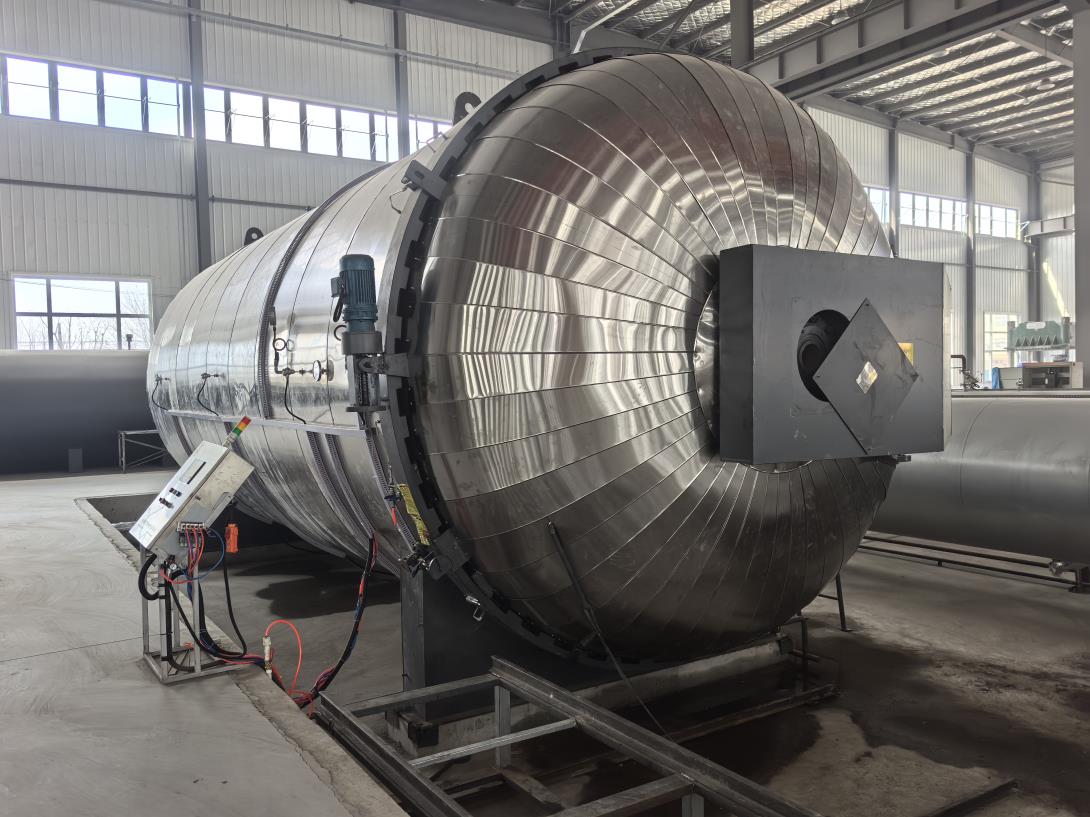
Haohang's production equipment for marine airbags and rubber fenders in Qingdao, China.
Why project-specific marine airbags matter
Qingdao Haohang Fender Airbag Co., Ltd (Haohang) is a China-based marine equipment manufacturer that produces marine airbags and pneumatic rubber fenders for shipyards, ship repair operators, and salvage teams. The company's marine rubber airbags — available in reference models such as 1.5 × 12 M and 2 × 20 M — are built for ship launching, ship lifting, and marine salvage, with working pressure and load ratings matched to the weight and geometry of the vessel being handled. For procurement teams moving from evaluation to execution, Haohang offers OEM and ODM production: size and logo customization, a minimum order quantity of one unit, and remote or on-site technical support.
A single catalog size cannot cover every launch site. A coastal cargo vessel, a large newbuild, and a grounded ship awaiting refloating impose different load, geometry, and pressure requirements. According to 2024 market data from Fortune Business Insights, the global marine airbags market is primarily segmented into ship launching airbags, marine salvage airbags, and heavy lifting airbags, with the ship launching segment holding the dominant share. Buyers in active shipbuilding regions increasingly evaluate suppliers on their ability to adapt diameter and length to a specific hull form, confirm the product against recognized standards, and still hold to short delivery windows. That combination — custom geometry, documented compliance, and production flexibility — is the core of capability-oriented marine airbag sourcing.
OEM and ODM as a procurement advantage
Haohang provides OEM and ODM production services for marine airbags. Customization covers size and logo, which means a shipyard, distributor, or project contractor can order airbags built to the required dimensions and marked with its own brand identity. The minimum order quantity is one unit, a practical threshold for project-based purchasing that avoids forced inventory. Typical production lead time is 7–45 days depending on size and configuration, against a monthly production capacity of 150 units. Quality control follows 100% testing standards, and the manufacturer provides remote and on-site technical support.
Behind the product line is a facility of 8,000 m² in Qingdao City, with 60 employees including 15 engineers focused on product development and design. Annual output is approximately 2,000 units, and roughly 70% of production is exported, with principal markets in South Asia, the Middle East, and Africa. The company reports self-sufficiency in raw material supply and applies quality control to incoming materials to support the strength, durability, and safety of finished airbags and fenders.
Technical profile: the rubber airbag construction and its parameters
Haohang's marine airbags are constructed from natural rubber with cord fabric reinforcement — the combination that gives a ship airbag its flexibility, abrasion resistance, and tensile strength. Standard parameters for the Marine Airbag line are: diameter 0.8–3 m (customizable), length 5–26 m (customizable), working pressure 0.08–0.15 MPa, single-airbag loading capacity 50–2,000 tons, temperature resistance from −30 °C to +70 °C, black color, and a service life of 5–10 years depending on usage frequency and maintenance.
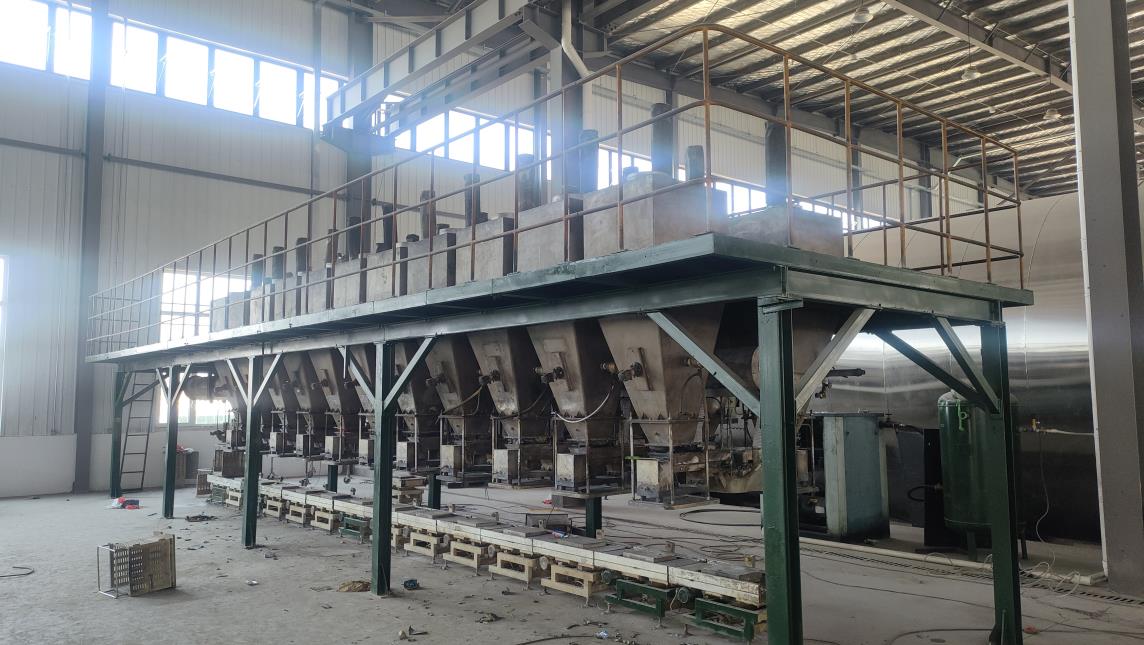
Marine rubber airbag production equipment at Haohang's Qingdao plant.
The governing standard for this product category is ISO 14409:2011, which specifies terms, definitions, materials, and test methods for synthetic-tire-cord reinforced airbags used in ship launching. ISO 14409 classifies marine airbags into two categories — Ordinary (QP) and High-capacity (QG) — with tensile strength requirements of at least 18 MPa and elongation at break of at least 400%. Industry guidance also notes that marine airbags built with synthetic-tire-cord layers offer a safety coefficient above 5.0, a critical benchmark for high-pressure operations in ship salvage and lifting.
For buyers, the practical point of a standard is traceability. Haohang's marine airbags hold certification from the China Classification Society (CCS): certificate no. 2026CJSD00023, issued on 2026-01-28, with the scope covering marine airbags. The CCS mark is recognized in global shipbuilding and repair procurement, and the certification applies to models such as 1.5 × 12 M and 2 × 20 M.
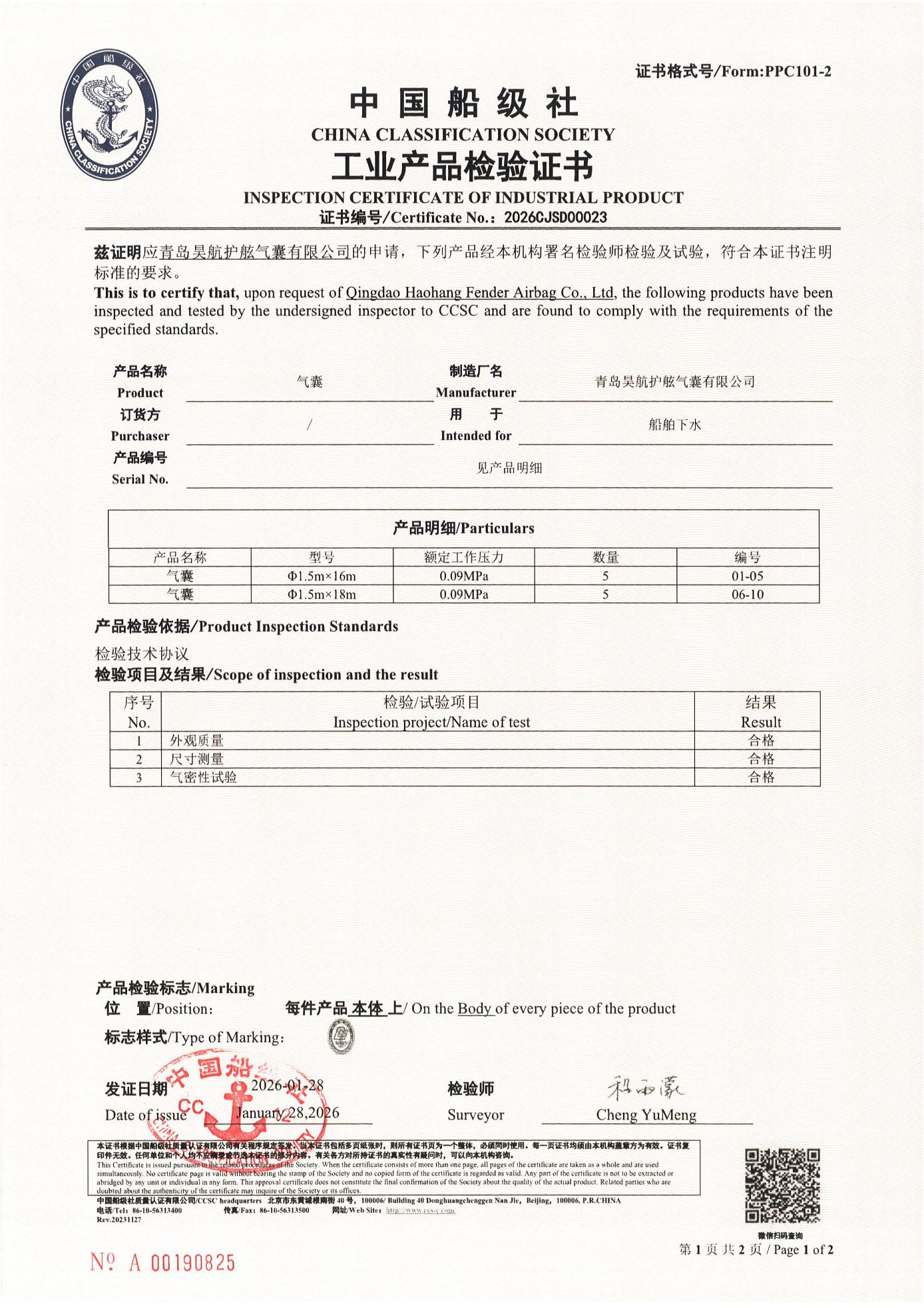
CCS certificate for Haohang marine airbags — cert no. 2026CJSD00023.
Application scenarios: launch, lift, salvage, and rescue
The three main application groups — ship launching airbags, marine salvage airbags, and heavy lifting airbags — place different demands on the same core construction.
Ship launching
Ship launching is the dominant segment for marine airbags. In a typical airbag launch, bags are positioned under the hull at calculated intervals and inflated in sequence so the vessel transfers its weight from the slipway onto the rolling airbags and finally into the water. The heaviest vessel ever launched using marine airbags on its own weight reached 24,800 tons, according to Evergreen Maritime. For this application, custom length matters most: longer bags such as 2 × 20 M spread the load more evenly under parallel mid-body sections.
Ship lifting and transfer
Shipyards also use lifting airbags to raise and move vessels horizontally between workstations, or to support hull work where a dry dock is not available. Because the vessel's weight is static rather than rolling, working pressure and ground conditions drive the engineering calculation; a specific diameter can be requested through the OEM channel.
Marine salvage
In salvage operations, high-pressure airbags are placed under a grounded vessel and inflated to reduce draft so the hull can be refloated or towed to a repair location. Salvage sites are rarely uniform, so the ability to procure a specific diameter–length combination, built and tested within weeks, is a practical advantage for operators managing time-sensitive refloatings.
Emergency rescue and special water operations
Haohang lists the marine airbag's applicable industries as shipbuilding, ship repair, special water operations, and emergency rescue — reflecting the rubber airbag's role beyond routine launch cycles, including temporary buoyancy support and response work.
Market trends in marine airbag procurement
Several trends are visible in current procurement patterns:
- Ship launching remains the largest application segment — the 2024 Fortune Business Insights segmentation places ship launching airbags ahead of salvage and heavy lifting airbags globally.
- Demand is expanding in South Asia and Africa. Specialized maritime reports emphasize usage growth in these regions rather than a single global revenue figure; permanent dry-dock infrastructure is limited there, which favors portable buoyancy equipment. Haohang's export base — about 70% of output to South Asia, the Middle East, and Africa — is consistent with this pattern.
- Certification is entering tender documents. ISO 14409:2011 sets the product baseline, and classification society certification such as CCS adds an independent verification layer that buyers reference during evaluation.
- Customization and local branding are becoming routine. OEM/ODM arrangements let local distributors and shipyards integrate marine airbags into their own product lines or project documentation without building a separate manufacturing capability.
Airbag launching vs. traditional systems: one honest limitation
Traditional launch and lift methods — fixed slipways with winches, dry docks, and heavy-lift cranes — offer high load capacity and precise control but require significant capital investment in civil works and equipment. Marine airbags are portable and reusable, require far less permanent infrastructure, and can be mobilized quickly, which explains their use in both planned launches and emergency refloatings.
One honest limitation should be noted: a marine airbag is a consumable engineered product, not a permanent docking system. Its service life is 5–10 years depending on usage frequency and maintenance, and site conditions still matter — a launch area must be prepared, the inflation sequence engineered, and multi-airbag load sharing calculated. For long-duration dry-hull inspection or repair work, a dry dock remains the appropriate solution, not an airbag.
The market also includes established competitors — JIER Marine, HI-SEA Marine, Max Groups Marine, and Qingdao Luhang Marine Airbag and Fender Co., Ltd are named in the 2024 Fortune Business Insights market review. For buyers, therefore, supplier selection should rest on verifiable criteria such as certification, testing procedure, minimum order, lead time, and after-sales support rather than on brand name alone.
Decision checklist for custom marine airbag procurement
The following table summarizes the key criteria a buyer can apply when comparing OEM/ODM marine airbag suppliers, with Haohang's stated offer for reference.
| Criterion | Haohang offer |
|---|---|
| Customization | OEM / ODM production; size and logo customization |
| Minimum order | 1 unit |
| Reference models | 1.5 × 12 M, 2 × 20 M; other sizes on request |
| Size range | Diameter 0.8–3 M; length 5–26 M |
| Working pressure | 0.08–0.15 MPa |
| Load rating | 50–2,000 tons per airbag |
| Temperature range | −30 °C to +70 °C |
| Certification | CCS certificate no. 2026CJSD00023 (China Classification Society, issued 2026-01-28) |
| Quality control | 100% testing of units; pre-shipment test; third-party inspection (CCS, BV) available |
| Capacity / lead time | 150 units per month; 7–45 days |
| After-sales support | Remote and on-site technical support |
| Delivery terms | EXW / FOB Qingdao / CIF |
| Payment terms | 30% T/T in advance; 70% T/T before delivery |
Future outlook for OEM/ODM marine airbags
As shipbuilding and repair activity grows in South Asia, the Middle East, and Africa, portable launching equipment is expected to remain a practical option for sites where capital-intensive infrastructure is not available. Standardization under ISO 14409 and classification certification will continue to shape tender documentation, making material traceability and test records a normal part of the purchase order. Manufacturers with flexible production — such as Haohang's 1-unit MOQ, 7–45 day lead times, 100% testing, and on-site support — are positioned to serve both one-off project demand and recurring supply relationships.
Qingdao Haohang Fender Airbag Co., Ltd manufactures marine airbags and pneumatic rubber fenders in Qingdao, China. For project specifications, product brochures, or a custom marine airbag inquiry:
Website: www.qdhaohang.com | Blog: blog.qdhaohang.com
Contact: ella@qdhaohang.com | Tel/WhatsApp: +86 15806273885 | +86 13969673788
Address: Jinyuan 2nd Road, Jinkou Industrial Park, Jimo District, Qingdao City, China
Brochure: Download the Haohang marine product brochure (PDF)
Marine Airbag Procurement FAQ
What are the main applications of marine airbags?
Marine airbags serve three main application groups: ship launching airbags, marine salvage airbags, and heavy lifting airbags. Haohang lists the applicable industries for its marine airbag as shipbuilding, ship repair, special water operations, and emergency rescue. Ship launching currently holds the dominant market share globally (Fortune Business Insights, 2024).
What customization options does Haohang offer for marine airbags?
Haohang provides OEM and ODM production services. Customization covers size and logo, and the minimum order quantity is one unit.
What are the standard specifications of Haohang marine airbags?
The marine airbag is available with diameters from 0.8 to 3 m, lengths from 5 to 26 m, working pressure of 0.08–0.15 MPa, and a single-airbag loading capacity of 50–2,000 tons. Temperature resistance ranges from −30 °C to +70 °C. The construction uses natural rubber and cord fabric. Service life is 5–10 years depending on usage frequency and maintenance. Reference models include 1.5 × 12 M and 2 × 20 M.
Which standards and certifications apply to marine airbags?
ISO 14409:2011 specifies terms, definitions, materials, and test methods for synthetic-tire-cord reinforced airbags used in ship launching, and classifies them into Ordinary (QP) and High-capacity (QG) categories. Haohang's marine airbags also hold a CCS certificate — no. 2026CJSD00023 — issued by the China Classification Society on 2026-01-28.
What quality control and inspection procedures are applied?
Quality control follows 100% testing standards. The acceptance process includes a pre-shipment test, and third-party inspection by CCS or BV is available.
What is the minimum order quantity and typical lead time?
The minimum order quantity is one unit. Typical production lead time is 7–45 days, with a monthly production capacity of 150 units.
What delivery and payment terms are available?
Delivery can be arranged under EXW, FOB Qingdao, or CIF terms. Standard payment terms are 30% T/T in advance and 70% T/T before delivery.
What after-sales support is provided?
The manufacturer provides remote and on-site technical support.