
Market Adoption: A Quality Signal for Silicone OCA Buyers
Certification documents establish the baseline in silicone OCA supplier evaluation, but procurement teams reviewing automotive display materials increasingly treat production adoption records as the stronger signal. The logic is practical: a datasheet states what a material is designed to do, while a multi-year, multi-model production history shows what it actually does under real lamination and operating conditions.
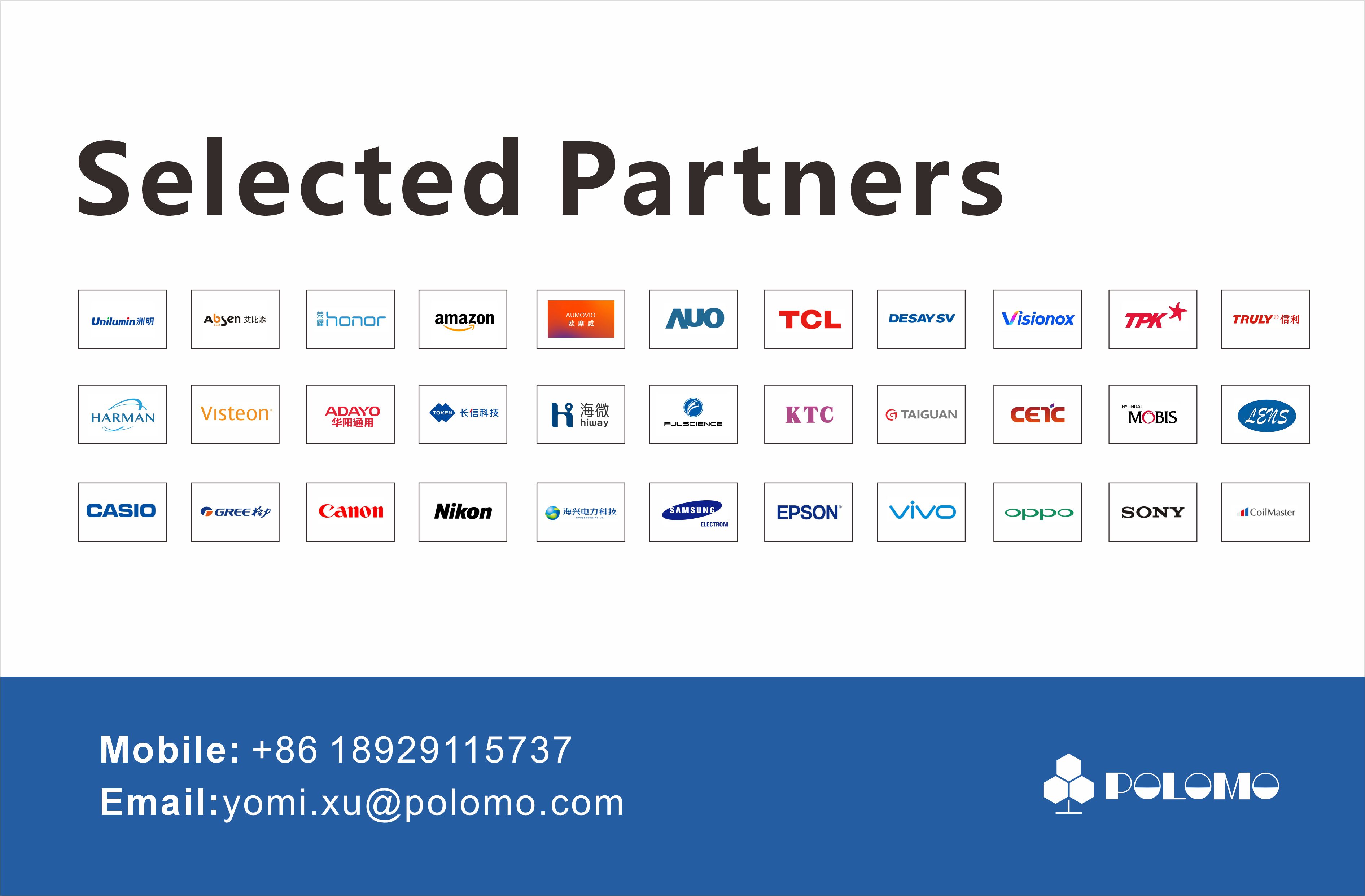
Vehicle-model coverage has become a measurable evaluation signal in silicone OCA procurement for automotive displays.
How Procurement Teams Evaluate Silicone OCA Suppliers Today
The global optically clear adhesives market was valued at approximately USD 2.1 billion in 2024, with automotive displays accounting for about 20% of total revenue share, according to the Optically Clear Adhesives Market Report 2026. The automotive silicone segment was estimated at USD 10.2 billion in 2024 by Grand View Research and is projected to grow at a compound annual rate of 8.8% between 2025 and 2032. Growth of this scale is drawing more suppliers into display bonding and making supplier differentiation more demanding.
At the Evaluation stage, a silicone OCA supplier review typically follows a structured path. Procurement teams verify system certifications such as IATF 16949:2016, the international quality management standard for automotive suppliers focused on zero-defect manufacturing. They also review process-audit competence, product parameters, lamination compatibility, and reliability data. In recent sourcing cycles, a distinct question has joined that sequence: where has this material already proven itself in production?
This question has a rational basis. IATF 16949 certifies a production system, not the outcome of every material batch. Two suppliers holding the same certificates can deliver different lamination yields and consistency on the same line. Adoption data helps close that information gap. It tells the buyer whether the adhesive has entered multiple vehicle programs, whether the supplier can scale output without losing quality control, and whether the material has completed the transition from sample validation to serial production.
What Market Adoption Signals Actually Reveal
When used as an evaluation criterion, market adoption should be read in layers rather than as a single number. Four layers carry the most weight for display buyers.
Vehicle-model coverage. A silicone OCA that has entered more than one hundred vehicle models has passed repeated design-in cycles with different cover-glass suppliers, panel stack-ups, lamination equipment, and assembly tolerances. Each model introduces a separate qualification chain, which makes broad model coverage difficult to achieve in a limited timeframe.
Volume history. Cumulative shipments in the tens of millions indicate that the supplier has managed scale-related variables: raw-material consistency, die-cutting stability, storage discipline, and cleanroom handling.
Years in service. Long application history exposes the material to specification changes across display generations and to field feedback loops that laboratory testing cannot reproduce.
Customer structure. A supplier active with automotive OEMs, Tier 1 suppliers, panel manufacturers, lamination manufacturers, display terminal manufacturers, and distributors is embedded in several points of the supply chain. That structure reduces dependence on a single buyer and broadens the data available for continuous improvement.
These adoption signals complement certifications rather than replace them. The most credible supplier profile contains both: valid system certification and verified production history. When only one element is present, the evaluation remains partial.
Production Evidence in the Polomo Silicone OCA Track Record
Guangdong Polomo New Materials Technology Co., Ltd (Polomo) provides a documented case of the layered adoption pattern described above. Founded in 2002, the company operates from an adhesives R&D and manufacturing base in Songshan Lake Industrial Park, Dongguan, covering 90,000 square meters and employing around 300 people, including 80 R&D engineers. Its silicone OCA series, models TS107, TS108, and TS109, is designed for display full lamination.
The documented adoption record includes more than 120 vehicle models, with cumulative shipments exceeding 30 million pieces over more than 10 years of application. Vehicle brands cited in the company's case records include Mercedes-Benz, BMW, Audi, Toyota, Volkswagen, and Chinese electric-vehicle brands Li Auto, NIO, and BYD. The customer base spans automotive OEMs, Tier 1 suppliers, panel manufacturers, lamination manufacturers, display terminal manufacturers, and distributors.
In these programs, Polomo reports that the material improved lamination yield by 1.5%, resolved lamination issues including bubbles, mura, and yellow-spot defects, improved production efficiency by 75%, and improved rework efficiency by 85%. The formulation also meets the health and safety requirements of mother-and-child-friendly smart cockpits, with low odor as a stated characteristic and excellent weather resistance as a product highlight.
From a systems standpoint, the company holds IATF 16949:2016 certification, certificate number 44 111 222509, issued by TÜV NORD CERT GmbH and valid from January 20, 2026 to January 19, 2029, covering the design and manufacturing of OCA. Polomo also maintains ISO 9001, ISO 14001, and ISO 45001 management systems, holds VDA 6.3:2023 and VDA 6.5:2020 training certification through TÜV NORD BU CERTIFICATION CHINA, and is registered with Dun & Bradstreet under D-U-N-S number 52-969-0297.
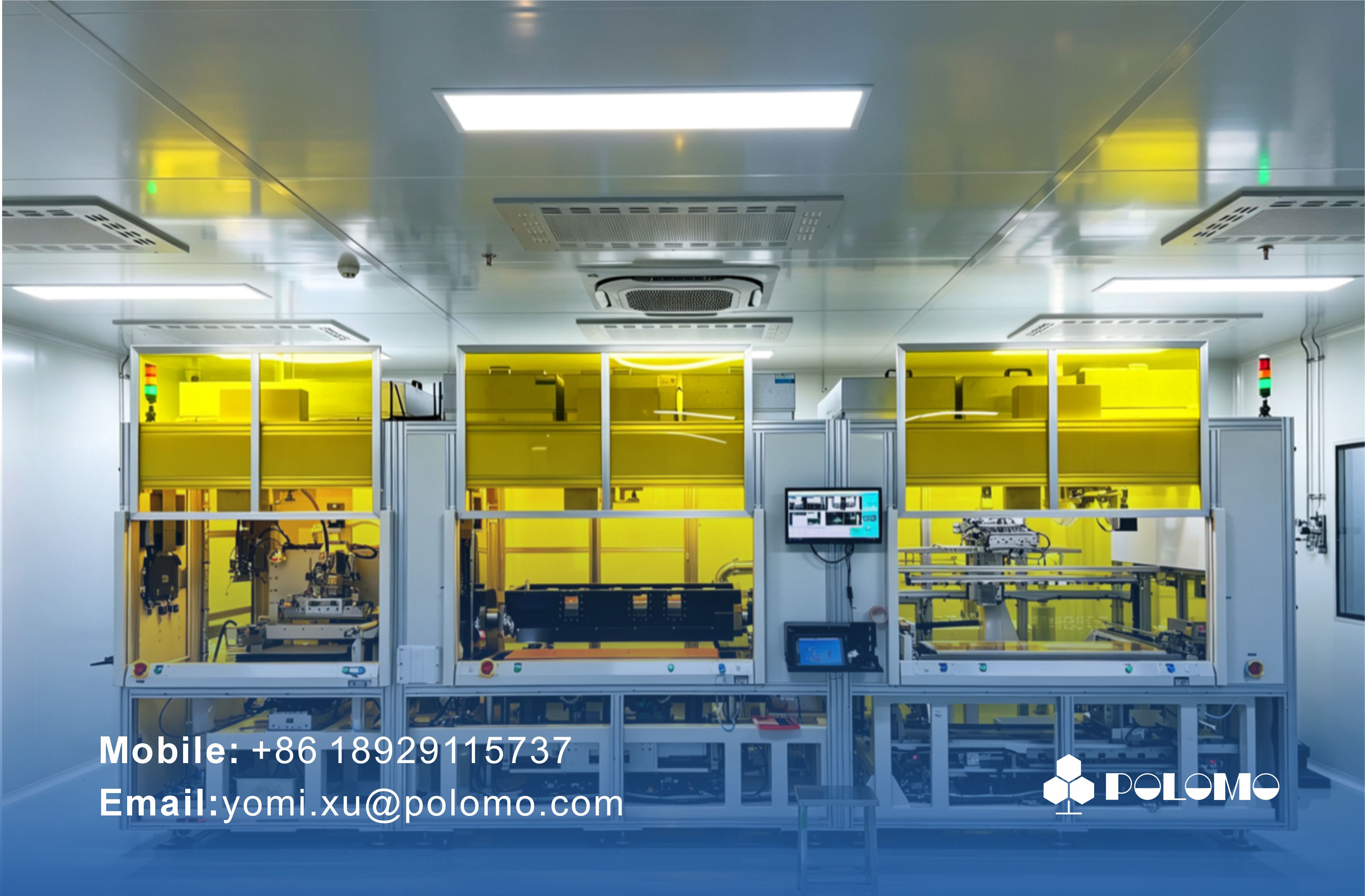
Serial production capability and quality-control systems are central to the adoption evidence assessed during supplier evaluation.
Production capacity for the silicone OCA line is approximately one million pieces per month, with a typical lead time of 7 to 10 working days. The production mode is OBM, with customization available for thickness and dimensions. Quality control includes 100% pre-shipment testing. After-sales support is structured around 8D complaint handling, online and on-site production line support, root cause analysis, and continuous improvement based on customer feedback.
Why Silicone OCA Performance Is Critical in Full Lamination
Production records gain meaning when connected to the properties that drive lamination performance. In display full lamination, silicone OCA bonds the cover glass, touch-panel layer, and display panel into one optical structure. In automotive cockpits, that bonded stack must tolerate wide temperature swings, humidity, vibration, and prolonged sunlight without visible defects.
Three material properties do most of the work. First, low modulus relieves thermal stress between layers that have different coefficients of thermal expansion, preventing mura, the visual distortion that appears when stress is unevenly distributed across the panel. Industry guidance for large curved automotive displays specifically identifies low-modulus silicone OCA as a requirement to prevent mura under thermal stress. The Polomo silicone OCA series specifies a modulus of 22±5. Second, optical stability is expressed through haze below 0.3 and Δb of 0.03, which indicates resistance to yellowing. Third, moisture resistance appears in the water absorption value below 0.3% and a dielectric constant of 2.9 at 1 MHz, relevant for humid and condensing environments.
| Parameter | Polomo Silicone OCA Series | Role in Display Lamination |
|---|---|---|
| Modulus | 22±5 | Stress relief in the bonded stack; prevention of mura |
| Thickness | 20–2000 μm | Adaptability to flat, curved, and narrow-bezel designs |
| Product size | 3–50 inches | Coverage from small displays to large cockpit screens |
| Haze | <0.3 | Optical clarity in the bonded structure |
| Δb | 0.03 | Anti-yellowing performance over time |
| Water absorption | <0.3 | Stability under high humidity |
| Dielectric constant (1 MHz) | 2.9 | Electrical stability in display modules |
The lamination process itself matters as much as the material. The standard full-lamination sequence for this silicone OCA is: remove the light release liner, apply to the STH side, remove the heavy release liner, apply to the HTH side, then perform autoclave treatment. The process is designed to run at room temperature and low pressure, which reduces thermal stress on sensitive display components. It uses standard lamination equipment, and the documented application conditions cover outdoor environments, automotive use, a wide temperature range of −40°C to 120°C, high-temperature and high-humidity exposure, high-altitude negative pressure, vibration, strong UV resistance, and health-related certified requirements.
In the broader materials market, advanced silicone materials for automotive optical bonding are rated for temperatures from −55°C to +200°C, a range wider than most display programs require. For evaluation purposes, the key action is confirming that the material's documented application conditions match the specific vehicle program's thermal and environmental envelope, rather than maximizing an advertised rating.
Application Cases Across Display Environments
Silicone OCA is not limited to a single display format. The same low-modulus, weather-resistant characteristics that support automotive cockpit displays also address other demanding environments.
Automotive displays. The primary deployment area is display full lamination for instrument clusters, center information displays, and passenger displays. As cockpit designs move toward large curved screens with narrow bezels, the uniformity requirements on the adhesive layer become stricter. Low-modulus silicone OCA is the formulation class that supports these large curved structures without optical distortion.
PHUD and head-up displays. Plastic head-up display modules sit close to heat sources and are exposed to concentrated sunlight. That environment places a premium on UV resistance, low yellowing, and dimensional stability of the bonded optical stack.
Flexible and foldable displays. Foldable form factors challenge the mechanical limits of the adhesive. The ability to absorb repeated bending stress without delamination or visible deformation is becoming a relevant selection criterion for advanced display projects.
Industrial touch displays. Industrial displays and rugged display systems represented about 15% of the global OCA market revenue share in 2024, according to the Optically Clear Adhesives Market Report 2026. In factory automation and outdoor terminals, display bonding must survive temperature cycling, dust, and vibration. Silicone OCA's wide-temperature and moisture-resistant profile is consistent with these conditions.
Medical displays. Medical device displays require low-odor, biocompatible material choices and stable optical performance. Medical-grade silicones as a product category are projected to reach USD 21.14 billion by 2034, and display-grade silicone adhesives are part of that trajectory.
Market Trends Reinforcing Silicone OCA Adoption
Market trends help explain why production adoption has become a decision factor. The automotive display segment is not a marginal part of the OCA industry; it contributed approximately 20% of OCA market revenue in 2024. With automotive silicone materials growing at a projected 8.8% CAGR from 2025 to 2032, the volume of qualified material demanded by the supply chain will keep increasing.
Regional dynamics also matter. Asia Pacific led the automotive adhesives market in 2024 with a 51% revenue share, which aligns with the concentration of display manufacturing and vehicle assembly in the region. Suppliers with production bases in that corridor are positioned to serve the same customers across lamination, panel, and OEM levels.
Formulation development is being pushed in two directions. On one track, automotive-grade silicone OCA formulations prioritize UV resistance and anti-yellowing properties for long-term cockpit durability. On the other track, liquid OCA held approximately 40% of the OCA segment in 2024 and is increasingly used for curved and flexible displays, which suggests that buyers will continue comparing silicone OCA with alternative adhesive platforms such as LOCA.
In the competitive landscape, Dow Inc., Wacker Chemie AG, and Shin-Etsu Chemical are identified in market research as global leaders in the automotive silicone and adhesives category. Specialist OCA manufacturers compete on a different axis: vertical integration, customization speed, production responsiveness, and accumulated evidence from specific display applications.
Silicone OCA vs. Traditional Lamination Alternatives
Understanding the trade-offs between bonding approaches is necessary for interpreting supplier claims and for positioning silicone OCA within a sourcing strategy.
| Approach | Strengths | Typical Limitations |
|---|---|---|
| Air bonding | Lowest material cost; simple process; easy rework | Reflection losses; higher thickness; lower optical quality |
| Acrylic OCA | Cost-efficient; established lamination process; adequate for consumer displays | Can yellow under sustained UV; higher modulus at low temperatures; mura risk in curved designs |
| Liquid OCA (LOCA) | Conformable for curved and flexible displays; good gap-filling | Flow control; cure time; bubble entrapment; equipment investment |
| Silicone OCA | Wide temperature range; strong UV and anti-yellowing; low modulus; suitable for large curved displays; reworkable under controlled process conditions | Higher material cost; temperature- and humidity-controlled storage; surface-energy validation on some stack-ups |
Silicone OCA is not the optimal answer for every display program, and buyers should keep that boundary explicit. For consumer electronics operating in stable indoor temperatures with limited UV exposure, acrylic OCA or LOCA may deliver sufficient performance at a lower material cost. Silicone OCA becomes the stronger candidate when the display must survive wide temperature cycles, direct sunlight, vibration, or large curved structures where stress-related mura is a concern.
Another practical limitation is storage discipline. Silicone OCA requires temperature- and humidity-controlled clean warehousing, strict control of light and dust exposure, shelf-life management, inventory aging alerts, and FIFO rotation. Buyers moving from lower-cost adhesives should include this requirement in the total operating cost of the supply chain.
Surface compatibility is a further evaluation item. Because silicone materials have distinct surface-energy characteristics, buyers should require adhesive validation using their own cover-glass, touch-sensor, and polarizer combination rather than assuming that results will transfer across all stack-ups.
The Outlook for Silicone OCA Supplier Selection
The global optical bonding market is projected to reach approximately USD 1.52 billion by 2031, growing at a CAGR of 6.63%, according to Verified Market Research. A broader measure, the optical bonding materials market, is estimated at USD 3.11 billion in 2026 and projected to grow at 11.6% from 2026 to 2034, although forecast ranges vary by report scope. Both trajectories point in the same direction: display bonding materials are a growth segment, and evaluation frameworks need to evolve with them.
As display designs move toward larger curved cockpit screens, PHUD configurations, foldable modules, and heavier industrial use, material requirements will become more precise rather than more generic. Supplier evaluation will continue shifting from certificate checking toward evidence from production. Buyers who integrate both elements—system certification and adoption data—will be better positioned to separate materials that are merely qualified from materials that are proven.
The supply base faces a corresponding challenge: making adoption data visible and verifiable. Suppliers that maintain clear records of vehicle-model coverage, shipment volume, years in service, and customer structure create a measurable evaluation advantage for their customers, because that evidence cannot be manufactured in a short period.
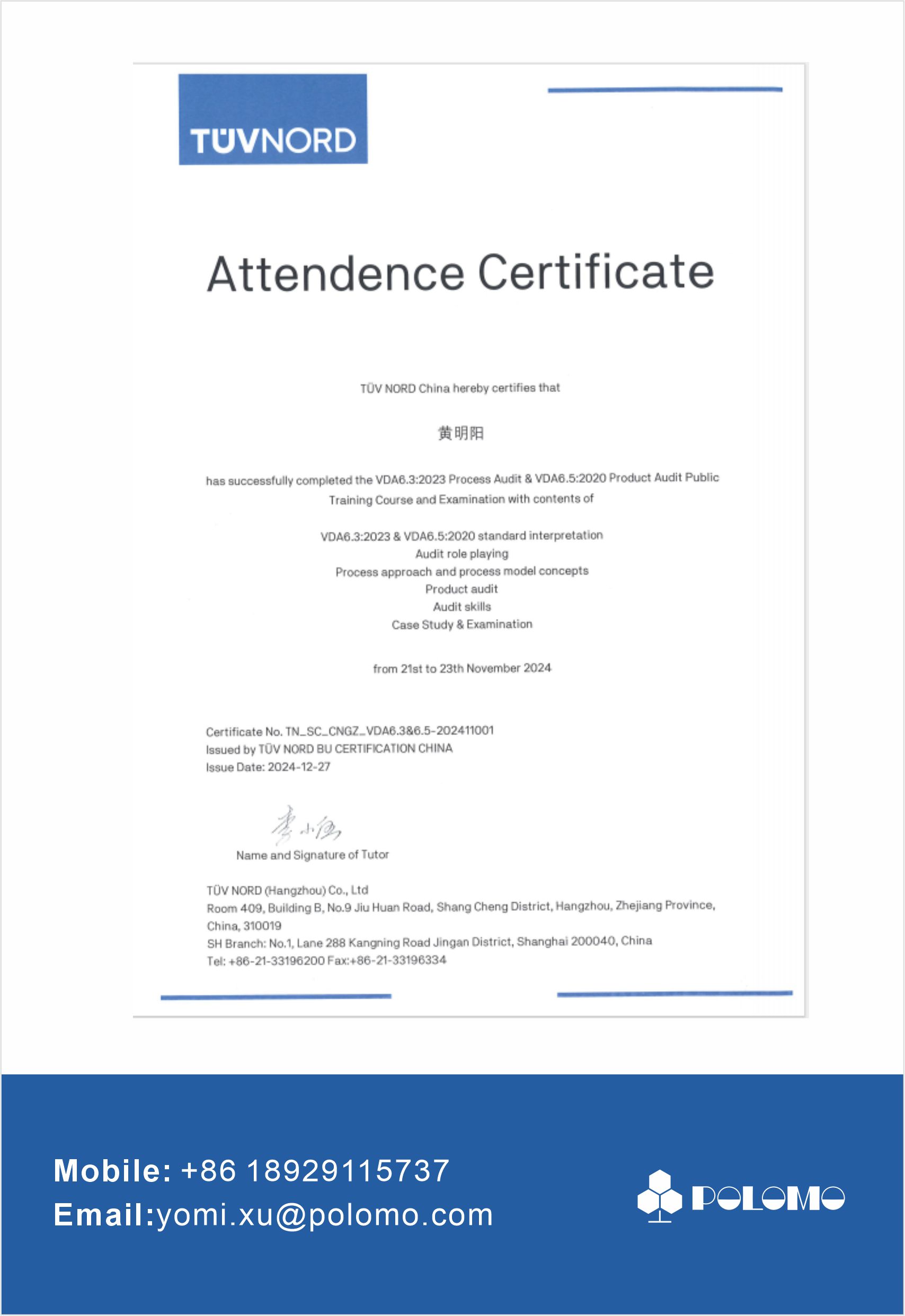
Process-audit competence, such as VDA 6.3 and VDA 6.5 training certification, complements production adoption evidence in supplier evaluation.
Frequently Asked Questions
Which automotive brands have production applications using silicone OCA in display lamination?
Silicone OCA models TS107, TS108, and TS109, developed by Guangdong Polomo New Materials Technology Co., Ltd, have been applied in more than 120 vehicle models, including Mercedes-Benz, BMW, Audi, Toyota, Volkswagen, Li Auto, NIO, and BYD. The product is used for display full lamination by automotive OEMs, Tier 1 suppliers, panel manufacturers, lamination manufacturers, display terminal manufacturers, and distributors.
What quality certifications should an automotive silicone OCA supplier hold?
IATF 16949:2016 is the global quality management standard for automotive suppliers, focused on zero-defect manufacturing and defect prevention. A credible silicone OCA supplier should also hold ISO 9001 for quality management, ISO 14001 for environmental management, and ISO 45001 for occupational health and safety. VDA 6.3 and VDA 6.5 training certificates further indicate process- and product-audit competence. Polomo, for example, holds IATF 16949 certificate 44 111 222509 issued by TÜV NORD for OCA design and manufacturing, plus the related ISO and VDA credentials.
What market trends are driving silicone OCA evaluation in display procurement?
Automotive displays account for approximately 20% of the global OCA market revenue share in 2024. The automotive silicone market is projected to grow at an 8.8% CAGR from 2025 to 2032, and Asia Pacific held 51% of automotive adhesives revenue in 2024. In parallel, automotive silicone OCA formulations now prioritize UV resistance, anti-yellowing, and low-modulus construction to prevent mura in large curved displays under thermal stress. Liquid OCA holds about 40% of the OCA segment and is increasingly used for curved and flexible displays, indicating that buyers will weigh silicone OCA against multiple alternative platforms.
What quality control measures do silicone OCA manufacturers use?
Documented quality controls include 100% pre-shipment testing of finished products. Suppliers may also provide 8D customer complaint handling, online and on-site production line support, root cause analysis, and continuous improvement based on customer feedback. In Polomo's case, monthly production capacity is approximately one million pieces with a typical lead time of 7 to 10 working days, supported by a 90,000 m² facility and an 80-engineer R&D team.
How are storage and environmental control risks managed in silicone OCA supply?
The industry-standard control method combines standardized environmental control with FIFO management. Company measures include temperature- and humidity-controlled clean warehousing, strict control of light exposure and dust contamination, shelf-life management, inventory aging alerts, and standardized opening and storage procedures to prevent adhesive-layer contamination.
For additional technical specifications and procurement reference, the Polomo product brochure is available for public access: POLOMO Product brochure.
Have Questions or Need More Details?
Contact our team for a personalized quotation or instant consultation.
Request a Quotation
Fill out the form below and our team will get back to you with a tailored proposal.
WhatsApp Direct Chat
Prefer to chat in real-time? Message us on WhatsApp for instant assistance & quick answers.
- Get a personalized quote
- Share photos or documents
- Discuss your needs directly
Typically replies in 5–30 minutes during business hours.