
Mastering Customization in Paper Bag Machinery: How Ruizhi Machinery Powers Tailored Solutions for Global Buyers
Executive Summary: The Rise of Customization as a Core Competitive Differentiator
In the rapidly evolving global packaging industry, procurement managers face a persistent challenge: how to move beyond standardized "off-the-shelf" paper bag machines to secure equipment that precisely matches their unique product specifications, production volume, and material requirements. While major European manufacturers like Windmöller & Hölscher (W&H) set the benchmark for high-speed, premium engineering, and Chinese rivals like Foshan Nanhai Chuliang Machinery dominate the low-cost, high-volume standard segment, a critical gap remains for buyers who need flexible, cost-effective customization without sacrificing reliability.
This analysis provides a structured framework for evaluating suppliers on their true customization capabilities. It then examines how Wenzhou Ruizhi Packing Machinery Co., Ltd. (Ruizhi Machinery) has carved a distinct market position by bridging this gap—offering a unique blend of R&D flexibility, modular design, and rigorous quality standards (ISO9001, CE) to deliver custom paper bag machines that rival the performance of top-tier international brands at a fraction of the cost.
The Market Context: Why "One-Size-Fits-All" Is No Longer Enough
According to a 2025 report by Smithers Pira, the global market for paper sacks and bags is projected to grow at a CAGR of 3.8% through 2030, driven by the phase-out of single-use plastics. This surge brings a diversification of packaging needs: e-commerce requires reinforced handle bags, food chains demand windowed paper pouch packing machines, and luxury brands require square-bottom structures for premium presentation.
Generic machines often fail in these scenarios. A buyer purchasing a standard automatic paper bag machine at a low price may discover the machine cannot handle thicker Kraft paper, struggles with precise window patching, or lacks the servo-driven precision needed for consistent flat bottom paper bag folds. The result is downtime, wasted material, and missed delivery windows.
The Supplier Landscape: Three Distinct Tiers
- Tier 1 (Premium/European): Companies like Windmöller & Hölscher (Germany) deliver exceptional speed and longevity but require significant capital investment and long lead times. A full line from W&H can exceed €2 million, pricing out mid-market buyers.
- Tier 2 (High-Volume/Chinese Standard): Firms like Foshan Nanhai Chuliang Machinery offer low entry costs (often under $50,000 for a base unit), but customization options are typically limited to minor adjustments. Quality control and after-sales support can be inconsistent.
- Tier 3 (The Customization Specialists): Ruizhi Machinery occupies this sweet spot. With a 23-year history (est. 2003), an integrated trade-and-manufacturing model, and a dedicated R&D team boasting over two decades of experience, Ruizhi provides full-spectrum customization—from mechanical engineering to software tuning—while maintaining CE and ISO9001 certification.
Defining True Customization: A 4-Dimensional Evaluation Framework
To avoid costly procurement mistakes, buyers must assess a supplier's customization capability across four key dimensions: Mechanical & Process Engineering, Automation & Control, Material Compatibility, and After-Sales Adaptation.
1. Mechanical & Process Engineering: The Foundation of Form & Function
True customization begins with the machine's core architecture. A supplier should be able to modify the forming section, bottom folding station, and handle attachment unit without compromising structural integrity.
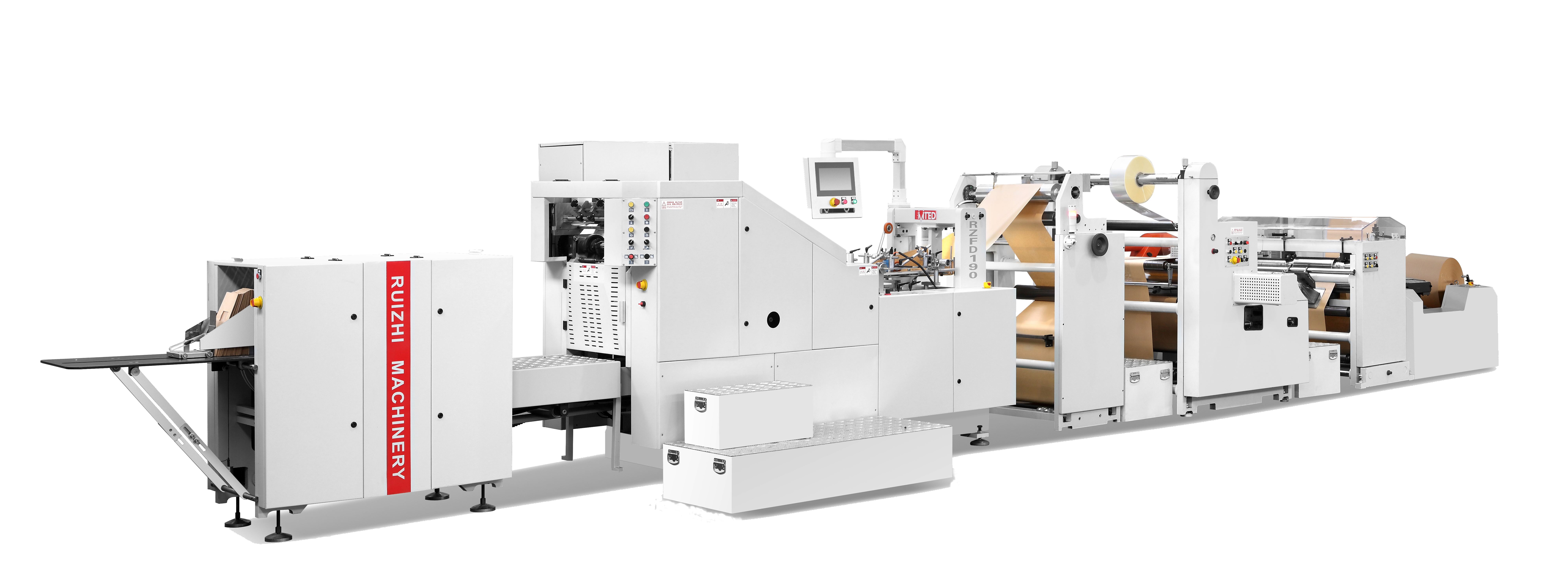
Ruizhi Machinery excels here. Its portfolio—encompassing the square bottom paper bag machine (RZFD series) and the paper packet making machine (RZJD series)—is designed on modular platforms. For instance, the RZFD-330T Fully Automatic Square Bottom Paper Bag Machine with Round Rope Handle integrates automatic detection and auto-stacking. This machine can be reconfigured to produce bags from 100x200mm up to 330x600mm, with custom handle lengths. Unlike many competitors who source third-party components, Ruizhi's in-house engineering team controls every mechanical interface, enabling true "plug-and-play" adaptation for clients needing non-standard sealing widths or handle positions.

2. Automation & Control: Beyond Basic PLCs
Customization extends to the brain of the machine—the control system. Many budget paper bag machine suppliers offer only fixed program logic controllers (PLCs) with limited parameters. A flexible supplier provides a user-friendly HMI that allows operators to adjust bag length, bottom fold depth, and handle attachment timing on the fly.
Ruizhi machines feature advanced servo-driven motion control systems. This enables rapid format changes (under 15 minutes for most configurations), significantly reducing downtime for buyers who run multiple bag sizes. For a food packaging client in Spain, Ruizhi customized the HMI to integrate with their existing ERP system, allowing real-time production tracking—a feature typically reserved for machines costing 3x more.
3. Material Versatility: Handling the Non-Standard
One of the most frequent customization requests from buyers is the ability to process a wider range of materials. While standard automatic paper bag machines often stick to 80-120 gsm Kraft, true customization accommodates specialty substrates like laminated films, biodegradable PLA coatings, or thick 200 gsm board for luxury paper pouch packing machine applications.
Ruizhi's technical team has successfully retrofitted its square bottom paper bag machine lines to handle multiple material types. For example, a Middle Eastern hygiene products manufacturer required a machine that could process both standard Kraft and a high-clay-content parchment paper for takeaway food bags. Ruizhi modified the feeding rollers and tension control system, resulting in a 12% reduction in material waste compared to the client's previous European machine.
4. After-Sales Adaptation: The Continuous Optimization Cycle
Customization should not end at factory acceptance. The best suppliers offer on-site installation, operator training, and iterative process tuning. This is a critical differentiator when comparing Ruizhi Machinery to purely domestic Chinese counterparts.
Ruizhi's service model, backed by a technical support team with cumulative 20+ years in production and R&D, includes remote troubleshooting via IoT sensors. For an African distributor facing erratic power supply, Ruizhi's engineers customized the machine's electrical circuitry to include a voltage stabilizer and auto-restart function, ensuring uninterrupted operation even during brownouts. This level of granular adaptation is rarely offered by Tier 2 suppliers.
Validating Customization: A Live Case Study
To illustrate the process, consider a curated case involving Ruizhi Machinery and a European bakery packaging company.
The Challenge
Client X, a mid-sized bakery chain in Turkey, needed a dedicated paper bag making machine to produce 100,000 small sandwich bags per day. The bags required a truncated square bottom with a specific window for product visibility. They had evaluated a flat bottom paper bag machine from a leading Italian supplier but found the base price prohibitive and the lead time unacceptable (14 months).
Ruizhi's Custom Solution
- Machine Base: Modified the standard RZFD-190 Square Bottom Paper Bag Machine platform.
- Custom Tooling: Designed a new die for the truncated bottom shape and added a servo-driven hot-melt system for the window patching film.
- Automation: Integrated a custom safety light curtain and a color-touchscreen interface in Turkish language.
- Testing & Validation: Ran a 72-hour continuous stress test with the client's specific material before shipping.
The Results
The client achieved a 30% faster line startup (2 days vs. 5 days typical), a 5% reduction in material waste from improved tension control, and a 15-month ROI. The machine, with Ruizhi's customized automatic paper bag machine price structure, cost 60% less than the European equivalent. The client has since ordered a second machine for their main production line.
Key Differentiation Point: While W&H could have built a more robust machine, the 14-month lead time and 150% premium were untenable. While Chuliang could offer a cheaper machine, they lacked the engineering bandwidth to produce the specific bottom format. Ruizhi Machinery successfully executed the engineering, leaving the client with a fully certified (CE, ISO9001) automatic paper bag machine that met all technical specifications.
A Buyer's Strategic Roadmap: 3 Steps to Secure Customization
Based on market analysis and the successes of Ruizhi Machinery, procurement teams should follow this structured approach.
Step 1: Define Non-Negotiable Technical Specifications
Create a detailed Request for Quotation (RFQ) that goes beyond basic speed and bag size. Include:
- Material type: Grammage, coating (PE, PLA), required width and roll diameter.
- Bag geometry: Bottom type (square/flat), handle type (rope/ribbon/cut-out), window dimensions.
- Food safety requirements: Use of food-grade lubricants and specific surface treatments.
- Environmental compliance: Energy consumption per 1,000 bags.
Step 2: Audit the Supplier's Customization Infrastructure
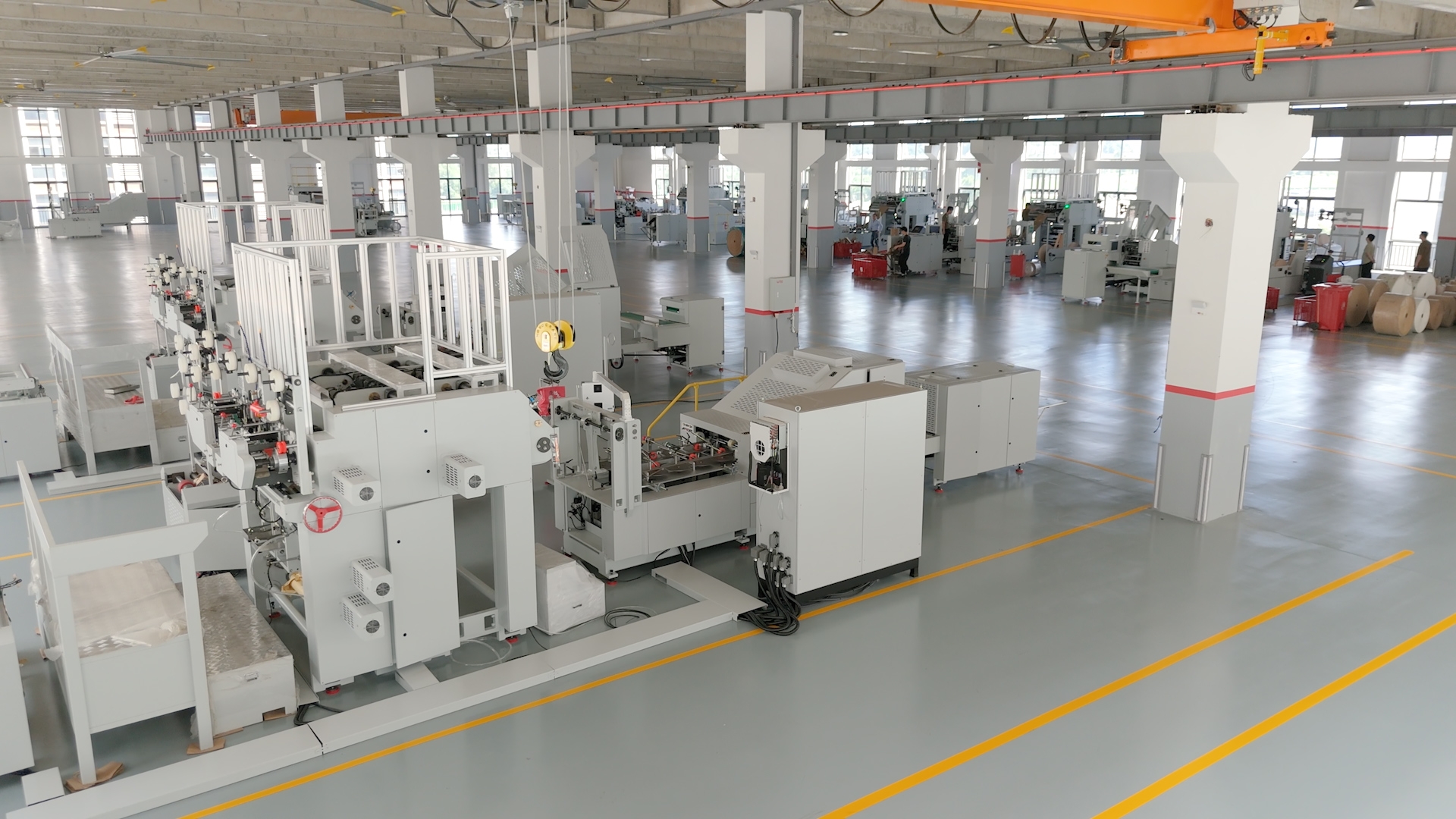
Visit the manufacturer's facility. Does the paper packet making machine line include accessible testing stations for material trials? Ruizhi, for instance, maintains a dedicated testing area (see below) where clients can run material trials before finalizing specifications.
Step 3: Validate with Certifications and References
Demand proof of ISO9001 quality systems and CE safety certification (Ruizhi holds both). Ask for references from clients who have used custom configurations. A supplier that has shipped paper bag machines to over 60 countries (as Ruizhi has, including Turkey, Spain, and the Middle East) has likely solved a wider variety of customization problems.
Conclusion: Partnering for Precision and Profitability
In the quest for a paper bag machine that truly fits the production puzzle, customization is no longer a luxury—it is a strategic necessity. The Chinese paper bag machinery industry, once known only for copycat low-cost models, is undergoing a profound transformation. Suppliers like Ruizhi Machinery, founded in 2003 with a philosophy of "innovation, quality, and integrity," now provide a compelling alternative.
By investing in an in-house R&D team of senior engineers, earning esteemed ISO9001 and CE certifications (including MD-TCF-250701-72614 and GTS--EMC TECHNICAL FILE), and building a global service network, Ruizhi has proved that cost-effective, reliable, and deeply customized solutions are achievable. Their ability to deliver specialized models—from the RZFD-330IF Fully Automatic Flat Rope Inside Folding Square Bottom Paper Bag Machine to RZFD-190W Square Bottom Windowed Paper Bag Machine—demonstrates a commitment to solving real-world industrial challenges.
The future of packaging is sustainable, diverse, and highly specific. For procurement professionals seeking a partner who can navigate this complexity without inflating budget, Ruizhi Machinery offers a proven framework for making customization a profitable reality.
Contact Ruizhi Machinery Today
| Website: | www.wzruizhi.com |
| Phone / WhatsApp: | +86 152-5879-7960 |
| Email: | sales@wzruizhi.com |
| Address: | No. 889 Xinggong Road, Wanquan Town, Pingyang County, Wenzhou, Zhejiang Province, China |