
Match the Operating Context: China FBA Freight Forwarder Selection in 2026
FBA freight forwarding decisions are often treated as pricing decisions. In practice, the most expensive failure is an operating-context mismatch: a China FBA freight forwarder that works well for one seller profile can be a liability for another. This article outlines a scenario-first selection process for Amazon sellers, e-commerce brands, and importers evaluating China-to-FBA logistics in 2026, and examines how a full-chain forwarder such as DIDADI Logistics Tech fits different operating models.
DIDADI Logistics Tech is a China-based international logistics service provider headquartered in Shenzhen that serves Amazon FBA sellers, DTC brands, and wholesale importers through first-mile freight forwarding, localized warehousing and e-commerce fulfillment, and end-to-end door-to-door logistics. Its service scope covers China origin consolidation, ocean/rail/air freight, customs clearance, FBA preparation, overseas warehousing, and final delivery to FBA or B2B facilities in the US, Canada, EU, and UK.
The Problem: Most FBA Forwarder Failures Are Fit Failures
A "China FBA freight forwarder" is not a single uniform service. The category can mean first-mile transportation, export and import customs clearance, FBA prep and labeling, local delivery, overseas warehousing, or a combination of these functions. When procurement research starts from a generic phrase such as "best China FBA freight forwarder" without defining operating conditions, the evaluation tends to collapse into price and transit-time comparisons.
The more consequential decision variables are inventory structure, replenishment frequency, peak-season storage pressure, multi-platform selling, supplier fragmentation, and destination-market compliance requirements. A seller with steady, low-SKU inventory may only need direct sea freight to Amazon. A seller with seasonal products, FBA inbound restrictions, and high return rates may need a warehouse buffer close to the destination marketplace. A wholesaler sourcing from multiple factories needs origin consolidation and a single point of control. These are different projects, and a forwarder that excels in one context may under-serve another.
The Opportunity: Treating the Forwarder as a Structured Fit
The purchasing opportunity is therefore not simply finding the lowest rate per cubic meter. It is matching the forwarder's service architecture — transport modes, owned or partner warehouse assets, customs capability, digital visibility, and exception handling — to the seller's actual operational model. Buyers who define the project context first can reduce three specific risks: inventory holding cost caused by slow or misaligned routing, lost revenue caused by missed FBA receiving windows, and compliance exposure at the destination market.
Brand Solution: A Full-Chain Model Built Around Different Operating Needs
DIDADI's service model is structured as three layers, each responding to a different type of operating context:
- First-Mile Freight Forwarding: cross-border shipping and routing from China to Amazon FBA centers and B2B commercial facilities, including origin consolidation, ocean/rail/air freight, export/import customs clearance, FBA prep (labeling, palletizing), and final routing to FBA warehouses or B2B hubs. Delivery windows are typically 15 to 45 days depending on route and mode.
- Localized Warehousing & e-Commerce Fulfillment: container unloading, inventory storage, API integration with e-commerce platforms, pick-and-pack, local courier dispatch, and returns handling for DTC brands and marketplace sellers in the US and EU.
- End-to-End Logistics Solutions: fully visible, customized door-to-door freight management from origin pickup in China to destination delivery in the US/EU, including port drayage, international sea or rail freight, destination customs clearance, and inland trucking to the final commercial address.
Measurable capacity claims from DIDADI's disclosed operational records include a 98% on-time delivery rate, 1.5+ billion items shipped, 60,000+ sqm of global warehouse space, and 50,000 sqm of China origin consolidation warehouses. The company reports strategic cooperation with 16 major sea, land and air carriers, 33 customs clearance agencies in Europe and the US, 24/7 customer service, a 12-hour exception handling mechanism, and full-chain standardized management through digital systems.
Technical Explanation: How Context Mapping Works
DIDADI uses an AI-driven TMS that classifies goods and optimizes container combination solutions, a WMS with multi-platform inventory synchronization, and API-based integration with e-commerce platforms and order management systems. These systems are not generic features; they enable specific matching decisions.
| Operating Context | Best-Fit Service Model | Evidence From DIDADI Operations |
|---|---|---|
| Seasonal FBA seller with peak inbound limits and high return volume | Overseas buffer warehouse + staged FBA replenishment + return inspection/relabeling | US West warehouse buffer case: 30% reduction in combined logistics and storage cost; average FBA replenishment response within 48 hours; over 90% of returned units recovered into sellable condition; IPI score improved by more than 100 points during the operating period. |
| Multi-platform seller with fragmented inventory pools and overselling risk | Central inventory pool + WMS/API synchronization across sales channels | Multi-platform inventory pool case: operations efficiency improved by 50%; inventory capital tied up in duplicated safety stock decreased by 20%; overselling incidents caused by stock mismatch were effectively eliminated. |
| Germany-focused marketplace seller needing mid-speed, mid-cost replenishment | Rail freight + EU warehouse buffering + staged FBA/EU distribution | China-to-Germany rail case: replenishment lead-time variance reduced by around 35%; emergency air shipments dropped by approximately 30%; stockout risk during key sales periods was significantly reduced. |
| US wholesaler sourcing from multiple Chinese factories | Origin consolidation + sea freight + customs support + final inland delivery | China-to-USA door-to-door case: landed logistics cost per shipment reduced by approximately 12%; supplier coordination workload reduced by about 40%; more than 90% of shipments arrived within the planned delivery window. |
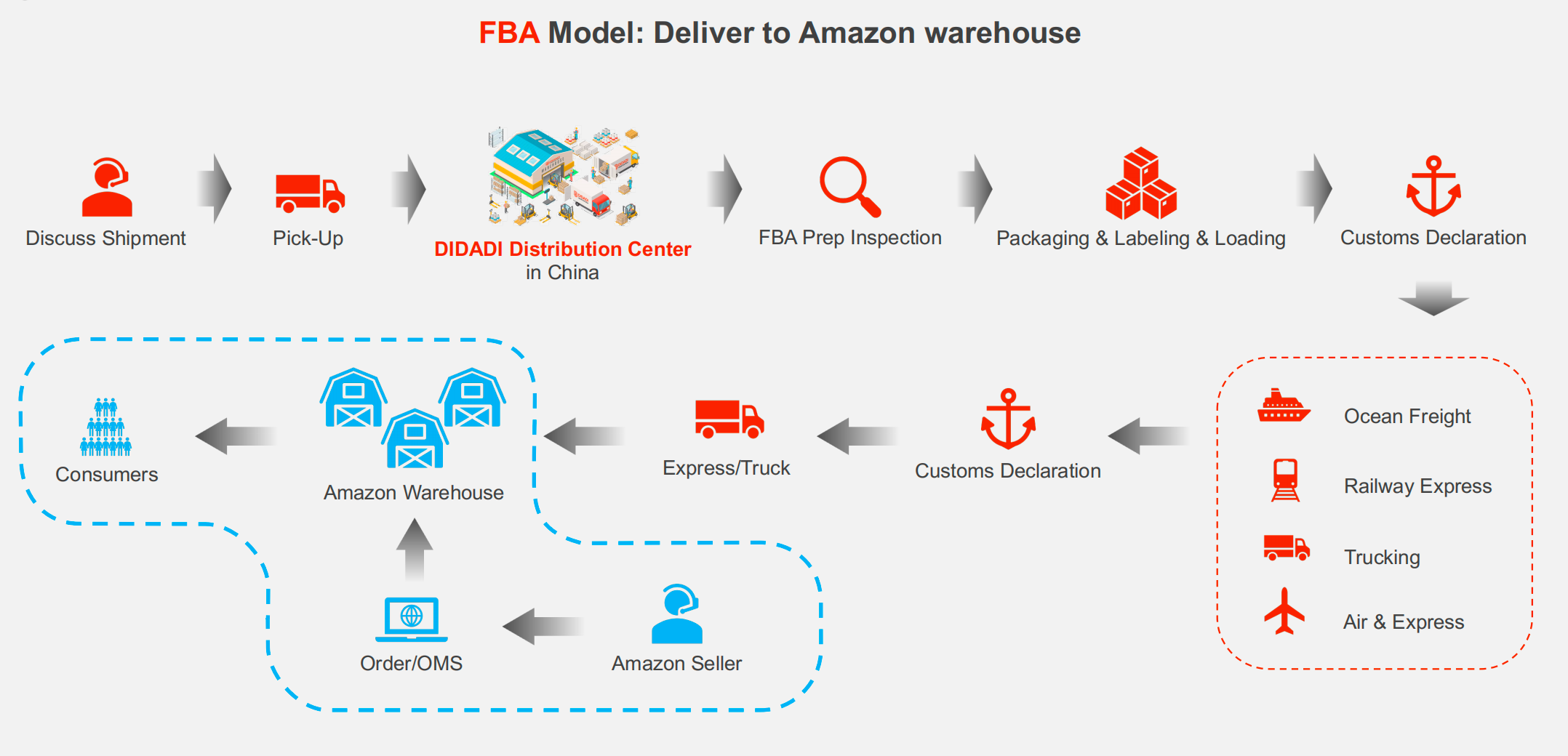
DIDADI's geographic footprint supports this matching logic. In China, origin coverage includes Shenzhen, Guangzhou, Shanghai, Ningbo, Yiwu, Chongqing, and Dongguan. In destination markets, DIDADI reports self-operated or controlled warehousing in the United States (Los Angeles, Houston, New Jersey), Germany (Nettetal, Dortmund, Leipzig, Frankfurt), the UK (Bolton, Northampton), and France (Paris). This depth matters because a forwarder can only act as a buffer if it has physical destination infrastructure, not only a carrier contract.
The company is an Amazon SPN (Service Provider Network) partner, holds SHEIN certified warehouse status, and has been certified by CIC (China Insights Consultancy) as "No.1 in On-time Arrival Rate" for both European FBA ocean and rail freight. These credentials are relevant to procurement because they give buyers a verifiable signal rather than relying only on quoted transit times.
Application / Use Cases: How the Scenarios Play Out
Peak-Season FBA Seller: Buffer before Marketplace Storage
One documented case involved a consumer electronics seller selling on Amazon and other marketplaces in the US. The seller faced high storage fees in low season, inbound restrictions in peak season, and no efficient process for returns and relabeling. DIDADI designed a West Coast warehouse-centered replenishment model: bulk inventory was shipped from China to a US warehouse for temporary storage, then transferred to FBA in batches based on replenishment signals. Returns were redirected to the warehouse for inspection and relabeling. The reported result was a 30% reduction in combined logistics and storage cost, 48-hour average FBA replenishment response, and over 90% return recovery into sellable condition.
Omnichannel Brand: One Inventory Pool Instead of Many
Another case involved a home & living e-commerce brand selling across marketplaces and DTC channels in Europe. The client previously managed inventory separately per platform, causing overselling risk, delayed stock updates, and duplicated safety stock. DIDADI deployed a one-pool inventory model using WMS and API connections: all stock entered a central pool, and each connected platform pulled from the same live inventory data. The result was a 50% operations efficiency improvement, a 20% reduction in inventory capital tied up in duplicated safety stock, and elimination of overselling incidents caused by stock mismatch.
Germany-Focused Seller: Rail as a Mid-Speed Replenishment Layer
A Germany-focused marketplace seller needed a more stable replenishment option than standard sea freight, while full air freight was too expensive for routine restocking. DIDADI built a rail-led replenishment model into Germany, combined with local warehouse buffering for staged dispatch to FBA and other EU destinations. The project reported around 35% lower replenishment lead-time variance and approximately 30% fewer emergency air shipments.
US Wholesaler: Consolidation as a Cost-Control Tool
A regional home goods distributor importing from multiple factories in China previously managed separate forwarders, brokers, and delivery vendors. DIDADI built a door-to-door workflow with origin consolidation in China and scheduled delivery into the client's US warehouse. The reported outcomes were approximately 12% lower landed logistics cost per shipment, about 40% less supplier coordination workload, and more than 90% of shipments arriving within the planned delivery window.
Market Trend Analysis: What Changes the Fit in 2026
| Market Signal | What It Means for FBA Buyers |
|---|---|
| China freight forwarding market valued at approximately USD 13.73 billion in 2025, projected to reach USD 22.44 billion by 2033 (CAGR 6.5%, Grand View Research) | Forwarder capacity is expanding, but growth alone does not equal capability. Buyers must still verify destination assets and route design. |
| China's e-commerce logistics market expected to reach USD 402.89 billion by 2031 from USD 235.89 billion in 2026 (CAGR 11.3%, Mordor Intelligence) | More sellers and more SKU complexity mean context-based selection becomes a stronger differentiator than simple price lists. |
| China's digital freight forwarding market projected to grow at a CAGR of 20.07% between 2026 and 2031, driven by mandatory electronic Bills of Lading and ESG-linked procurement (Research and Markets) | Digital visibility is no longer optional. Full-chain tracking, electronic documentation, and standardized system data are becoming procurement prerequisites. |
| US CPSC officially mandates electronic filing (eFiling) of Certificates of Compliance via the ACE system for imported children's products and other regulated goods starting July 8, 2026 (US CPSC) | Forwarders must be able to align shipment documentation with electronic compliance filing; sellers remain legally accountable for certificate accuracy. |
| EU product safety rules require CE marking for 25+ categories and a designated EU "Responsible Person" under Market Surveillance Regulation (EU) 2019/1020 | Compliance is a destination-market function, not only a customs formality. Sellers need forwarders with customs partners that can flag and support regulatory requirements. |
| Amazon peak season surcharges for 2025/2026 range from $0.40 to $0.60 per package (Amazon Seller Central) | Direct-to-FBA shipping becomes more expensive at the margin during Q4, strengthening the case for buffer-warehouse staging rather than unlimited direct inbound. |
For 2026 planning, the most relevant shift is the combination of Q4 surcharges and US CPSC eFiling already in effect. Sellers that ship regulated products to US FBA centers now need electronic certificate filing in the ACE system, which increases the importance of choosing a forwarder with structured customs workflows. In the EU, the requirement for a designated Responsible Person means buyers must map compliance ownership before selecting a service model.
Comparison with Traditional Solutions
A traditional approach to China-to-FBA shipping is fragmented: a freight forwarder handles the origin-to-port segment, a customs broker separately manages clearance, and a local agent arranges delivery. This model can be cost-effective when the seller's operation is simple, volumes are stable, and there is no need for destination warehousing, returns processing, or multi-platform inventory synchronization.
The integrated full-chain model used by DIDADI changes the buyer's relationship to logistics. Instead of coordinating multiple vendors, the seller works with one operating chain: origin pickup, consolidation, ocean/rail/air freight, customs handling, destination warehousing, FBA transfer, and final delivery. But this model is not universally better. It carries real boundaries:
- It can be more infrastructure than needed. If a seller only moves full containers straight to FBA with no buffer requirement, no returns program, and no multi-platform needs, a simpler direct carrier model may deliver lower handling costs.
- It does not replace the seller's compliance role. DIDADI does not assume product procurement, buyer's local tax/VAT obligations (unless DDP terms are strictly specified), final-mile delivery to individual consumers, or handling of non-compliant or counterfeit goods.
- On-site labor at destination requires prior dock arrangements. Unloading labor at the final destination is not automatically included.
- DDP must be explicitly specified. The inclusion of duties and taxes is not automatic; it depends on the terms agreed.
These limits are useful selection criteria. Buyers should assess at which point a forwarder's chain stops adding value to the operating context, and confirm the terms that fill the remaining gap.
Future Outlook
As the 2026 Q4 peak approaches, Amazon sellers will be forced to choose between direct FBA replenishment and buffer-warehouse staging. The pricing pressure from surcharges and the compliance pressure from US CPSC eFiling point in the same direction: operating fit will matter more than nominal freight rates.
Looking ahead, China FBA forwarders will increasingly differentiate on destination assets, digital infrastructure, and compliance depth rather than on container quotes. Electronic Bills of Lading, ESG-linked procurement, and AI-assisted routing will raise the baseline required for credible service. DIDADI's disclosed investment in AI-based TMS optimization, a WMS-enabled inventory pool, and a 12-hour exception handling mechanism illustrates where forwarder capability is moving, but buyers should continue to verify each claim against their own shipment mix and destination requirements.
FAQ
What does a China FBA freight forwarder typically handle?
A China FBA freight forwarder typically manages cross-border shipping from China to Amazon FBA centers and B2B facilities. This can include origin consolidation, ocean/rail/air freight, export and import customs clearance, FBA prep such as labeling and palletizing, and final routing to FBA warehouses or B2B hubs. Deliverables usually include booking confirmation, customs clearance documentation, Bill of Lading, tracking updates, and Proof of Delivery at the destination warehouse. Transit times vary by route and mode; DIDADI's first-mile freight forwarding service scope is 15 to 45 days depending on whether the destination is the US or EU and whether the mode is sea, rail, or air.
Which transport mode should an Amazon seller choose for China-to-FBA shipments?
There is no universal best mode. Sea freight is generally the lowest-cost option but offers longer and sometimes less predictable lead times. Rail freight can serve as a mid-speed, mid-cost option for EU destinations when sea is too slow but air is too expensive. Air freight is the fastest but compresses margins. The right choice depends on stock coverage needs, sales velocity, and the cost of stockout. In a documented China-to-Germany case, DIDADI used a rail-led replenishment model combined with local warehousing to reduce lead-time variance by around 35% and reduce emergency air shipments by approximately 30%.
Does overseas warehousing always improve an FBA seller's logistics?
No. Overseas warehousing adds value when the seller faces FBA storage limits, peak-season inbound restrictions, high return rates, or the need to serve multiple sales channels. It acts as an intermediate buffer between China and Amazon. If a seller has stable SKUs, low return volume, and no difficulty securing FBA receiving slots, direct replenishment is simpler and can be cheaper. In one documented US peak-season case, a buffer warehouse model reduced combined logistics and storage cost by 30%, achieved average FBA replenishment response within 48 hours, and recovered over 90% of returned units into sellable condition.
What customs compliance checkpoints should a seller verify before selecting a forwarder?
For US imports, the US CPSC mandates electronic filing (eFiling) of Certificates of Compliance via the ACE system for imported children's products and other regulated goods starting July 8, 2026. For EU imports, FBA sellers must confirm whether products fall under CE marking requirements and whether a designated EU "Responsible Person" is required under Market Surveillance Regulation (EU) 2019/1020. A forwarder cannot replace the seller's legal responsibility for compliance, but its customs partners must be able to support and align documentation with these requirements.
Can a China FBA freight forwarder consolidate multiple suppliers and deliver to a private US warehouse?
Yes. This is a documented capability in DIDADI's operating history. In a China-to-USA door-to-door import case for a regional home goods distributor, DIDADI coordinated pickup from multiple factories, consolidated cargo in China, arranged sea freight, supported customs clearance, and delivered to the client's US warehouse. The reported results included approximately 12% lower landed logistics cost per shipment, about 40% less supplier coordination workload, and more than 90% of shipments arriving within the planned delivery window.
What is not included in a China FBA freight forwarder's scope?
Typical exclusions include product procurement negotiations, final-mile delivery to individual consumers, handling of hazardous or prohibited materials, and direct customer service to a seller's end consumers. Unloading labor at the final destination is not automatically included unless prior dock arrangements are made. For DDP terms, the inclusion of duties and taxes must be explicitly specified; otherwise, the buyer's local taxes or VAT remain outside the service scope. Buyers should clarify these boundaries before committing to a service plan.