
Matching 23R075 and 27Q095 Hi-B to Distribution Transformer Cores
Efficiency requirements for distribution transformers are now settled largely at the steel specification stage, before winding, clamping or cooling decisions are finalised. Within the Hi-B (high magnetic induction) grain-oriented electrical steel family, two grades form a frequently compared pair for high-efficiency distribution cores: 23R075, a 0.23 mm grade with a maximum specific loss of 0.75 W/kg at 1.7 T and 50 Hz, and 27Q095, a 0.27 mm grade with a maximum of 0.95 W/kg at the same reference point. Both are part of the oriented silicon steel range supplied by HL AND SL LIMITED, a China-based electrical steel export and processing company founded in 2012, and both sit inside the nominal thickness framework defined by IEC 60404-8-7:2020.
The short answer for an evaluation-stage buyer is that the two grades answer different design questions rather than competing for one slot. 23R075 is the loss-led choice when a no-load loss guarantee is the binding constraint and the core-building process can hold tolerance at a thinner gauge. 27Q095 is the design-led choice when a higher flux density target — at least 1.91 T against at least 1.88 T — buys a smaller core section, fewer turns or more magnetising headroom, and it is the more practical single grade when one material has to serve distribution transformers alongside photovoltaic converter transformers and frequency-conversion equipment.
Evaluation summary
- Loss-led distribution core with a tight no-load loss guarantee: 23R075, 0.23 mm, P1.7/50 ≤0.75 W/kg, B8 ≥1.88 T.
- Flux-density-led design seeking a compact core or fewer turns: 27Q095, 0.27 mm, P1.7/50 ≤0.95 W/kg, B8 ≥1.91 T.
- Single-grade consolidation across distribution, PV converter and variable-frequency builds: 27Q095’s listed application scope covers all three.
- Either grade: batch test data, delivery state, coating type and the acceptance method must be written into the purchase order.
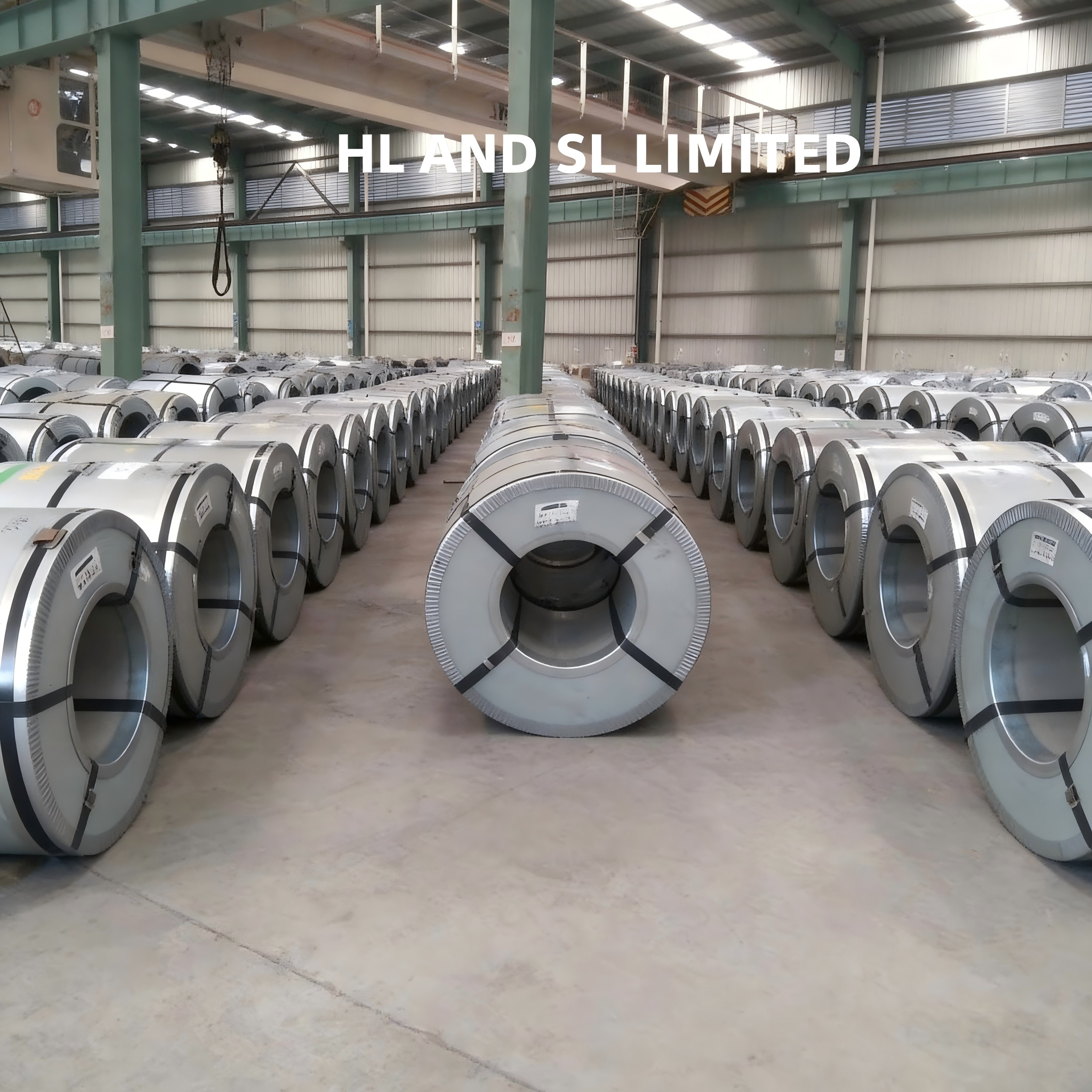
HL AND SL LIMITED — oriented silicon steel supply and processing for transformer core manufacturing.
Why the core specification now carries the efficiency argument
IEC 60404-8-7:2020 defines grades of cold-rolled grain-oriented electrical steel strip and sheet in nominal thicknesses of 0.20 mm, 0.23 mm, 0.27 mm, 0.30 mm and 0.35 mm. The same document sets out general requirements, magnetic properties, geometric characteristics, tolerances, technological characteristics and inspection procedures, and it describes the product scope as Goss-textured grain-oriented steel supplied in the final-annealed condition in coils or sheets for the construction of magnetic circuits. Two practical consequences follow. First, a grade label on its own is not a purchase specification, because thickness, loss limit and test conditions are all part of what is being bought. Second, delivery state belongs in the contract, not in an assumption.
Demand adds pressure to that technical picture. Commercial research published by Strategic Revenue Insights estimates the global silicon steel market at USD 31.55 billion in 2025 and projects USD 59.41 billion by 2035. Category-level forecasts of this kind should be read as directional rather than as a procurement model, but the direction matters: when a material category expands at that pace, grades with tight loss limits and high flux density targets are the ones that reach allocation limits first. That is one reason evaluation-stage buyers increasingly qualify two grades — a loss-led grade and a flux-density-led grade — instead of one.
There is also a design-side reason. Distribution transformer efficiency obligations are usually expressed as a maximum no-load and load loss at a specified rating, which means the core decision has to be resolved against the whole build: core section, turns, flux density, lamination count and building factor. A grade table can only settle one of those variables. The rest is engineering, which is why the comparison below separates what is verifiable from what has to be tested on a first-article core.
23R075 and 27Q095 stated as verifiable facts
Both grades belong to the same product family and share the Hi-B designation. What separates them is the combination of gauge, guaranteed loss limit and flux density target.
| Attribute | 23R075 | 27Q095 |
|---|---|---|
| Product type | High magnetic induction grain-oriented silicon steel (Hi-B) | High magnetic induction grain-oriented silicon steel (Hi-B) |
| Nominal thickness | 0.23 mm | 0.27 mm |
| Specific loss P1.7/50 (maximum) | ≤0.75 W/kg | ≤0.95 W/kg |
| Magnetic flux density B8 (minimum) | ≥1.88 T | ≥1.91 T |
| Composition as described | Iron with silicon around 3.0–3.2%, plus Al and Mn; C, S and N strictly controlled | Iron with silicon around 3%, plus Al and Mn, with MnS and AlN inhibitors present |
| Application scope as listed | Energy efficiency standard transformers, high-efficiency distribution transformers, power transformer cores | High-efficiency power transformers, photovoltaic DC converter transformers, industrial frequency conversion equipment |
The table also marks the boundary of what a grade sheet can prove. The loss figures are maximum limits, not typical measured values, and the flux density figures are minimum targets. A 0.27 mm coil that measures comfortably below its 0.95 W/kg limit can outperform a 0.23 mm coil sitting at the top of its window, which is why acceptance testing carries more weight than catalogue ranking during evaluation.
What changes between 0.23 mm and 0.27 mm in a distribution core
The reference point: P1.7/50
P1.7/50 denotes specific total loss at a peak flux density of 1.7 T and a frequency of 50 Hz. It is the single number that maps most directly onto a no-load loss guarantee in a 50 Hz distribution transformer, because core loss scales with the specific loss of the steel multiplied by the mass of the core and by the building factor of the assembled core. Comparing 0.75 W/kg with 0.95 W/kg therefore describes the size of the material-level advantage available before any manufacturing effects are applied: on identical core geometry and identical operating flux, the 0.23 mm grade offers a lower loss floor.
B8 and design headroom
B8 expresses the flux density reached at a magnetising field of 800 A/m and is used as an indicator of induction capability. On the published minimum targets, 27Q095 at 1.91 T sits roughly 1.6% above 23R075 at 1.88 T. In design terms that headroom can be spent in two ways: hold the same flux density and gain magnetising margin, or raise the operating flux to reduce the required core section or the number of turns for a given rating. Both routes change the loss arithmetic, because specific loss rises as flux density rises. The loss advantage of 23R075 must therefore be evaluated at the flux density the design actually runs at, not only at the 1.7 T reference point.
Lamination count and build reality
Gauge changes the build, not just the loss. For the same stack height, a 0.23 mm core requires about 17% more laminations than a 0.27 mm core (0.27 divided by 0.23 is approximately 1.17). That difference is visible in cutting hours, handling, burr control and stacking time, and it is where a paper loss advantage can be consumed. Realised core loss also depends on joint design, clamping pressure, burr height and cutting stress — collectively the building factor — none of which appears in a grade table. The practical rule is that grade selection sets the ceiling that a design can reach, while first-article core testing establishes what the line actually delivers.
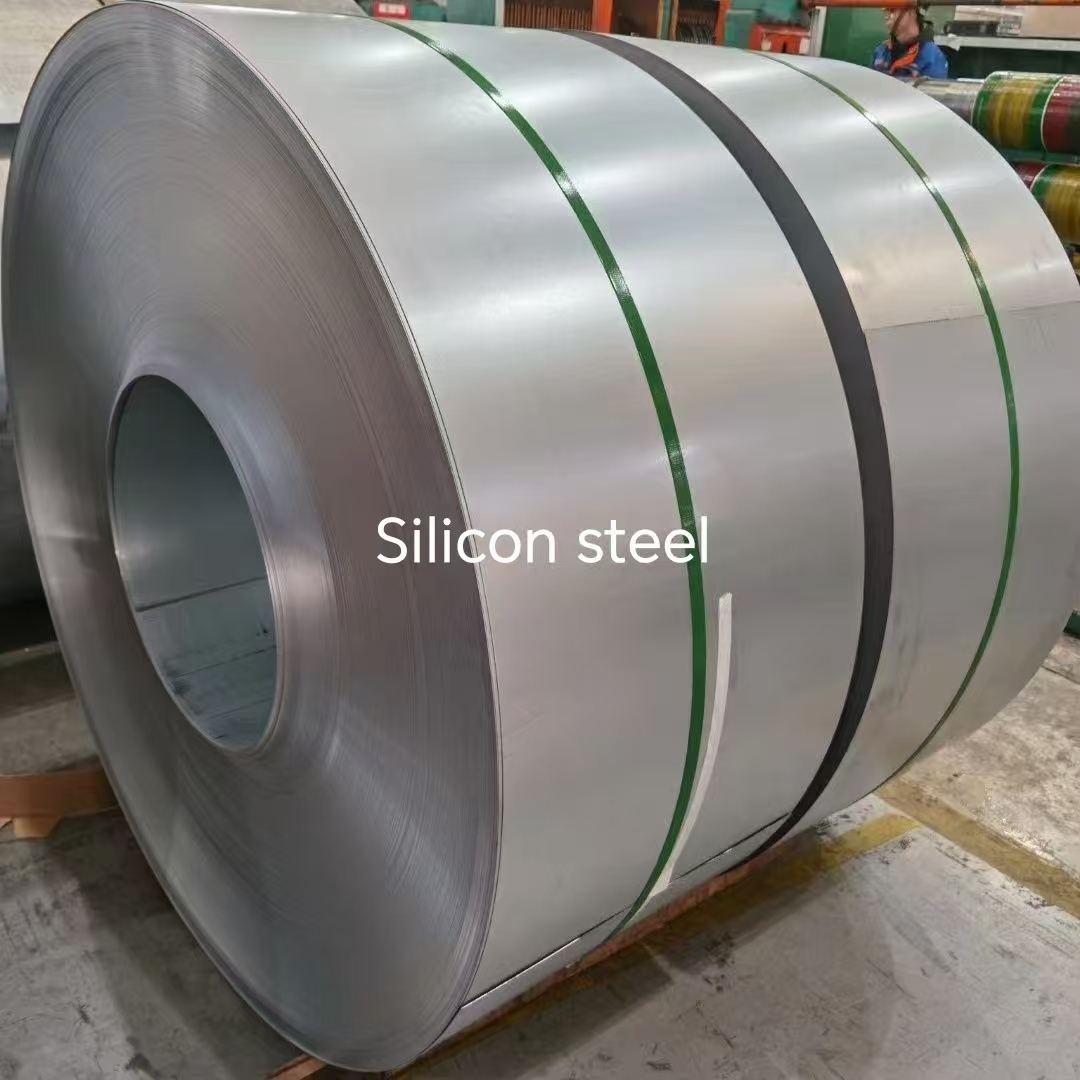
HL AND SL LIMITED — electrical steel processing and supply supporting transformer lamination production.
Matching grade to scenario: four decision rules
- Start from the binding constraint. If the no-load loss guarantee is the constraint and there is no room to raise operating flux, the 0.23 mm grade is the direct fit: 23R075 is listed for energy efficiency standard transformers and high-efficiency distribution transformers and power transformer cores, and its 0.75 W/kg limit is the lower of the two.
- Test whether flux density buys more than loss saves. If the design can be compacted — smaller core section, fewer turns, lower copper weight — the 1.91 T minimum of 27Q095 can recover more value than the loss gap costs. This is a calculation per rating, not a general preference, and it should be run at the intended operating flux.
- Consider product-line consolidation. 27Q095 is listed for high-efficiency power transformers, photovoltaic DC converter transformers and industrial frequency conversion equipment. A plant building distribution transformers alongside converter or variable-frequency units can hold one Hi-B grade across all three, simplifying qualification, inventory and cutting programmes. The trade-off is explicit: distribution cores then operate against a 0.95 W/kg limit rather than a 0.75 W/kg limit.
- Qualify both where volume justifies it. Dual qualification protects against allocation and gives design flexibility between ratings. Keep the loss difference documented as a design variable so that a substitution does not quietly void a loss guarantee on a unit already type-tested.
Where these two grades stop being the right answer
Neither grade is a default for every magnetic circuit. For ultra-high-voltage or highly compact high-frequency designs, thinner and more specialised variants in the same oriented silicon steel range — the 0.20 mm and 0.18 mm classes, laser-engraved and heat-resistant variants — are normally evaluated instead. 23R075 and 27Q095 are distribution-core answers; extending them into applications with different frequency or flux conditions needs its own justification and its own test data.
A higher grade also does not automatically deliver a lower total cost. Moving from 0.27 mm to 0.23 mm raises the lamination count by roughly 17% for the same stack height, adds cutting and handling time, and increases sensitivity to burr and coating damage. Gauge premiums in this category can be substantial: research in the same dataset notes premiums of 50–100% for ultra-thin electrical steel below 0.2 mm in high-speed EV motor applications, a figure that applies to that segment rather than to the 0.23 mm to 0.27 mm step, but one that shows why the differential must be quoted rather than assumed. Where the gauge premium exceeds the value of the loss reduction at the actual loss evaluation rate, the thicker grade is the better commercial decision.
There is an evidence boundary as well. The supplier’s transformer references, in Mexico and Brazil, confirm sustained supply into transformer manufacturing over more than ten years; they do not publish grade-specific loss outcomes. Grade fit therefore has to be proven on first-article cores rather than extrapolated from a case reference. A standards boundary applies too: IEC 60404-8-7:2020 and ASTM A876-17e1 define grades and test requirements in their own terms, and equivalence between the two systems should not be assumed without a grade-by-grade comparison recorded in the contract.
Application evidence from transformer manufacturing
HL AND SL LIMITED is a China-based electrical steel export and processing company founded in 2012, operating a 30,000 m² processing plant with a research and development team of 10 engineers, an annual output of 30,000 t and a monthly capacity of 4,000 t. The company states that it is an authorized agent of China Baowu Steel Group and ranks among the top three in China’s electrical steel export volume, with exports accounting for 80% of its business and principal markets in Mexico, Brazil, Italy, the UAE and India.
Two transformer references are relevant to distribution core evaluation. In Mexico, a transformer manufacturer has used the supplier’s oriented silicon steel for iron cores in power transformers, converter transformers and special engineering transformers for more than ten years, with batch supply and an annual business scale of approximately USD 500 million. In Brazil, described as the largest power equipment market in Latin America, WEG has used the material for over ten years in the local manufacture of power and distribution transformers, supporting compliance with local grid energy efficiency and low-carbon requirements; a representative office in Brazil provides localised technical services and supply chain support for the region.
For a buyer, the useful part of that evidence is narrower than it looks. It establishes continuity of supply to transformer manufacturing at industrial scale, and it establishes that distribution transformer builds are within the supplier’s working experience. It does not establish what loss a specific core achieved with 23R075 or 27Q095, because those figures are not published. Evaluation-stage due diligence should treat the references as supply-continuity evidence and the grade data as performance evidence, and keep the two separate.
Purchasing terms and acceptance criteria that prevent disputes
Most disagreements over Hi-B material come from an incomplete order text rather than from the coil itself. The clauses below turn a grade reference into an enforceable specification.
| Term | What to state | Why it matters |
|---|---|---|
| Grade and gauge | 23R075 or 27Q095, with nominal thickness (0.23 mm or 0.27 mm) written separately | Thickness is part of the grade definition, not a workshop preference |
| Magnetic limits | Maximum P1.7/50 (≤0.75 or ≤0.95 W/kg) and minimum B8 (≥1.88 T or ≥1.91 T) | Separates a guaranteed limit from a typical value |
| Standard reference | IEC 60404-8-7:2020, or the ASTM specification agreed with the design team | Anchors tolerances, inspection procedures and test conditions |
| Delivery state | Fully processed, final-annealed material in coil or sheet | Affects downstream stress-relief and lamination practice |
| Coating | Organic (temperature resistance up to 180 °C), inorganic (up to 800 °C) or semi-organic | Must match annealing route, oil compatibility and clamping pressure |
| Dimensions | Width within 800–1250 mm, slitting and cut-to-length details, burr limit | Burr and edge quality feed directly into the building factor |
| Documentation | Material certificate and batch inspection report with each shipment; third-party CMA/CNAS testing on request | Turns the delivery into an auditable record for incoming inspection |
| Commercial frame | 25 t minimum order quantity; regular orders 15–20 days, stock or urgent orders 3–7 days to shipment, bulk export 30–45 days to port | A 25 t minimum means first-article validation sits inside the first order, so plan it there |
Two further clauses are worth adding where the design is sensitive to them. Noise and vibration are not covered by the published grade tables for these materials, but IEC 60404-17:2021 defines measurement of magnetostriction characteristics of grain-oriented electrical steel under an applied AC magnetic field at 50 Hz or 60 Hz, so a defined test route exists where noise is a constraint; the requirement must be raised explicitly and, if relevant, confirmed by test report. For units placed on the EU market, RoHS Directive (2011/65/EU) and Directive (EU) 2025/2456 restrict ten hazardous substances in electrical and electronic equipment, with ECHA taking over technical assessments from 13 August 2027; buyers should request the relevant supplier declarations for coating systems rather than assume conformity.
Service terms support these clauses rather than replacing them. The supplier provides lifecycle technical guidance, handles inbound quality inspection disputes through re-inspection, and commits to feedback within 1–3 working days on complaints. Processing capability covers thickness from 0.18 mm to 0.35 mm, widths typically 800–1250 mm with up to 1250 mm available, slitting and cut-to-length, and export sea-worthy packaging with logo and graphic customisation.
Market signals worth reading into the grade decision
Three signals shape how this pair will be specified over the next buying cycle. The first is volume: the projection from USD 31.55 billion in 2025 to USD 59.41 billion by 2035 describes a category in expansion, and expansion concentrates pressure on the higher-specification end of the range. The second is measurement rather than material: magnetostriction testing under IEC 60404-17:2021 gives buyers a defined way to bring noise requirements into a specification that was previously settled on loss and flux density alone. The third is documentation: EU substance restrictions plus the transfer of technical assessment to ECHA in 2027 raise the value of complete coating declarations, which is a paperwork advantage that a technically equivalent coil may not share.
None of these signals changes the physics of 0.23 mm versus 0.27 mm. They change the evaluation criteria around it, and they reward buyers who ask for evidence at quotation stage instead of at complaint stage.
Outlook: dual qualification becomes the normal answer
The realistic direction for distribution core procurement is not a single winning grade but a qualified pair. Efficiency obligations keep pushing designs toward the lower loss floor that 23R075 provides, while compact build and mixed product lines keep pulling toward the flux density headroom of 27Q095. Buyers who hold both, with documented loss differences and agreed substitution rules, can respond to allocation constraints and design changes without re-running a full qualification cycle.
What is likely to change fastest is not the grade table but the evidence attached to it: batch-level test data, magnetostriction reports where noise matters, coating declarations for regulated markets, and first-article core results that connect material limits to a finished transformer. Precision at the purchasing-terms stage is the cheapest way to secure all four.
FAQ
How much lower is the iron loss of 23R075 than 27Q095?
On the quoted limits, 23R075 caps specific loss at 0.75 W/kg and 27Q095 at 0.95 W/kg, both at 1.7 T and 50 Hz. That is a difference in guaranteed maximum values, not a measured comparison: both grades are supplied against limits, and actual coil values are reported in batch inspection documents. Buyers comparing quotations should compare the guaranteed limit, the test method and the reported batch data together.
Does the thinner 0.23 mm grade also have the higher flux density?
No. In this pair, the 0.27 mm grade carries the higher published flux density target: 27Q095 is specified at B8 ≥1.91 T, while 23R075 is specified at B8 ≥1.88 T. Lower thickness reduces specific loss but does not automatically raise flux density; the two are separate specification lines and should be requested separately.
Which grade should be specified for a high-efficiency distribution transformer core?
If the design is limited by a no-load loss guarantee and the lamination line can hold burr and stacking tolerance at 0.23 mm, 23R075 is the direct fit, since its listed scope includes energy efficiency standard transformers and high-efficiency distribution transformers. If the design gains more from flux density — smaller core section, fewer turns, or one grade shared with photovoltaic converter and variable-frequency builds — 27Q095 fits better. Where both designs exist in one plant, dual qualification is the practical answer.
What should a request for quotation include for these grades?
Grade designation and nominal thickness; the standard reference, for example IEC 60404-8-7:2020; the maximum specific loss at 1.7 T and 50 Hz; the minimum B8; delivery state; coating type; width and cut-to-length requirements within the supplier’s range of 0.18–0.35 mm thickness and 800–1250 mm width; the documentation set; and the agreed test method. Standard documentation includes a material certificate and batch inspection reports, with third-party CMA/CNAS testing available on request.
Are IEC and ASTM specifications for these grades interchangeable?
Not automatically. IEC 60404-8-7:2020 sets out grades, magnetic properties, tolerances and inspection procedures for cold-rolled grain-oriented strip and sheet, while ASTM A876-17e1 covers flat-rolled, grain-oriented, fully processed low-carbon silicon-iron electrical steels with approximately 3.2% silicon content. Because each document defines grades and test requirements in its own terms, equivalence should be established grade by grade and recorded in the contract rather than assumed.
How should noise or magnetostriction be handled when specifying these grades?
IEC 60404-17:2021 defines measurement of magnetostriction characteristics of grain-oriented electrical steel strip and sheet under an applied AC magnetic field at 50 Hz or 60 Hz, so a defined test route exists where noise is a design concern. Published grade data for 23R075 and 27Q095 does not include magnetostriction values, so the requirement has to be raised explicitly with the supplier and, where relevant, verified by test report rather than inferred from the loss figure.
Reference material
Grade data, processing capability and transformer references are documented in the HL AND SL LIMITED company brochure, available for download at the HL AND SL LIMITED brochure. Company information is also published at www.hlslind.com.
Have Questions or Need More Details?
Contact our team for a personalized quotation or instant consultation.
Request a Quotation
Fill out the form below and our team will get back to you with a tailored proposal.
WhatsApp Direct Chat
Prefer to chat in real-time? Message us on WhatsApp for instant assistance & quick answers.
- Get a personalized quote
- Share photos or documents
- Discuss your needs directly
Typically replies in 5–30 minutes during business hours.