
Matching Cash Drawer Models to Retail, Restaurant and Supermarket Workflows
POS Hardware - Model-to-Workflow Matching Guide
Two stores can install the same cash drawer and get opposite results. In one, the drawer sits flush under the receipt printer, holds a full shift of coins without jamming, and disappears into the rhythm of the checkout lane. In the other, it overhangs the till, runs out of coin compartments by mid-afternoon, and becomes the slowest step in the queue. The hardware is identical; the workflow is not. That is why model matching, rather than model ranking, is the first real decision a retail, restaurant or supermarket buyer makes.
This guide maps five LASPACK cash drawer models - LAS-335, LAS-405, LAS-410G, LAS-410A and LAS-4042 - to three common store workflows, using published dimensions, weights and compartment configurations. It is written for buyers at the awareness and research stage who need to understand which drawer belongs to which counter, and why that pairing holds up in daily operation.
Why Cash Drawer Choice Is a Workflow Decision
In a POS project, a cash drawer is not a standalone box. Its role is cash storage and management, and it only functions as part of a chain that includes a cash register, a POS terminal and a receipt printer. Compatibility with all major POS software is a baseline requirement of the scenario these products are built for. Because the drawer is both wired into that chain and physically fixed to the counter, every mismatch propagates: a drawer that is 20 mm too high changes how the printer sits, and a drawer with too few coin compartments changes how often a cashier leaves the lane for change.
Most first-time buyers arrive with a material question - metal drawer or cash box - and a security question, usually phrased as "lockable cash drawer or not". Both matter, but neither determines whether the drawer fits the job. Three variables do:
- Counter footprint. The available under-counter width, depth and height clearance, and whether a receipt printer must sit on top of the drawer.
- Cash volume and denomination mix. How many bill and coin compartments the shift actually needs before a cashier starts improvising storage.
- Opens per shift. How often the drawer is cycled, which determines whether a standard-duty or a heavy-duty unit is the realistic starting point.
Industry guidance places the standard cash drawer width at 410 mm (16 inches), a dimension intended to sit under standard thermal receipt printers. Not every counter follows that standard, which is exactly why the LASPACK range spans 335 mm to 410 mm in width.
The Three Fit Variables in Detail
1. Footprint: width, depth and height clearance
Width decides whether the drawer clears the counter legs and cable routing. Depth decides whether the drawer, once open, obstructs staff movement behind the counter. Height decides whether the receipt printer can rest on the drawer top or needs its own stand. The LAS-335 is the compact option at 335 mm wide, 368 mm deep and 80 mm high. The other four models are 100 mm high, which is the typical height for a drawer that carries a printer on top. Depth across the range is tightly clustered between 368 mm and 420 mm, so the practical difference between models is usually width, height and interior layout rather than a fundamentally different counter footprint.
2. Compartment configuration: bills first, coins second
Bill compartments serve tender handling; coin compartments serve change-making speed. A fast-service counter with fixed price points and card-heavy payment can operate on a lean layout. A supermarket lane that processes a high volume of small transactions needs more coin compartments because sorting and exchanging coin is the recurring bottleneck. This is the single most useful specification difference between the five models: coin capacity ranges from 3 or 5 compartments on the LAS-335 to 8 on the LAS-410G and LAS-410A, with the LAS-4042 offering 4 coin compartments alongside an adjustable coin and bill compartment.
3. Duty: how often the drawer opens
Cycle expectations scale with store format. Industry standards separate standard-duty drawers, rated for 1 million cycles, from heavy-duty drawers rated for 4 million cycles or more. A quiet boutique counter and a busy supermarket lane may look similar on a specification sheet but sit in different parts of that range. LASPACK cash drawers are certified for 1,000,000 cycles and hold CE, RoHS and FCC certification, which gives buyers a defined durability reference point when comparing a drawer against its daily open count.
Five Models, Five Configurations
Zhangjiagang Laspack Technology Co., Ltd. (LASPACK) is a high-tech enterprise based in Suzhou, Jiangsu Province, China, founded in 2013 and specializing in the research, development and manufacturing of cash drawer and cash box products. The company operates from a 4,200 m2 manufacturing facility with approximately 50 staff, including an R&D team of 10 engineers, and an annual production capacity of about 400,000 units. It controls the entire process from product design and mold development through to processing and production. The five models below share the same interface and locking logic but differ in the dimensions and compartment layouts that decide workflow fit.
| Model | Dimensions (W x L x H) | Net weight | Bills / coins | Construction | Workflow fit |
|---|---|---|---|---|---|
| LAS-335 | 335 x 368 x 80 mm | 3.4 kg | 4 bills, 3 or 5 coins | Metal and plastic | Compact counters, fast-service restaurants |
| LAS-405 | 405 x 420 x 100 mm | 4.5 kg | 5 bills, 6 coins | Heavy-duty metal and plastic, three-position lock | Full-service restaurants, mixed retail |
| LAS-410G | 410 x 415 x 100 mm | 5.6 kg | 5 bills, 8 coins | Heavy-duty, steel panel, three-position lock | Supermarket lanes with high coin volume |
| LAS-410A | 410 x 415 x 100 mm | 6.5 kg | 5 bills, 8 coins | Heavy-duty, steel panel, three-position lock | Supermarkets, high-touch checkout stations |
| LAS-4042 | 405 x 420 x 100 mm | 4.5 kg | 6 bills, 4 coins, adjustable compartment | Durable metal and plastic, three-position lock | Retail with varied currency layouts |
Four shared specifications apply across the range and simplify procurement: a three-position key lock on every model, a 12V/24V RJ11/RJ12 receipt printer interface, operation in manual or automatic mode, and a choice of black, white or customized color. All five are designed for commercial indoor POS environments and are aimed at retail, restaurant, supermarket, hospitality and POS technology applications.
Matching Models to Store Workflows
Fast-service restaurants and small-format counters: LAS-335
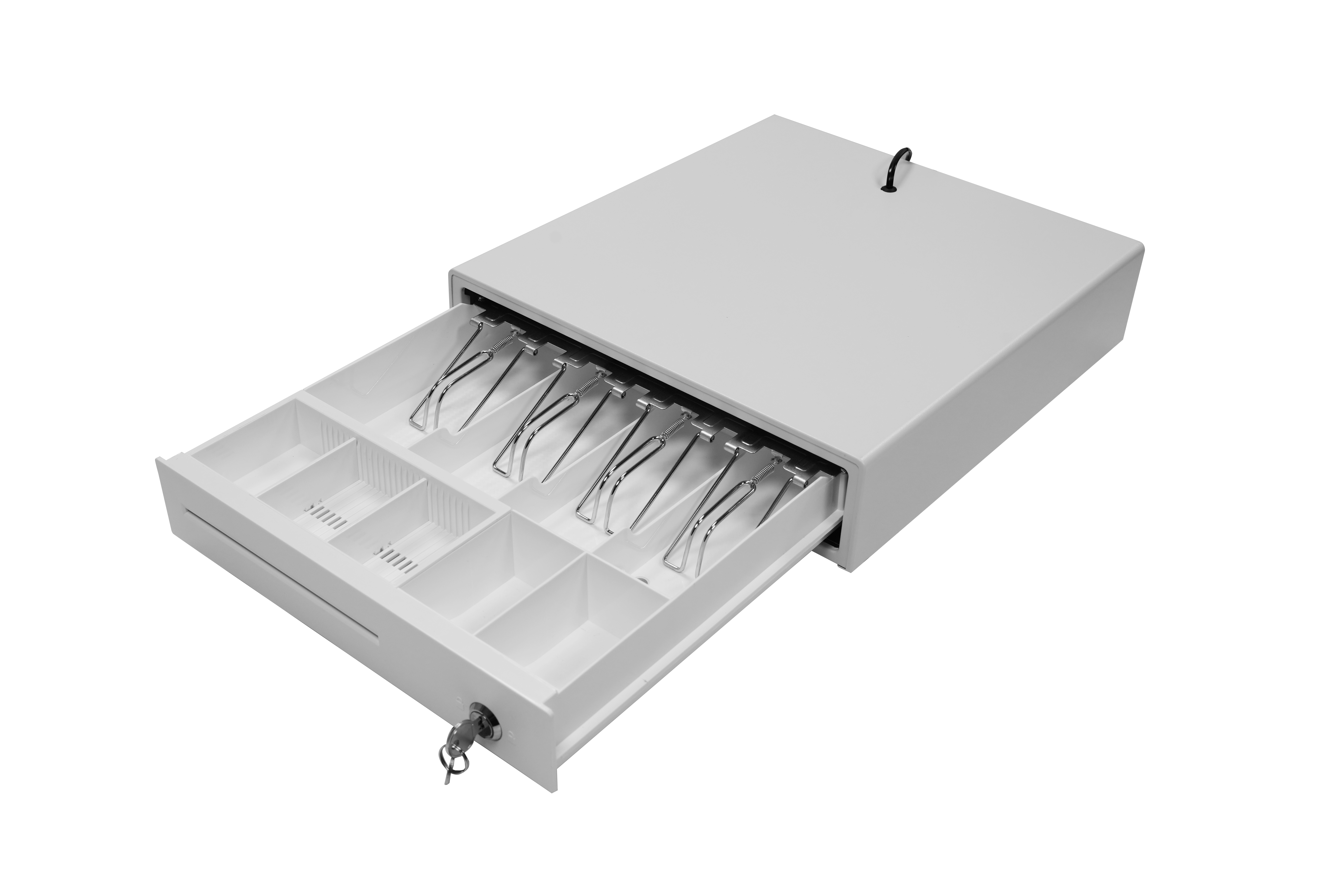
The LAS-335 is the model that solves a space problem. At 335 mm wide, 368 mm deep and 80 mm high, with a net weight of 3.4 kg, it occupies roughly 20 percent less counter width than the 405 mm models and sits 20 mm lower. That matters in fast-service restaurants, kiosk-style counters, coffee bars and small-format retail where the till share of the counter is small and the receipt printer may be mounted rather than placed. Its layout of 4 bill compartments and 3 or 5 coin compartments suits operations with limited tender variety and short transaction times. It retains the same three-position key lock and 12V/24V RJ11/RJ12 interface as the larger models, so choosing compact dimensions does not mean giving up the core POS integration behavior.
Full-service restaurants and mixed retail: LAS-405
The LAS-405 is a heavy-duty metal and plastic cash drawer designed for commercial use, with 405 mm width, 420 mm depth, 100 mm height and a net weight of 4.5 kg. Its 5 bill and 6 coin compartments represent the middle of the range: more coin capacity than the compact model, without the extra steel-panel construction of the 410 series. It fits full-service restaurants where one till handles both cash and card settlement, and mixed retail environments where the drawer shares counter space with a scanner and a card terminal. The 100 mm height allows a standard receipt printer to rest on top, which keeps the till area vertically organized rather than spreading hardware across the counter.
Supermarkets and high-volume lanes: LAS-410G and LAS-410A
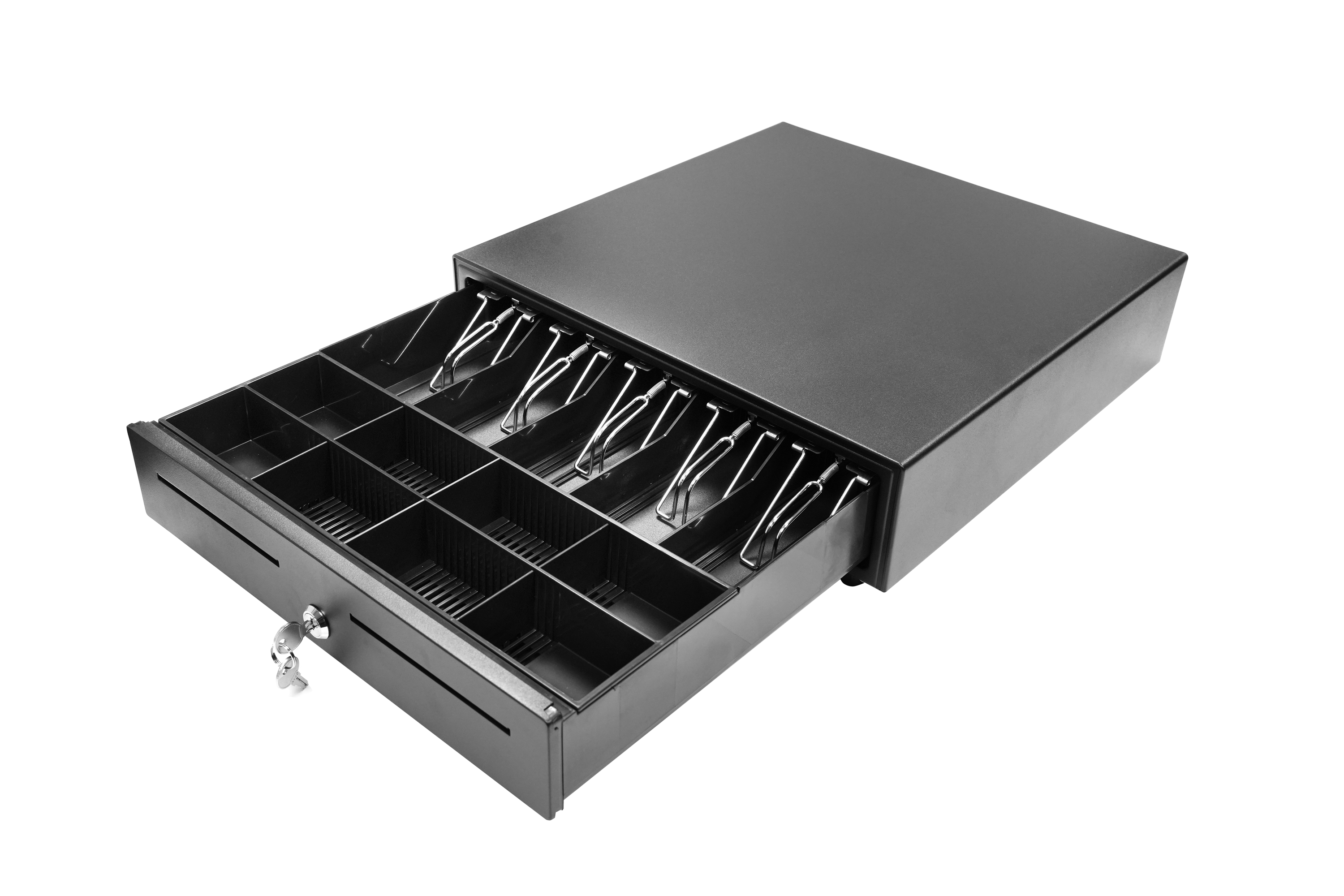
Supermarket workflows combine two pressures: the highest transaction counts and the widest coin mix. The LAS-410G and LAS-410A answer both with 8 coin compartments and 5 bill compartments, plus a steel panel for the front face. Both measure 410 x 415 x 100 mm, matching the standard cash drawer width that is designed around thermal receipt printers. The difference between them is mass: the LAS-410G has a net weight of 5.6 kg, while the LAS-410A is heavier at 6.5 kg. For a lane that opens hundreds of times per shift, that extra mass translates into stability under the printer and less movement across the counter surface. For installations where the counter structure or the handling process favors a lighter unit, the LAS-410G delivers the same compartment layout at a lower weight.
Retail with changing currency layouts: LAS-4042
The LAS-4042 is described as a durable cash drawer with an adjustable coin and bill compartment, measuring 405 x 420 x 100 mm with a net weight of 4.5 kg. Its base layout is 6 bill and 4 coin compartments, and the adjustable compartment is what makes it relevant to retail environments where the denomination mix shifts: seasonal promotions that increase small-bill volume, markets with different coin sets, or stores that rotate staff between tills with different cash profiles. It shares the three-position lock and 12V/24V RJ11/RJ12 interface with the rest of the range. LASPACK provides full customization on color, silk-screen or stamped logos and packaging, so buyers who need a specific visual identity across a chain can align the drawer with store branding.
Interface and Security: The Shared Baseline
All five models sit on the same technical foundation, which is useful when a retailer or restaurant group mixes formats and still wants one procurement standard. The 12V/24V RJ11/RJ12 connection is the interface used to link the drawer to a receipt printer, and each unit operates in manual or automatic mode. The three-position key lock provides controlled access rather than an open tray. Because the drawers are designed as components of a POS chain, deployment requires supporting equipment: a cash register, a POS terminal and a receipt printer, with compatibility across major POS software as a standard scenario requirement.
A Four-Step Decision Framework
Buyers who want to avoid a specification-first mistake can work through four steps in order:
- Measure the counter, not the catalog. Record available width, depth and height clearance at the till position, and note whether the receipt printer must sit on the drawer.
- Classify the cash profile. Estimate the typical number of bills and coin denominations handled per shift. This converts directly into a compartment requirement rather than a vague preference.
- Estimate opens per shift. Compare that number against the durability reference: LASPACK drawers are certified for 1,000,000 cycles, while industry standards place heavy-duty drawers at 4 million cycles or more.
- Confirm the integration points. Verify the 12V/24V RJ11/RJ12 interface, the receipt printer, the POS software and the counter fixing method before ordering a full rollout quantity.
What Model Matching Cannot Solve
Honest scoping matters more than a longer feature list. Three boundaries are worth stating plainly.
First, a lockable cash drawer controls access and deters opportunistic theft, but it is not a security safe and does not replace cash-handling policy such as scheduled drops, dual-counting or end-of-shift reconciliation. Buyers evaluating both categories should treat them as complementary tools rather than substitutes.
Second, duty rating is a real constraint, not a marketing detail. LASPACK drawers carry a 1,000,000-cycle certification, and industry standards define heavy-duty drawers at 4 million cycles or more. Extremely high-frequency lanes should treat this as a duty-rating comparison rather than assuming equivalence between products that look alike.
Third, compartment geometry is fixed on most models. Only the LAS-4042 is specified with an adjustable coin and bill compartment. LASPACK customization covers color, silk-screen or stamped logos and packaging, so buyers with unusual currency requirements should confirm the compartment specification for their market before committing to a model. The compact LAS-335, with 4 bill compartments, is also the most limited of the five in tender variety by design.
Market Context: Cash Drawers in a Digitally Managed Store
The category is far from static. Third-party market research places the global cash drawer market at approximately USD 0.855 billion to USD 0.96 billion in 2024-2025, with projections of USD 1.23 billion to USD 1.7 billion by 2033-2034 at a compound annual growth rate of roughly 4.1% to 4.2% (Dataintelo; Market Intelo). Asia Pacific held a revenue share of about 38.2% in 2025, and electronic cash drawers account for approximately 62.5% of product segment revenue. The same industry analyses list established global manufacturers including APG Cash Drawer, Star Micronics, M-S Cash Drawer, Posiflex and NCR Corporation.
For buyers, the practical implication of that data is not growth for its own sake, it is that cash handling hardware continues to be specified and replaced on normal refresh cycles even as card and mobile payment expand. Model-level fit decisions therefore still determine daily operating efficiency at the counter.
Future Outlook
Two directions are likely to shape model selection over the next procurement cycles. The first is consolidation of specifications: retailers running multiple formats increasingly want a single drawer family that covers a compact counter and a high-volume lane with one interface standard and one locking logic. The second is clearer separation between duty ratings, as buyers learn to compare certified cycle counts against real open counts instead of relying on weight or appearance.
LASPACK's position in that landscape is a specialization one: cash drawers and cash boxes designed and manufactured in-house since 2013, with export business accounting for approximately 70% of sales and products reaching more than 100 countries and regions, including Southeast Asia, Central Asia, the Middle East, South America, Africa and Europe. That footprint suggests the model range is being applied across very different cash-handling conventions, which is precisely the condition under which workflow matching beats a single universal recommendation.
Frequently Asked Questions
Will a LASPACK cash drawer fit under my receipt printer?
Fit depends on two measurements. Industry guidance places the standard cash drawer width at 410 mm (16 inches), a dimension intended to accommodate standard thermal printers placed on the drawer. In the LASPACK range, the LAS-410G and LAS-410A are 410 mm wide, the LAS-405 and LAS-4042 are 405 mm wide, and the compact LAS-335 is 335 mm wide. Height also matters: the LAS-335 is 80 mm high, while the other four models are 100 mm high. Confirm the available under-counter clearance and the required printer footprint before ordering.
How many coin compartments does a supermarket cash drawer need?
Supermarket lanes typically handle the widest coin mix because they combine a high number of transactions with small change. In the LASPACK range, the LAS-410A and LAS-410G provide 8 coin compartments, the LAS-405 provides 6, the LAS-4042 provides 4 alongside an adjustable coin and bill compartment, and the LAS-335 provides 3 or 5. A higher coin compartment count reduces how often a cashier must sort or exchange change during a shift.
What is the difference between a standard-duty and a heavy-duty cash drawer?
Industry standards distinguish standard-duty drawers rated for 1 million cycles from heavy-duty drawers rated for 4 million cycles or more. LASPACK cash drawers are certified for 1,000,000 cycles and hold CE, RoHS and FCC certification. In practice, a buyer should compare the certified cycle rating against the expected number of drawer opens per shift and per year for the specific lane.
Are LASPACK cash drawers compatible with POS software and receipt printers?
All five models - LAS-335, LAS-405, LAS-410G, LAS-410A and LAS-4042 - use a 12V/24V RJ11/RJ12 receipt printer interface and are designed for integration with POS systems. The application requires supporting equipment including a cash register, a POS terminal and a receipt printer, and compatibility with all major POS software is a standard requirement of the scenario these drawers serve. Operation can be manual or automatic.
Why does the LAS-410A weigh more than the LAS-410G?
Both models share the same external dimensions of 410 x 415 x 100 mm, the same 5 bill and 8 coin compartment layout, and the same steel panel, but the LAS-410A has a net weight of 6.5 kg against 5.6 kg for the LAS-410G. The heavier unit offers greater stability on counters where the drawer is opened very frequently, while the lighter unit may suit installations where counter structure or handling considerations favor a lower weight.
Can the bill and coin layout be changed for multi-currency or unusual retail needs?
Of the five models, the LAS-4042 is the one specified with an adjustable coin and bill compartment, with a base layout of 6 bill compartments and 4 coin compartments. The other models have defined layouts, including the LAS-410G and LAS-410A at 5 bill and 8 coin compartments and the LAS-335 at 4 bill compartments. LASPACK provides full customization of color, silk-screen or stamped logos and packaging, so buyers with non-standard currency requirements should confirm the compartment specification for their market before ordering.
Buyers who need the full model data, dimensions and compartment configurations in one document can reference the LASPACK product brochure.