
Matching Concrete Pump Pipe to Project Conditions
Concrete pump pipe selection is not a routine procurement task. In modern construction, infrastructure, and mining projects, the conveying line operates under continuous pressure, high flow rates, and constant abrasion from aggregate, sand, and cement. A single pipe failure can halt concrete placement, delay schedules, and add significant labor and material costs.
The global concrete pump market was valued at approximately USD 6.05 billion in 2024 (Credence Research), and the demand for durable, high-performance pump pipes is closely tied to this growth. Although pumps receive most of the attention, the pipe system is what physically delivers concrete to the placement point. Matching pipe type to project-specific conditions is therefore a critical engineering decision, not an afterthought.
Project-Specific Challenges: Why One Pipe Does Not Fit All
Operating environments differ considerably from one job site to another. High-rise construction requires long vertical lines that operate at high static and dynamic pressure. Tunneling and mining projects involve moving abrasive materials through curved routings. Mass concrete infrastructure works, such as dam foundations and bridge piers, require sustained flow over long periods without interruption.
Standard pipe products often struggle under these conditions. Premature wear leads to pipe blowouts, leakage, and loss of pressure. The consequences are costly: downtime for the entire pump system, labor to disassemble and replace lines, and often wasted concrete that has already been mixed. Some projects experience several pipe failures during a single pour, multiplying both material and labor expenses.
The opportunity lies in systematically matching pipe material, geometry, and wear-protection treatment to the specific requirements of each project. In a documented U.S. infrastructure project, the use of wear-resistant pipes reduced replacement frequency by 50% compared to standard parts — a strong incentive for procurement teams to go beyond price-based comparisons.
Manufacturer Capabilities: The Case of Hebei Qixiang Pipe Industry
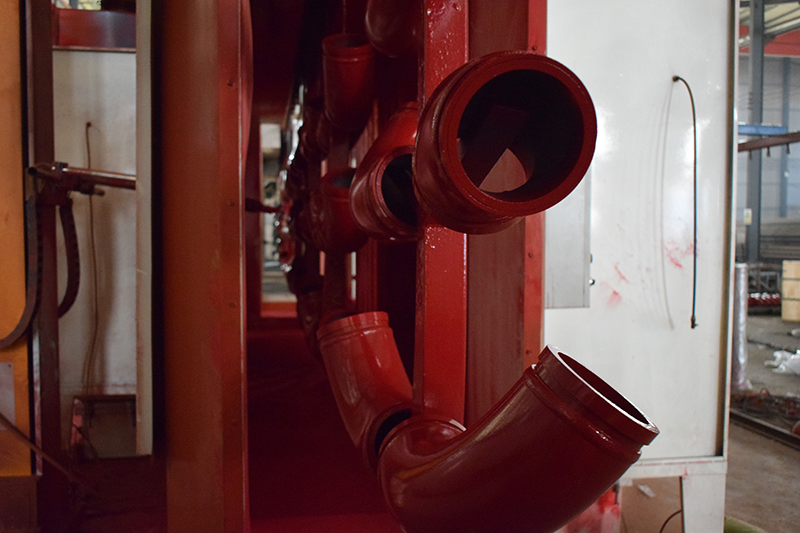
Hebei Qixiang Pipe Industry Co., Ltd., a manufacturer based in the Boerzhuang Industrial Zone, Mengcun Hui Autonomous County, Cangzhou City, Hebei Province, China, has developed a product portfolio specifically to address condition-dependent requirements. The company operates a 30,000 m² facility with over 10 advanced production lines dedicated to pump truck pipelines, achieving an annual production capacity of 7,000 tons. This scale enables the company to handle both large-volume orders and multi-specification procurement programs.
Its core products cover concrete pump pipes, mortar pump pipes, wear-resistant pump pipes, rubber hoses for concrete pumps, elbows, and a wide scope of spare parts for concrete pump systems. The company supplies pipes in steel grades including ST52 seamless structural steel, 45Mn2 alloy steel, grade 20 carbon steel, Q235 carbon structural steel, and 37Mn5 alloy steel. Standard specifications commonly include DN125 straight pipes in 3-meter lengths, with diameters from 2 to 6 inches. Custom products such as seamless steel straight pipes and double-wall pump pipes are also available.
For project-specific requirements, Hebei Qixiang offers ODM services covering concrete pump pipes, wear-resistant pipes, rubber hoses, mortar pump pipes, elbows, couplings, clamps, cleaning balls, pistons, grease, and pipe flanges. The monthly capacity reaches 7,000 tonnes, with a typical lead time of 20–25 days and a MOQ of just one unit, which makes trial orders viable for new customers.
Quality Control System
Quality is managed through a whole-process inspection system. The factory is equipped with precision testing equipment including delivery flow testing systems and hardness testing instruments. Every finished product is subject to 100% inspection before shipment. The company operates under the ISO 9001:2008 quality management system, with raw material procurement, production processing, and finished product delivery all passing through rigorous checks. For international buyers, this level of inspection discipline reduces the risk of receiving substandard piping components.
Technical Fundamentals: Materials, Heat Treatment, and Geometry
Steel Grade Selection
The choice of steel grade determines baseline strength, toughness, weldability, and hardenability.
- ST52 seamless structural steel — good strength and weldability for general-purpose lines.
- 45Mn2 alloy steel — higher manganese content improves hardenability and wear resistance after heat treatment.
- 37Mn5 alloy steel — commonly used in seamless pipes requiring higher strength and toughness.
- Grade 20 carbon steel / Q235 — cost-effective for moderate-duty applications.
- 55Mn alloy steel — used for premium wear-resistant pipes.
Wear-resistant pipes produced by Hebei Qixiang are made from 45Mn2 and 55Mn alloy structural steel. They are processed with special quenching and inner-wall carburizing treatments. Quenching raises the hardness of the steel matrix, while carburizing enriches the carbon content at the surface layer. The combination creates a microstructure that resists abrasive wear from concrete aggregates while retaining core toughness to withstand pressure and impact.
According to industrial component research, hardened concrete pump pipes with inner-wall hardness of 58–60 HRC can increase service life by 3–5 times compared to standard pipes. This is one of the most relevant technical benchmarks for procurement teams evaluating wear-resistant options.
Elbow Geometry and Structure
Elbows are wear hotspots because the flow direction changes abruptly, causing aggregate particles to impact the wall. A common heavy-duty configuration is the DN125 R275 90° elbow, where R275 refers to a bending radius of 275 mm. This geometry balances flow efficiency and wear distribution.
For extreme conditions, single-wall and double-wall elbows are available. Double-wall elbows add an inner wear-resistant layer, protecting the structural outer shell and greatly extending service life. Non-standard elbow angles can be custom-made to suit complex routing constraints on site.
System Integration
The pipe system is not limited to straight pipes and elbows. It includes couplings/clamps, flanges, cleaning balls, pistons, and lubricants. Proper selection of these supporting components is necessary for sealing integrity, quick assembly, and effective line cleaning. Suppliers that can provide a complete system package simplify procurement and reduce compatibility risks.
Documented Use Case: Large Infrastructure Project in the United States
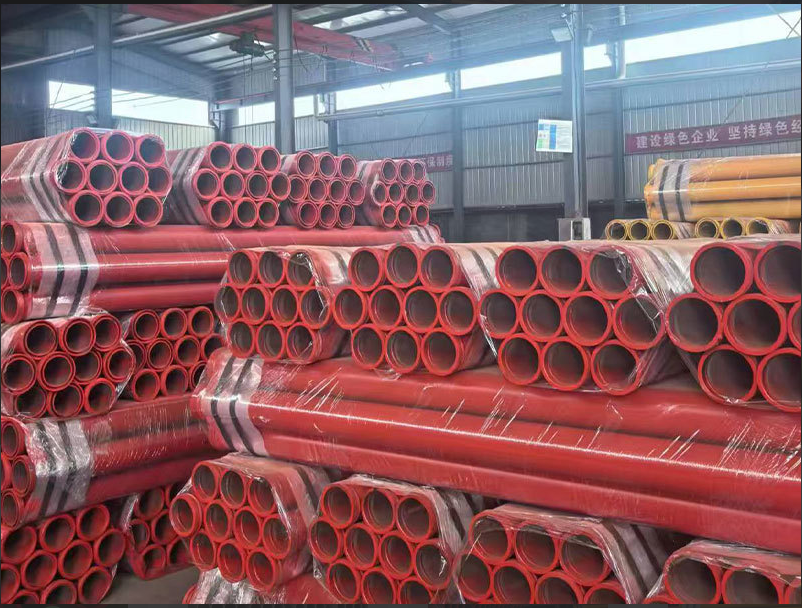
A concrete pumping service company in the United States used 5,000 pieces from Hebei Qixiang for a large-scale infrastructure project. The operating condition was continuous high-pressure pumping, with high wear from aggregate-laden concrete. The project recorded a 50% reduction in pipe replacement frequency compared to standard parts, while the wear-resistant material extended service life by 30%. These figures illustrate the operational value of selecting the right pipe specification for demanding conditions.
The same principle applies in other heavy-use environments: high-rise building placing booms, long-distance pipeline systems, and mining backfilling operations. In all these cases, downtime caused by pipe failure is disproportionately expensive compared to the pipe component cost itself.
Market Trends and Procurement Implications
The global demand for high-performance pump pipes continues to rise. Asia-Pacific accounted for 56.8% of the global concrete pump market in 2023 (Zion Market Research), driven primarily by infrastructure projects in China and India. China itself was the leading global exporter of concrete pumps in 2024, with export value of approximately USD 153 million (OEC). Countries investing heavily in transport, energy, and urban construction generate sustained demand for concrete conveying equipment and its wear parts.
At the same time, industry standards are raising the bar. ISO 21573-1:2024 establishes commercial specifications for concrete pumps and related conveying equipment, pushing suppliers toward more rigorous engineering and documentation. Buyers are increasingly expected to verify material grades, hardness values, and inspection certificates.
Several procurement implications follow:
- Total cost of ownership matters more than unit price. A cheaper pipe that fails twice as often can be more expensive once downtime and replacement labor are included.
- Technical dialogue before ordering reduces risk. Sharing operating pressure, pumping distance, and aggregate properties with the manufacturer helps align pipe design with actual conditions.
- Verifiable quality data is essential. Suppliers that provide 100% inspection and transparent material documentation are safer partners for large projects.
Comparison with Traditional Standard Pipes
Standard steel pipes cost less upfront and are easier to modify in the field. They can be cut, welded, and adapted more readily than hardened pipes. For projects with low utilization intensity or short planned durations, standard pipes remain a logical choice.
However, in high-pressure and abrasive applications, standard pipes have clear limitations. Their lower surface hardness leads to rapid wall thinning, blowouts, and frequent replacement cycles. Each replacement requires stopping the pump, bleeding the line, and reassembling — all of which consume costly site time.
Wear-resistant pipes impose a higher initial cost. But their extended service life, in some cases 3–5 times longer, directly lowers lifecycle costs. A key limitation is that hardened pipes are heavier and more difficult to modify on site. Prefabrication to exact lengths and angles is strongly recommended. For projects where the line is frequently repositioned, the logistics of handling heavier pipes must also be considered.
| Selection Factor | Standard Pipe | Wear-Resistant Pipe |
|---|---|---|
| Initial cost | Lower | Higher |
| Service life in high-wear conditions | Shorter | Up to 3–5x longer |
| On-site modification ease | Easier to cut/weld | More difficult |
| Recommended use | Light-duty, short-term projects | High-pressure, high-wear, long-term projects |
Future Outlook: Customization and Condition-Specific Design
The market is moving toward more customized, condition-specific solutions. Large contractors and pumping service companies now supply detailed operating data to manufacturers before ordering, allowing pipe systems to be engineered for specific pressure, flow, and wear profiles. Hebei Qixiang already provides ODM services in response to this trend, covering everything from material selection to elbow geometry and packaging design.
Material science will continue to improve the cost-performance ratio of wear-resistant pipes. Advanced quenching processes, new micro-alloyed steels, and more precise heat treatment control will make premium pipes more accessible to a broader range of projects. Procurement teams that adopt a technical evaluation framework today will be better positioned to benefit from these developments.
Frequently Asked Questions
What types of concrete pump pipe are available for different project conditions?
Concrete pump pipes are available in various materials, sizes, and structures, including seamless pipes, flange pipes, hardened pipes, and double-wall elbows. The choice depends on operating pressure, line length, and material abrasiveness. Common diameters include DN125, DN100, and DN80, with standard lengths of 3 meters.
How does pipe material affect performance in high-pressure and high-wear applications?
Alloy steels such as 45Mn2 and 37Mn5, combined with quenching and carburizing, improve surface hardness and wear resistance. Hardened inner walls reaching 58–60 HRC can multiply service life by 3–5 times compared to standard pipes, according to industrial component research.
What are the key specifications to match concrete pump pipe to a specific project?
Key specifications include diameter (e.g., DN125), length (typically 3 meters), material grade, wall thickness, and elbow geometry (e.g., DN125 R275 90°). For complex site layouts, non-standard elbows and custom lengths can be manufactured.
How can procurement teams evaluate the quality and reliability of concrete pump pipe suppliers?
Important criteria include production capacity, quality control processes, inspection rates, and experience with similar projects. Suppliers that provide 100% pre-shipment inspection and clearly document material grades and test results are generally more reliable. ISO 9001 certification is a baseline indicator of management system quality.
What lead times and customization options are available for project-specific orders?
Typical lead time is 20–25 days, and minimum order quantities can be as low as one unit for trial orders. Many suppliers, including Hebei Qixiang, offer ODM services for custom dimensions, materials, and packaging, which is useful for project-specific requirements.
For detailed specifications, product range, and manufacturing capabilities, download the Hebei Qixiang Pipe Industry brochure: