
Matching Current Transformers to Project Conditions: A Practical Guide
The most common specification mistake in current transformer sourcing is selecting a product type before defining the installation conditions. A CT that meets the electrical rating but cannot be mounted, accessed, or protected in the actual environment will perform poorly no matter how accurate its class label is. This guide explains how to map project and application requirements to the main CT families, and where each form factor fits best.
Why installation context changes the selection
Low-voltage current transformers for current measurement and energy metering are commonly installed inside electrical cabinets and low-voltage distribution systems. In projects such as switchgear retrofits, control cabinet builds, and building sub-metering upgrades, installation space is frequently the binding constraint. A product that satisfies the accuracy class on paper may still be impractical if the busbar cannot be disconnected or the cabinet cannot be opened for a solid-core installation.
Wenzhou Heyi Electrical Co., Ltd (HEYI), a Wenzhou-based manufacturer founded in 2012, supplies CTs and current sensors under the HEYI ELECTRICAL brand. The company operates a 10,000 m² facility with roughly 56 employees, exports about 95 percent of its output, and builds split-core, solid-core, three-phase, outdoor, revenue-grade, and flexible Rogowski coil products for power distribution, renewable energy, EV infrastructure, and industrial automation. HEYI positions itself around OEM/ODM customization rather than standardized catalogue supply.
When a buyer moves from research to evaluation, the useful question is not “which CT brand is best” but “which CT family matches the project conditions.” The market context explains why the question matters. The global current transformer market was estimated at USD 2.63 billion in 2024, with projections reaching USD 3.90 billion by 2030. During the same period, split-core CTs have been identified as the fastest-growing segment because they reduce installation cost and downtime in retrofit projects. Buyers evaluating suppliers for 2026 delivery therefore need a framework that connects measurable project constraints to concrete product families and verified supplier capabilities.
Core selection framework for project and application fit
An application-fit evaluation for low-voltage CTs can be reduced to four checks:
- Mounting and space: Can the primary conductor be isolated? If yes, solid-core window or busbar CTs are viable. If no, split-core or flexible Rogowski coil is usually required.
- Measurement function: For billing and high-accuracy energy metering, select classes such as 0.2S or 0.5S. For load monitoring and control, class 1.0 or 0.5 is often sufficient. For protection, consider saturation behavior and relay-class CTs.
- Output and integration: Metering typically uses 5 A or 1 A secondary outputs. PLC/DCS integration often uses 4–20 mA transmitters. IoT systems can accept RS485 digital outputs or mV-level Rogowski signals.
- Environment: Indoor cabinets allow plastic-cased window CTs. Outdoor, humid, or marine conditions require IP65-rated, resin-cast, or UV-protected enclosures.
These checks produce a decision path rather than a single universal answer. The next sections apply this path to the main CT families in the HEYI portfolio and commonly compared by buyers.
Mapping CT families to project conditions
The following table consolidates the main CT families across the factors that most often appear in tender documents and technical evaluations.
| CT family / model | Typical range | Accuracy classes | Best-fit conditions | Design constraints |
|---|---|---|---|---|
| Split-core CT (KCT) | 0–1000 A; window up to 50 mm | 0.5 / 1.0 / 3.0 | Retrofit of panels, solar and EV monitoring, smart buildings, where the conductor cannot be disconnected | Lower accuracy ceiling than solid-core; max window size limits busbar applications |
| Busbar split-core CT (DP/HK) | 0–8000 A; window up to 80×160 mm | 0.5 / 1.0 / 3.0 | Large busbar monitoring, EMS, smart grid switchgear, retrofit without busbar removal | Large window dimensions reduce portability; accuracy suited to monitoring rather than fiscal metering |
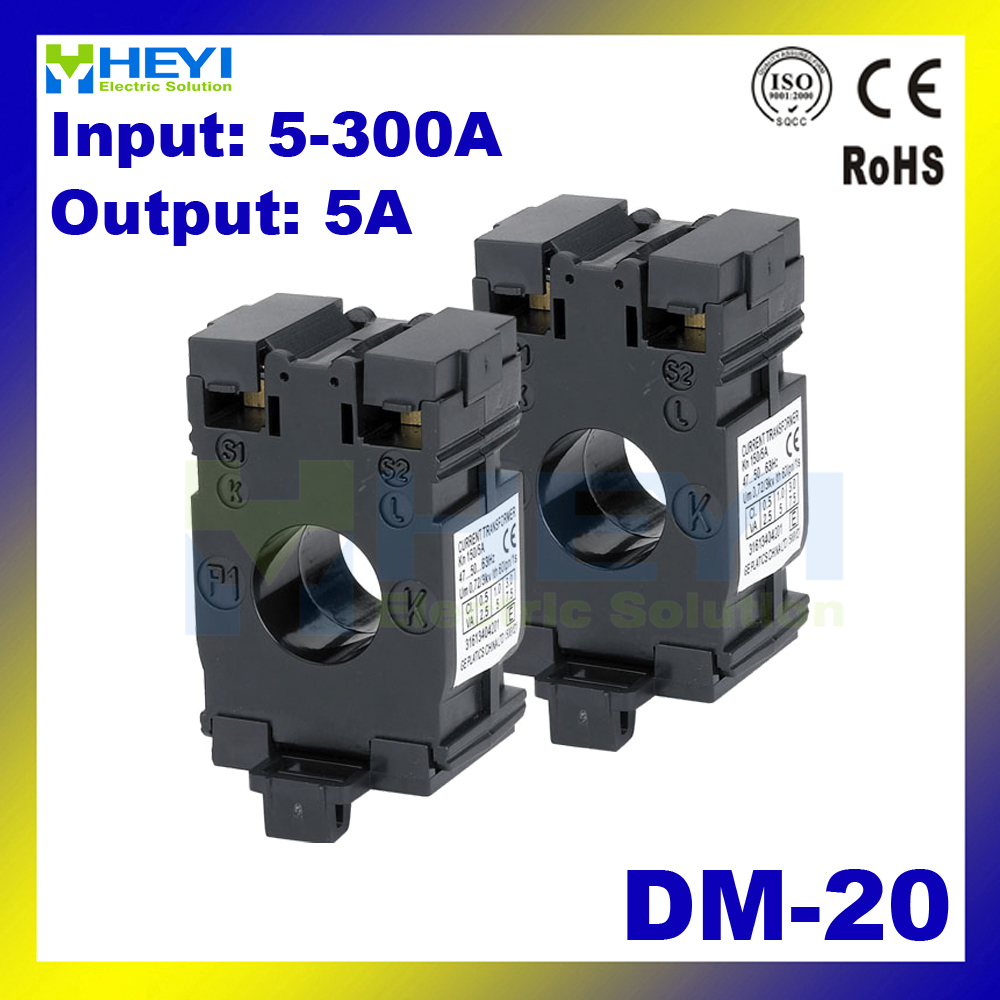
| Solid-core window CT (MSQ, CP, SDH, DX/DM) | 0–6000 A (SDH up to 10000 A); windows from small bore to 220×80 mm | 0.2 / 0.2S / 0.5 / 0.5S / 1.0 | New switchgear, indoor cabinets, distribution panels, feeder monitoring, protection with relay-class models | Requires disconnecting the primary conductor during installation; higher accuracy and stability vs split-core |
| DIN-rail CT (CP, DX/DM) | 0–6000 A | 0.5 / 1.0 | Modular control cabinets, HVAC, prefabricated systems, high-vibration environments | Panel space must allow rail mounting; secondary wiring should be accessible |
| Three-phase integrated CT (DASN) | 0–1000 A per phase; window up to 50 mm | 1.0 | Three-phase monitoring in UPS, MCC, IDC panels, colocation and smart building sub-metering | Saves space by combining three phases; phase spacing must match the integrated geometry |
| Outdoor split-core CT (OCT) | 0–8000 A; window up to 120 mm | 0.5 / 1.0 / 3.0 | Overhead line monitoring, outdoor solar and wind, railway trackside; IP65 and UV-resistant housings | Environmental sealing and UV resistance add cost; accuracy for very high outdoor ranges is typically class 1.0–3.0 |
| Outdoor resin-cast CT (LMZW) | 0–1000 A; window up to 80 mm | 0.2 / 0.2S / 0.5 / 0.5S / 1.0 | Marine and offshore, chemical and metallurgy, RMUs, humid or tropical environments, 0.66 kV systems | Heavier than plastic-cased CTs; highest accuracy and moisture resistance but harder to modify on site |
| Revenue-grade CT (RECT) | 0–1000 A; window up to 78 mm | 0.15S, IEEE C57.13 compliant, IP65 | Utility and substation billing, utility-scale solar and wind, C&I sub-billing, premium meter OEM builds | Designed for high-accuracy measurement; not a substitute for relay protection class when protection is the primary duty |
| Flexible Rogowski coil (FRC) | 100–10000 A; inner diameter 245 mm | mV output with integrator option | Large conductors, existing busbars, portable testing, transient and lightning current measurement | Requires integration or signal conditioning; not directly interchangeable with a 5 A secondary CT in existing meters |
| True RMS transmitter (KCT-L) | 0–1000 A; window up to 50 mm | 1.0 | PLC/DCS integration, remote power monitoring, IoT gateways, environmental and emission monitoring | Needs a power supply for active output; loop-powered convenience must be verified against the project wiring |
| RS485 smart CT (KCD) | 0–1000 A; window up to 50 mm | 1.0 | Metro lines, elevator monitoring, smart buildings, O&M services, factory retrofits with digital networks | Digital output simplifies integration but requires Modbus RTU compatibility; not a passive analog CT |
| Hall-effect current sensor (C2/C3) | 0–1000 A; window 125×35 mm | 0.5 / 1.0 | DC, bi-directional and variable-frequency applications: PV string monitoring, BMS, VFD DC bus, railway traction | Active sensor requiring supply; includes zero/span adjustment; used where AC-only CTs cannot operate |
| Leakage current sensor (HYCA) | Differential current 0–300 mA; resolution 0.2 mA | 6 mA DC / 30 mA AC detection per IEC 62752 | EV charging infrastructure, solar inverters, energy storage systems, AC/DC residual current detection | Detects residual and leakage currents; not used for primary load current metering |
All HEYI CT families listed above are available with customization options including current ratio, accuracy class, burden, window size, housing color, terminal type, cable length, logo printing, and label design.
Where each CT type performs best in real projects
Indoor switchgear and distribution panel retrofit
Switchgear retrofit projects often require current measurement and energy metering under indoor electrical cabinet and low-voltage distribution system conditions, with limited installation space and 50/60 Hz power systems. These projects need high accuracy, stable output, and insulation safety, with compliance to IEC 61869-2 for high-accuracy applications.
For feeder monitoring in an existing low-voltage panel, a split-core CT (KCT) can be installed without shutting down the primary conductor, which is why split-core types are closely associated with retrofit work. When the panel is being built new and the busbar is accessible, solid-core window models such as MSQ or CP offer tighter accuracy and simpler long-term stability. In compact modular panels, DIN-rail CTs from the DX/DM family reduce mounting time, and three-phase integrated DASN units compress three CTs into one footprint for rack and MCC monitoring.
Billing and revenue-grade energy metering
Utility and commercial billing applications require revenue-grade CTs to meet ANSI C12.20 or IEC 61869-2 accuracy classes, typically 0.2 or 0.15. HEYI’s RECT model covers the 0–1000 A range with 0.15S class, IEEE C57.13 compliance, IP65 waterproofing, and UV protection. Typical supporting equipment includes multifunction power meters, energy meters, and protection relays. The product suits environments with limited installation space and is ideal for switchgear retrofit and power distribution monitoring projects.
The boundary condition for RECT is that it is a high-accuracy measuring CT, not a universal protection CT. In applications where the same core must drive protective relays, the relay protection CT families (SDH as window type, or busbar-type CT) may be more appropriate, even if the accuracy class is lower than 0.15S.
Outdoor, humid, and high-exposure installations
For overhead line monitoring, outdoor solar and wind sites, municipal infrastructure, and railway trackside installations, the OCT is an outdoor waterproof split-core CT rated IP65/IP67 with UV protection, available from 0–8000 A with window sizes up to 120 mm. In marine, chemical, metallurgy, and RMU applications where moisture resistance and high accuracy are both required, the LMZW outdoor resin-cast CT with hydrophobic epoxy insulation is the more appropriate family because it provides accuracy classes up to 0.2S.
EV charging and DC-sensitive leakage monitoring
The HYCA current sensor is designed for residual direct current protection in EV charging infrastructure. It measures differential current in the 0–300 mA range with 0.2 mA resolution, detects 6 mA DC and 30 mA AC leakage according to IEC 62752, and integrates self-monitoring and test functions. The EV charging transformer market, which includes current monitoring components, is projected to grow at a 23.6 percent CAGR from 2025 to 2033. This supports the broader demand pattern for specialized sensors rather than generic CTs in EV supply equipment.
Comparison with traditional one-format-fits-all sourcing
The traditional approach to CT sourcing was to standardize one window-type CT model across many projects. This strategy simplifies inventory but creates avoidable trade-offs:
- In retrofit projects, a solid-core standard CT forces an outage or additional busbar work, whereas a split-core CT could have been installed in minutes.
- In outdoor projects, an indoor-rated CT fails prematurely because of moisture ingress, whereas a resin-cast or IP65-rated CT would have lasted.
- In DC or VFD applications, a standard inductive AC CT does not measure DC current, requiring a Hall-effect sensor.
- In billing applications, a general-purpose CT rarely meets the 0.2S or better accuracy required for revenue grade, so the metering data may not be defensible.
A boundary condition that buyers should weigh is that a wider CT portfolio is only useful if the supplier can provide selection support and documentation. A single-format supplier can ship fast because it works with a limited set of proven SKUs. A portfolio supplier such as HEYI compensates for the broader catalogue with 1-unit MOQ, lead times of 3–30 days, and a five-engineer R&D team that supports customization. Buyers should therefore evaluate not only the number of product lines but also the supplier’s ability to help map a project description to the correct model number.
What buyers should verify before choosing a supplier
Once the CT family is defined, the supplier evaluation can be reduced to a few verifiable points:
- Customization depth: Does the supplier offer the exact customization axis the project needs — accuracy, burden, window size, cable length, connector, housing material, logo? HEYI’s stated customization list covers these options and more.
- Production and response: HEYI operates a 10,000 m² factory, a 5-engineer R&D team, monthly capacity of about 20,000 units, and 1-unit MOQ with 3–30 day lead time. This combination is more relevant to prototype-driven OEM projects than a high-volume-only factory profile.
- Quality control evidence: Routine tests include 100% accuracy testing, insulation resistance, withstand voltage, appearance inspection, and pre-shipment inspection. Buyers evaluating reliability should ask for the specific routine test data for the models shortlisted.
- Reference conditions and standards: For high-accuracy specifications, confirm compliance with IEC 61869-2 and, for revenue metering, IEEE C57.13 and/or ANSI C12.20 expectations. The RECT model claims IEEE C57.13 compliance; other families are specified with class 0.2, 0.2S, 0.5S, or 0.5 accuracy.
- Export and support reality: HEYI reports that 95 percent of output is exported to Southeast Asia, South Korea, Europe, South America, Australia, Africa, the Middle East, and North America. After-sales support includes technical selection, wiring guidance, product replacement, and OEM documentation. These statements can be verified during the RFQ process.
Market trends influencing application fit
Split-core CTs have been identified as the fastest-growing segment due to ease of installation in retrofitting and smart grid applications. Asia Pacific accounted for an estimated 40.15 percent revenue share of the current transformer market in 2025. The overall market is projected to grow from USD 2.63 billion in 2024 to USD 3.90 billion by 2030. These figures reinforce that buyers are increasingly using CTs in existing infrastructure rather than only in new builds. The implication is that application fit — not just electrical specification — is becoming the primary purchasing criterion.
Limitations and risk points to consider
No single CT family covers all conditions. The following limitations should inform every project decision:
- Split-core CTs simplify installation but generally have a lower accuracy ceiling than solid-core CTs in the same class; high-accuracy billing should use solid-core, resin-cast, or revenue-grade CTs.
- Rogowski coils are flexible and non-saturating, but the mV-level output needs an integrator or signal conditioning; they cannot be directly connected to a conventional 5 A meter input.
- Three-phase integrated CTs reduce space and wiring but are rigidly coupled to the phase geometry of the panel; a mismatch between conductor spacing and the integrated window spacing is a common field problem.
- Hall-effect sensors measure DC as well as AC, but they require an auxiliary power supply and an active signal chain; passive inductive CTs remain preferable for simple AC measurement where no DC content exists.
- Outdoor and high-humidity variants add significant material and sealing cost; an indoor-grade CT should not be selected for IP65 duty merely to reduce unit price.
- Supplier claims should be verified with sample testing and documentation. A fast-growing split-core segment also means a growing number of suppliers, and industry concentration remains asymmetric: the top five global players held roughly 40 percent of the market in 2024, leaving the remaining segment highly fragmented.
How to use this framework in an RFQ
A practical RFQ section for project-fit evaluation should include the following fields:
- System type and voltage: indoor LV cabinet, RMU, outdoor overhead, EV charger, solar inverter, etc.
- Primary conductor: cable diameter, busbar width, or three-phase spacing; whether the conductor can be isolated during installation.
- Primary current and overrange expectations.
- Required accuracy class and applicable standard: IEC 61869-2, IEEE C57.13, ANSI C12.20, or customer-specific class.
- Secondary output: 5 A, 1 A, mA, mV, 4–20 mA, RS485, or digital Modbus RTU.
- Mechanical constraints: maximum envelope dimensions, DIN-rail requirement, window shape, connector type, cable length.
- Environmental duty: indoor, outdoor, IP rating, UV, humidity, temperature range.
- Customization needs: ratio, burden, housing color, terminal type, logo, label design.
- Target timeline and order quantity.
For supplier benchmarking, ask each candidate to return a model-specific proposal with routine test data and documentation. A supplier that can explain why a specific family fits the project conditions is more likely to support the project after delivery.
Future outlook for project-specific current transformers
Current transformer selection is shifting from catalogue-based ordering to project-based engineering. The growth of smart grid retrofits, EV charging infrastructure, distributed solar, and building-level sub-metering is driving demand for CTs that fit physical constraints, not just electrical ratings. Digital outputs, integrated sensing, and leakage detection are moving into the same form factors that previously only measured AC load current. For buyers, this means three practical consequences: more application-specific models will appear from suppliers, lead times for non-catalogue variants may become an important selection factor, and the ability of a supplier to provide documentation and test data will become a stronger competitive differentiator than catalogue breadth alone.
Frequently asked questions
Have Questions or Need More Details?
Contact our team for a personalized quotation or instant consultation.
Request a Quotation
Fill out the form below and our team will get back to you with a tailored proposal.
WhatsApp Direct Chat
Prefer to chat in real-time? Message us on WhatsApp for instant assistance & quick answers.
- Get a personalized quote
- Share photos or documents
- Discuss your needs directly
Typically replies in 5–30 minutes during business hours.