
Matching Custom Plush Pet Toys to Veterinary, Training and Retail Use Cases
A specification mismatch, not a manufacturing defect, is the most common reason a custom plush pet toy underperforms in a B2B programme. A toy selected for a veterinary waiting room and a toy selected for a 28 kg dog with a hard, persistent bite are different briefs, even when both are plush.
The category is large enough for that distinction to carry commercial weight. Fortune Business Insights put the global pet toys market at USD 9.60 billion in 2025, in a report published in September 2026. Custom Market Insights estimates in its 2026 dog toys report that plush and soft toys account for approximately 30% of the dog toys segment. Plush is therefore a core category that buyers segment deliberately, not a filler line carried for range completeness.
Jiameile (Tianchang Jiameile Gifts Co., Ltd.) is a China-based manufacturer of plush and textile toys, including custom plush pet toys, and runs OEM, ODM and private-label programmes for export buyers. Its published product line gives a buyer three usable variables: weight band, dimension band and chew level. This article maps those variables onto veterinary, training and retail use cases, and states where the mapping stops being reliable.

Figure 1 — Manufacturing environment supporting custom plush pet toy production for veterinary, training and retail programmes.
Three specification variables decide scenario fit
Scenario fit is set by three variables used together: the dog weight band, the toy dimension band, and the chew level the construction is built for. The intended use tells a buyer how to weigh those three variables; it does not replace them.
The weight bands listed in Jiameile's pet toy specifications are under 5 kg, 5–15 kg and 15–30 kg, while the published product scope describes suitability across dogs from 5 kg to 40 kg. Dimension bands are 10–15 cm and 15–20 cm for small-size toys, 20–30 cm for medium toys and 30–50 cm for large toys. Chew resistance is classified as Light Chewer, Moderate Chewer or Aggressive Chewer.
Materials track the size architecture rather than cutting across it: small-size toys are specified in short plush, medium toys in Oxford fabric, and large toys in TPR (thermoplastic rubber). That is a structural difference worth registering at briefing stage, because a 30–50 cm TPR toy and a 10–15 cm short-plush toy are not interchangeable answers to the same procurement question.
The mapping below is a programme-planning aid assembled from published product specifications. It is not veterinary or behavioural advice, and chew behaviour varies considerably within any single weight band.
| Intended use | Weight band to plan around | Dimension band typically specified | Chew level to specify | Why it matters |
|---|---|---|---|---|
| Daily companionship and emotional calming (veterinary waiting rooms, boarding, home) | Under 5 kg; 5–15 kg | 10–15 cm; 15–20 cm | Light to Moderate | Softness and the calming function carry more weight than tear strength; washability governs reuse. |
| Teething and chewing training (puppy classes, training centres) | Under 5 kg; 5–15 kg | 10–15 cm; 15–20 cm | Light to Moderate | Jaw strength is still developing, so a heavily reinforced build adds little and reduces softness. |
| Interactive play and behavioural training | 5–15 kg; 15–30 kg | 15–20 cm; 20–30 cm | Moderate | Squeaker response and a size the dog can carry and retrieve both matter. |
| Retail chain shelf programmes | All three bands | All three bands | Light, Moderate and Aggressive as separate SKUs | Shelf tiers mapped to weight bands reduce shopper confusion at the point of purchase. |
| Heavy-duty and aggressive chewer programmes | 15–30 kg, extending to 40 kg | 30–50 cm (TPR construction) | Aggressive | Plush remains a limited-duration option at this chew level; TPR is the structurally appropriate answer. |
| Subscription, gift and small-dog programmes | Under 5 kg | 10–15 cm | Light | Unit cost, packaging and theme variety dominate the brief rather than chew resistance. |
What each use case actually asks the product to do
Veterinary and pet care settings
Clinics, boarding facilities and pet-care providers are buying calm and cleanability, not maximum tear resistance. The relevant functions in the product line are emotional calming, anxiety relief and washability — the same feature set that appears in the published use cases of daily companionship and emotional calming.
Two practical consequences follow. First, specification should favour plush softness and a size the animal can hold comfortably: 10–15 cm or 15–20 cm small-size toys for toy and small breeds, 20–30 cm medium toys for larger animals. Second, washability has to be treated as a programme requirement rather than a marketing line. Published care guidance for plush dog toys consistently recommends a gentle cold machine cycle followed by air drying, and warns that dryer heat can damage squeakers and stitching.
A boundary worth stating plainly: shared plush toys in a clinical or boarding environment accumulate saliva and coat debris, so reuse depends on a documented cleaning routine. Buyers running high-turnover shared-toy programmes should confirm wash instructions against the specific construction rather than assume that general consumer care guidance applies to every build.
Training and behavioural programmes
Training buyers are purchasing repetition and a reliable interrupt. In the published use cases, teething and chewing training, behavioural training, interactive play and reducing destructive behaviour all appear alongside an interactive squeaker design — which is why squeaky custom plush pet toys sit closer to the training brief than to the display brief.
Puppy and beginner classes generally call for small-size toys at 10–15 cm or 15–20 cm in a light to moderate chew construction, because jaw strength at that stage is low. Adult obedience and scent-work sessions more often use 15–20 cm or 20–30 cm items that the dog can carry and retrieve. Teething custom plush pet toys are therefore a distinct brief from heavy duty custom plush pet toys, and combining the two on a single purchase order usually produces a specification that satisfies neither group.
Consistency matters more than variety here. A training school issuing toys to handlers needs the same dimensions, the same squeaker behaviour and the same fabric across replacement batches, which turns the order into a customization question rather than a catalogue question.
Retail chains and supermarket programmes
Retail buyers are purchasing shelf logic. The weight bands give a natural three-tier structure — under 5 kg, 5–15 kg, 15–30 kg — that a shopper can navigate without reading a specification table. Dimension bands allow the same tier to be merchandised in different footprints.
Packaging is part of the specification in this channel. Published customization covers logo printing, fabric material, size, colour, stuffing type, squeaker type, packaging in box, blister or card format, and hang tags. For a chain, washable custom plush pet toys carry an additional merchandising advantage: care expectations are already established with consumers, because major pet retail and editorial sources routinely publish washing guidance for plush dog toys.
The constraint is order economics. Custom programmes of this type typically start at 500–3,000 pieces per style, with complex designs often at 3,000–5,000 pieces, and sample lead times of 7–15 days ahead of bulk production of 20–45 days. A chain piloting a new shelf tier across many stores may need to consolidate styles rather than spread volume thinly across a wide assortment.
Pet brands, private label and e-commerce
Brands and online sellers are buying differentiation with a defensible specification. The relevant capabilities are OEM manufacturing, ODM development and private-label customization, with control over fabric, size, colour, stuffing, squeaker type and packaging. Interactive custom plush pet toys and tear resistant custom plush pet toys are the two positions that survive contact with online review behaviour, because both are claims a buyer can verify in use rather than take on trust.
For e-commerce specifically, weight band and dimension band should be published together. A listing that states medium without a centimetre range invites exactly the return that a 20–30 cm dimension band would have prevented.
Subscription and gift programmes are a separate case again. They usually want small size custom plush pet toys at 10–15 cm in mixed themes, where unit cost and packaging carry more weight than chew resistance.
Boarding, grooming and multi-dog environments
Facilities handling multiple animals on the same day have a different failure mode from a single-pet household: the toy is used more often, by animals of different sizes, and cleaned more frequently. In practice these buyers specify one durable construction for the general play area and reserve softer plush for individual calm-down use. The reported service-life spread — 3–12 months for standard plush, 6–24 months for reinforced chew, and 12–36 months for rubber or TPR — is what makes that split budgetable rather than arbitrary.
How the Jiameile product architecture supports use-case matching
The line is organised by size class rather than by species or theme, which is what makes scenario mapping possible at all. Small Dog Toys are specified at 10–15 cm and 15–20 cm in short plush, Medium Dog Toys at 20–30 cm in Oxford fabric, and Large Dog Toys at 30–50 cm in TPR.
Feature claims across the range include chew-resistant construction with reinforced stitching, non-toxic materials, an interactive squeaker, no-stuffing designs for safety, and washable, easy-to-clean surfaces. The published product scope also states compliance with the Chinese companion animal product safety standard GB/T 43839-2024 and references international toy safety standards including EN71 and CPSIA for the plush range.
On the manufacturing side, Jiameile holds an ISO 9001 quality management system certificate issued by CQC under GB/T19001-2016, certificate number 00124Q35906R5M/3400, covering the production of cloth and plush toys and valid to 1 September 2027. Company-level certifications stated in its profile include ICTI, BSCI, Disney FAMA and ISO 14001. For a buyer in evaluation, the useful detail is the certificate scope: it names cloth and plush toy production specifically, which is the operation actually audited.
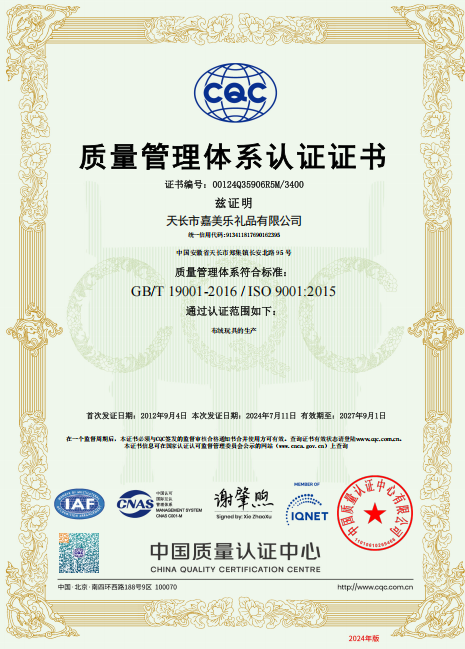
Figure 2 — ISO 9001 quality management system certificate issued by CQC under GB/T19001-2016, covering the production of cloth and plush toys.
Reported commercial terms for Jiameile programmes include a typical minimum order of 500–3,000 pieces per style and sample lead times of 7–15 days. These are programme-entry figures to confirm at RFQ stage rather than market benchmarks, because terms move with fabric, size mix and testing requirements.
Service life is where the use-case mapping becomes a budget line. Reported ranges are 3–12 months for standard plush toys, 6–24 months for reinforced chew toys and 12–36 months for rubber or TPR toys, depending on usage intensity. A veterinary buyer planning a twelve-month replacement cycle and a training centre planning a six-month cycle are therefore specifying different constructions from the same supplier, and should be quoting them separately.
Market signals that make use-case segmentation a purchasing issue
Three data points frame the buying decision.
The first is scale. The global pet toys market stood at USD 9.60 billion in 2025, and in the United States the pet supplies, OTC medications and live animals segment reached USD 34.4 billion in 2024, according to the American Pet Products Association. Custom programmes compete inside a category that already supports dedicated shelf space and specialist buyers.
The second is segment weight. Plush and soft toys at roughly 30% of the dog toys segment are large enough that a differentiated plush range is a strategic decision rather than an experiment.
The third is regulatory asymmetry. Pet toys fall outside mandatory CPSC jurisdiction in the United States, and ASTM F963 is applied voluntarily in that category. That places the testing requirement in the purchase contract rather than in statute, which means a buyer who does not name EN71, ASTM F963 or GB/T 43839-2024 in the brief has not actually required them. During evaluation, the practical question is not whether a supplier claims compliance but which standard, which part, and which test report covers the specific construction being ordered.
Consumer expectation is moving in the same direction on hygiene. Retail and editorial guidance on plush dog toys repeatedly covers washing — gentle cold cycle, air dry, no dryer heat — which suggests washability is now read as a baseline property rather than a premium feature.
Where plush stops working: honest limits
Plush is not a universal answer, and the limits are specific enough to plan around rather than discover after delivery.
| Construction | Reported service life | Best-fit use case | Boundary |
|---|---|---|---|
| Standard plush | 3–12 months | Companionship, emotional calming, light chewing | Short life in any moderate-to-strong chew environment |
| Reinforced chew-resistant plush | 6–24 months on average | Moderate chewers, training programmes, retail tiering | Still a plush product; determined chewers will shorten life materially |
| Rubber or TPR | 12–36 months | Aggressive chewers, large dogs, high-turnover facilities | Does not deliver the soft, comforting texture that plush provides |
Four boundaries deserve to be stated in any evaluation.
- Weight band is not chew strength. A 10 kg dog with a hard, persistent bite can destroy a toy built for a 25 kg gentle chewer. Chew level should be specified from observed behaviour, and the weight band used for size selection only.
- Plush has a finite life at the aggressive end. Even reinforced chew-resistant plush is reported at 6–24 months of average service life, against 12–36 months for TPR. A buyer who needs a long-life SKU for strong chewers is buying a different construction, not a stronger stitch.
- Shared clinical use needs a cleaning protocol. Washability supports reuse; it does not remove the need for a documented cycle between animals.
- Custom economics favour focus. Minimum order quantities of 500–3,000 pieces per style reward a narrow, well-chosen range over a broad one spread thinly across many SKUs.
The comparison against basic, non-reinforced plush is therefore not a straightforward upgrade story. Basic plush is softer and cheaper and remains adequate for companionship and calming in low-chew environments. Reinforced construction buys time in moderate-chew settings at some cost in softness and unit price. TPR buys durability where plush structurally cannot compete, at the cost of the comforting texture that made plush the correct answer in the first place.
Future outlook
The direction of travel in this category is toward specification by use case rather than by appearance. Three shifts are visible in the available evidence.
First, washability is migrating from a feature bullet to a specification line, driven by the care guidance that retail and editorial sources already publish. Buyers are likely to ask for washing instructions as part of artwork approval rather than after it.
Second, test documentation is becoming a briefing input. With pet toys outside mandatory CPSC jurisdiction in the United States, the standard named in the purchase order does the work that regulation does not. Suppliers able to state standard, part and report at quotation stage shorten the evaluation cycle for every buyer downstream.
Third, the size architecture itself is becoming the merchandising unit. Weight-banded ranges allow one product platform to serve veterinary, training and retail channels with different packaging and different chew constructions, which is more capital-efficient than maintaining separate product lines per channel.
Frequently asked questions
What size of custom plush pet toy should be specified for a dog under 5 kg?
Published dimension bands place small-size toys at 10–15 cm and 15–20 cm in short plush. For a dog under 5 kg, the 10–15 cm band is the closer fit for carry-and-cuddle use, while 15–20 cm suits retrievable interactive play. The weight band sets size; chew level should be set separately from the individual animal's observed behaviour.
Which chew level fits a veterinary waiting room or boarding facility?
Light to Moderate Chewer construction is the closer fit where the priority is emotional calming and repeated washing rather than tear resistance. Published care guidance for plush dog toys recommends a gentle cold machine wash followed by air drying, and warns that dryer heat can damage squeakers and stitching.
How long do reinforced chew-resistant custom plush pet toys last?
Reported service life is 6–24 months on average for reinforced chew toys, against 3–12 months for standard plush and 12–36 months for rubber or TPR toys, depending on usage intensity. The range is wide because chew behaviour, not body weight, drives wear.
Can washable custom plush pet toys be reused across training sessions?
Yes, with a caveat. Washable designs are part of the published feature set, and general care guidance supports gentle cold washing and air drying. Reuse across sessions depends on drying the toy fully between uses and on retiring units once stitching or the squeaker shows damage.
What customization options are available for retail private-label programmes?
Published customization covers logo printing, fabric material, size, colour, stuffing type, squeaker type, packaging in box, blister or card format, and hang tags. Typical minimum order quantities are 500–3,000 pieces per style, with complex designs often at 3,000–5,000 pieces, and sample lead times of 7–15 days.
Are custom plush pet toys suitable for aggressive chewers?
Only within limits. Reinforced chew-resistant plush extends service life to a reported 6–24 months, but TPR construction is reported at 12–36 months and is the more appropriate specification for dogs that destroy plush quickly. Plush remains the better fit for companionship, calming and light-to-moderate chewing.
What should a buyer request in order to verify compliance?
Buyers should name the standard, the part and the report in the purchase order. Jiameile's plush range references GB/T 43839-2024, EN71 and CPSIA, and the company holds an ISO 9001 certificate issued by CQC under GB/T19001-2016, certificate number 00124Q35906R5M/3400, covering cloth and plush toy production and valid to 1 September 2027. Because pet toys fall outside mandatory CPSC jurisdiction in the United States and ASTM F963 is applied voluntarily, contract-level specification is what creates the testing obligation.
Have Questions or Need More Details?
Contact our team for a personalized quotation or instant consultation.
Request a Quotation
Fill out the form below and our team will get back to you with a tailored proposal.
WhatsApp Direct Chat
Prefer to chat in real-time? Message us on WhatsApp for instant assistance & quick answers.
- Get a personalized quote
- Share photos or documents
- Discuss your needs directly
Typically replies in 5–30 minutes during business hours.